Securities Litigation in 2026: What It Is, How Claims Work, and What Investors Need to Know
Quick Answer
- Securities litigation covers legal disputes over stocks, bonds, and investment fraud claims.
- Most investors don’t need their own lawyer to participate in a settled class action.
- The PG&E securities settlement has a July 6, 2026 claim deadline for eligible shareholders.
If you own stocks and lost money when a company’s share price dropped after bad news, you might have wondered whether you have any recourse. Securities litigation is the legal mechanism that lets investors pursue recovery when a public company misled the market.
This area of law covers everything from accounting fraud to false statements about a product. The rules are technical, the timelines are strict, and the payouts depend on how many shares you held during a specific window. What follows is a plain-language breakdown of how securities litigation actually works, who qualifies, and what deadlines matter right now.
The Facts
| Case | PG&E Corporation Securities Litigation (active settlement); multiple pending cases in 2026 |
| Status | PG&E settlement fund approved; claim deadline July 6, 2026 |
| Fund Size | $100 million (PG&E) |
| Est. Per Person | Not yet determined; depends on shares and claims filed |
| Claim Deadline | July 6, 2026 (PG&E); other cases vary |
| Administrator | Not yet confirmed for PG&E; check official settlement site |
| Proof Needed | Brokerage records showing purchase dates, share counts, prices |
What Is Securities Litigation?
Securities litigation means legal disputes that arise from the buying, selling, or trading of financial instruments like stocks and bonds. When a company makes false statements that inflate its stock price, investors who bought at those inflated prices can sue to recover losses.

The two main federal laws governing this area are the Securities Act of 1933 and the Securities Exchange Act of 1934. The SEC enforces these laws, but private investors can also file civil claims. Most securities litigation happens in federal court, and the largest category is securities fraud class actions.
These cases don’t happen overnight. A typical securities fraud case starts when a company’s stock drops after a disclosure, then law firms investigate, file complaints, and litigate for years before any settlement occurs.
Is Securities Litigation Legit or a Scam?
Securities litigation is legitimate when filed through federal courts under established laws. But you should verify any specific case before acting. Scammers sometimes use the language of class actions to trick people into paying fees for money they’re already entitled to receive.
Real securities settlements don’t require you to pay upfront. Claims administrators handle distributions, and the process is free for class members. If someone contacts you demanding payment to “release” settlement funds, that’s a red flag.
You can verify a case by checking federal court dockets, the SEC’s litigation releases, or the official settlement website named in court-approved notices. Legitimate notices always include a case number, court name, and administrator contact information.
How Much Can You Get from Securities Litigation?
Payouts depend on your documented losses and how many other investors file valid claims. There’s no fixed amount per person.
Securities settlements distribute funds on a pro rata basis. That means the total fund is divided among all valid claimants based on the size of their recognized losses. If fewer people file claims, each claimant gets more. If more file, each gets less.
For the PG&E settlement, the fund is $100 million. The actual per-share recovery won’t be known until all claims are processed. Average settlement amounts across Rule 10b-5 cases doubled in the first half of 2026 to approximately $63.2 million, but that’s the total fund size, not individual payouts.
Settlement Payout Factors
- Number of shares you purchased during the class period
- Prices you paid and when you sold
- Total valid claims submitted by all class members
- Court-approved plan of allocation
- Attorneys’ fees and administrative costs deducted from the fund
Key Takeaway: Securities litigation payouts are never guaranteed and depend entirely on documented losses and how many other investors file valid claims.
Who Qualifies for Securities Litigation Claims?
You may qualify if you purchased a company’s securities during a specific time window called the class period, and the price dropped after the misconduct was revealed. You don’t need to still hold the shares.
Eligibility hinges on two things: when you bought and whether you suffered a loss. If you bought before the class period started, you generally aren’t included. If you bought during the period and sold at a profit, you may not have a claim.
For the Bloom Energy case filed in 2026, the class period runs from February 27, 2025 to July 8, 2026. Investors who bought during that window and lost money when the stock fell 5.7% on July 8 may be eligible. The lead plaintiff deadline is September 28, 2026.
You don’t need to have held the stock when the lawsuit was filed. What matters is your purchase date and whether you suffered a loss.
How Do You File a Securities Litigation Claim?
Filing a claim means submitting a form with proof of your trades before the deadline. The process is free and doesn’t require your own attorney.
Step 1: Find the official settlement website from the court-approved notice or administrator.
Step 2: Confirm you’re in the class by checking your purchase dates against the class period.
Step 3: Gather brokerage statements showing purchase dates, share counts, and prices paid.
Step 4: Complete the claim form, either online or by mail, depending on the administrator.
Step 5: Submit supporting documents, typically trade confirmations or account statements.
Step 6: Keep a copy of everything you submit and note the confirmation number.
Step 7: Wait for the administrator to review your claim and notify you of any defects.
The PG&E claim deadline is July 6, 2026. Miss it and you lose your share of the fund, no exceptions.
Reality Check: No legitimate settlement administrator will ever ask you to pay a fee to receive your settlement money. Filing a claim is free. If someone charges you to “process” a claim, they’re taking money you don’t need to spend.
What Is a Lead Plaintiff in Securities Litigation?
A lead plaintiff is the investor appointed by the court to represent the entire class. They typically have the largest documented losses and get direct oversight of the case.
Being lead plaintiff doesn’t increase your individual payout, but it gives you a seat at the table. You help select lead counsel and make decisions about settlement negotiations. If you want that role, you must file a motion within 60 days of the lawsuit’s public notice.
Most investors don’t seek lead plaintiff status. They simply wait for a settlement, receive a notice, and file a claim if they qualify. That’s perfectly normal and doesn’t reduce your recovery.
When Will You Get Paid in Securities Litigation?
Payment usually arrives nine to twelve months after final court approval of the settlement. The administrator must review every claim, resolve disputes, and calculate pro rata shares before any checks go out.
Here’s the timeline: preliminary approval, notice to class members, claim deadline, final approval hearing, then distribution. Each stage can take months. If there are objections or appeals, add more time.
For the Hayward Holdings settlement, final approval came on July 29, 2026. Payments will follow after claims are processed. For active cases still in litigation, no payout timeline exists yet because there’s no settlement to distribute.
Key Takeaway: The money from a securities settlement doesn’t move quickly; budget for months of waiting after the claim deadline passes.
What Securities Litigation Cases Are Active in 2026?
Several major securities cases are moving through federal courts in 2026. The PG&E settlement is the closest to distribution with its July 6, 2026 deadline.
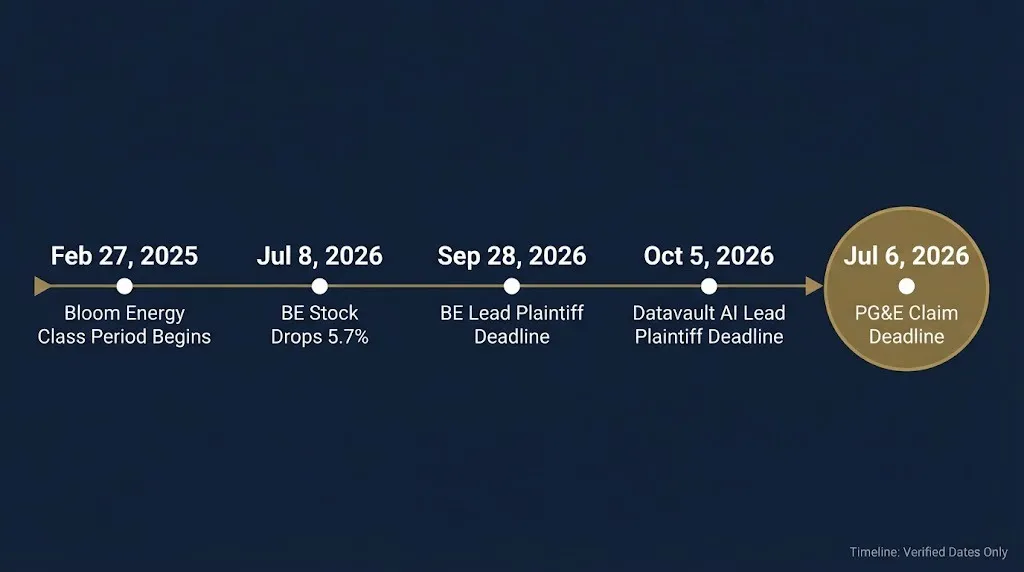
Bloom Energy faces a class action over alleged misstatements about its scandium supply chain. Investors who bought between February 2025 and July 2026 may have claims. Datavault AI faces a lawsuit alleging inflated partnership values, with an October 5, 2026 lead plaintiff deadline.
Hayward Holdings settled for $19.85 million, with final approval granted in July 2026. The exposure numbers across all Rule 10b-5 cases hit $449.6 billion in the second quarter of 2026 alone, driven by mega-cases against Oracle and Microsoft.
These cases show that securities litigation activity remains intense, especially around technology and clean energy companies where disclosure issues can move stock prices sharply.
What Happens Next in Securities Litigation
July 6, 2026: PG&E settlement claim deadline, the hard cutoff for filing.
September 28, 2026: Bloom Energy lead plaintiff deadline for investors seeking that role.
October 5, 2026: Datavault AI lead plaintiff deadline.
Expected late 2026: Hayward Holdings settlement payments begin processing after final approval.
Expected 2027: Distribution for PG&E settlement after claims are validated and calculated.
Frequently Asked Questions
Do I need a lawyer to join a securities class action?
No, you don’t need your own attorney to file a claim as an ordinary class member.
The lead counsel represents the entire class, and you can submit a claim on your own.
You only need personal counsel if you want to seek lead plaintiff status or object to a settlement.
How do I know if I qualify for a securities settlement?
You qualify if you bought securities during the class period and suffered a loss.
Check your brokerage statements against the class period dates in the official notice.
Buying before or after the window typically disqualifies you.
What documents do I need to file a securities claim?
Brokerage statements showing purchase dates, share counts, and prices paid.
Trade confirmations work too. The goal is proving you bought during the class period and what you paid.
Keep copies of everything you submit.
Can I still claim if I sold my shares before the lawsuit was filed?
Yes, selling before the lawsuit doesn’t disqualify you.
What matters is that you bought during the class period and lost money because of the alleged fraud.
The claim form will ask about your buy and sell transactions.
How long does it take to receive payment?
Typically nine to twelve months after final court approval.
Claim review, pro rata calculation, and distribution logistics all take time.
Appeals can extend that timeline further.
What happens if I miss the claim deadline?
You lose your right to share in the settlement fund.
There are no extensions for individual claimants, so calendar the deadline immediately.
The PG&E deadline is July 6, 2026.
Is it worth filing a claim if my losses were small?
Yes, even small losses can produce a proportional recovery.
Since payouts are pro rata, you get a share based on your loss relative to all valid claims.
The effort is minimal, and any recovery is better than none.
What’s the difference between a securities class action and a derivative lawsuit?
A class action is filed by investors seeking damages for their own losses.
A derivative lawsuit is filed by shareholders on behalf of the company itself, often against executives for breaches of duty.
Sometimes both types proceed in parallel.
The Single Most Important Step Right Now
Check your brokerage records against the class period for any settlement where you held shares. If you qualify, gather your trade confirmations and file before the deadline. The PG&E cutoff is July 6, 2026, and missing it means forfeiting your share permanently.
Don’t wait for someone to contact you. The burden is on you to find the settlement, verify your eligibility, and submit a valid claim.