Average Car Accident Settlement 2026: What the Real Data Shows
Quick Answer
- There’s no single “average” settlement. It depends on injury severity, state, and legal representation.
- National data shows bodily injury claims averaging over $20,000, with wide variation by case.
- No deadline applies universally. Your state’s statute of limitations sets your filing window.
The average car accident settlement in the United States is not one number, and anyone who gives you a single flat figure is oversimplifying. The most rigorous available data, from the Insurance Research Council’s July 2026 study, puts average bodily injury claim payments above $20,000 as of 2022 figures, the most recent verified by that research body.
This matters to anyone who just got into a crash and is trying to figure out what’s normal. The number that moves your case most isn’t a national average. It’s whether you hire an attorney, since IRC data shows represented claimants net different amounts than those who don’t.
This article breaks down the real data by injury type, by representation status, and by what’s driving costs up in 2026. One detail that surprises people: claimants with attorneys often wait more than twice as long to get paid.
The Facts
| Topic | National and state-level car accident settlement data, not a single case or lawsuit |
| Status | Most recent verified dataset released July 30, 2026 (data through mid-2022) |
| Primary Data Source | Insurance Research Council, Auto Injury Claims Analytics Database (AICAD) |
| Average Bodily Injury Claim | Over $20,000 as of 2022, up from about $14,000 in 2017 |
| Filing Deadline | Varies by state. Check your state’s statute of limitations |
| Who Sets the Amount | Insurers, courts, or negotiated agreements. No single administrator |
| Proof Needed | Police report, medical records, wage loss documentation, and repair estimates |
Is there really an “average” car accident settlement, or is that misleading?
The phrase “average car accident settlement” is technically real but statistically misleading, because a small number of catastrophic claims pull the number up. Most individual cases settle far below any quoted average.
The most rigorous dataset comes from the Insurance Research Council, built from 7.4 million auto injury claims closed with payment between mid-2017 and mid-2022, contributed by nine insurers covering roughly 43% of the U.S. private passenger auto market.
What the IRC data actually shows:
- Average bodily injury (BI) claim payments rose from about $14,000 in 2017 to more than $20,000 in 2022
- That’s a 7.8% annualized increase, more than double the pace of medical care inflation
- Growth was moderate before the pandemic and accelerated sharply afterward
Other frequently cited figures include a median auto injury settlement around $31,000, reported by industry aggregator sources citing Insurance Research Council survey data from 2023. That figure describes closed bodily injury claims specifically, not all accidents.
Treat any site quoting one exact number without a source as a guess dressed up as data.
How much can you actually get for a car accident settlement in 2026?
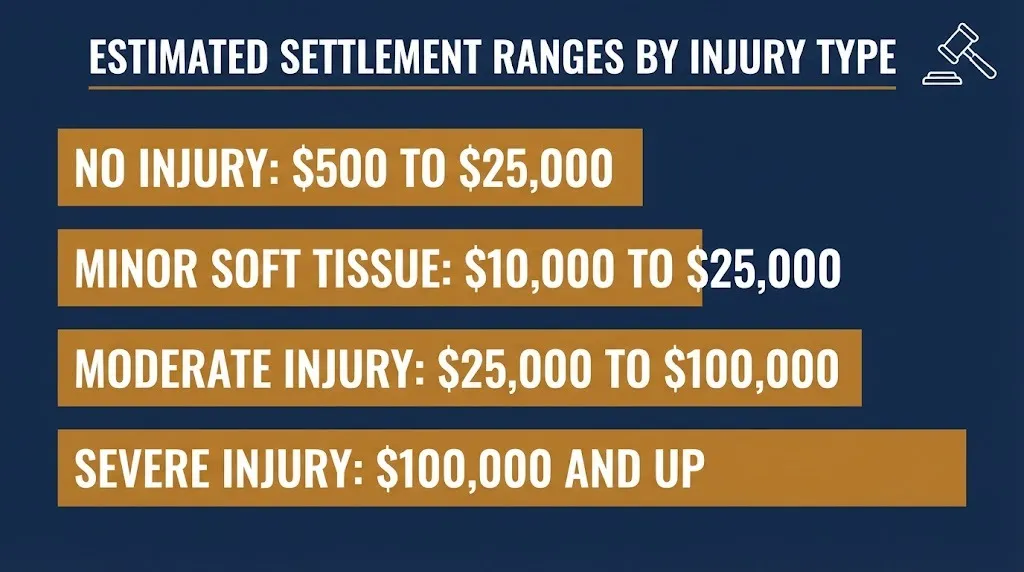
Payout ranges from under $1,000 for minor property damage to well over $1 million for catastrophic injuries, and the honest answer is that severity drives almost everything. National data breaks into rough tiers by injury type.
Reported settlement ranges by injury severity, compiled from multiple 2026 industry sources:
| Injury category | Typical range |
|---|---|
| No injury, property damage only | Roughly $500 to $25,000 |
| Minor soft tissue or whiplash | Roughly $10,000 to $25,000 |
| Moderate injury requiring ongoing treatment | Roughly $25,000 to $100,000 |
| Severe injury (fractures, surgery) | $100,000 and up |
| Catastrophic injury (spinal cord, brain injury) | Often exceeds $1 million |
These are industry-reported ranges compiled from law firm and claims-data sources in 2026, not a single verified court figure, and your actual case can fall outside them entirely. Insurance policy limits often cap what’s available regardless of how severe your injuries are.
Reality Check: No insurance adjuster’s first offer is the final word, and settlement negotiation is a normal, expected part of the process, not a sign something is wrong. Be skeptical of any online calculator or “instant settlement estimate” that asks for payment or personal financial details before giving you a number, since a real estimate depends entirely on documents specific to your case.
Does hiring a lawyer actually increase your settlement?
Yes, IRC data confirms attorney representation is associated with higher gross claim payments, though the net amount after fees and delay tells a more complicated story. This is the single most consistent finding across every major dataset on the topic.
What the July 2026 IRC study found:
- Attorney involvement among bodily injury claimants rose to 57% by 2022, up sharply from prior years
- Represented BI claimants received $1.40 in claim payment per dollar of medical expense, after costs and estimated legal fees
- Unrepresented claimants received $1.80 per dollar of medical expense
- Represented claims took a median of nearly 440 days to close, more than double the time for unrepresented claims
That’s a real tradeoff, not a simple “lawyers get you more” story. Attorneys tend to raise the gross settlement figure significantly, since general damages for pain and suffering get argued more aggressively with legal representation. But fees and delay eat into the net outcome.
Key Takeaway: Attorney representation raises gross settlement figures but doesn’t guarantee a higher net payout once fees and the longer wait are factored in.
Why are car accident settlements getting bigger every year?
Settlements are rising because medical costs, general damages, and legal representation rates are all climbing simultaneously, and they’re compounding rather than working independently. The IRC study frames this as the core driver of 2026’s higher claim costs.
Three forces stacking on top of each other:
- Medical treatment costs keep rising faster than general inflation.
- General damages, the pain-and-suffering portion, are growing as a multiplier on medical bills.
- More claimants are hiring attorneys and litigating, which extends timelines and often increases gross payouts.
The leverage ratio, meaning total settlement dollars per dollar of medical bills paid, rose from $1.80 in early 2018 to more than $2.30 by mid-2022, according to the IRC report. That means the non-medical portion of settlements is growing faster than medical costs themselves.
Think of it like a restaurant tab where the service charge keeps climbing faster than the food prices. The base cost matters, but it’s not the only thing driving the total up.
How does your state affect your car accident settlement?
Your state changes your settlement significantly, because fault rules, damage caps, and insurance minimums vary widely across the country. There’s no single number that applies everywhere.
State-specific data compiled by legal industry sources in 2026 shows real spread. California bodily injury liability claim severity was reported around $51,634 for 2021 by one law firm analysis citing NAIC data, a figure the firm says has likely grown further with medical inflation. Missouri car accident settlements were reported in the $15,000 to $45,000 range by a separate 2026 industry compilation.
What actually varies by state:
- Whether the state uses pure comparative negligence, modified comparative negligence, or contributory negligence
- Minimum required insurance policy limits
- Whether the state caps non-economic damages
- The statute of limitations for filing a claim
That last one is the deadline that actually matters to you, and it’s not universal. Some states give you two years to file. Others give you three or more. Check your specific state’s rule rather than assuming a national default applies.
How long does it take to get a car accident settlement?
Timelines depend heavily on whether you’re represented and whether the claim gets litigated, ranging from a few months to several years. There’s no fixed schedule that applies to every case.
Reported timelines across industry sources:
- Claims that don’t require a lawsuit typically settle in 3 to 6 months
- Cases requiring litigation typically settle within 12 to 24 months of filing
- Cases that go all the way to trial average 2 to 4 years from the date of injury
- Represented bodily injury claimants specifically waited a median of nearly 440 days for claim closure, per the July 2026 IRC study
- Unrepresented claimants closed in less than half that median time
Only a small fraction of cases ever reach trial. Industry data consistently reports that roughly 95% of personal injury cases settle before a trial verdict, and most of those settle before a lawsuit is even filed.
Key Takeaway: Most car accident claims settle within months, but adding an attorney and litigation roughly doubles the typical wait.
What documents do you need to support a settlement claim?
You need documentation connecting the accident directly to your injuries and losses, since insurers and courts weigh evidence, not your account alone. Missing paperwork is one of the most common reasons initial offers come in low.
Core documentation that supports a claim:
- The police report filed at the scene or shortly after.
- Medical records and bills tied specifically to the accident.
- Wage loss documentation if the injury kept you from work.
- Photos of vehicle damage and the accident scene.
- Repair estimates or a total-loss valuation for your vehicle.
- A written record of pain, limitations, and recovery timeline.
- Witness contact information, if available.
- Any correspondence with insurers, kept in one place.
Treat it like an insurance claim after a house fire. The payout depends heavily on what you can document, not just what happened.
What’s dragging down or inflating settlement numbers you see online?
Online “average settlement” figures often mix very different populations of claims, and that mixing is exactly why numbers you find can vary by tens of thousands of dollars. Two sites can both be technically accurate and still disagree sharply.
Why the numbers spread so widely:
- Some figures include only claims with attorney involvement, which skew higher
- Some figures average across all injury severities, including minor claims that pull the number down
- Some figures come from small samples, like three to five law firms self-reporting
- National insurer data, like the IRC’s, reflects actual paid claims across millions of cases
A median figure and a mean average describe different things entirely. The median splits a dataset in half. The mean can be pulled sharply upward by a handful of million-dollar catastrophic cases.
If a site can’t tell you whether its number is a median, a mean, or a small self-reported sample, treat that figure with caution.
What happens next with car accident settlement data in 2026?
Just released: The Insurance Research Council published its Auto Injury Claims Analytics Database findings on July 30, 2026, covering claims through mid-2022.
Expected ongoing: The IRC has stated future studies will examine geographic variation in attorney involvement, litigation patterns, and medical treatment trends by region.
Expected ongoing: State legislatures continue adjusting comparative negligence rules and damage caps, which will keep shifting state-by-state averages.
Expected ongoing: Rising medical costs and general damages leverage are likely to keep pushing national averages upward, based on the trend IRC documented through 2022.
Frequently Asked Questions
What is the average car accident settlement in 2026?
There’s no single confirmed figure, but the most recent national data shows average bodily injury claim payments above $20,000 as of 2022.
Industry-reported figures for 2026 specifically range from roughly $23,900 to $31,000 depending on the data source and methodology.
Does having a lawyer increase your settlement amount?
Generally yes for the gross settlement figure, based on Insurance Research Council data showing higher attorney involvement correlating with higher claim payments.
Net amounts after fees and longer wait times can narrow that advantage.
How much is a minor car accident settlement worth?
Industry-reported ranges put minor soft tissue or whiplash claims around $10,000 to $25,000.
Non-injury property damage claims average lower, with one 2026 industry compilation reporting roughly $9,900.
How long does a car accident settlement take?
Claims without litigation typically settle in 3 to 6 months.
Litigated claims typically take 12 to 24 months, and cases reaching trial average 2 to 4 years.
Why did car accident settlements get more expensive?
Rising medical costs, growing general damages leverage, and increased attorney involvement are all compounding, according to the Insurance Research Council’s July 2026 study.
Claim severity rose 7.8% annualized between 2017 and 2022, more than double medical inflation.
Does your state affect how much you can get?
Yes significantly, through comparative negligence rules, damage caps, and minimum insurance requirements that vary by state.
Check your specific state’s statute of limitations, since filing deadlines are not uniform nationally.
What percentage of car accident claims go to trial?
Only about 5% of personal injury cases reach a trial verdict, based on industry-reported data.
The large majority settle before a lawsuit is even filed.
Is there a deadline to file a car accident claim?
Yes, but it varies by state rather than following one national rule.
Confirm your specific state’s statute of limitations rather than assuming a standard timeframe applies.
Pull your own documentation together now if you were recently in an accident, since medical records and repair estimates carry more weight than any online average. The IRC’s July 30, 2026 dataset remains the most current verified national benchmark available.