What Is Workers Compensation? A 2026 Guide (Including Kansas Rules)
Quick Answer
- Workers compensation is no-fault insurance that pays medical bills and partial wages after a job injury.
- Kansas caps weekly benefits at roughly 75% of the state’s average weekly wage, verify the exact 2026 to 2027 figure with the Kansas Department of Labor.
- You generally must notify your employer within 20 days of a Kansas workplace injury to protect your claim.
Workers compensation is insurance that pays your medical bills and part of your wages if you get hurt doing your job. You do not have to prove your employer did anything wrong to collect it. That single fact separates workers comp from a personal injury lawsuit.
This system exists in every state except Texas, where it is optional for private employers. If you work in Kansas, coverage is required once your employer’s payroll passes $20,000 a year, and the rules that follow decide how fast you get paid and how much.
This guide walks through what workers compensation covers, how Kansas calculates your check, what deadlines can end your claim early, and what to do the day you get hurt. One detail surprises a lot of workers: being fired does not automatically cut off benefits you already qualify for.
The Facts
| Category | Detail |
|---|---|
| What It Is | No-fault insurance covering medical care and partial wage replacement for job injuries |
| National Coverage | Required in 49 states; Texas allows private employers to opt out |
| Kansas Requirement | Mandatory once gross annual payroll exceeds $20,000 |
| Kansas Wage Replacement | 66.67% of your average weekly wage |
| Kansas Weekly Cap | Capped at 75% of the state’s average weekly wage; confirm the current dollar figure with KDOL, it resets each July 1 |
| Employer Notice Deadline | 20 days from the date of injury |
| Formal Claim Deadline | Generally 1 to 3 years depending on the circumstances; confirm your specific deadline with the Kansas Division of Workers Compensation |
| Administering Agency | Kansas Department of Labor, Division of Workers Compensation |
What Is Workers Compensation?
Workers compensation is a state-regulated insurance system. It pays medical treatment and partial lost wages to employees hurt on the job, regardless of who was at fault.
Your employer, not you, pays the premium. In exchange, most states bar injured workers from suing their employer in civil court over the same injury. Lawyers call this the exclusive remedy rule.
The system covers two kinds of harm. Sudden accidents, like a fall from a ladder, count. So do occupational illnesses that build up over time, like repetitive strain injuries or certain lung conditions tied to your job.
Key Takeaway: Workers compensation trades your right to sue your employer for a guaranteed, no-fault path to medical care and partial wages.
Is Workers Compensation Insurance Mandatory in Kansas?
Yes, workers compensation is mandatory for most Kansas employers. Generally, an employer in a non-agricultural business, with more than $20,000 in gross annual payroll in a calendar year, must secure workers compensation coverage and file reports of alleged work accidents.
That threshold applies whether you have one employee or five hundred. The statute is broad and covers both full-time and part-time employees once a business crosses the payroll line.
A short list of exemptions exists. Some agricultural workers, real estate agents classified as independent contractors, and firefighters covered by relief associations fall outside the requirement.
Employers can meet the requirement three ways:
- Buy a policy from a private commercial carrier
- Apply to the assigned risk plan if commercial carriers decline them
- Qualify to self-insure through the Kansas Department of Labor
Key Takeaway: In Kansas, crossing $20,000 in annual payroll triggers a legal duty to carry workers comp, with very few exceptions.
How Much Does Workers Compensation Pay?
Workers compensation pays medical costs in full and a portion of lost wages, capped by state formula. It does not pay 100% of your paycheck.
Most states, Kansas included, use a two-thirds formula. Kansas pays 66⅔% of your average weekly wage for the weeks you cannot work because of the injury. That amount is capped at a maximum of 75 percent of the state’s average weekly wage.
Not yet confirmed at a single fixed number: the exact 2026 to 2027 dollar cap, because Kansas resets it every July 1. One industry tracking site lists the current Kansas weekly maximum as $804.00, but you should confirm the live figure directly with the Kansas Department of Labor before relying on it for a claim.
| Benefit Type | Kansas Formula |
|---|---|
| Temporary Total Disability | 66.67% of average weekly wage, capped |
| Temporary Partial Disability | Wage difference while working reduced hours |
| Permanent Partial Disability | Based on a statutory schedule by body part |
| Permanent Total Disability | Ongoing wage replacement, often long-term |
Key Takeaway: Your check is capped by law, so a high earner in Kansas will not receive two-thirds of every dollar once wages cross the state maximum.
What Is the Maximum Workers Comp Benefit in Kansas?
The maximum weekly benefit in Kansas is set annually and takes effect every July 1. It applies once your two-thirds wage calculation exceeds the state cap.
Nearby states show how much this figure swings. New York’s maximum, for comparison, sits at $1,222.42 per week for the period running July 1, 2025 through June 30, 2026. Kansas runs its own separate schedule and typically lands lower.
Because this number changes yearly, treat any figure you see online as a starting point, not a final answer. The safest move is a direct check with the Kansas Division of Workers Compensation before you calculate what you expect to receive.
How Is Workers Compensation Calculated?
Kansas calculates your benefit from your average weekly wage before the injury, then applies the statutory percentage. The math sounds simple until your wage crosses the cap.
Here is the basic sequence:
- Your employer or insurer calculates your average weekly wage
- That figure is multiplied by 66.67%
- The result is compared to the state maximum and minimum
- You receive whichever number the cap allows
- Permanent injuries use a separate schedule tied to the affected body part
Reality Check: No legitimate insurer or state agency will text you out of the blue offering a fast workers comp payout. Filing a claim through the Kansas Department of Labor is always free, and paid “claim helper” services are not required to file or track your case.
How to File a Workers Compensation Claim in Kansas
You file a Kansas workers comp claim by reporting the injury to your employer, then submitting a formal application if the claim is disputed. Missing the early notice window can hurt you later.
Follow these steps:
- Report the injury to your supervisor in writing, same day if possible
- Seek medical treatment, using an employer-authorized provider when required
- Confirm your employer files an accident report with the state
- Track all medical visits, dates, and lost work time
- Watch for a claim acceptance or denial notice from the insurer
- If disputed, apply in writing to the Director for a formal determination
- Keep copies of every document you submit or receive
When the employer, worker, or insurance carrier cannot agree on the right to compensation or any benefit issue, the party may apply in writing to the director for a determination, and the matter is then assigned to an administrative law judge.
Key Takeaway: A disputed Kansas claim does not go straight to court, it goes to an administrative law judge inside the Division of Workers Compensation.
What to Do Immediately After a Workplace Injury
Report the injury the same day it happens, in writing, to a supervisor. Verbal-only reports are harder to prove later.
Think of it like a store return without a receipt. You can still make your case, but proof of purchase, or in this case proof of injury, makes everything faster.
Get medical care right away, even for injuries that seem minor. Some conditions worsen over days, and a documented visit ties the injury to the date it happened.
Write down what you were doing, where, and who saw it. Employers must post written notice, Form K-WC 40, telling employees what to do in case of injury, so check your breakroom or HR portal for that posting.
How Long Do You Have to File a Workers Comp Claim in Kansas?
Kansas gives injured workers a short window to notify their employer and a longer window to file a formal claim. Both deadlines matter, and missing either can end your case.
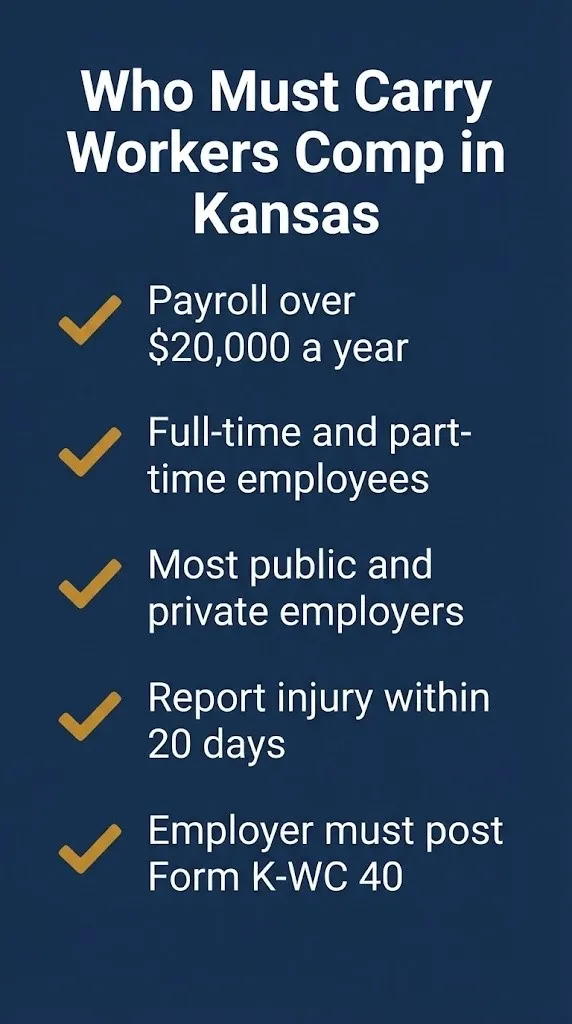
Notice to the employer is due within 20 days from the date of the injury. Employers, separately, must file an accident report with the Division of Workers Compensation within 28 days of learning about a reportable injury.
The formal claim deadline is more complicated and depends on your specific facts, including whether benefits were already being paid. Recording Law lists Kansas among the states with a 3-year statute of limitations, while Kansas statute K.S.A. 44-520 also involves a shorter written claim rule tied to the last payment date. Because these rules interact, confirm your personal deadline with the Kansas Division of Workers Compensation or a licensed attorney rather than relying on a general number.
Reality Check: Missing a workers comp deadline is one of the most common reasons legitimate claims get denied, not because the injury wasn’t real, but because the paperwork clock ran out.
What Happens After You File a Workers Comp Claim?
After you file, the insurer investigates and either accepts or disputes the claim within a state-defined window. Accepted claims move into ongoing medical and wage payments.
In a comparable state process, the insurer has 60 days to accept or deny a claim once it’s filed, and if accepted, the worker receives medical treatment and wage-loss payments. Kansas follows a similar accept-or-dispute structure through its Division of Workers Compensation.
If the insurer disputes any part of your benefits, either side can ask the Director for a formal hearing. That request is assigned to an administrative law judge for resolution.
Can You Be Fired While on Workers Comp?
Yes, in most cases you can still be fired while receiving workers comp, but the firing itself does not automatically end your benefits. Being fired does not automatically disqualify you from receiving the benefits you’re entitled to under workers’ comp laws, though you may still be able to collect depending on the specific circumstances of your case.
Retaliation for filing a claim is a separate legal issue. Workers remain protected from retaliation for filing a workers comp claim, even though there are important exceptions to that protection.
If you believe a termination was retaliatory, that is generally treated as a separate employment claim, not part of your workers comp case itself.
What Does Workers Compensation Cover?
Workers compensation covers medical treatment, a portion of lost wages, and, in fatal cases, death benefits for dependents. Coverage generally requires the injury to have happened in the course and scope of your job.
Workers’ comp covers work-related injuries and occupational illnesses, including injuries that result from an on-the-job accident such as falling from scaffolding. Four main benefit categories exist across states: medical benefits, wage-replacement benefits, permanent disability benefits, and death and survivor benefits for dependents when a work injury is fatal.
Typical covered costs include:
- Emergency room and hospital care
- Surgery and prescription medication
- Physical therapy and rehabilitation
- Partial wage replacement during recovery
- Permanent disability payments for lasting impairment
- Funeral and survivor benefits in fatal cases
Key Takeaway: Coverage isn’t limited to sudden accidents, gradual occupational illness can qualify too if it’s tied to your job duties.
What Is Not Covered by Workers Compensation?
Workers compensation generally excludes injuries that happen outside the course of your job duties, and it excludes pain and suffering damages that a lawsuit might allow.
Common exclusions include:
- Injuries during your commute to and from work, in most states
- Self-inflicted injuries or those caused by intoxication on the job
- Injuries from horseplay or activities outside your job description
- Pain and suffering, since workers comp is a no-fault trade-off
This is one reason workers comp checks often feel smaller than a lawsuit settlement might. The system pays medical bills and wage loss, not emotional distress.
Understanding Workers Compensation: No-Fault and Exclusive Remedy Explained
Workers compensation runs on two core legal principles: no-fault liability and exclusive remedy. Together they define what you can and cannot do after a job injury.
No-fault means you don’t have to prove your employer did anything wrong, only that your injury arose out of and in the course of your job.
Exclusive remedy means in exchange for these no-fault benefits, employees generally cannot sue their employer for workplace injuries, though there are important exceptions to this rule.
Think of it like a warranty claim. You give up the right to sue the manufacturer for a defective product, but in return you get a guaranteed, faster repair or replacement.
Who Is Exempt From Kansas Workers Compensation Coverage?
A small group of workers and employers fall outside Kansas’s mandatory coverage rule. Exemptions are narrower than most people expect.
Certain agricultural workers, realtors classified as independent contractors, and firefighters covered by relief associations are exempt from the Kansas requirement. Businesses under the $20,000 gross annual payroll threshold also fall outside the mandate, though many still carry coverage voluntarily.
Employers who intentionally fail to provide coverage face a class A misdemeanor and a civil penalty of either twice the annual premium they should have paid or $25,000, whichever is greater.
What If My Workers Comp Claim Is Denied?
A denied Kansas claim can be challenged through the state’s administrative hearing process. Denial is not automatically the end of your case.
If a claim is denied, the worker generally has the right to a hearing before an administrative law judge. In Kansas, that process runs through the Director’s office and the Division of Workers Compensation.
Steps to challenge a denial typically include:
- Requesting the written reason for denial from the insurer
- Gathering medical records that support your claim
- Filing a written application for a director’s determination
- Attending the scheduled administrative hearing
- Appealing further if the judge’s ruling goes against you
Workers Compensation vs Personal Injury Lawsuit: What’s the Difference?
Workers compensation is a no-fault insurance claim against your employer’s policy. A personal injury lawsuit requires proving someone else was negligent, and it is generally not available against your own employer.
The exclusive-remedy rule means workers compensation is the only remedy against your employer for most work injuries, even if the employer was careless. A separate personal injury claim may still be possible against a third party, like a contractor or equipment maker, if their negligence contributed to your injury.
| Feature | Workers Comp | Personal Injury Lawsuit |
|---|---|---|
| Fault required | No | Yes |
| Who you claim against | Employer’s insurer | At-fault party (often third party) |
| Pain and suffering | Not covered | Can be covered |
| Speed | Generally faster | Often slower, court-dependent |
What Happens Next
Expected next steps: Your employer’s payroll and injury reporting obligations stay in effect through 2026.
Expected July 2026: Kansas resets its maximum and minimum weekly benefit figures, as it does every July 1.
Ongoing: The Kansas Division of Workers Compensation continues to process disputed claims through administrative law judges.
Expected 2027 and 2028: Some states, including Colorado, are already preparing broader reforms to physician choice rules that could influence other states’ approaches.
Frequently Asked Questions
What is workers compensation in simple terms?
Workers compensation is insurance your employer carries that pays your medical bills and part of your wages if you get hurt on the job.
You don’t need to prove your employer was careless to collect it.
Do all Kansas employers have to carry workers comp?
Most do, once their gross annual payroll passes $20,000.
A narrow set of agricultural, real estate, and firefighter roles are exempt.
How much does Kansas workers comp pay per week?
Kansas pays 66.67% of your average weekly wage, capped at 75% of the state’s average weekly wage.
The exact dollar cap changes every July 1, so confirm the current figure with the Kansas Department of Labor.
How long do I have to report a work injury in Kansas?
You generally must notify your employer within 20 days of the injury.
Waiting longer can jeopardize your claim, so report it in writing as soon as possible.
Can I sue my employer instead of filing workers comp in Kansas?
Generally no, because workers comp is your exclusive remedy against your employer for most job injuries.
A separate lawsuit against a third party may still be possible in some situations.
Can I be fired while receiving workers comp benefits in Kansas?
Yes, termination is possible, but it does not automatically end benefits you’re already entitled to.
Retaliation specifically for filing a claim is treated as a separate legal issue.
What if my Kansas workers comp claim gets denied?
You can request a formal determination from the Director, and the dispute is assigned to an administrative law judge.
Gathering medical records and written injury reports strengthens your position at that hearing.
Does workers comp cover occupational illness, not just accidents?
Yes, gradual conditions tied to your job duties can qualify, not just sudden accidents.
The illness still needs to be connected to your work to be covered.
Workers compensation exists to keep injured workers covered without a courtroom fight, but the deadlines are unforgiving. If you’re hurt on the job in Kansas, report it in writing within 20 days and confirm your benefit figures directly with the Kansas Department of Labor. Calendar your notice deadline today, it’s the single date that protects everything that follows.