Workers Compensation Insurance NJ 2026: Requirements, Rates, and What Employers Must Know
Quick Answer
- Is it required? Yes. Nearly every New Jersey employer with one or more employees must carry coverage.
- How much does it cost? Average small business premium runs about $47 per month, or $568 yearly.
- Most important deadline? Coverage must be active from the first day you have an employee. No grace period.
What Is Workers Compensation Insurance in NJ?
Workers compensation insurance in New Jersey is a no-fault system that pays medical bills and wage replacement for employees hurt on the job. The employer buys the policy. The employee gives up the right to sue the employer for negligence in exchange for guaranteed benefits.
New Jersey law requires coverage for virtually every employer with at least one employee, including part-time, seasonal, and corporate officers. The system is administered by the New Jersey Division of Workers’ Compensation, and rates are set through the New Jersey Compensation Rating and Inspection Bureau (NJCRIB), not the national NCCI.
If you run a business in New Jersey and you have anyone working for you, this coverage is not optional. The penalties for going without are steep, and the state audits aggressively.
The Facts
| Topic | New Jersey Workers Compensation Insurance |
| Status | Active. 2026 rates in effect since January 1, 2026. |
| Statewide Rate Change | -4.3% overall premium level decrease for 2026 |
| Max Weekly Benefit | $1,199 for 2026 injuries |
| Min Weekly Benefit | $320 for 2026 injuries |
| Est. Cost | Average $47/month for small business policies |
| Claim Deadline | Employee: report promptly. Employer: file with Division within required timelines. |
| Administrator | NJ Division of Workers’ Compensation / NJCRIB |
| Proof Needed | Payroll records, employee classification, loss history |
Is Workers Compensation Insurance Required in NJ?
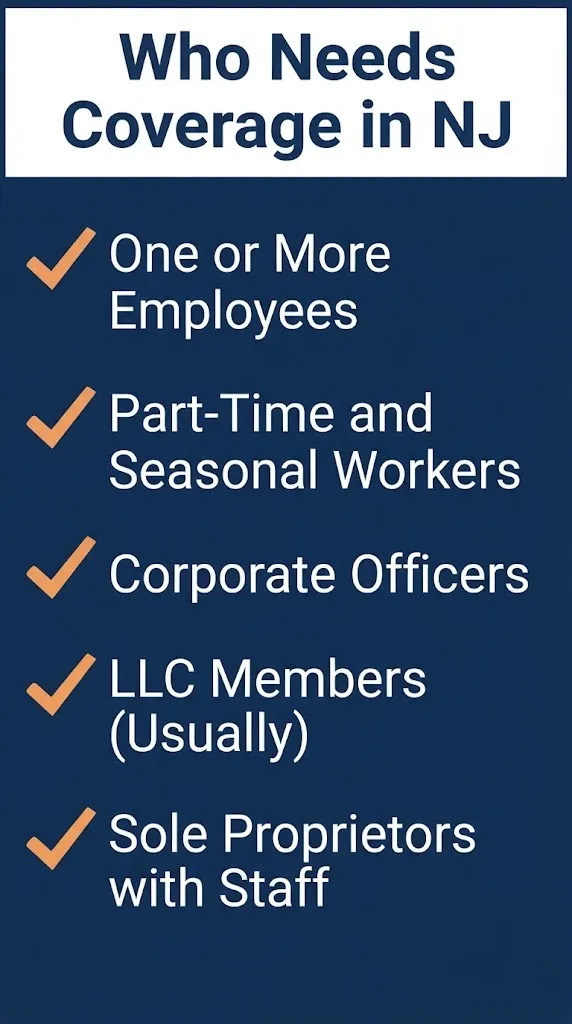
Yes. New Jersey requires workers compensation coverage for all employers with one or more employees, with very few exceptions. The law applies to corporations, LLCs, partnerships, and sole proprietorships that have any worker receiving financial consideration.
The requirement is broad. Part-time workers count. Seasonal workers count. Family members working for the business generally count. Corporate officers are considered employees and must be covered unless they qualify for a specific exclusion.
Sole proprietors and partners are typically excluded by default. They can elect to buy coverage for themselves, but they are not automatically required to do so. If a sole proprietor hires even one employee, coverage becomes mandatory.
Independent contractors are the gray area. New Jersey applies the ABC test to determine whether a worker is truly independent or actually an employee. Labeling someone a 1099 contractor does not avoid coverage if the worker is economically dependent on your business. Misclassification is a common audit finding and an expensive one.
Key Takeaway: If you have anyone working for you in New Jersey, assume you need coverage. The exceptions are narrow, and the state audits aggressively.
How Much Does Workers Compensation Insurance Cost in NJ?
The average cost of workers compensation in New Jersey is about $47 per month, or $568 annually, based on policy data from small business insurers. That average hides a wide range. A clerical office pays far less than a roofing contractor.
New Jersey’s average manual rate is $1.43 per $100 of payroll for 2026, down from $1.90 in 2021 and $2.18 in 2016. The statewide rate level dropped 4.3% for 2026.
Premiums depend on four main factors:
- Your payroll by employee classification code
- The classification rate for each type of work performed
- Your experience modification rate (EMR), which reflects your claims history
- Credits or debits applied by the insurer
Here are some 2026 manual rates for common classifications:
| Classification | 2026 Rate per $100 Payroll |
|---|---|
| Clerical office (8810) | $0.136 |
| Retail store (8017) | $2.390 |
| Restaurant (9079) | $2.131 |
| Carpentry (5403) | $14.946 |
| Roofing (5551) | Higher risk range |
The formula is: Classification rate × Experience mod × (Annual payroll ÷ $100). If your EMR is 1.0, you pay the base rate. A 1.2 mod means you pay 20% more because your claims history is worse than average.
Who Is Exempt from Workers Compensation in NJ?
New Jersey has very few exemptions from workers compensation insurance requirements. This trips up business owners who assume small operations are exempt.
The law covers employers with one or more employees. There is no small-business exemption. A single part-time employee triggers the requirement.
Sole proprietors with no employees are not required to cover themselves. Partners in a partnership are generally excluded unless they elect coverage. LLC members may be able to exclude themselves depending on the structure and elections made.
Corporate officers are a special case. They are considered employees under New Jersey law. Executive officers cannot freely opt out of coverage. Some corporate officers may qualify for exclusion if they meet statutory criteria and complete the required election form.
Independent contractors are exempt only if they are truly independent under the ABC test. If you control their work, provide their tools, or they work exclusively for you, they may be reclassified as employees in an audit.
Reality Check: The “Ghost Policy” Trap
Some contractors are offered a cheap “ghost policy” that provides a certificate of insurance but no actual coverage. It fulfills a contract requirement and nothing else. If a worker gets hurt, the employer is personally on the hook for medical bills and disability. New Jersey penalties for operating without real coverage can reach $5,000 for the first ten days and $5,000 for each additional ten-day period. In a corporation, those penalties can reach officers individually.
What Are the Penalties for Not Having NJ Workers Comp?
Failing to carry required workers compensation coverage in New Jersey is a disorderly persons offense. If the failure is willful, it becomes a crime of the fourth degree.
The financial penalties are severe. The state can assess up to $5,000 for the first ten days of non-compliance and $5,000 for each additional ten-day period after that. Penalties assessed for failure to insure are not dischargeable in bankruptcy.
If an employee gets hurt while you are uninsured, you are directly liable for medical expenses, temporary disability, and permanent disability benefits. Corporate officers, partners, and LLC members can be held personally liable. Awards and penalties can become liens against personal assets.
The state can also issue stop-work orders, shutting down your operations until coverage is in place.
How Do You Get Workers Compensation Insurance in NJ?
Getting coverage is straightforward. You can buy a policy from any of the more than 400 private insurance companies authorized to sell workers compensation in New Jersey.
Step 1: Determine your employee classifications. Each type of work has a NJCRIB classification code. Office workers have low rates. Roofers have high rates.
Step 2: Calculate your payroll by classification. The premium formula uses payroll divided by $100, so accurate payroll numbers matter.
Step 3: Get your experience modification rate. If your annual premium is above a threshold, NJCRIB calculates an EMR based on your loss history. A mod below 1.0 saves money.
Step 4: Contact an insurance carrier, agent, or broker. You can buy directly from a carrier or work through a broker who can compare multiple options.
Step 5: Provide accurate payroll and classification data. Misclassification is the most common audit problem. Be honest about what your workers actually do.
Step 6: Receive your policy and certificate of insurance. The certificate proves coverage to general contractors and clients.
If you cannot get voluntary coverage, the NJCRIB Assigned Risk Plan provides coverage through the residual market. It is more expensive, but it fulfills the legal requirement.
What Does NJ Workers Compensation Cover?
New Jersey workers compensation pays four main benefit categories plus medical care. The system is no-fault, meaning the employee does not have to prove the employer was negligent.
| Benefit | What It Pays |
|---|---|
| Medical care | All reasonable and necessary treatment. No deductible or co-pay. |
| Temporary Total Disability (TTD) | 70% of average weekly wage during recovery, capped at $1,199/week |
| Permanent Partial Disability (PPD) | Scheduled or non-scheduled benefits based on impairment rating |
| Permanent Total Disability (PTD) | 70% of wage, initially 450 weeks, extendable for life if still disabled |
| Death benefits | 70% of wage to dependents plus up to $3,500 funeral allowance |
The waiting period is 7 days. If disability lasts more than 7 days, benefits become retroactive to day one.
Medical care has no dollar cap. The employer or carrier directs treatment and can choose the treating physician. This is a frequent point of dispute between injured workers and insurers.
Workers compensation does not cover injuries caused by intoxication, drug use, or company policy violations. It does not pay for pain and suffering. It does not cover wages for a replacement worker. It does not pay OSHA fines.
What Are the 2026 NJ Workers Comp Benefit Rates?
The maximum weekly benefit in New Jersey rose to $1,199 for 2026 injuries, up from $1,159 in 2025. The minimum weekly benefit rose to $320, up from $309.
These caps apply to temporary total disability, permanent total disability, and the upper range of permanent partial disability. The minimum for permanent partial injuries remains $35 per week.
Here is how the rate increase affects a worker earning $1,000 per week:
| Scenario | Calculation | Weekly Benefit |
|---|---|---|
| Average weekly wage | $1,000 | |
| TTD rate (70%) | $1,000 × 0.70 | $700 |
| Capped at max? | $700 < $1,199 | No |
| Weekly benefit | $700 |
A worker earning $2,000 per week would hit the cap. Their benefit would be $1,199, not $1,400.
What Happens Next in New Jersey Workers Comp Compliance?
January 1, 2026: New rates and benefit caps took effect. Policies renewed on or after this date use the new figures.
Ongoing: NJCRIB conducts payroll audits. Misclassification and underreporting are the most common findings.
Ongoing: The Department of Banking and Insurance enforces self-insurance requirements for large employers.
Expected 2027: NJCRIB will file new rates and benefit caps for the next policy year. The pattern has been rate decreases for several consecutive years.
TBD: No legislative changes to the coverage mandate are pending as of September 2026.
Frequently Asked Questions
Who needs workers comp insurance in New Jersey?
Nearly every employer with one or more employees. This includes corporations, LLCs, partnerships, and sole proprietors with any worker receiving financial consideration. Part-time and seasonal workers count.
How much does workers comp cost in NJ?
The average small business policy runs about $47 per month, or $568 yearly. Your actual premium depends on payroll, classification codes, and claims history. Statewide rates dropped 4.3% for 2026.
What happens if I don’t have workers comp in NJ?
You face fines up to $5,000 for the first ten days and $5,000 for each additional ten-day period. It is a disorderly persons offense, and a willful failure is a fourth-degree crime. If an employee gets hurt, you are personally liable.
Are independent contractors covered in NJ?
Only if they are truly independent under the ABC test. If you control their work or they are economically dependent on your business, they may be reclassified as employees. Misclassification is heavily audited.
Can I exclude myself as a corporate officer?
Some corporate officers may qualify for exclusion if they meet statutory criteria and complete the required election. Executive officers cannot freely opt out. Check with your insurance carrier about specific eligibility.
What is the maximum workers comp benefit in NJ for 2026?
The maximum weekly benefit is $1,199 for injuries occurring in 2026. The minimum is $320. Permanent partial disability benefits range from $35 to $1,199 depending on the duration of disability.
What is NJCRIB and why does it matter?
NJCRIB sets classification codes, experience modification rates, and manual rates for New Jersey. Unlike most states that use NCCI, New Jersey is an independent rating state. Your premium is calculated using NJCRIB rates.
What You Should Do Right Now
If you employ anyone in New Jersey, verify your coverage is active and your classifications are correct. Gather your payroll records by class code. Check your experience modification rate.
The single most important number to remember for 2026: $1,199 per week is the maximum benefit an injured worker can receive. Make sure your coverage is in place before someone gets hurt.