457(b) Deferred Compensation Plan: 2026 Contribution Limits, Catch-Up Rules, and What the IRS Notice Actually Says
Quick Answer
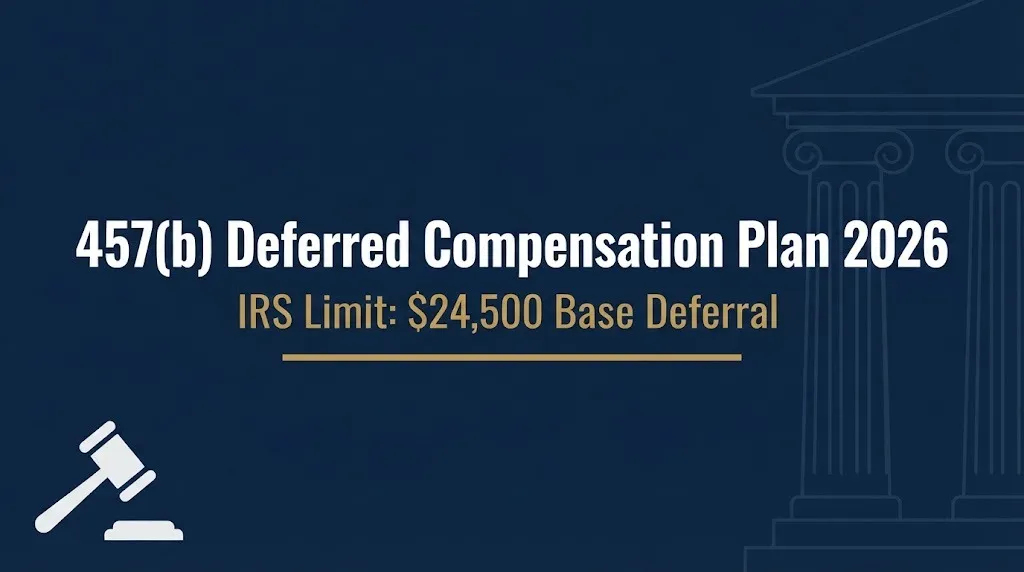
- 2026 457(b) base limit is $24,500, up $1,000 from 2025, per IRS Notice 2025-67.
- Age 50+ catch-up adds $8,000; ages 60-63 get $11,250, but high earners must use Roth.
- Special catch-up allows up to $49,000 in the three years before your plan’s normal retirement age.
If you work for a state or local government, or a tax-exempt organization, your 457(b) deferred compensation plan just got a raise. The IRS released Notice 2025-67 in November 2025, and the numbers for 2026 are now locked in.
That notice sets the base elective deferral limit at $24,500 for 457(b) plans . That’s a $1,000 increase from the $23,500 limit that applied in 2025.
But the base limit is only part of the story. The 457(b) has two separate catch-up provisions, and they don’t work the same way. One is age-based. The other is service-based, tied to how close you are to retirement. You can’t use both in the same year.
What follows is what the IRS notice actually says, what changed under SECURE 2.0, and where people are getting confused.
The Facts
| Case | 2026 IRS contribution limits for 457(b) plans |
|---|---|
| Status | Active for calendar year 2026 |
| Fund Size | N/A (retirement plan limits, not a settlement) |
| Est. Per Person | $24,500 base limit |
| Claim Deadline | Deferral elections must be made before compensation is earned |
| Administrator | Your employer’s plan administrator |
| Proof Needed | Plan eligibility, W-2 Box 3 for Roth catch-up threshold |
Is the 457(b) Deferred Compensation Plan Legit?
Yes. The 457(b) is a legitimate retirement savings plan established under Internal Revenue Code Section 457. The IRS recognizes two types of 457 plans: eligible plans under 457(b) and ineligible plans under 457(f) .
Eligible 457(b) plans are available to employees of state and local governments and certain tax-exempt organizations described in IRC Section 501(c) . The plan allows you to defer a portion of your compensation on a pre-tax basis, which reduces your current taxable income. The money grows tax-deferred until you withdraw it, at which point traditional (pre-tax) distributions are taxed as ordinary income .
The 457(b) is not a scam. It’s a government-recognized retirement vehicle. But it’s also not a bank account. Your money goes in through payroll deferrals, and getting it out follows specific IRS rules.
Key Takeaway: The 457(b) is a legitimate IRS-recognized deferred compensation plan for government and nonprofit workers, not a consumer settlement or class action payout.
How Much Can You Contribute to a 457(b) in 2026?
The standard elective deferral limit for 457(b) plans in 2026 is $24,500 . This limit applies to the combined total of employee and employer contributions, if your plan allows employer contributions .
That’s the number for workers under age 50 who aren’t using any catch-up provisions. If you’re 49 or younger, $24,500 is your ceiling for the year.
The limit applies separately from any 401(k) or 403(b) you might also have through your employer . Some government workers have access to both a 457(b) and a 403(b) or 401(k). Those plans have separate contribution limits, which means you can potentially max out both.
The $24,500 figure comes from IRS Notice 2025-67, which adjusted the limit upward for inflation from the 2025 level of $23,500 .
What Are the 457(b) Catch-Up Contribution Limits for 2026?
The 457(b) has two distinct catch-up provisions, and they are mutually exclusive in the same calendar year . You have to pick the one that lets you contribute more, or the one you’re eligible for.
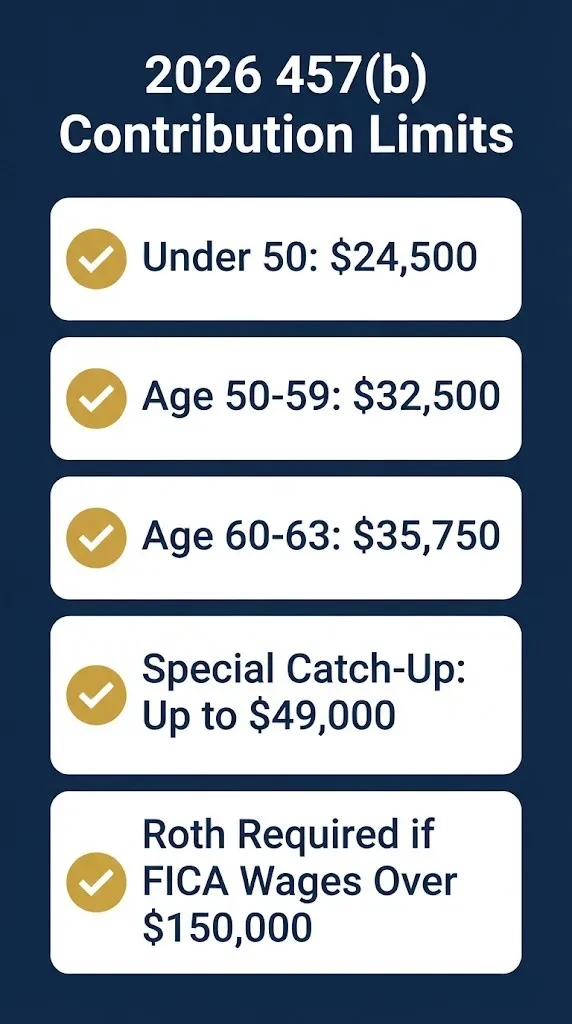
| Age or Situation | 2026 Maximum Contribution |
|---|---|
| Under 50 | $24,500 |
| Age 50-59 | $32,500 ($24,500 + $8,000) |
| Age 60-63 | $35,750 ($24,500 + $11,250) |
| Age 64+ | $32,500 ($24,500 + $8,000) |
| Special pre-retirement catch-up | Up to $49,000 |
The age-based catch-up for workers 50 and older is $8,000 in 2026, up from $7,500 in 2025 . If you’re 50 through 59, or 64 and older, that’s your additional amount.
Workers who turn 60, 61, 62, or 63 during the calendar year qualify for a higher catch-up of $11,250 . That’s a SECURE 2.0 change that took effect January 1, 2025. The $11,250 figure is unchanged from 2025.
The special pre-retirement catch-up is different. It’s available in the three taxable years ending before you reach your plan’s normal retirement age . If you use this provision, you can contribute up to double the regular limit, which means up to $49,000 in 2026 .
But there’s a catch within the catch-up. The special pre-retirement catch-up is limited by your “underutilized amount.” That’s the total of contribution room you didn’t use in prior years. If you maxed out every year, you have no underutilized amount, and the special catch-up gives you nothing .
You cannot combine the age-based catch-up and the special pre-retirement catch-up in the same year. The IRS doesn’t allow it .
Key Takeaway: The 457(b) gives you two separate catch-up paths, but you have to choose one per year. The special pre-retirement catch-up can double your limit to $49,000 if you have unused contribution room from prior years.
Why Do High Earners Have to Make Roth Catch-Up Contributions in 2026?
Starting January 1, 2026, if your prior-year FICA wages exceeded $150,000, any age-based catch-up contributions you make must be designated as Roth (after-tax) contributions .
This is a SECURE 2.0 Act requirement. The threshold was $145,000 for 2025 and is indexed for inflation . For 2026, it’s $150,000.
The key word is FICA wages. That’s the amount reported in Box 3 of your W-2, which is Social Security wages . It’s not your total income. It’s not your adjusted gross income. It’s specifically the wages subject to Social Security tax.
If you’re over the threshold and your plan doesn’t offer a Roth option, you cannot make age-based catch-up contributions at all . Your catch-up limit is effectively reduced to zero until your plan adds Roth.
The special pre-retirement catch-up is not subject to this Roth requirement. If you qualify for the special catch-up, you can still make those contributions on a pre-tax basis .
How Does the 457(b) Special Catch-Up Actually Work?
The special catch-up is the most misunderstood part of the 457(b). It’s not automatic, and it’s not unlimited.
Here’s the formula: in each of the three years before your normal retirement age, you can contribute up to the lesser of double the regular limit or your “underutilized amount” .
The underutilized amount is the sum of all the contribution room you left unused in prior years. If you contributed $10,000 one year when the limit was $15,000, you have $5,000 of underutilized room from that year. Add up all those gaps, and that’s your cap on the special catch-up .
If you’ve always maxed out, your underutilized amount is zero. The special catch-up does nothing for you.
If you have a large underutilized amount, you can contribute up to double the normal limit, which is $49,000 in 2026 .
You can only use the special catch-up in the three years before your plan’s normal retirement age. Your plan document defines what “normal retirement age” means .
Key Takeaway: The special 457(b) catch-up is limited by your prior years’ unused contribution room. If you’ve consistently maxed out, you may have no special catch-up available.
How Do You File or Change Your 457(b) Deferral Election?
You don’t file a claim for a 457(b). You make a deferral election through your employer’s payroll system. Here’s how it typically works:
- Contact your employer’s benefits or payroll office for the deferral election form.
- Decide whether to contribute pre-tax (traditional) or after-tax (Roth), if your plan offers Roth.
- Choose your contribution amount per paycheck, up to the IRS limit.
- Submit the election before the compensation is earned, per SECURE 2.0 timing rules.
- Review your pay stub to confirm the deferral is being withheld correctly.
- Adjust your election if needed by submitting a new form before the next payroll period.
SECURE 2.0 changed the timing rule for governmental 457(b) plans. You can now elect to defer compensation at any time before the date the compensation becomes available . That’s more flexible than the old rule, which required elections before the beginning of the month.
What Happens If You Contribute Too Much to a 457(b)?
Excess contributions to a 457(b) must be corrected, or they lose pre-tax treatment .
If you exceed the annual limit, the excess amount may be included in your gross income for the year. The plan may also need to correct the error to maintain its eligible status.
There’s an April 15 deadline for certain 457(b) plan corrections related to excess contributions . The correction process involves the plan administrator, and it’s not something you can fix on your own.
If you’re using the special pre-retirement catch-up and you miscalculate your underutilized amount, you can accidentally over-contribute. That’s one reason the special catch-up is best done with help from your plan administrator.
Reality Check: No one will text you about a 457(b) “settlement payout.” The 457(b) is a retirement plan, not a lawsuit. If someone contacts you claiming you’re owed money from a 457(b) class action or settlement, that’s not how these plans work. Filing a deferral election is always free through your employer.
What Happens Next for 457(b) Contribution Rules?
The 2026 limits are already in effect. Here’s what to watch going forward:
January 2027: IRS releases 2027 contribution limits, likely with another inflation adjustment to the base limit.
Ongoing: The Roth catch-up requirement for high earners remains in effect. If your plan doesn’t offer Roth and you’re over the $150,000 threshold, you cannot make age-based catch-up contributions.
Pending: Final regulations on the SECURE 2.0 Roth catch-up mandate are still being developed. Proposed regulations were issued, but final rules may clarify implementation details .
Plan-by-plan: Some employers are adding automatic enrollment for 457(b) plans. Delaware passed legislation in 2026 to auto-enroll new state employees in its 457(b) plan, with the ability to opt out within 120 days .
Frequently Asked Questions
Is the 457(b) deferred compensation plan legitimate?
Yes. The 457(b) is an IRS-recognized eligible deferred compensation plan for state and local government employees and certain tax-exempt organizations.
How much can I contribute to a 457(b) in 2026?
The base limit is $24,500. If you’re 50 or older, you can add an $8,000 catch-up. If you’re 60-63, the catch-up is $11,250.
Can I contribute to both a 457(b) and a 401(k)?
Yes, in many cases. The limits are separate. If your employer offers both, you may be able to contribute the maximum to each plan.
What is the 457(b) special catch-up?
It allows up to double the regular limit, or $49,000 in 2026, in the three years before your plan’s normal retirement age. It’s limited by your prior years’ unused contribution room.
Do I have to make Roth catch-up contributions in 2026?
Only if your prior-year FICA wages exceeded $150,000 and you’re making age-based catch-up contributions. The special pre-retirement catch-up can still be pre-tax.
Can I withdraw from my 457(b) before age 59½?
Governmental 457(b) plans generally do not impose the 10% early withdrawal penalty that applies to 401(k) and 403(b) plans. You can typically access funds after severance from employment, regardless of age. Income tax still applies to pre-tax distributions.
What happens if I contribute too much to my 457(b)?
Excess contributions must be corrected. If not, they may be included in your taxable income for the year. Contact your plan administrator if you think you’ve over-contributed.
Where can I find the official 2026 457(b) limits?
The limits are published in IRS Notice 2025-67. Your plan administrator should also have the current limits for your specific plan.