What Is Workers Compensation in Florida? A 2026 Guide to Rules, Rates, and Filing
Quick Answer
- Florida workers compensation is no-fault insurance covering medical care and partial wages for job injuries.
- Non-construction employers need 4+ employees to be required to carry coverage; construction employers need just 1.
- You must notify your employer within 30 days of a workplace injury to protect your Florida claim.
Workers compensation in Florida is insurance that pays medical bills and part of your lost wages if you’re hurt doing your job. You don’t have to prove your employer did anything wrong to collect it.
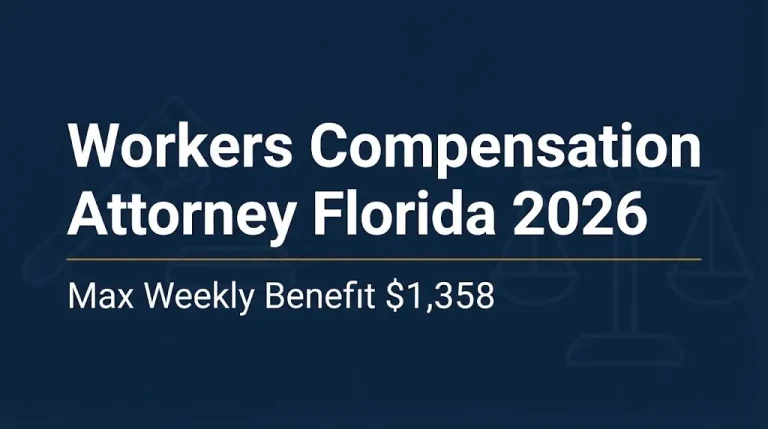
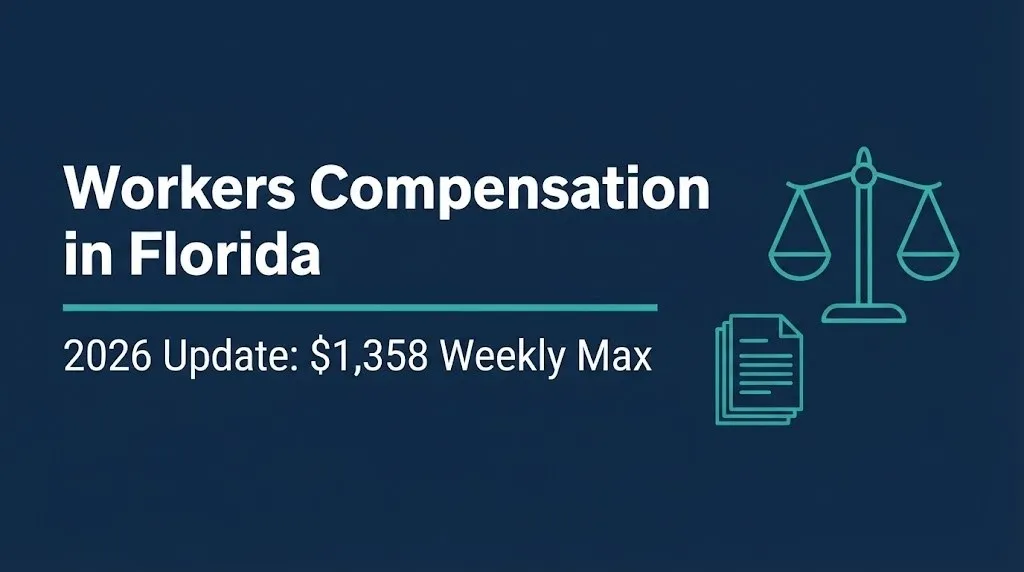
The system affects millions of Florida workers and thousands of employers, and one number matters most in 2026: the maximum weekly wage-replacement check is capped at $1,358. That cap changes every year based on the state’s average wage.
This guide covers what Florida workers compensation covers, who must carry it, how much it pays, and the deadlines that can end a claim early. One detail surprises a lot of workers: Florida just changed how the filing clock works, and it now gives some injured workers more time than before.
The Facts
| Category | Detail |
|---|---|
| Administering Agency | Florida Division of Workers’ Compensation, Department of Financial Services |
| Coverage Threshold | 4 or more employees for non-construction businesses; 1 or more for construction; 6 or more regular employees for agriculture |
| 2026 Rate Change | 6.9% average statewide premium decrease, effective January 1, 2026 |
| Max Weekly Benefit (2026 injuries) | $1,358 |
| Min Weekly Benefit | $20 |
| Wage Replacement Rate | 66⅔% of your average weekly wage, up to the cap |
| Injury Notice Deadline | 30 days from the date of the accident |
| Formal Claim Deadline | 2 years to file a Petition for Benefits, with a 1-year keep-alive rule after your last payment or treatment |
Is Workers Compensation Insurance Mandatory in Florida?
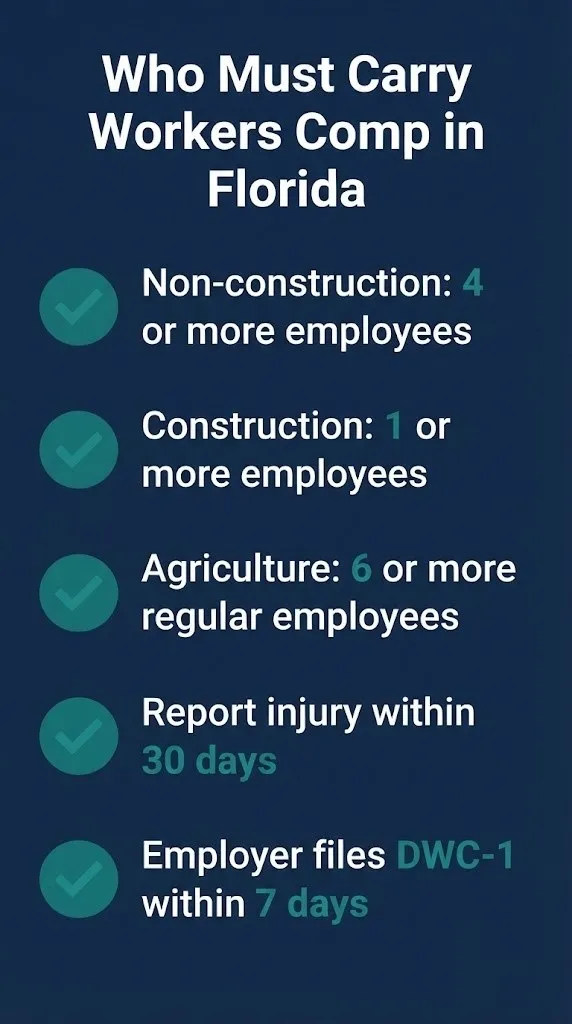
Yes, workers compensation insurance is mandatory for most Florida employers, but the exact threshold depends on your industry. Non-construction businesses need four or more employees before coverage is legally required.
Construction is treated differently. Florida requires construction businesses to carry coverage with just one employee, including part-time, seasonal, or subcontracted workers.
Agricultural employers face their own threshold: coverage is required once a business has six or more regular employees, or a set number of seasonal workers employed beyond a certain number of days.
| Business Type | Employee Threshold |
|---|---|
| Non-construction | 4 or more employees (full or part-time) |
| Construction | 1 or more employees |
| Agricultural | 6 or more regular employees, or seasonal threshold |
Key Takeaway: Florida’s coverage rule isn’t one-size-fits-all, construction businesses face a far lower bar than office or retail employers.
Workers Compensation Insurance in Florida: Is My Employer Required to Have It?
Your employer is likely required to carry workers compensation insurance if they meet Florida’s industry-specific employee threshold. Part-time, seasonal, and temporary employees all count toward that number.
Corporate officers and LLC members in non-construction businesses aren’t automatically counted as employees. They can file for a formal exemption if they meet ownership requirements.
In construction businesses, the rule flips. Owners and officers generally must be covered, with only limited exemptions available, reflecting the higher injury risk in that industry.
Key Takeaway: Counting employees for Florida workers comp purposes includes part-timers and seasonal staff, not just full-time payroll.
How Much Does Workers Compensation Pay in Florida?
Florida workers compensation pays 66⅔% of your average weekly wage for lost work time, capped at a state maximum that changes every year. For injuries in 2026, that maximum is $1,358 per week.
The minimum weekly benefit is $20. Most injured workers fall somewhere between the floor and the cap, depending on their pre-injury wages.
| Benefit Type | Florida Rule (2026) |
|---|---|
| Temporary Total Disability (TTD) | 66⅔% of average weekly wage, capped at $1,358/week |
| Waiting Period | First 7 days unpaid, unless disability exceeds 21 days (then paid retroactively) |
| TTD Time Limit | Maximum 104 weeks (2 years) under Fla. Stat. § 440.14 |
| Temporary Partial Disability (TPD) | Partial wage-loss benefit while working reduced hours or duties |
| Minimum Weekly Benefit | $20 |
Temporary total disability benefits continue until you reach maximum medical improvement, return to work, or hit the statutory time limit, whichever comes first.
Reality Check: No legitimate insurer or state office will contact you out of the blue offering a fast workers comp payout in exchange for a fee. Filing through the Florida Division of Workers’ Compensation is free, and so is reporting an injury to your employer.
Florida Workers Compensation Insurance Rates: What Changed in 2026?
Florida’s workers compensation rates dropped again in 2026, marking the ninth consecutive year of statewide rate reductions. The Florida Office of Insurance Regulation approved an average 6.9% decrease.
That decrease, based on a filing from the National Council on Compensation Insurance (NCCI), applies to new and renewal policies effective January 1, 2026. It affects what employers pay, not what injured workers receive.
Rate changes vary by job classification. Higher-risk classifications, like construction or roofing, still carry higher base rates than office-based classifications, even after the statewide reduction.
Key Takeaway: A falling statewide rate doesn’t mean every employer’s bill drops the same amount, your specific classification code still drives your premium.
How Do I Apply for Workers Compensation in Florida?
You apply for Florida workers compensation by reporting your injury to your employer, who then forwards a report to their insurance carrier. You generally don’t need to file paperwork directly with the state unless your claim gets denied.
Follow these steps:
- Report your injury to your employer within 30 days
- Seek treatment from an authorized doctor as soon as possible
- Confirm your employer files Form DWC-1 with its insurance carrier within 7 days
- Wait for the insurance carrier to investigate and respond
- Start receiving medical and wage benefits if the claim is approved
- If wage benefits are owed, expect payment generally within 14 to 21 days of approval
- If your claim is denied, you may need to file a Petition for Benefits with the state
Your employer must submit Form DWC-1, the First Report of Injury or Illness, and you generally don’t need to file anything with the Division of Workers’ Compensation unless the carrier denies your claim.
How Do I Get a Florida Workers Compensation Certificate or Exemption?
A Florida workers compensation exemption is a formal certificate that lets eligible business owners or corporate officers opt out of coverage requirements. You apply through the Division of Workers’ Compensation’s online Notice of Election to be Exempt system.
Eligibility generally requires an ownership stake or corporate officer status, and applicants must personally sign the application. A valid state driver’s license is required to apply or renew.
Exemption certificates typically expire and must be renewed, and non-construction applicants must complete an online compliance tutorial as part of the process. Construction industry exemptions are more limited given the higher-risk nature of that work.
Key Takeaway: An exemption certificate isn’t automatic, it has to be filed, signed, and renewed on a set schedule to stay valid.
How Do I Verify a Company’s Workers Compensation Coverage in Florida?
You can verify workers compensation coverage or exemption status through the Florida Division of Workers’ Compensation’s free public databases. No account or login is required.
The state maintains a Proof of Coverage database searchable by employer name, Federal Employer Identification Number (FEIN), or policy number. A separate exemption search database lets you confirm whether a specific officer or business holds a valid exemption certificate.
For general contractors hiring subcontractors, verifying coverage independently matters. Insurance policies can lapse mid-year, and exemptions expire every two years, so a certificate you saw last year may no longer be valid today.
What Is the Florida Workers Compensation Statute of Limitations in 2026?
Florida generally requires injured workers to file a Petition for Benefits within 2 years of the date of the accident. A newer 2026 court ruling has changed how that clock is calculated in some cases.
Under a First District Court of Appeal decision issued March 23, 2026 (Estes v. Palm Beach County School District), the two-year statute of limitations does not run while a worker is still receiving authorized medical treatment or indemnity benefits. Once treatment or benefits stop, a one-year tolling period begins, and only after that period ends does the two-year clock start.
There’s also a shorter “keep it alive” rule under the older framework: once benefits have started, a claim can become time-barred if a full year passes without any authorized treatment or payment. For occupational diseases, the clock generally starts from when you knew, or should have known, the condition was work-related, or from your last exposure, whichever is later.
| Deadline | Timeframe |
|---|---|
| Notice to employer | 30 days from the accident |
| Employer report to carrier | 7 days from employer’s knowledge (if offsite treatment needed) |
| Petition for Benefits (general rule) | 2 years from date of accident |
| Keep-alive rule after last benefit | 1 year without treatment or payment can bar further claims |
| 2026 tolling update | SOL paused while authorized treatment or benefits continue |
Key Takeaway: Florida’s 2026 court ruling gives some injured workers more breathing room, but the safest move is still to track your last treatment or payment date closely.
What Happens After You File a Workers Comp Claim in Florida?
After you report an injury, your employer’s insurance carrier investigates and must promptly approve or deny your claim. Investigations may include medical record reviews, wage verification, or an independent medical examination.
If approved, medical treatment begins right away, and wage-loss payments generally start within 14 to 21 days once accepted. If the insurer denies the claim, you or your attorney can file a Petition for Benefits with the state.
Disputed Florida claims are heard by a Judge of Compensation Claims, a specialized adjudicator separate from Florida’s regular civil court system.
What Does Florida Workers Compensation Cover?
Florida workers compensation covers medical treatment, a portion of lost wages, and death benefits for dependents in fatal workplace injury cases. Coverage applies regardless of fault, as long as the injury arose out of and in the course of employment.
Typical covered costs include:
- Doctor visits, hospital care, and surgery with an authorized provider
- Prescription medication tied to the work injury
- Temporary and permanent disability wage-loss payments
- Vocational reemployment services if you can’t return to your prior job
- Death and funeral benefits for dependents
Reemployment services can include vocational counseling, resume assistance, and job placement support, generally available if your injury happened on or after October 1, 1989, and you request screening within one year of your last benefit.
What Is the Florida Division of Workers’ Compensation?
The Florida Division of Workers’ Compensation (DWC) is the state agency, housed inside the Department of Financial Services, that oversees the entire workers comp system. It regulates claims, employer coverage, exemptions, and dispute processes.
The DWC maintains the forms used throughout a claim, including Form DWC-1 for reporting injuries and the Notice of Election to be Exempt for business owners seeking exemption.
Think of the DWC like the DMV for workplace injuries: it’s the state office that keeps the official record of who’s covered, who’s exempt, and how disputes get resolved.
Who Is Exempt From Florida Workers Compensation Law?
Sole proprietors and independent contractors without employees are often excluded from Florida’s mandatory system by default. However, many still need a formal exemption certificate to satisfy general contractors or clients.
LLC members can generally elect exemption if they meet ownership requirements, often 10% or more, and file the official Notice of Election to be Exempt. Corporate officers, including president, vice president, secretary, and treasurer, can also exempt themselves if the corporation is active and registered with the state.
Failing to file the exemption paperwork doesn’t automatically make you exempt. Without it, you’re treated as a covered employee by default, and premiums may be owed on your income.
What Happens if My Employer Doesn’t Have Workers Compensation in Florida?
If your employer is required to carry workers comp and doesn’t, you can file a complaint with the Florida Division of Workers’ Compensation and may be able to collect from the state’s Uninsured Employer Fund.
Penalties for employers operating without required coverage are significant:
- A minimum fine of $1,000, or double the avoided premium for up to two years, whichever is greater
- Immediate stop-work orders halting business operations
- Criminal penalties, since operating without required coverage is a criminal offense in Florida
- Repeated violations can escalate to third-degree felony charges
Reality Check: An uninsured employer doesn’t erase your right to benefits. It shifts where you may need to pursue them, through a state complaint and potentially the Uninsured Employer Fund, rather than a standard private claim.
Construction vs Non-Construction: How Florida’s Rules Differ
Florida treats construction businesses far more strictly than other industries when it comes to workers compensation. The threshold, exemption rules, and enforcement all differ.
| Rule | Construction | Non-Construction |
|---|---|---|
| Coverage threshold | 1 or more employees | 4 or more employees |
| Owner/officer coverage | Generally required, limited exemptions | Broader exemption eligibility |
| Enforcement focus | High, frequent job-site inspections | Lower, but still enforced |
Florida’s Division of Workers’ Compensation conducts frequent job-site inspections, with a particular focus on construction, given the higher injury rates in that sector.
What if My Florida Workers Comp Claim Is Denied?
A denied Florida workers comp claim can be challenged by filing a Petition for Benefits with the Division of Workers’ Compensation. Denial isn’t the end of the process.
Once filed, a disputed claim moves toward a Judge of Compensation Claims for resolution. This is a specialized judicial process separate from Florida’s regular court system.
Steps if your claim is denied typically include:
- Requesting the specific written reason for denial
- Gathering medical records supporting the work-related injury
- Filing a Petition for Benefits with the state
- Attending mediation, which is often required before a hearing
- Presenting your case before a Judge of Compensation Claims if unresolved
Workers Compensation vs Personal Injury Lawsuit in Florida
Florida workers compensation is a no-fault system where you generally cannot sue your employer directly for a workplace injury. That’s the tradeoff for guaranteed, no-fault benefits.
A separate personal injury lawsuit may still be possible against a third party, like equipment manufacturers or subcontractors, if their negligence contributed to your injury.
| Feature | Workers Comp | Personal Injury Lawsuit |
|---|---|---|
| Fault required | No | Yes |
| Who you claim against | Employer’s insurance carrier | At-fault third party |
| Pain and suffering | Not covered | Can be covered |
| Deciding body | Judge of Compensation Claims | Civil court judge or jury |
Think of it like a store return without a receipt versus a warranty claim: workers comp guarantees something back quickly without proving fault, while a lawsuit can pay more but requires proving someone else was careless.
What Happens Next
January 1, 2026: The 6.9% statewide rate decrease took effect for new and renewal policies (confirmed, already occurred).
March 23, 2026: The First District Court of Appeal issued its tolling ruling on the statute of limitations (confirmed, already occurred).
Ongoing through 2026: The Division of Workers’ Compensation continues processing claims, exemptions, and enforcement inspections statewide.
Expected annually each July: Florida’s statewide average weekly wage is recalculated, which can shift future maximum benefit caps.
Ongoing: Disputed claims continue moving through mediation and Judges of Compensation Claims across the state.
Frequently Asked Questions
What is workers compensation in Florida?
Workers compensation in Florida is no-fault insurance that pays medical bills and part of your wages after a job injury.
You don’t need to prove your employer was careless to receive benefits.
Is workers compensation insurance mandatory in Florida?
Yes for most employers, though the threshold depends on industry.
Non-construction needs 4 or more employees, construction needs just 1.
How much does Florida workers comp pay per week?
Florida pays 66⅔% of your average weekly wage, capped at $1,358 for 2026 injuries.
The minimum weekly benefit is $20.
How long do I have to file a workers comp claim in Florida?
You generally have 2 years from the date of the accident to file a Petition for Benefits.
A 2026 court ruling can pause that clock while you’re still receiving authorized treatment or benefits.
How do I apply for workers compensation in Florida?
You report the injury to your employer within 30 days, and they forward the claim to their insurance carrier.
You typically don’t need to file anything directly with the state unless your claim is denied.
How do I get a Florida workers compensation exemption certificate?
You apply through the Division of Workers’ Compensation’s online Notice of Election to be Exempt system.
Eligibility generally requires ownership stake or corporate officer status, and certificates must be renewed.
What happens if my employer doesn’t have workers comp insurance in Florida?
You can file a complaint with the Division of Workers’ Compensation and may pursue benefits through the Uninsured Employer Fund.
Employers operating without required coverage face fines, stop-work orders, and possible criminal charges.
Can I sue my employer instead of filing workers comp in Florida?
Generally no, since workers comp is typically your exclusive remedy against your employer for job injuries.
A separate lawsuit against a third party may still be possible depending on the circumstances.
Florida’s workers comp deadlines move fast, and the 30-day employer notice window is the one that trips people up most. If you’re hurt on the job, report it in writing today and confirm your case details directly with the Florida Division of Workers’ Compensation.