What Does Total Compensation Mean in 2026? Salary vs. Total Compensation Explained
Quick Answer
- Total compensation means everything of value you receive from your employer, not just your paycheck .
- Your base salary is just one piece. Health insurance, 401(k) matches, PTO, and bonuses are all part of the total package .
- When comparing job offers, total compensation is the number that actually tells you which offer is worth more .
If you’re staring at a job offer or negotiating a raise, you probably keep hearing the term “total compensation.” It’s not corporate jargon meant to confuse you. It’s the real number that determines whether one offer beats another.
Your salary is the cash you see in your bank account. Total compensation is the value of everything your employer pays for on your behalf, including things you never see in a paycheck . Benefits constitute 30 to 40 percent of an employee’s total compensation package .
This article explains exactly what total compensation means, what counts toward it, how it differs from salary, and how to calculate yours so you can make better career decisions.
The Facts
| Item | Detail |
|---|---|
| Total Compensation | Base pay + variable pay + benefits + PTO + perks |
| Base Salary | Fixed annual amount before taxes and deductions |
| Benefits Share | 30 to 40 percent of total compensation |
| Key Distinction | Salary is cash only; total compensation includes non-cash value |
| Government Definition | Any form of remuneration payable for work performed |
Is Total Compensation the Same as Salary?
No. Total compensation and salary are not the same thing. Salary is just one component of total compensation .
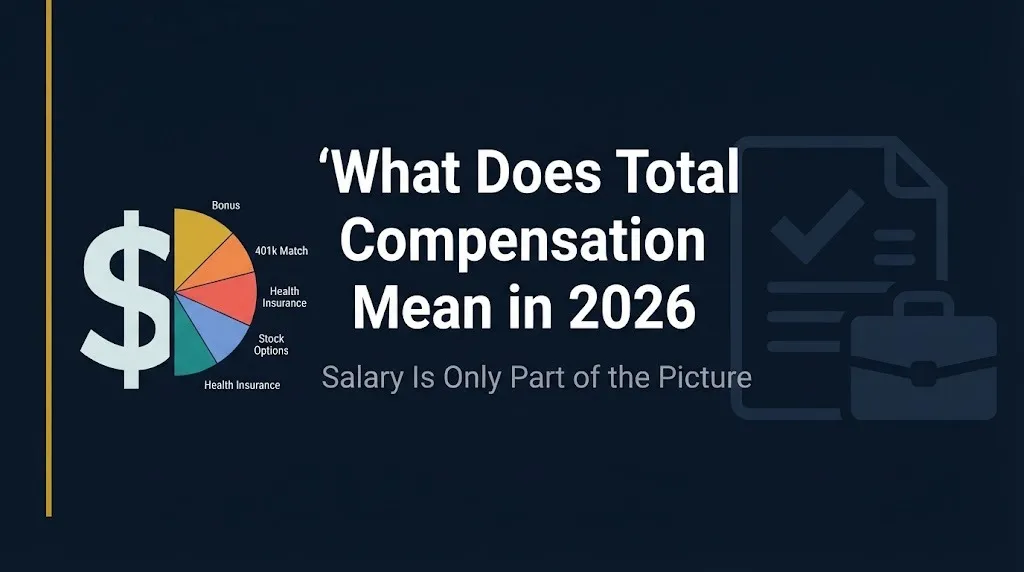
Your salary is the fixed amount of money you’re paid for your job each year, before taxes are taken out. Total compensation includes that salary plus all the additional benefits and perks your employer provides .
Think of it like buying a house. The listing price is the salary. But the total cost includes closing costs, property taxes, insurance, and maintenance. The sticker price doesn’t tell you the real cost, and your salary doesn’t tell you the real value of your job.
Key Takeaway: Salary is what you get paid. Total compensation is what your job is actually worth.
What Is Included in a Total Compensation Package?
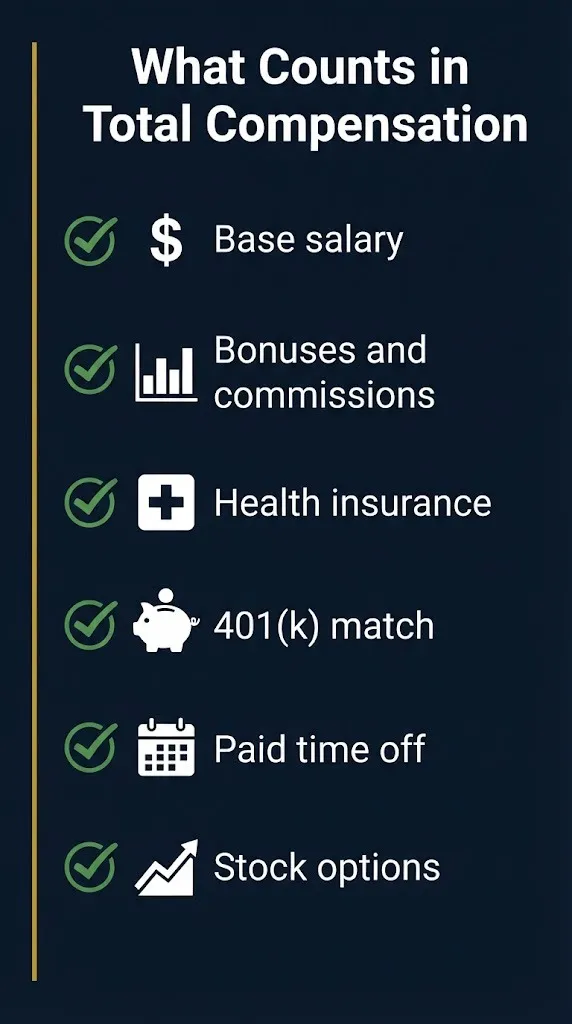
A total compensation package includes every form of value your employer provides, both cash and non-cash .
Common components:
- Base salary: The fixed annual or hourly wage
- Bonuses and commissions: Variable pay tied to performance
- Health, dental, and vision insurance: Employer-paid or subsidized coverage
- Retirement contributions: 401(k) matches, pensions, or other plans
- Stock options or equity: Company shares or the option to buy them
- Paid time off: Vacation days, sick leave, and holidays
- Wellness perks: Gym memberships, mental health support, wellness programs
- Professional development: Training, certifications, conference budgets
- Relocation or transportation assistance: Commuter benefits or moving costs
The government defines compensation broadly. Under the Canadian Human Rights Commission’s Pay Equity Act, compensation includes salaries, commissions, vacation pay, severance pay, bonuses, payments in kind, employer contributions to pension and health plans, and “any other advantage received directly or indirectly from the employer” .
How Do You Calculate Your Total Compensation?
You calculate total compensation by adding your base salary to the dollar value of every benefit and perk your employer provides .
Step-by-step:
- Start with your base salary. This is your fixed annual pay before taxes.
- Add variable pay. Include bonuses, commissions, and profit-sharing received over the year.
- Add employer retirement contributions. If your employer matches 5% of your salary, that’s 5% added to your total.
- Add the value of health insurance. Use the employer’s cost, not just your premium. If your employer pays $600 per month for your coverage, that’s $7,200 per year.
- Add the value of paid time off. Multiply your daily rate by your PTO days. If you earn $200 per day and get 15 PTO days, that’s $3,000.
- Add other perks. Gym memberships, commuter benefits, tuition assistance, and other benefits have real dollar values.
The result is your total compensation. It’s often significantly higher than your salary alone.
Why Does Total Compensation Matter More Than Salary?
Total compensation matters more than salary because it shows the true value of a job and lets you compare offers accurately .
A job with a $60,000 salary and fully paid health insurance, a 6% 401(k) match, and four weeks of PTO may be worth more than a job with a $70,000 salary and no benefits. The salary looks higher, but the total package is worse.
This is where people get tricked. A higher salary can feel like a win, but if you’re paying $500 a month for health insurance and getting no retirement match, you’re losing money compared to a lower salary with better benefits.
Key Takeaway: Two jobs with the same salary can have wildly different total compensation. Always compare the full package, not the headline number.
What Is the Difference Between Total Compensation and Total Rewards?
Total compensation refers to monetary value, while total rewards includes non-monetary elements like company culture and work-life balance .
Total rewards is a broader concept. It includes everything in total compensation plus intrinsic factors: career growth opportunities, flexible work arrangements, recognition, and company mission .
For practical purposes, when you’re comparing job offers, total compensation is the number you calculate. Total rewards is the broader experience of working somewhere.
How Does the Government Define Total Compensation?
The U.S. Department of Labor defines total annual compensation for highly compensated employees as including salary, commissions, and non-discretionary bonuses, but excluding board, lodging, medical insurance, retirement contributions, and other fringe benefits .
Under the Fair Labor Standards Act, a “highly compensated employee” must receive at least $107,432 in total annual compensation, including at least $684 per week on a salary or fee basis .
This definition matters for overtime exemptions. It shows that the legal definition of total compensation can be narrower than the everyday one. For your own career decisions, use the broader definition that includes all benefits.
What Mistakes Do People Make When Comparing Job Offers?
The biggest mistake people make is comparing salaries only and ignoring the value of benefits .
Common errors:
- Ignoring health insurance costs. A job with “great benefits” that costs you $400 per month is worse than a job with a lower salary and $100 per month premiums.
- Forgetting retirement matches. A 5% match on a $60,000 salary is $3,000 per year. That’s real money.
- Undervaluing PTO. Two extra weeks of vacation is worth thousands of dollars in time and flexibility.
- Overlooking bonuses. A 10% annual bonus on a $70,000 salary is $7,000 per year. That’s significant.
- Not counting equity. Stock options and restricted stock units can be worth more than salary at some companies, or worth nothing if the company struggles.
Run the numbers on every component. The offer with the higher salary isn’t always the better offer.
What Happens If You Don’t Understand Total Compensation?
If you don’t understand total compensation, you may accept a job that pays less than you think or reject an offer that was actually better .
Negotiating without understanding total compensation puts you at a disadvantage. You might ask for a higher salary when what you really need is better health coverage or more PTO. Employers often have more flexibility on benefits than on base pay.
Understanding total compensation also helps you evaluate raises and promotions. A 3% raise on your salary is nice, but if your employer also increases their 401(k) match or adds a new benefit, your total compensation may have grown more than you realize.
Frequently Asked Questions
What does total compensation mean?
Total compensation is the full value of everything you receive from your employer, including salary, bonuses, benefits, retirement contributions, and perks .
Is total compensation the same as salary?
No. Salary is just the base cash amount. Total compensation includes salary plus all additional benefits and value .
What is included in a total compensation package?
Base salary, bonuses, commissions, health insurance, retirement contributions, stock options, paid time off, and perks like gym memberships or professional development .
Why is total compensation important?
It shows the true value of a job and lets you compare offers accurately. A lower salary with great benefits can be worth more than a higher salary with poor benefits .
How do I calculate my total compensation?
Add your base salary, variable pay, employer retirement contributions, the employer’s cost of health insurance, the value of PTO, and other perks .
What is the difference between total compensation and total rewards?
Total compensation covers monetary value. Total rewards includes non-monetary factors like culture, growth opportunities, and work-life balance .
Does total compensation include paid time off?
Yes. PTO has a calculable dollar value based on your daily rate and the number of days you receive .
What Should You Do With This Information?
Calculate your total compensation before your next job offer or salary negotiation. Add up every component, not just the salary. Compare offers on total compensation, not headline numbers.
The most important fact to remember: benefits make up 30 to 40 percent of total compensation . If you’re only looking at salary, you’re missing a huge part of the picture.