Wisconsin Workers Compensation Attorneys: 2026 Fees, Deadlines, and Benefits Guide
Quick Answer
- Wisconsin caps workers’ comp attorney fees at 20 percent of what you recover, or 10 percent (max $250) on undisputed claims.
- Payouts depend on wages and disability rating; the 2026 maximum weekly PPD rate is $454.
- You generally have 12 years from your injury date, or your last payment, to file a claim.
If you got hurt on the job in Wisconsin, the first question is usually about money, not law school theory. Wisconsin caps what a workers’ compensation attorney can charge you at 20 percent of your recovery, set by state statute, not negotiated case by case.
That fee structure matters because it affects who can afford a lawyer. Every injured worker in Wisconsin, regardless of income, can access legal representation without paying anything upfront, since attorneys work on contingency and get paid only from what they recover.
This article breaks down what a Wisconsin workers’ comp attorney actually costs, what they can recover for you, the 12-year filing deadline most people don’t know about, and the new 2026 penalty rules that now punish insurers for bad-faith delays. One detail most competing pages skip entirely: the state just raised the penalty for insurers who stall your payments to as much as $30,000 per violation.
The Facts: Wisconsin Workers’ Comp Quick Reference
| Category | Verified Figure |
|---|---|
| Attorney fee cap, contested claims | 20% of amount recovered (Wis. Stat. 102.26) |
| Attorney fee cap, conceded/undisputed claims | 10%, not to exceed $250 |
| Max weekly PPD rate, injuries Apr. 1 to Dec. 31, 2026 | $454 |
| Max weekly PPD rate, injuries on/after Jan. 1, 2027 | $462 |
| Wage replacement rate (TTD/TPD) | 66.67% (two-thirds) of average weekly wage, up to state max |
| General statute of limitations to file a claim | 12 years from injury date or last compensation paid |
| No statute of limitations | Certain severe traumatic injuries (knee/hip replacement, spinal disc, shoulder replacement) |
| Bad-faith delay penalty (effective Jan. 1, 2026) | Up to the lesser of 200% of compensation due or $30,000 |
| Late payment interest (effective Jan. 1, 2026) | 1% per month after 30 days |
| Administering agency | Wisconsin Department of Workforce Development, Worker’s Compensation Division |
| Appeals body | Labor and Industry Review Commission (LIRC) |
Not every figure applies to every case. Your specific benefit rate depends on your wages and injury date, but this table reflects the verified 2026 framework governing every Wisconsin claim.
Do You Need a Workers’ Compensation Attorney in Wisconsin?
You don’t legally need one to file a claim, but representation becomes valuable the moment your employer or insurer disputes anything. Simple, undisputed medical-only claims often move fine without a lawyer.
Once your claim involves denied benefits, a disputed injury cause, or a permanent disability rating, the stakes rise fast. Insurance adjusters are trained to minimize payouts, and Wisconsin’s benefit calculations involve wage averaging and disability percentages that are easy to get wrong.

Think of it like disputing a denied home insurance claim after a fire. You can technically fight it alone, but the company has adjusters who do this daily and you don’t.
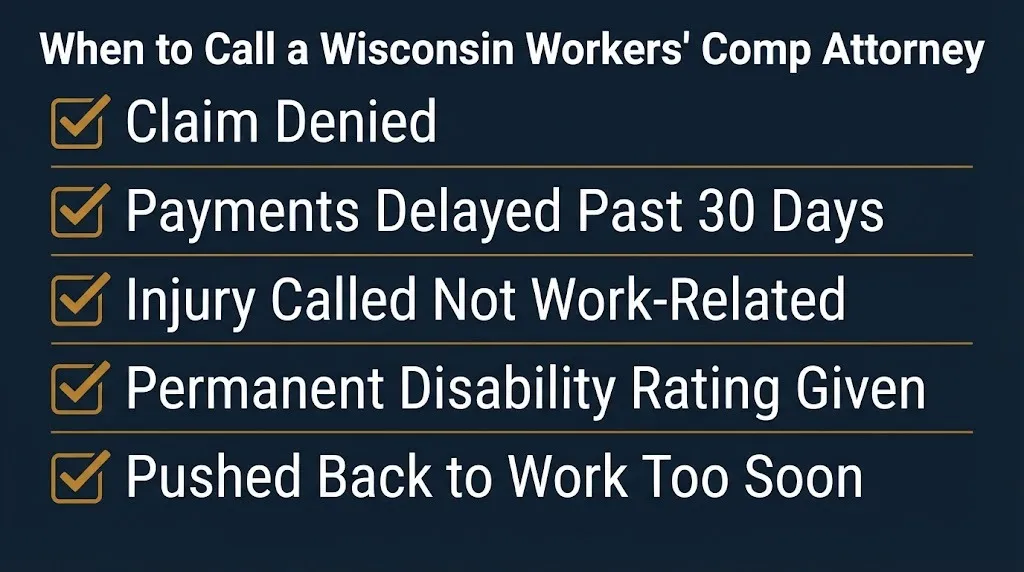
Common signs it’s time to consult an attorney:
- Your claim was denied outright
- Payments stopped or arrived late without explanation
- You were told your injury isn’t work-related
- You’re being pushed back to work before you’re medically ready
- You’ve been assigned a permanent disability rating you disagree with
How Much Does a Wisconsin Workers’ Compensation Attorney Cost?
Wisconsin attorneys can charge at most 20 percent of whatever they recover for you, a limit set directly by Wisconsin Statute 102.26. There’s no separate hourly billing on top of that fee.
For cases where liability is fully admitted and no hearing or appeal is needed, the cap drops even lower. In those conceded cases, the fee is limited to 10 percent, capped at $250 total.
Every fee agreement must be submitted for approval to the Worker’s Compensation Division or a judge before it’s enforceable. An attorney who charges above these limits can be required to forfeit double the amount collected.
| Case Type | Maximum Attorney Fee |
|---|---|
| Contested claim requiring hearing or appeal | 20% of amount recovered |
| Conceded liability, no dispute, no hearing needed | 10%, capped at $250 |
Key Takeaway: Wisconsin law caps workers’ comp attorney fees at 20 percent, and most attorneys don’t charge anything unless they recover money for you.
Reality Check: No attorney or “claims consultant” needs to charge you an upfront fee to review your Wisconsin workers’ comp case. Filing a claim with the Worker’s Compensation Division is always free, and legitimate attorneys only get paid from your actual recovery.
What Can a Workers’ Compensation Attorney Recover for You in Wisconsin?
A Wisconsin workers’ comp attorney can pursue several categories of benefits, not just a single lump-sum check. What you can recover depends on your injury type, wage history, and whether the disability is temporary or permanent.
Wage replacement benefits (temporary total or partial disability) generally pay two-thirds of your average weekly wage, up to the state maximum. For injuries occurring between April 1 and December 31, 2026, the maximum weekly permanent partial disability rate is $454. That rate rises to $462 for injuries on or after January 1, 2027.
Benefit categories an attorney typically pursues:
- Temporary total disability (TTD), while you’re unable to work at all
- Temporary partial disability (TPD), if you return to lighter, lower-paying work
- Permanent partial disability (PPD), based on a percentage disability rating
- Permanent total disability (PTD), for injuries preventing any future work
- Medical expense coverage, including future treatment
- Vocational retraining benefits, if you can’t return to your prior job
Death benefits are also available to dependents in fatal workplace injury cases, calculated separately under Chapter 102.
Key Takeaway: Wisconsin workers’ comp covers far more than a single check; wage replacement, medical costs, disability ratings, and retraining can all factor into what you recover.
How to File a Workers’ Compensation Claim in Wisconsin
Filing correctly and promptly protects your right to full benefits. Here is the general process reported by the Wisconsin Department of Workforce Development and current legal resources.
- Report the injury to your employer as soon as possible
- Seek medical treatment and tell the provider it’s work-related
- Confirm your employer files a First Report of Injury with their insurer
- Keep copies of all medical records and correspondence
- Track missed workdays and reduced hours for wage-loss documentation
- File an Application for Hearing with the Worker’s Compensation Division if the claim is denied or disputed
- Consult an attorney if payments stop, are delayed, or the claim is contested
Missing early documentation steps is the most common reason a legitimate claim gets disputed later.
What Is the Statute of Limitations for a Wisconsin Workers’ Comp Claim?
Wisconsin generally gives you 12 years from the date of injury, or from the date compensation was last paid, whichever is later, to file a claim. That’s a longer window than most states, but it’s not unlimited for every case.
Certain severe traumatic injuries fall outside the 12-year limit entirely, meaning there is no statute of limitations at all. Under current law and 2026 legislative updates, this exception list includes:
- Total or partial knee or hip replacement
- Artificial spinal disc placement
- Loss of a hand, arm, foot, or leg
- Permanent brain injury or loss of vision
- Shoulder or reverse shoulder replacement (added under 2026 legislative changes)
Occupational disease claims also generally fall under the 12-year framework, measured from the date the disease was discovered or last treated. Filing an Application for Hearing pauses this deadline while your case is active.
Key Takeaway: Wisconsin’s 12-year filing window is generous, but certain severe injuries carry no deadline at all, while most claims still need documentation started immediately.
What Happens If Your Claim Is Denied or Disputed?
A denied Wisconsin workers’ comp claim moves to a formal hearing process, not an automatic dead end. You or your attorney file an Application for Hearing with the Worker’s Compensation Division to contest the denial.
An administrative law judge reviews evidence, medical records, and testimony before issuing a decision. If either side disagrees with that ruling, the next step is appeal to the Labor and Industry Review Commission (LIRC), an independent state body that reviews workers’ comp and unemployment decisions.
Beyond LIRC, further appeal is possible through Wisconsin’s circuit court system, though that stage is far less common. Most disputes resolve at the administrative law judge or LIRC level.
Starting January 1, 2026, insurers face steeper consequences for bad-faith delays. If an employer or insurer acts with malice or bad faith in stopping or delaying payment, the division can add a penalty of up to the lesser of 200 percent of the compensation due or $30,000.
How Long Does a Wisconsin Workers’ Comp Case Take?
Straightforward, undisputed claims can pay out within weeks of the injury being reported and accepted. Disputed claims requiring a hearing typically take considerably longer, often several months to over a year depending on medical evidence and appeal activity.
Beginning January 1, 2026, ordered payments are due within 30 days, with unpaid amounts accruing 1 percent monthly interest after that. This new interest rule gives injured workers a concrete financial consequence when insurers drag their feet.
Cases involving permanent disability ratings take longer because they typically wait until your medical condition stabilizes, sometimes called reaching “maximum medical improvement,” before a final rating and settlement can be calculated.
What New Workers’ Comp Laws Took Effect in Wisconsin in 2026?
Wisconsin’s legislature passed significant workers’ compensation updates in early 2026 through the Worker’s Compensation Advisory Council’s agreed-upon bill process. The Assembly approved the measure 97-0 on January 20, 2026, and the Senate passed it 32-1 on February 11, 2026.
Verified changes taking effect in 2026 include:
- Maximum weekly PPD rate increased to $454 for injuries from April 1 through December 31, 2026
- Supplemental benefit eligibility expanded to workers injured before January 1, 2020, up from the prior January 1, 2003 cutoff
- New bad-faith penalty of up to the lesser of 200% of compensation due or $30,000, effective January 1, 2026
- 1% monthly interest on payments unpaid past 30 days, effective January 1, 2026
- Shoulder and reverse shoulder replacement added to the list of injuries with no statute of limitations
- $30 minimum weekly earnings floor established for partial disability calculations
Key Takeaway: 2026 brought real financial teeth to Wisconsin’s workers’ comp system, with new insurer penalties designed to punish delayed or bad-faith payments.
Can You Sue Your Employer Instead of Filing Workers’ Comp in Wisconsin?
Generally, no. Wisconsin’s workers’ compensation system is the “exclusive remedy” against your employer, meaning you typically can’t sue your employer directly for a workplace injury, even if they were negligent.
There’s an important exception. If a third party, someone other than your employer or a coworker, contributed to your injury, you may be able to pursue both a workers’ comp claim and a separate personal injury lawsuit against that third party simultaneously.
This distinction matters financially. Workers’ comp limits wage replacement to two-thirds of your average weekly wage and excludes pain and suffering damages entirely, while a successful third-party lawsuit can recover full lost wages and pain and suffering with no statutory cap.
What Is the Difference Between a Workers’ Comp Attorney and a Personal Injury Attorney in Wisconsin?
A workers’ comp attorney handles claims against your employer’s insurance under Chapter 102, with fees capped at 20 percent under state law. A personal injury attorney handles claims against a negligent third party, typically under a separately negotiated contingency fee, often around a third of the recovery, that isn’t statutorily capped the same way.
Some Wisconsin injuries qualify for both tracks at once. A delivery driver hit by another company’s vehicle, for example, may file workers’ comp for medical costs and wage loss while also suing the at-fault driver for full damages.
An attorney experienced in both areas can coordinate the two claims so one doesn’t reduce the value of the other, since workers’ comp insurers are often entitled to reimbursement from a third-party settlement.
How Do You Choose the Right Workers’ Compensation Attorney in Wisconsin?
Look for an attorney who focuses specifically on Wisconsin workers’ compensation, not a general practice firm that occasionally takes these cases. The rules under Chapter 102 are specific enough that unfamiliarity can cost you money.
Questions worth asking before hiring:
- How many Wisconsin workers’ comp cases have you handled?
- Do you charge anything if my claim isn’t approved?
- Who covers costs like medical record requests or expert opinions?
- Have you handled cases involving my type of injury or dispute?
- Do you have experience with both hearings and LIRC appeals?
A free initial consultation is standard in this practice area, and there’s no legitimate reason to pay upfront just to have your case reviewed.
What Happens Next: Typical Claim Timeline
Immediately after injury: Report to employer, seek medical care, request the injury be documented as work-related.
Weeks 1 to 4: Employer files First Report of Injury, insurer begins processing wage and medical benefits.
If disputed: Application for Hearing filed with the Worker’s Compensation Division.
Months 3 to 12+: Administrative law judge hearing, evidence review, and ruling on contested issues.
If appealed: Case proceeds to the Labor and Industry Review Commission, then potentially circuit court.
Frequently Asked Questions
How much does it cost to hire a workers’ comp lawyer in Wisconsin?
Wisconsin law caps attorney fees at 20 percent of what you recover in contested cases.
Undisputed, conceded claims cap fees even lower, at 10 percent up to $250.
Most attorneys charge nothing upfront and only collect if they recover money for you.
What is the deadline to file a workers’ comp claim in Wisconsin?
You generally have 12 years from the date of injury, or from the date compensation was last paid, to file a claim.
Certain severe injuries, like knee or hip replacements or spinal disc surgery, have no statute of limitations at all.
Starting the claim process immediately still protects your evidence and medical documentation.
Can I be fired for filing a workers’ comp claim in Wisconsin?
Wisconsin law prohibits retaliation against employees for filing a legitimate workers’ compensation claim.
If you believe you were terminated because of your claim, that may support a separate legal action.
Document any changes in treatment or communication from your employer after filing.
What is the maximum workers’ comp payment in Wisconsin in 2026?
For permanent partial disability, the maximum weekly rate is $454 for injuries occurring between April 1 and December 31, 2026.
That rate increases to $462 for injuries occurring on or after January 1, 2027.
Wage replacement benefits generally pay two-thirds of your average weekly wage up to the applicable state maximum.
Do I need a lawyer if my employer admits the injury happened at work?
Not necessarily. Straightforward, undisputed claims often move through without legal representation.
Fees are capped even lower, at 10 percent up to $250, specifically for these conceded cases.
A lawyer becomes more valuable the moment any part of the claim is denied or disputed.
What happens if my employer’s insurance denies my claim?
You can file an Application for Hearing with the Wisconsin Worker’s Compensation Division to contest the denial.
An administrative law judge reviews the evidence and issues a ruling.
Further appeal is available through the Labor and Industry Review Commission if you disagree with that decision.
Can I sue my employer directly for a workplace injury in Wisconsin?
Generally no, since workers’ compensation is the exclusive remedy against your employer under Wisconsin law.
An exception exists if a third party, not your employer or a coworker, contributed to your injury.
In that situation, you may pursue both a workers’ comp claim and a separate lawsuit at the same time.
What new workers’ comp penalties apply to insurers in Wisconsin in 2026?
Starting January 1, 2026, insurers acting in bad faith to delay or stop payments face penalties up to the lesser of 200 percent of compensation due or $30,000.
Payments are also now due within 30 days, with 1 percent monthly interest accruing on late amounts.
These changes were part of the 2026 Worker’s Compensation Advisory Council agreed-upon bill.
Start by reporting your injury and documenting everything in writing, even if you’re not sure yet whether you’ll need an attorney. If your claim gets denied, delayed, or disputed, the 12-year filing window gives you time, but the sooner you consult a Wisconsin workers’ comp attorney, the stronger your documentation trail will be.