What Happens at a Mediation for a Lawsuit: The 2026 Process, Costs, and What You Need to Know
Quick Answer
- Mediation is a non-binding settlement conference where a neutral third party helps both sides negotiate.
- You are not required to settle, and nothing you say can be used against you if the case goes to trial.
- Mediation often costs far less than trial, and federal courts may require your attendance.
You’ve been told your lawsuit is going to mediation. Maybe your lawyer scheduled it, or a judge ordered it. You probably want to know what actually happens in that room, who will be there, and whether you’re forced to accept whatever number gets thrown at you.
The short answer is that mediation is a structured negotiation, not a trial. No judge decides anything. No jury hears evidence. A neutral person, called a mediator, helps both sides talk through the numbers until they either agree or walk away.
This guide covers the entire mediation process from the moment you get the notice to the moment you sign (or don’t sign) a settlement agreement. You’ll see what happens in the joint session, what happens behind closed doors, and what you should bring with you.
The Facts
| Case Type | Civil lawsuits (personal injury, employment, consumer, business disputes) |
|---|---|
| Process | Non-binding settlement conference with neutral third party |
| Who Attends | Parties, attorneys, insurance representatives, mediator |
| Cost | Typically split between parties, often less than trial costs |
| Authority to Settle | Required: someone with full settlement authority must attend |
| Confidentiality | Yes, communications privileged and inadmissible in court |
| Binding Effect | Only if both parties sign a written settlement agreement |
What Is Mediation in a Lawsuit?
Mediation is a voluntary, confidential settlement process where a neutral third party helps both sides of a lawsuit negotiate a resolution without going to trial. The mediator does not decide who wins or loses. That person facilitates conversation, clarifies issues, and helps both sides see the strengths and weaknesses of their positions.
The key word is voluntary. Even when a court orders you to attend mediation, the court cannot force you to agree to a settlement. You can hear every offer, reject them all, and proceed to trial. The mediator’s job is to help, not to pressure.
What makes mediation different from a settlement conference with a judge is the format. A judge-led settlement conference tends to be more formal, and the judge may push harder for a resolution. A mediator has no authority to impose anything.
Key Takeaway: Mediation is negotiation with a referee, not a trial with a judge. You keep full control over whether you settle and for how much.
Is Mediation Legally Required in My Lawsuit?
Mediation is mandatory in some courts and voluntary in others. Many federal district courts, including the Northern District of California, maintain ADR programs and may order parties to mediation. Local rules in states like North Carolina require mediated settlement conferences in certain civil cases. Some courts automatically assign certain case types, like personal injury claims under a certain value, to mediation.
Even when mediation is ordered, the voluntary part remains: you must show up, but you cannot be forced to settle. Willful failure to attend a court-ordered mediation can result in sanctions, including fines and attorney fee awards.
If your case is in a court that doesn’t require mediation, either side can suggest it. Your attorney may recommend it to avoid the cost and risk of trial. The other side may request it to test whether you’ll accept less than your full demand.
Key Takeaway: Check whether your court requires mediation. If it does, skipping it can lead to sanctions. If it doesn’t, either party can propose it.
Who Will Be in the Room at Mediation?
A typical mediation session includes you, your attorney, the other party (or their representative), their attorney, and the mediator. If an insurance company is paying the defense, a claims representative with authority to settle usually attends in place of or alongside the defendant.
That last detail matters more than most people realize. If the person in the room can’t actually approve a settlement number, the mediation can’t resolve anything. Court rules often require that a representative with full settlement authority attend or be available by phone.
Your attorney will be there to advise you, but the mediator will likely want to hear from you directly at some point. You don’t have to say anything you’re uncomfortable saying. Discuss with your lawyer beforehand whether you want to speak.
Key Takeaway: The most important person at mediation is whoever holds the checkbook. Confirm that someone with real settlement authority will attend before you show up.
What Happens During the Joint Session?
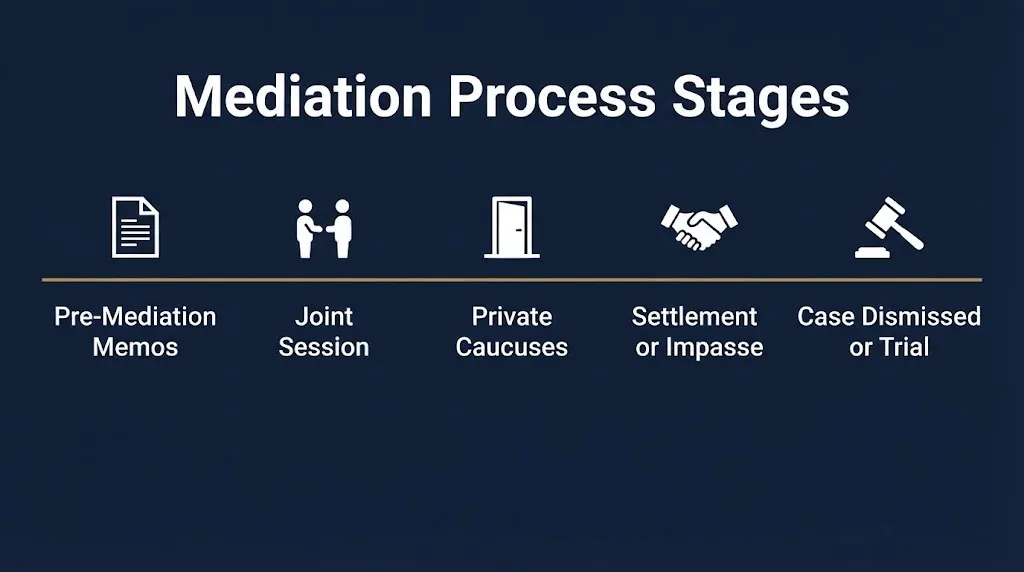
Mediation usually starts with a joint session where everyone sits in the same room (or on the same videoconference). The mediator explains the ground rules: this is confidential, nothing said here can be used in court, and either side can walk away if no agreement is reached.
Then each side gets a chance to present their view of the case. Your attorney will summarize the facts, the damages, and why you believe you’re entitled to compensation. The other side’s attorney will do the same, pointing out weaknesses in your case and strengths in theirs. The mediator may ask questions to clarify the issues.
Some mediators skip the joint session entirely if emotions are running high. If the parties can’t stand being in the same room, going straight to separate sessions avoids a blowup that could kill any chance of settlement.
Key Takeaway: The joint session is informational. Nothing decided there is binding. Its main purpose is to let the mediator hear both sides and identify where the real gaps are.
What Happens in the Private Caucus Sessions?
After opening statements, the mediator typically separates the parties into different rooms, called caucuses. This is where the real negotiation happens. The mediator goes back and forth between rooms, carrying offers and counteroffers, testing what each side will accept.
In your private caucus, the mediator will ask about your interests, not just your legal position. What do you actually need to walk away satisfied? What are your concerns about trial? The mediator may push you to think realistically about what a jury might do. That doesn’t mean the mediator is against you. It means the mediator knows that juries are unpredictable and wants you to evaluate risk clearly.
Everything you say in caucus is confidential. The mediator will not share anything with the other side unless you authorize it. That’s called shuttle diplomacy, and it’s the engine of most mediations.
Key Takeaway: Caucus sessions are where numbers move. The mediator is not your adversary, but is not your advocate either. Use the private time to be honest about your bottom line.
How Much Does Mediation Cost?
Mediation is almost always cheaper than trial. The mediator’s hourly rate, which is typically split between the parties, can range from a few hundred dollars to several thousand depending on the mediator’s experience and the complexity of the case. Some court-connected programs offer free or low-cost mediation, sometimes on a sliding scale.
The bigger savings come from what you don’t spend. Trial preparation involves expert witnesses, depositions, exhibit preparation, and attorney time that can run into tens of thousands of dollars. Mediation can resolve the case in a single day or a series of short sessions. Even if mediation fails, it often narrows the issues and gives both sides a clearer picture of what trial would look like.
Key Takeaway: Mediation is a cost-control tool. Even a failed mediation can save money by revealing what the other side will actually pay.
What Happens If You Reach a Settlement at Mediation?
If both sides agree on terms, the mediator or the attorneys will reduce the agreement to writing before anyone leaves. You and the other party sign it. Once signed, the settlement is binding. The case is typically dismissed, and payment is made according to the terms you agreed to.
Do not sign anything at mediation that you haven’t read carefully and discussed with your attorney. The pressure to close a deal after a long day is real. If you’re not sure, you can ask for time to review. A reputable mediator will not rush you into a signature.
If the settlement includes confidentiality provisions, your attorney can file closing documents that don’t reveal the terms. Courts generally respect mediated settlement confidentiality.
What Happens If Mediation Fails?
If no agreement is reached, the case returns to the court docket and proceeds toward trial. Nothing you said in mediation can be used against you. The offers you made are not admissions. The other side cannot tell the jury that you refused to settle for a certain amount.
A failed mediation is not a wasted day. You now know the other side’s settlement range and their view of your case’s weak points. Your attorney can use that information to adjust strategy, refine discovery, or prepare a stronger trial presentation. Some cases settle weeks later because the mediation planted the seed.
Key Takeaway: A failed mediation still produces intelligence. You learn what the other side values and where they think your case is vulnerable.
Reality Check: No legitimate mediator or court will ever ask you to pay a fee upfront to “release” settlement funds. If someone contacts you claiming you owe money to receive a mediation payout, that’s a scam. Mediation costs are paid to the mediator, not to unlock your own money.
How Should You Prepare for Mediation?
Preparation is the difference between a productive mediation and a frustrating one. Here’s what you should do:
- Review the other side’s mediation memorandum. Your attorney should have a written summary of the other side’s arguments and evidence. Read it and ask questions.
- Know your bottom line. Decide the lowest number you would accept before you walk in. Write it down. Don’t share it with anyone except your attorney.
- Bring documents. Medical records, bills, pay stubs, repair estimates, and any evidence supporting your damages.
- Prepare a short statement if you want to speak. You don’t have to, but if you do, keep it factual and brief.
- Plan for a long day. Mediations can last hours or all day. Bring snacks, water, and medication if needed.
- Discuss the settlement authority question. Confirm that the other side’s representative can actually approve a deal.
- Manage your expectations. Mediation involves compromise. You probably won’t get everything you asked for.
What Happens Next After Mediation?
The timeline after mediation depends on the outcome.
If you settled: The settlement agreement is signed, the case is dismissed, and payment is made per the agreed schedule. Some settlements pay within 30 days, others take longer if liens or probate issues need to be resolved.
If you didn’t settle: The case returns to the active docket. Your attorney will likely file a notice that mediation was unsuccessful. Discovery continues, and trial preparation resumes. A second mediation can be scheduled later if both sides agree.
If the mediator declared an impasse: That means the mediator determined no further progress was possible at that session. The case moves forward toward trial unless the parties later resume negotiations.
Expected next 12 months:
- Weeks 1-4: Case returns to court docket, scheduling orders updated
- Months 2-6: Remaining discovery completed, expert depositions taken
- Months 6-12: Pretrial motions filed, trial date set
- Trial or renewed settlement talks: Many cases settle on the courthouse steps
Key Takeaway: Mediation doesn’t end your case unless you sign a deal. If you don’t settle, the litigation clock keeps ticking toward trial.
Frequently Asked Questions
Can I be forced to settle at mediation?
No. Mediation is voluntary, and the mediator cannot impose a settlement. You can reject any offer and proceed to trial.
Is mediation confidential?
Yes. Communications made during mediation are privileged and generally cannot be used in court if the case proceeds to trial.
Do I have to attend mediation in person?
Not always. Many courts now allow or require videoconference mediation. Check your court’s local rules for attendance requirements.
What happens if I don’t show up to court-ordered mediation?
You can face sanctions, including fines and paying the other side’s attorney fees.
Can the mediator give me legal advice?
No. The mediator is a neutral facilitator, not your lawyer. Only your attorney can give you legal advice.
How long does mediation take?
It varies. Some mediations resolve in a few hours. Complex cases can take multiple sessions over days or weeks.
What if the other side doesn’t have authority to settle?
If the representative lacks settlement authority, the mediation may be rescheduled or the court may impose sanctions. Confirm authority before the session.
Can I bring a family member or friend to mediation?
Generally, no. Mediation attendance is limited to parties, attorneys, and necessary representatives. Ask your attorney about your specific court’s rules.