Workers Compensation for Independent Contractors 2026: Coverage, Costs, and What Happens If You Get Hurt
Quick Answer
- Independent contractors are generally excluded from workers’ comp unless they buy optional coverage or win a misclassification claim.
- Self-employed workers’ comp typically costs $5 to $15 per month for low-risk industries like consulting and photography.
- California, Louisiana, and New York have passed or are considering laws expanding coverage for gig workers and independent contractors.
Do Independent Contractors Get Workers Compensation?
Independent contractors generally do not get traditional workers’ compensation coverage because they are classified as self-employed, not employees . In most states, workers’ comp laws apply only to W-2 employees, and 1099 contractors are explicitly excluded from the system.
That means if you’re hurt on the job as an independent contractor, you can’t file a workers’ comp claim against the company that hired you. Your health insurance may also deny the claim because the injury happened at work .
The gap is real. A freelancer who breaks a wrist and misses six weeks of work faces both medical bills and lost income. Workers’ comp would cover both. Without it, you’re on your own .
Some states have carved out exceptions. California requires roofers to carry workers’ comp coverage whether they have employees or not . New Jersey and other states have specific rules for construction contractors.
The general rule holds: if you’re a true independent contractor, workers’ comp is your responsibility, not your client’s.
How Much Does Workers Compensation Cost for Self-Employed Workers?
Workers’ compensation for self-employed workers costs roughly $5 to $15 per month for low-risk industries, with rates driven primarily by your industry classification code rather than your business structure .
Here’s what self-employed workers pay by industry in 2026:
| Industry | Average Monthly Premium | Average Annual Premium |
|---|---|---|
| Consulting | $15 | $182 |
| Computer Programming | $14 | $170 |
| Tech/IT | $14 | $164 |
| Photography | $9 | $103 |
| Beauty Salon | $7 | $88 |
| Barber | $7 | $85 |
| Home-Based | $5 | $60 |
| Tutoring | $5 | $60 |
High-risk trades like construction and landscaping pay substantially more .
The cost is influenced by four main factors: your industry class code, your state’s benefit levels, your annual payroll (a deemed wage set by the state for sole proprietors), and your claims history .
A ghost policy is a cheaper alternative if you only need a certificate of insurance to satisfy a client’s contract requirement. A ghost policy provides proof of coverage but doesn’t actually pay benefits if you get hurt .
What Are Portable Benefits for Independent Contractors?
Portable benefits are employee-style benefits attached to the worker rather than a specific employer, allowing coverage to follow you from job to job. This is the biggest legislative trend in workers’ comp for independent contractors in 2026 .
The National Council on Compensation Insurance reported a noticeable increase in portable benefits legislation across states in 2026, primarily driven by bills addressing independent contractors and gig workers .
Here’s what’s happening in key states:
California: Proposition 22 created an “occupational accident insurance” product for app-based drivers. Coverage typically includes up to $1 million in medical expenses and disability payments at 66% of net earnings for up to 104 weeks .
New York and Massachusetts: Both states have moved toward portable benefits frameworks for gig workers .
Washington State: Passed a minimum pay and benefits law for rideshare drivers in 2022 .
Louisiana: Senate Bill 358, effective in 2026, allows independent contractors to obtain “independent contractor occupational accident coverage” with minimum medical benefits of $1 million per occurrence, temporary disability benefits, and accidental death coverage .
The Louisiana law also clarifies that a principal won’t be deemed a statutory employer if the contractor maintains valid business identification, signs a written agreement, carries occupational accident coverage, and retains control over work methods .
Reality Check
A “ghost policy” gives you a certificate of insurance but pays you nothing if you’re injured. It satisfies a client’s contract requirement, not your actual need for coverage. If you’re paying for insurance, make sure it actually covers you, not just a piece of paper.
How Do You Know If You’re Misclassified as an Independent Contractor?
You may be misclassified if the company controls your schedule, requires exclusivity, provides your equipment, or directs how you do your work, and misclassification can open the door to full workers’ comp benefits.
States use different tests. California uses the ABC test, which presumes you’re an employee unless the hiring company proves three things: you’re free from control, you perform work outside their usual business, and you have an independent established trade .
Meeting the second prong is nearly impossible for many gig workers. If you’re delivering food for a delivery app, that’s squarely within their usual course of business .
If you win a misclassification claim, you may recover full workers’ comp benefits retroactively, plus penalties . The hiring company can also face back-premium assessments and fines.
Here are common signs you may be misclassified:
- The company sets your hours or requires you to work specific shifts.
- You’re required to wear a uniform or use branded equipment.
- You can’t work for competitors.
- The company trains you on how to perform tasks.
- You’re paid hourly or by salary rather than by project.
If most of these apply, you may have a misclassification claim worth exploring with an attorney.
What Happens If You Get Hurt as an Independent Contractor?
If you’re hurt as an independent contractor, your recovery options depend on your state, your classification, and the circumstances of the injury.
Vehicle accidents are often the strongest path. If you’re driving for a gig platform and someone else causes the crash, the at-fault driver’s insurance may cover your injuries. Your personal auto insurance may also apply if you have a rideshare endorsement. The platform’s contingent liability coverage may kick in while you have a passenger or order in the car .
Occupational accident insurance is available in some states and through some platforms. DoorDash and Instacart have added supplemental on-the-job injury coverage, though it varies significantly from full workers’ comp .
Misclassification claims can retroactively establish you as an employee and unlock full workers’ comp benefits. This requires proving the hiring company controlled your work in ways inconsistent with contractor status .
Health insurance may cover the medical bills, but it typically excludes work-related injuries and never replaces lost wages .
Your own workers’ comp policy is the most direct protection if you bought one. Sole proprietors and independent contractors can purchase coverage in most states, even where it’s not required .
Can You Buy Workers Compensation Insurance as an Independent Contractor?
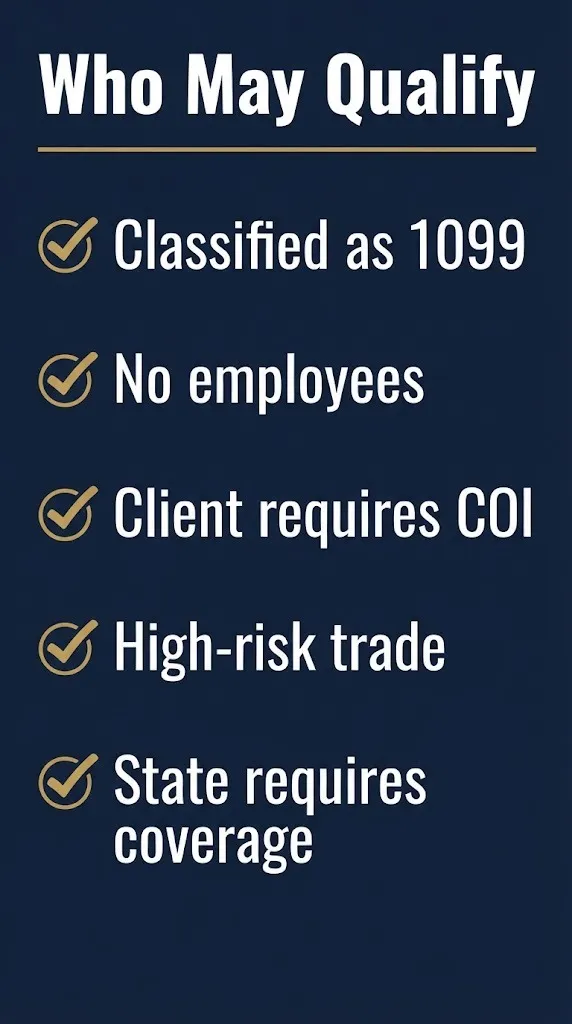
Yes, you can buy workers’ compensation insurance as an independent contractor in most states, even when it’s not legally required. This is called optional coverage or personal coverage, and it works like a standard policy but covers you instead of employees.
The coverage works like a warranty on your income. You pay a premium, and if you get hurt on the job, the policy pays medical bills and a portion of your lost wages.
States that offer optional coverage for self-employed workers include:
- New Hampshire: Sole proprietors and partners may choose to carry coverage .
- North Dakota: Independent contractors can seek an exemption from the state fund .
- Washington State: Businesses may need to provide workers’ comp for independent contractors depending on the nature of their work .
- Manitoba, Canada: Independent contractors can purchase Personal Coverage with minimum annual income of $30,940 for 2026 .
- Prince Edward Island, Canada: Personal Coverage ranges from $17,860 to $89,300 per year .
The Hartford, a major workers’ comp carrier, explains that self-employed workers often buy coverage even when it’s optional because health insurance doesn’t cover work-related injuries or lost wages .
Key Takeaway: Independent contractors are excluded from traditional workers’ comp in most states, but optional coverage costs as little as $5 to $15 per month for low-risk industries. Portable benefits legislation and misclassification claims are creating new paths to coverage in 2026.
What Happens If Your Client Requires Workers Comp Coverage?
Many commercial clients, property managers, and government contracts require independent contractors to provide a certificate of insurance showing workers’ comp coverage before they’ll sign a contract .
This is common for fitness instructors, cleaning businesses, IT consultants, and construction subcontractors .
You have two options:
- Buy a standard policy that actually covers you if you’re injured.
- Buy a ghost policy that provides the certificate but doesn’t pay benefits.
The ghost policy is cheaper because it doesn’t carry real coverage. But if you get hurt, you get nothing .
The Hartford notes that workers’ comp coverage isn’t always optional for the self-employed. California requires roofers to have coverage whether they have employees or not. Your clients might also require it as a precondition for working with them .
Frequently Asked Questions
Do independent contractors need workers compensation insurance?
Most states do not require independent contractors to carry workers’ comp for themselves. However, you may need it if a client requires a certificate of insurance, if you work in a hazardous profession like roofing, or if your state has specific rules for your industry .
Can I get workers comp if I’m a 1099 worker?
Generally, no. Workers’ comp usually does not cover 1099 independent contractors because they’re considered self-employed. In most cases, you’re responsible for purchasing your own coverage .
What is a ghost policy for workers comp?
A ghost policy provides a certificate of insurance to satisfy a client’s contract requirement but doesn’t provide actual coverage benefits if you’re injured. It’s cheaper than a full policy but offers no real protection .
What is the ABC test for independent contractors?
The ABC test is a strict standard used in California and other states to determine if a worker is an employee or independent contractor. It presumes employee status unless the hiring company proves three factors: the worker is free from control, performs work outside the company’s usual business, and has an independent trade .
How much does workers comp cost for a sole proprietor?
Workers’ comp for self-employed workers costs about $5 to $15 per month for low-risk industries like consulting, photography, and tutoring. High-risk trades pay significantly more .
What happens if I’m injured as a gig worker?
Your recovery options include your own occupational accident insurance, the platform’s contingent liability coverage, the at-fault driver’s insurance if a vehicle was involved, and a misclassification claim that could unlock full workers’ comp benefits .
Can I sue if I’m hurt as an independent contractor?
Yes, you generally can sue for negligence because you’re not covered by workers’ comp immunity. That means the hiring company can be held liable for your injuries in a personal injury lawsuit .
Is workers comp optional for self-employed workers?
In most states, yes. Sole proprietors, partners, and independent contractors are typically exempt from mandatory coverage but can purchase it voluntarily. Some states like California require coverage for specific trades like roofing .
What Happens Next in 2026 for Independent Contractor Coverage?
The landscape for independent contractor workers’ comp is shifting. Here’s what to watch in the coming months:
2026-2027 legislative sessions: Portable benefits bills are pending in multiple states, following the trend NCCI identified in its 2026 report .
Federal action: Congress is considering the “Empowering App-Based Workers Act,” which addresses transparency and algorithmic management in digital labor platforms .
California enforcement: The ABC test continues to be applied in misclassification cases, with the Workers’ Compensation Appeals Board reaffirming the presumption of employee status in a 2026 decision .
New state funds: Louisiana’s new independent contractor occupational accident coverage framework takes effect, giving contractors a statutory option to obtain coverage while preserving their independent status .
Gig platform coverage: More platforms may add supplemental injury coverage as public pressure and state laws evolve .
The Bottom Line
Workers’ compensation for independent contractors in 2026 is a patchwork of state laws, optional coverage, and emerging portable benefits programs. The general rule remains: if you’re a true independent contractor, you’re not covered unless you buy your own policy. The cost is manageable, often less than a streaming subscription. The bigger risk is going without. If you get hurt and you’re uninsured, you face medical bills and lost income with no safety net. Buy coverage if you can, and if you suspect you’re misclassified, talk to an attorney.
Key Takeaway: Independent contractors are excluded from workers’ comp in most states. Optional coverage costs $5 to $15 per month for low-risk industries, and misclassification claims can unlock full benefits retroactively.