Workers’ Compensation Fraud in 2026: How the System Investigates, Prosecutes, and Penalizes Fraud (Full Guide)
Quick Answer
- Workers’ compensation fraud is a crime in every state, covering both workers who fake or exaggerate injuries and employers who underreport payroll to cut premiums.
- Penalties range from mandatory restitution (often tens or hundreds of thousands of dollars) to prison time, with felony sentences commonly running 12 to 24 months behind bars.
- If you suspect fraud, report it to your state’s fraud hotline or the employer’s insurance carrier; you do not need a lawyer to file a report.
What Is Workers’ Compensation Fraud, and Is It a Felony?
Workers’ compensation fraud is any deliberate deception used to obtain benefits you are not entitled to, or to avoid paying premiums you legally owe. It is a felony in most states when the amount involved exceeds a statutory threshold.
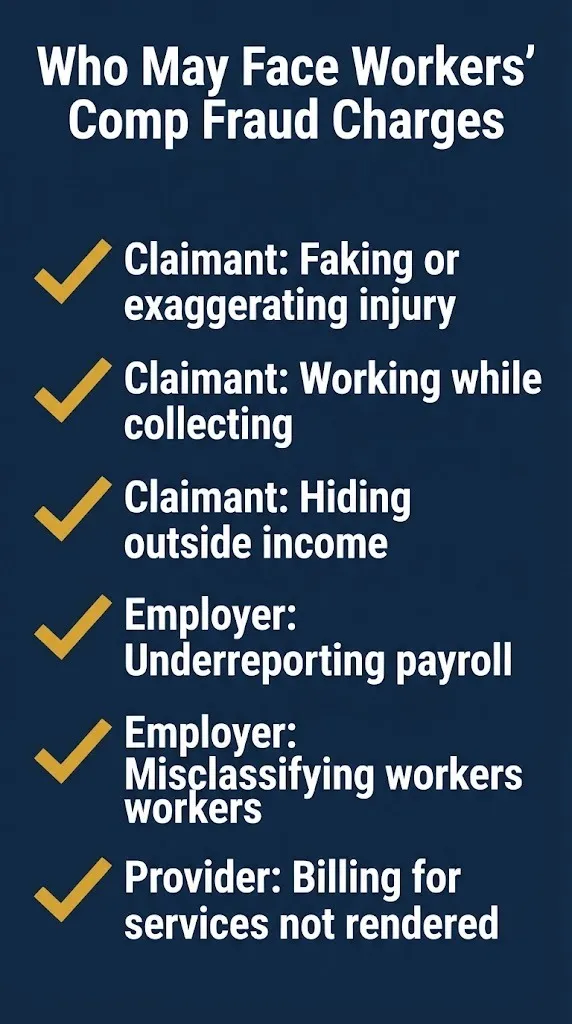
The crime splits into two broad categories: claimant fraud and employer fraud. Claimant fraud happens when an injured worker lies about the severity of an injury, works while collecting benefits, or invents an injury that never occurred. Employer fraud happens when a business underreports payroll, misclassifies workers, or hides employees to lower insurance premiums.
Both categories carry serious consequences. In California, Insurance Code section 1871.4 makes workers’ compensation fraud a wobbler offense, meaning prosecutors can charge it as a misdemeanor or a felony depending on the facts. A felony conviction carries a sentence of two, three, or five years in state prison, plus a fine of up to $150,000 or double the amount of fraud, whichever is greater.
The statute applies to anyone who makes a false statement to obtain benefits. It also applies to employers who make false statements to reduce premiums.
Most states have similar statutes. Some impose mandatory restitution on top of any criminal sentence. A Louisiana appellate court recently upheld a ruling that a worker who lied in a deposition forfeited all future benefits and owed a $1,000 civil penalty.
Key Takeaway: Workers’ compensation fraud is not a paperwork problem. It is a criminal charge that can send you to prison and require you to repay every dollar you received.
How Much Can You Get for Reporting Workers’ Compensation Fraud?
There is no standard payout for reporting workers’ compensation fraud. Some states offer reward programs, but amounts vary widely and are not guaranteed. In most cases, reporting fraud does not put money in your pocket directly.
Your state’s fraud bureau may offer a small percentage of recovered funds as a reward. California, for example, has a fraud assessment fund that can pay rewards, but the amounts are modest and discretionary. Florida’s Division of Investigative and Forensic Services accepts tips through its Fraud Free Florida program but does not advertise fixed rewards.
The bigger financial impact is indirect. When fraud goes undetected, honest employers and workers pay the price through higher premiums. The Insurance Information Institute estimates that workers’ compensation fraud costs insurers $7 billion to $9 billion annually, and those costs get passed to policyholders. Every fraudulent claim adds roughly $400 to $700 to the average policyholder’s annual premium.
If you are a worker who was injured on the job and your employer is disputing your legitimate claim, you may be entitled to benefits, not a reward. That is a different situation entirely. An employer who falsely denies a valid claim can face penalties and attorney’s fees on top of the benefits owed. A San Francisco construction company was charged in August 2026 with premium fraud and with discouraging an injured worker from claiming benefits after the worker lost a finger on a table saw.
Not yet determined: There is no nationwide uniform reward structure for fraud tips. Check your state’s fraud bureau website for specific programs.
How Do You File a Workers’ Compensation Fraud Claim or Report?
You do not file a “claim” for workers’ compensation fraud the way you file an insurance claim. You report suspected fraud to the proper authorities. The process is free and does not require a lawyer.
Here are the steps:
- Identify the fraud type. Is a coworker working while collecting benefits? Is your employer underreporting payroll? The reporting path differs.
- Gather what you know. Dates, names, locations, and any documents or photos help investigators.
- Contact the state fraud bureau. Every state has one, usually under the Department of Insurance, Attorney General, or Labor Department.
- Report to the insurance carrier. If you know the employer’s workers’ compensation insurer, their Special Investigation Unit handles tips.
- Use the federal pathway for federal cases. Postal workers, federal employees, and cases crossing state lines may go to the U.S. Department of Labor Office of Inspector General.
- Keep a record. Note the date you reported and any reference number you receive.
- Do not expect updates. Investigations are confidential, and you may never learn the outcome.
You can report anonymously in most states. The New York State Inspector General accepts tips through its office, and the U.S. Postal Service Office of Inspector General runs a hotline for postal employee fraud.
If you are the one accused of fraud, the steps are different. You should not speak to investigators without understanding your rights. Workers’ compensation fraud investigations often start with a routine claims review, then escalate to surveillance and interviews. By the time you are contacted, the insurer may already have months of evidence.
What Happens If You Are Convicted of Workers’ Compensation Fraud?
A conviction means restitution, possible prison time, and a permanent criminal record. The specific sentence depends on the amount of fraud, your state’s sentencing guidelines, and whether you have prior convictions.
Consider recent cases from 2026.
Henry Lam, 68, of Lowell, Massachusetts, was sentenced to 13 months in federal prison for hiding more than $6.2 million in payroll to avoid $1.5 million in taxes and lower his workers’ compensation premiums. He was also ordered to pay $1,652,573 in restitution.
Todd Faustin, a former Rikers Island correction officer, pleaded guilty in March 2026 to making false statements to obtain benefits. He received at least $370,336.79 in benefits he was not entitled to and agreed to pay that amount in both restitution and forfeiture. He was scheduled for sentencing on July 7, 2026.
A Brisbane, Australia worker was sentenced to 18 months in prison for fraud and attempted fraud after a CCTV recording contradicted her injury claim. She received over $74,000 in compensation and was ordered to repay $74,648.84 plus costs.
These cases share a pattern: the fraud amount becomes the restitution amount, and the prison sentence follows the severity of the deception. Courts treat repeat offenders and organized schemes more harshly than one-time mistakes.
If you are convicted, you may also lose your job. Faustin resigned from the Department of Correction effective March 17, 2026, the day after his guilty plea. A conviction can also affect professional licenses, immigration status, and your ability to collect future benefits.
Can You Sue for Workers’ Compensation Fraud?
In most cases, no. Workers’ compensation systems are designed to be the exclusive remedy for workplace injuries, which means you generally cannot sue your employer in civil court for a work-related injury. But there are narrow exceptions when fraud is involved.
An employer can file a disputed claim against an employee if it believes the employee committed fraud under the state’s workers’ compensation fraud statute. Louisiana law allows an employer or payor to file a disputed claim when it alleges the employee committed fraud that caused an improper payment.
A worker who is the victim of employer fraud, such as an employer who falsely denies a valid claim, may have a claim for penalties and attorney’s fees within the workers’ compensation system. That is not the same as a civil lawsuit for damages.
Some states allow a civil cause of action when the fraud is extreme. A California court once found that an insurer’s fraudulent misrepresentation that no policy existed, made to defeat a valid claim, fell outside the protected boundary of normal claims handling. But those cases are rare and require specific, detailed allegations, not just a denied claim.
If you believe you have a civil fraud claim, consult an attorney licensed in your state. The rules vary significantly.
What Are the Different Types of Workers’ Compensation Fraud?
There are three main types: claimant fraud, employer premium fraud, and provider fraud. Each looks different and is investigated by different units.
Claimant fraud is the most publicized. It includes faking an injury, exaggerating symptoms, working while collecting benefits, or lying about outside income. The U.S. Postal Service Office of Inspector General highlighted a case in which a mail handler collected over $2,500 per month in tax-free benefits while biking 100-plus miles and running a mobile detailing business. He was ordered to repay over $45,000.
Employer premium fraud often involves larger dollar amounts. Employers hide payroll, pay workers in cash, misclassify employees as independent contractors, or rent certificates of insurance to uninsured subcontractors. A Florida case in 2026 involved seven defendants who used shell corporations to process nearly $100 million in payroll and defraud insurers. The Massachusetts U.S. Attorney’s Office prosecuted a staffing agency owner who hid $6.2 million in payroll.
Provider fraud happens when doctors, clinics, or medical vendors bill for services not rendered, upcode, or pay kickbacks for referrals. California has suspended over 1,300 providers and stayed roughly 866,000 liens as part of its fraud control efforts.
Reality Check: Workers’ compensation fraud is not just something workers do. Employers who hide payroll and doctors who bill for phantom treatments are often the bigger financial threat.
How Do Investigators Detect Workers’ Compensation Fraud?
Investigators use surveillance, data analytics, and records cross-checks. Social media is a common source. So are payroll databases and medical records.
Surveillance video is decisive in many claimant fraud cases. The Brisbane worker was caught on CCTV not performing the activities she claimed caused her injury. A UPS mechanic in Sacramento was recorded on video walking normally after claiming a chunk of ice fell on his head.
Data analytics now play a larger role. The Insurance Information Institute reports that SIU referral rates increased 30% with AI surveillance tools. Investigators cross-reference payroll records, EDD data, social media posts, and employment databases to test whether a claimant is really unable to work.
For employer fraud, investigators compare reported payroll to tax filings, bank records, and job site observations. The New York Inspector General’s investigation of an asbestos removal company found that the owner reported one employee and $50,000 in payroll but actually employed a multitude of workers with a $354,112 payroll, underpaying premiums by $163,561.
Employers also face scrutiny for certificates of insurance fraud. Four Nassau County contractors were charged in 2026 with submitting altered insurance certificates to obtain licenses.
If you are under investigation, assume your public activity is visible. Investigators can and do use social media, bank records, and surveillance.
What Are the Penalties for Employer Workers’ Compensation Fraud?
Employer fraud carries felony charges, restitution, and sometimes prison. The penalties scale with the amount of premium avoided.
A Patchogue, New York asbestos removal company owner was charged with underpaying premiums by $163,561 and faced felony counts of fraudulent practices and failure to secure compensation. A Florida man was arrested for a scheme that deprived an insurer of $1,090,504 in premiums.
In San Francisco, the owners of An Dun Construction were charged with premium fraud and payroll tax fraud after allegedly underreporting payroll and then trying to deny a valid claim from a worker who lost a finger on a table saw. The false denial delayed the worker’s benefits by four months.
Federal cases can add tax fraud charges. Henry Lam’s $6.2 million payroll concealment led to charges of failure to collect and pay over taxes and mail fraud, plus a 13-month federal prison sentence and $1.65 million in restitution.
Penalties for employer fraud include:
- Restitution for unpaid premiums and taxes.
- Felony criminal record that can bar the owner from certain licenses and contracts.
- Prison time, typically 12 to 36 months for large schemes.
- Civil penalties and potential loss of insurance coverage.
Employers who commit fraud also put their workers at risk. If the business has no valid coverage, an injured worker may have no benefits to claim.
How Long Does a Workers’ Compensation Fraud Investigation Take?
Investigations can take months or years. There is no fixed timeline. Complexity, jurisdiction, and the amount of fraud all affect the pace.
The New York Inspector General’s investigation into the asbestos removal company began with a policy application in March 2023 and led to an arrest in August 2026, a span of more than three years. The Rikers Island case involved years of false claims before federal prosecutors brought charges.
Claimant fraud investigations often move faster when surveillance captures clear evidence. The Sacramento UPS mechanic was investigated in 2025 and pleaded in June 2026, roughly a year after the suspected false claim.
If you report fraud, do not expect a quick resolution. Investigators may need to build a case that can survive in court. They may also wait to see if the fraud continues, which strengthens the evidence.
Frequently Asked Questions
Is workers’ compensation fraud a felony or a misdemeanor?
It depends on the state and the amount. In California, it is a wobbler, meaning prosecutors can charge it as either a felony or a misdemeanor. Felony sentences can run up to five years in state prison. Smaller cases often stay at the misdemeanor level.
Do I need a lawyer to report workers’ compensation fraud?
No. Reporting fraud is free, and you can do it anonymously in most states. You only need a lawyer if you are the one being investigated, or if you are pursuing a claim for benefits and the employer is disputing it.
Can I get in trouble for reporting fraud if I am wrong?
No, as long as you report in good faith. Investigators decide whether a crime occurred. A mistaken report is not a crime. Making a knowingly false report to harass someone could expose you to liability, but honest tips are protected.
What happens if I work while collecting workers’ compensation?
You must report any work and income to your claims administrator. Working while collecting benefits without reporting it is fraud. You can be ordered to repay the benefits and face criminal charges.
How far back can investigators look for workers’ compensation fraud?
Statutes of limitations vary by state. Some jurisdictions allow prosecution for fraud committed years earlier, especially when the scheme was continuous. Federal cases can reach back five years or more under tax and mail fraud statutes.
Can an employer fire me for filing a workers’ compensation claim?
No. Retaliation for filing a valid workers’ compensation claim is illegal in every state. If you are fired for filing a claim, you may have a separate legal action for retaliation.
What is premium fraud in workers’ compensation?
Premium fraud is when an employer lies to its insurance company to pay lower premiums. Common tactics include hiding payroll, misclassifying workers, and using shell companies to rent insurance certificates.
Does workers’ compensation fraud affect my taxes?
If you receive workers’ compensation benefits, those benefits are generally not taxable. But if you are ordered to pay restitution, that is not a tax deduction. If you are an employer who underreported payroll, you may owe back taxes plus penalties and interest.
What Happens Next: The Enforcement Pipeline
October 2026: Sentencing in multiple pending cases, including defendants who pleaded guilty earlier in the year. Courts will set restitution amounts.
Late 2026: State fraud bureaus publish annual enforcement statistics. These numbers show whether detection rates are rising or falling.
2027: More states are expected to expand AI-assisted claims review, which will increase fraud referrals. Expect more claimant investigations based on data analytics, not just surveillance.
Ongoing: Federal task forces focused on payroll fraud and shell company schemes will continue bringing cases, especially in construction and staffing industries.
No deadline for reform: Legislative changes to workers’ compensation fraud statutes are introduced nearly every session, but major overhauls move slowly.
The system is watching more closely than ever. If you are injured on the job, report honestly and document everything. If you are an employer, report payroll accurately. The cost of getting caught far exceeds the premiums you save.