Trade Settlement 2026: What It Means, How It Works, and Why the Deadline Just Got Shorter
Quick Answer
- What it is: Trade settlement is the exchange of cash and securities that legally completes a trade.
- How long it takes: Most markets use T+2, but T+1 is spreading fast. Pakistan switched in February 2026.
- Key deadline: Europe and the UK move to T+1 on October 11, 2027.
If you bought or sold a stock recently, you probably noticed the money did not move instantly. That gap between the trade and the final transfer is called settlement. It is the unglamorous plumbing that keeps markets from collapsing into chaos.
The term “trade settlement” sounds like legal jargon, but it describes something simple: the moment ownership actually changes hands. You agree to buy shares on Monday, but the cash leaves your account and the shares land in your brokerage on Wednesday. That two-day window is T+2 settlement.
This article breaks down exactly what trade settlement means, how the cycle works in plain English, and why regulators across the world are racing to shorten it.
The Facts
| Definition | The exchange of cash and securities that completes a trade |
|---|---|
| Standard Cycle | T+2 in most markets, T+1 spreading rapidly |
| Pakistan Change | Effective February 9, 2026 |
| Europe/UK Target | October 11, 2027 |
| Key Agencies | SECP, PSX, NCCPL, CDC, ESMA |
| Global Adoption | US, Canada, China, Pakistan already on T+1 |
What Is a Trade Settlement?
A trade settlement is the process that transfers ownership of a security from the seller to the buyer and moves the corresponding cash in the opposite direction. It is the final stage of a transaction, after the trade has been executed and cleared.

The term gets confusing because “trade” can mean two different things. In financial markets, a trade is the execution of a buy or sell order. In commercial trade, a trade is the shipment of goods across borders. Trade settlement in the financial sense refers to securities and currencies, not shipping containers.
The United Nations Centre for Trade Facilitation and Electronic Business defines trade settlement as “the information that enables the reconciliation of a financial transaction with the item(s) that the financial transaction is intended to settle, for example a commercial invoice”. That definition covers both commercial and financial contexts.
For stock market investors, the practical meaning is simpler: settlement is when the deal becomes official. Until settlement happens, you are technically a creditor or debtor, not the legal owner of the shares.
How Does the Trade Settlement Cycle Work?
The trade settlement cycle works on a T-plus-X formula, where T is the trade date and the number is how many business days later settlement occurs. Most global markets currently operate on T+2, meaning settlement happens two business days after the trade.
Here is how it flows:
- Trade Date (T): You execute a buy or sell order. The price and quantity are locked in.
- Clearing: A central counterparty validates the trade, matches buyer and seller, and guarantees performance.
- Settlement Date: Cash and securities exchange hands. Ownership officially transfers.
The Central Securities Depository (CSD) handles the actual transfer. It moves securities from the seller’s account to the buyer’s account and ensures cash moves in the opposite direction simultaneously, a process called delivery-versus-payment.
The difference between trade date and settlement date matters for tax purposes, dividend eligibility, and your ability to withdraw funds. A trade executed on Monday under T+2 settles on Wednesday. Under T+1, it settles Tuesday.
What Is the Difference Between Clearing and Settlement?
Clearing and settlement are two distinct stages of the same process. Clearing prepares the trade. Settlement completes it.
Clearing involves validating trade details, matching buyer and seller records, netting offsetting obligations, and setting margin requirements. A central counterparty (CCP) steps between the two sides, becoming the buyer to every seller and the seller to every buyer. This guarantees the trade will complete even if one party defaults.
Settlement is the final exchange. The CSD transfers securities and cash between accounts, and the central registry updates ownership records.
Think of it like buying a house. Clearing is the title search, appraisal, and escrow setup. Settlement is the closing day when keys and money actually change hands. You cannot have a clean closing without the prep work, but the closing is the moment that matters legally.
Key Takeaway: Clearing prepares the trade and guarantees performance, while settlement is the final exchange of cash and securities that transfers ownership.
Why Are Markets Moving to T+1 Settlement?
Markets are moving to T+1 settlement to reduce risk, improve liquidity, and free up capital faster. The shorter the gap between trade and settlement, the less time there is for something to go wrong.
Pakistan implemented T+1 on February 9, 2026, replacing its previous T+2 cycle. The Securities and Exchange Commission of Pakistan said the change reduces settlement and counterparty risk by shortening exposure periods and improves liquidity by giving investors faster access to funds.
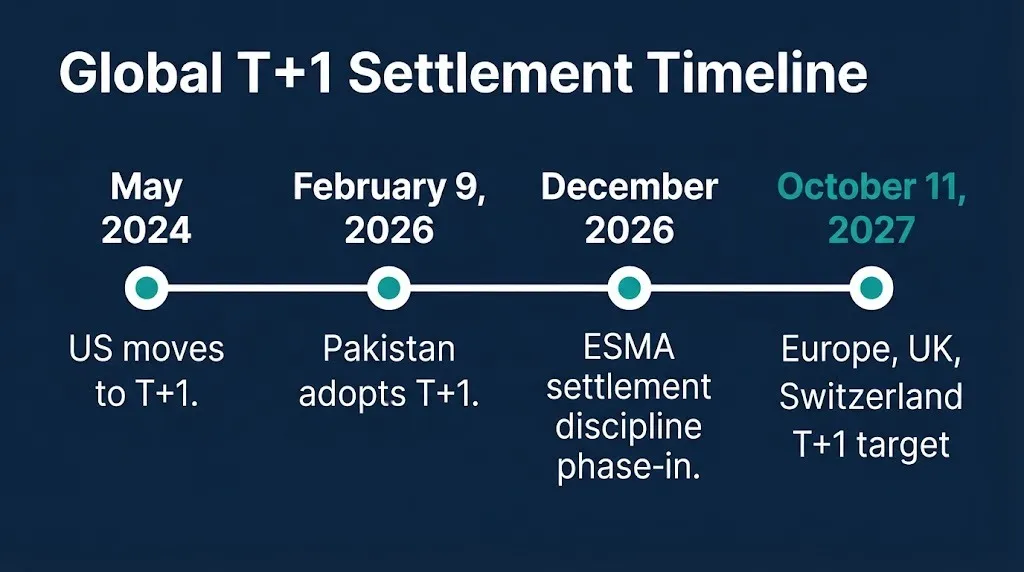
The United States moved to T+1 in May 2024. Canada, Mexico, Argentina, Jamaica, and China have also adopted the shorter cycle. Europe, the UK, and Switzerland are targeting October 11, 2027 for their transition.
The data is striking. Swift settlement instruction data shows 35% of the market now settles on T+1, with expectations that will rise to 50% by 2027 and surpass 70% by 2030.
Shorter cycles mean less counterparty risk, but they also squeeze the operational window. Firms must complete validations, reconciliations, allocations, and cash preparations almost in real time.
Reality Check: T+1 Does Not Mean You Get Money Instantly
Reality Check: T+1 settlement shortens the cycle, but it does not eliminate the gap between trade and cash. Your brokerage may still hold funds for withdrawal or restrict trading until settlement completes. The speed at which you can access cash depends on your broker’s policies, not just the regulatory settlement cycle. Do not confuse faster settlement with instant liquidity.
How Does Pakistan’s T+1 Transition Work?
Pakistan’s capital market moved to T+1 settlement on February 9, 2026. All trades executed on or after that date settle one business day after the trade date.
The transition was coordinated by the Securities and Exchange Commission of Pakistan (SECP), Pakistan Stock Exchange (PSX), National Clearing Company of Pakistan Limited (NCCPL), and Central Depository Company (CDC).
Here is the timeline:
| Date | Milestone |
|---|---|
| February 6, 2026 | NCCPL and CDC issue revised time schedule |
| February 9, 2026 | T+1 becomes effective for all trades |
| February 10, 2026 | Revised CDS Designated Time Schedule applies |
SECP Chairman Dr Kabir Ahmed Sidhu said the reform aligns Pakistan with modern jurisdictions, reduces market and counterparty risks, and improves liquidity. The change also aims to strengthen investor confidence, particularly among institutional and foreign investors.
The shift means brokers must complete trade confirmations, fund transfers, and securities deliveries in a tighter window. Firms that relied on the two-day buffer now have one day to resolve discrepancies.
How Does Trade Settlement Work for International Payments?
Trade settlement for international payments works through banking rails, payment terms, and currency conversion. It is separate from securities settlement but follows similar principles: money moves from buyer to seller through intermediaries.
Common payment methods include:
- Letters of Credit (LC): Bank guarantees payment if documents comply with terms. Best for high-value, first-time transactions.
- Documentary Collection: Bank handles documents but does not guarantee payment. Lower cost than LC.
- Open Account: Seller ships first and invoices later. Requires established trust.
- Cash in Advance: Buyer pays before shipment. Maximum seller protection.
- Stablecoins: Dollar-pegged digital assets that settle in seconds. Growing in B2B trade.
Cross-border bank transfers typically take 1 to 5 business days and incur correspondent bank deductions and FX markups. A Korean trading company that could not get paid by the issuing bank illustrates the risk: document discrepancies can delay or kill payment.
The infrastructure differs from securities settlement. There is no central counterparty guaranteeing the trade. Instead, banks and payment providers manage the flow.
How Do You Ensure a Trade Settlement Goes Through?
Ensuring a trade settlement completes requires verifying details before the deadline, not after. Most settlement failures trace back to preventable errors.
Here are the steps:
- Verify beneficiary details. Incorrect bank information is a common cause of rejected payments.
- Match the name on registration documents to the bank account. Mismatches block KYB approval.
- Attach commercial invoices and purchase orders when required for trade-based AML processes.
- Confirm cut-off times and currency requirements. Missing a cut-off delays settlement by a full cycle.
- Reconcile records weekly. Keep payment confirmations filed against purchase orders.
- Monitor for compliance holds. Sanctions reviews can freeze settlement without warning.
- Use forward contracts for FX timing if the shipment is imminent or the payable is 30 to 90 days out.
Settlement failures are like a delayed tax refund. The money exists, but a missing form or wrong account number keeps it stuck. Fix the paperwork before the deadline, not after.
What Happens Next for Global Trade Settlement?
October 2027: Europe, the UK, and Switzerland transition to T+1. The EU has mandated that trades on a trading venue settle no later than the first business day after the trade date.
December 2026: ESMA’s revised Settlement Discipline standards phase in, including same-day trade allocations and auto-partial settlement.
2027: Swift data projects 50% of the market will settle on T+1.
2030: T+1 adoption is expected to surpass 70% globally.
TBD: T+0, or same-day settlement, remains a long-term ambition. Firms are being urged to future-proof infrastructure for real-time or atomic settlement.
Frequently Asked Questions
What is a trade settlement in simple terms?
A trade settlement is the final step of a financial transaction where cash and securities actually change hands and ownership officially transfers.
How long does trade settlement take?
Most markets use T+2, meaning two business days. T+1 is spreading, with Pakistan adopting it in February 2026.
What does T+1 and T+2 mean?
T+1 means settlement happens one business day after the trade date. T+2 means two business days.
Why is T+1 settlement better than T+2?
T+1 reduces counterparty risk, frees capital faster, and improves liquidity by shortening the exposure window between trade and settlement.
Is trade settlement the same as clearing?
No. Clearing validates, matches, and guarantees the trade. Settlement is the final exchange of cash and securities.
What happens if a trade fails to settle?
Failed settlements can result in penalties, buy-in procedures where the trade is forced through, and reputational damage for the firms involved.
When does Europe move to T+1 settlement?
Europe, the UK, and Switzerland are targeting October 11, 2027 for their transition to T+1.
Does trade settlement apply to international payments?
Yes. Trade settlement covers cross-border payments through banking rails, letters of credit, and emerging stablecoin options.
What You Should Do Next
If you trade securities, check your brokerage’s settlement schedule and cash access policies. The T+1 transition changes when funds become available, not just when the trade completes.
For businesses engaged in international trade, verify beneficiary details before every payment. A single mismatched account number can delay settlement by days.
The single most important date: Europe and the UK move to T+1 on October 11, 2027. Markets that have already transitioned are seeing faster capital turnover. The rest of the world is catching up.