How Long After Deposition Is Settlement 2026: Realistic Timelines and What Delays Payment
Quick Answer
- Settlement after deposition usually takes weeks to a few months, not days, because transcripts and medical records must be finalized.
- There is no guaranteed timeline; the strongest predictor is how clearly your deposition established liability and damages.
- The most important factor: your medical treatment should be complete or near complete before you settle, or you may forfeit future care costs.
You finished your deposition. The court reporter packed up. Now you are waiting, checking your phone, wondering if the defense attorney is going to call with an offer or if this thing drags on for another year. The honest answer is that depositions do not trigger settlement on a schedule. They trigger leverage. Once your testimony is locked in, the insurance company can finally calculate its risk. If you were credible and your injuries are well-documented, that calculation often pushes them toward a deal.
But the timing depends on more than just your performance. The transcript takes days or weeks to prepare. Your medical records need to be collected. The adjuster needs internal authority to pay. Understanding the real sequence helps you stop refreshing your email every hour and start preparing for the next phase.
The Facts
Typical Timeline | 30 to 90 days after depositions for cases that settle
Common Range | 2 to 8 weeks if liability is clear and treatment is complete
Delayed Cases | 3 to 6 months or longer when injuries are complex or damages disputed
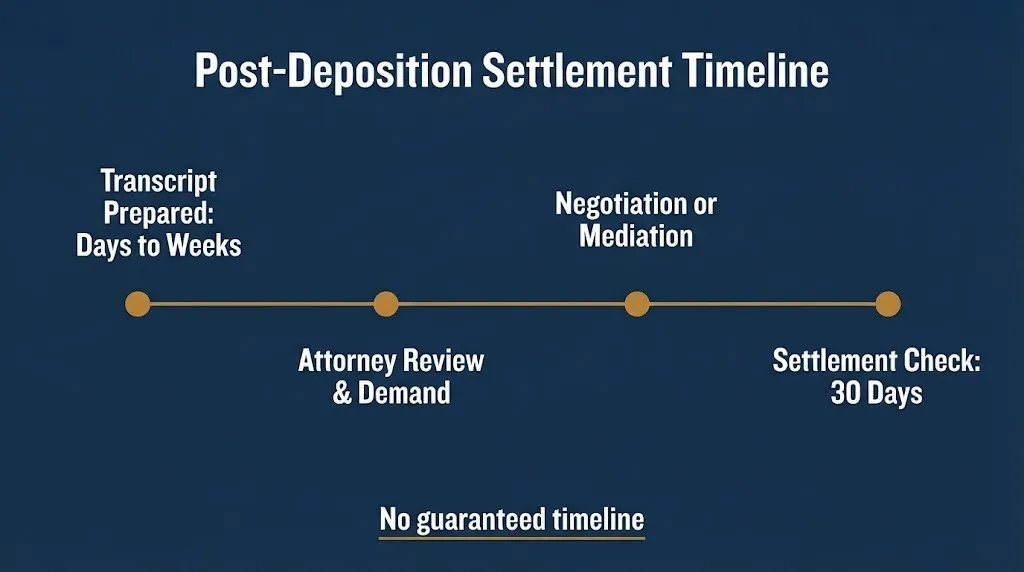
Transcript Prep | Days to weeks after the deposition
Settlement Check | Typically within 30 days of signing the release
Key Variable | Completion of medical treatment and clarity of liability
No Guarantee | Settlement can happen at any time, including during trial
What happens immediately after a deposition?
Immediately after a deposition, the court reporter prepares a transcript, and both attorneys review the testimony to assess the case’s new posture. This review period is the quiet before any settlement negotiations begin, and it usually takes days to weeks .
The transcript is the official record of what you said under oath. Your attorney reads it to check for inconsistencies or admissions that could hurt the case. The defense attorney does the same, looking for weaknesses to exploit. If you were clear and consistent, the defense learns that you will be a strong witness at trial. If you were scattered or contradicted your medical records, the defense learns that cross-examination could damage your credibility .
Once both sides have a full picture, strategy shifts. Your attorney may send a demand letter to the insurance company, or the defense may reach out with a settlement offer. In some cases, the insurance company makes an offer at the deposition itself, though many attorneys discourage that because it can distract from the testimony .
How long after a deposition does a settlement usually happen?
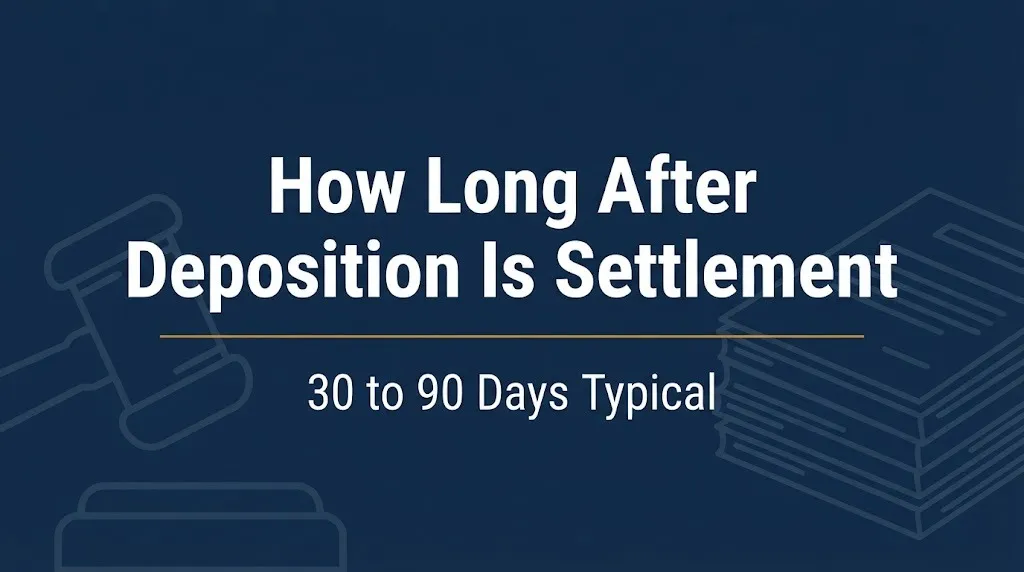
A settlement usually happens 30 to 90 days after a deposition in a typical personal injury case, but the range stretches from a few weeks to many months depending on the factors below .
For straightforward cases where liability is clear and your medical treatment is finished, settlement can occur within 2 to 8 weeks after depositions . The defense sees the evidence, calculates its exposure, and decides that paying is cheaper than the risk of trial.
Complex cases take longer. When there are multiple defendants, disputed fault, or catastrophic injuries with ongoing treatment, the post-deposition phase can stretch 3 to 6 months or more . Insurance companies may also deliberately delay, hoping that financial pressure will make you accept a lower offer .
| Case Type | Typical Post-Deposition Timeline |
|---|---|
| Clear liability, treatment complete | 2 to 8 weeks |
| Standard disputed case | 30 to 90 days |
| Complex injuries or multiple parties | 3 to 6 months or longer |
| Stalled by insurance delays | Indefinite, often tied to trial deadlines |
Key Takeaway: The most common window for settlement after deposition is 30 to 90 days, but there is no rule, and complex cases routinely take longer.
What factors determine how long settlement takes after deposition?
The factors that determine how long settlement takes after deposition are: clarity of liability, severity and stability of your injuries, insurance company tactics, and whether your medical treatment is complete .
Clarity of liability is the biggest driver. If your deposition made it obvious that the other party was at fault, the insurance company has little incentive to delay. They know a jury will likely agree. If fault is murky or your testimony created contradictions, expect the defense to dig in and negotiate harder .
Severity and stability of your injuries matters because you cannot value a claim until you know the final medical outcome. If you are still treating, your attorney may deliberately wait before settling. Settling too soon could leave you paying for future surgeries or therapy out of pocket .
Insurance company tactics can either speed up or slow down the process. Some insurers make reasonable offers quickly once they see a strong deposition. Others use delay as a strategy, hoping you will get frustrated and take less. A good attorney knows how to counter this .
Completion of medical treatment is often the practical trigger for settlement. Once you reach Maximum Medical Improvement (MMI), your damages become calculable. Before that, both sides are guessing about future costs .
Do most personal injury cases settle after a deposition?
Yes, most personal injury cases do settle after a deposition, and approximately 95% of personal injury cases settle before trial overall . The deposition is often the point where the defense finally sees the full picture of your credibility and the strength of your claim.
A strong deposition can accelerate settlement dramatically. If your testimony aligns with your medical records and the accident evidence, the defense’s risk assessment shifts. They may call your attorney within days to open negotiations .
But a deposition does not guarantee settlement. If the defense believes your case has weaknesses, or if they want to pressure you into a low offer, they may wait. Some cases do not settle until mediation, and a small percentage go all the way to trial .
The 95% figure is a national statistic, not a promise about your case. Even in cases that eventually settle, the timing can vary wildly. Patience is part of the process .
What is the difference between mediation and direct negotiation after deposition?
Mediation is a formal settlement conference with a neutral third party, while direct negotiation is a back-and-forth between attorneys. Mediation often produces faster resolutions because it forces both sides to focus on the numbers with a deadline.
After depositions, your attorney may try direct negotiation first. This involves sending a demand letter with a specific dollar amount and supporting evidence, then receiving a counteroffer. The back-and-forth can take weeks or months .
If direct talks stall, mediation is the next step. A mediator shuttles between the parties, helping them find common ground. Mediation is confidential, and the mediator does not decide the case. Their job is to help both sides see the realistic value of the claim .
Many cases settle in a single day of mediation. Data shows that a significant number of mediated cases settle within 60 days of the session . If mediation fails, the case proceeds toward trial, but settlement can still happen at any point before a verdict.
How long does it take to receive the settlement check?
You typically receive the settlement check within 30 days of signing the release agreement, though the exact timing depends on state law and the complexity of lien resolution .
Once you agree on a number, the defense attorney prepares a release document. You sign it, and the insurance company issues a check. Some insurers take longer than others, and state laws impose deadlines in many jurisdictions.
Before you receive the money, your attorney must resolve any liens. Health insurance companies, Medicare, and Medicaid may have a right to reimbursement from your settlement. Negotiating those liens can add time .
After the check arrives, your attorney deducts their fee and any case costs, then disburses the remainder to you. The whole process from agreement to money in hand usually takes 2 to 6 weeks, but it can be longer if liens are disputed.
Reality Check: No one calls you promising a specific settlement amount before your case is evaluated. Settlement value depends on evidence, not on how long you have waited. Be wary of any “advocate” or company that offers to speed up your payment for a fee.
What should you do while waiting for a settlement offer?
While waiting for a settlement offer, you should focus on completing your medical treatment, documenting your damages, and maintaining open communication with your attorney. The waiting period is not passive; it is when your case is being built.
Here are the steps to take:
- Finish your medical treatment. Continue appointments and follow your doctor’s recommendations. Gaps in treatment are used by the defense to argue your injuries are not serious.
- Keep all records. Save medical bills, wage loss documentation, and receipts for out-of-pocket expenses.
- Avoid social media. Defense attorneys search for posts that contradict your injury claims.
- Stay in touch with your lawyer. Ask for updates and understand the next scheduled steps.
- Be patient with negotiations. The first offer is rarely the final offer. Your attorney is working to maximize the value.
- Do not discuss the case with the insurance company directly. All communication should go through your attorney.
What happens next if your case does not settle after deposition?
If your case does not settle after deposition, it proceeds through the remaining litigation stages toward trial. The timeline stretches from 6 to 12 months or more for trial preparation after depositions conclude .
The next steps typically include:
- Additional discovery. The defense may take more depositions or request more documents.
- Expert disclosures. Both sides designate expert witnesses and exchange reports.
- Dispositive motions. Either side may file a motion for summary judgment.
- Pre-trial motions and preparation. Witness preparation, exhibit lists, and trial briefs.
- Trial. If no settlement occurs, the case goes before a judge or jury.
Court backlogs can add significant delay. In busy jurisdictions, trial dates are often set months or even years in advance . Many cases that do not settle right after depositions eventually settle just before or during trial, when the pressure and expense peak.
Frequently Asked Questions
How long after a deposition does a case usually settle?
Most cases settle within 30 to 90 days after depositions, though some resolve in weeks and others take many months .
Do most personal injury cases settle after a deposition?
Yes, approximately 95% of personal injury cases settle before trial, and the deposition often accelerates negotiations .
Can a case settle at the deposition itself?
It can happen, but many attorneys prefer to complete the deposition first and negotiate afterward with a full record .
What if I have not finished medical treatment after my deposition?
Your attorney may wait to settle until your treatment is complete, so future medical costs can be calculated accurately .
Does a strong deposition increase my settlement value?
Yes. Clear, credible testimony that aligns with the evidence increases the defense’s perception of risk and often leads to higher offers .
How long does it take to get the settlement check after agreeing?
Typically 30 days after signing the release, though lien resolution can add time .
What happens if the insurance company delays settlement after deposition?
Your attorney can push back, involve mediation, or proceed toward trial. Delay is often a tactic to pressure you into accepting less .
The Bottom Line
Settlement after a deposition usually happens within 30 to 90 days, but no rule forces it. The strongest predictor is the clarity of your testimony and whether your medical treatment is complete. Do not measure progress by the calendar. Measure it by the strength of your records and the leverage your deposition created. Keep treating, keep documenting, and let your attorney handle the negotiation. The next 90 days are about building the case, not just waiting for a check.