Personal Injury Lawsuit Process 2026: What Actually Happens, Step by Step
Quick Answer
- The personal injury lawsuit process starts with medical treatment and a demand letter, not a courtroom.
- Roughly 95 to 97 percent of cases settle before trial, often within 6 to 18 months.
- The statute of limitations in Ohio is two years from the injury date for most claims.
You got hurt. Someone else caused it. Now you’re staring at medical bills, missed work, and an insurance adjuster who keeps saying “we’ll get back to you.” The personal injury lawsuit process is how you force the issue when negotiation stalls.
That process doesn’t start in a courtroom. It starts with medical records, a demand letter, and a whole lot of patience. Most cases never see a judge. But understanding every stage matters, because one missed deadline or one bad recorded statement can gut your claim.
This guide walks through the full personal injury lawsuit process in 2026, from the moment you hire an attorney to the day a check arrives. It covers timelines, settlement calculations, discovery, trial, and the deadlines that actually matter.
The Facts
| Process Type | Civil litigation, typically settled pre-trial |
| Statute of Limitations (Ohio) | 2 years from injury date (ORC 2305.10) |
| Settlement Rate | 95 to 97 percent resolve before trial |
| Typical Timeline (settled) | 6 to 18 months |
| Typical Timeline (trial) | 18 to 36 months |
| Attorney Fees | Contingency, typically 33 1/3 percent |
| First Offer | Almost always lower than case value |
| Government Claims Notice | 1 to 6 months, much shorter deadline |
Is the personal injury lawsuit process legit or a scam?
The personal injury lawsuit process is a legitimate legal procedure governed by state and federal court rules. Every state has a civil court system designed to resolve disputes over negligence and harm. The process has defined stages, filing requirements, and deadlines that apply equally to plaintiffs and defendants.
That doesn’t mean everyone involved is honest. Scam risks do exist. Some “claim assistance” companies charge fees for things attorneys do for free. Others promise settlements before a case is even evaluated.
The legitimate process looks like this:
- You consult an attorney, usually free of charge.
- The attorney evaluates liability and damages.
- A demand letter goes to the insurance company.
- Negotiation happens. If it fails, a lawsuit gets filed.
- Discovery, mediation, and possibly trial follow.
No legitimate attorney asks for money upfront in a personal injury case. Contingency fees mean the lawyer gets paid from the recovery, not from your pocket .
If someone contacts you first about a claim you didn’t pursue, that’s a red flag. Real personal injury representation starts with you seeking help, not a cold call.
How much can you get from a personal injury lawsuit?
There is no fixed payout amount in a personal injury lawsuit. Compensation depends on your medical bills, lost income, future treatment needs, and the severity of your injuries. Insurance adjusters use a formula to calculate a starting point, but that number is negotiable.
The damages formula works like this: add up your economic damages (medical bills, lost wages, out-of-pocket costs), then apply a multiplier based on injury severity .
| Injury Severity | Typical Multiplier | Example |
|---|---|---|
| Soft tissue (whiplash, sprains) | 1.5x to 3x | $30,000 medical + $5,000 lost wages = $35,000 economic; settlement range $52,500 to $105,000 |
| Moderate (broken bones, herniated discs) | 3x to 5x | $50,000 medical + $10,000 lost wages = $60,000 economic; settlement range $180,000 to $300,000 |
| Severe or permanent | 5x to 10x or more | $200,000 medical + $150,000 lost earning capacity = $350,000 economic; settlement range $1.75 million to $3.5 million+ |
Those multipliers are benchmarks, not guarantees . The final number depends on liability clarity, insurance policy limits, how well your attorney documents the injury, and whether the case goes to trial.
Economic damages include past and future medical bills, rehabilitation costs, lost wages, and reduced earning capacity. Non-economic damages cover pain and suffering, emotional distress, loss of enjoyment of life, and scarring or disfigurement .
Not yet determined applies until your treatment stabilizes. Settling before maximum medical improvement means guessing at future costs, and that guess usually comes out low .
Key Takeaway: The damages formula gives you a negotiation floor, not a ceiling. Insurance adjusters start low because they assume unrepresented claimants will accept the first number.
What is the statute of limitations for a personal injury lawsuit?
The statute of limitations for most personal injury lawsuits in Ohio is two years from the date of injury. That deadline comes from Ohio Revised Code Section 2305.10 and applies to bodily injury and property damage claims .
Miss it, and your case gets dismissed. No exceptions for how strong the evidence is. Courts rarely bend on this.
Some claims have different deadlines:
- Medical malpractice: Typically one year from discovery or the end of the physician-patient relationship, with a possible 180-day extension if you give written notice before the one-year period expires .
- Wrongful death: Two years from the date of death, not the injury .
- Government claims: Notice requirements as short as 60 to 90 days, sometimes up to six months, depending on the agency .
- Minors: The clock generally starts when the child turns 18 .
The discovery rule can extend deadlines in cases where you didn’t know you were injured or didn’t know the cause. That applies to latent injuries, toxic exposure, and some product liability claims. But courts interpret the discovery rule narrowly .
If you’re anywhere near the two-year mark, talk to an attorney now. Filing early preserves evidence and prevents defendants from destroying records.
How do you start a personal injury lawsuit?
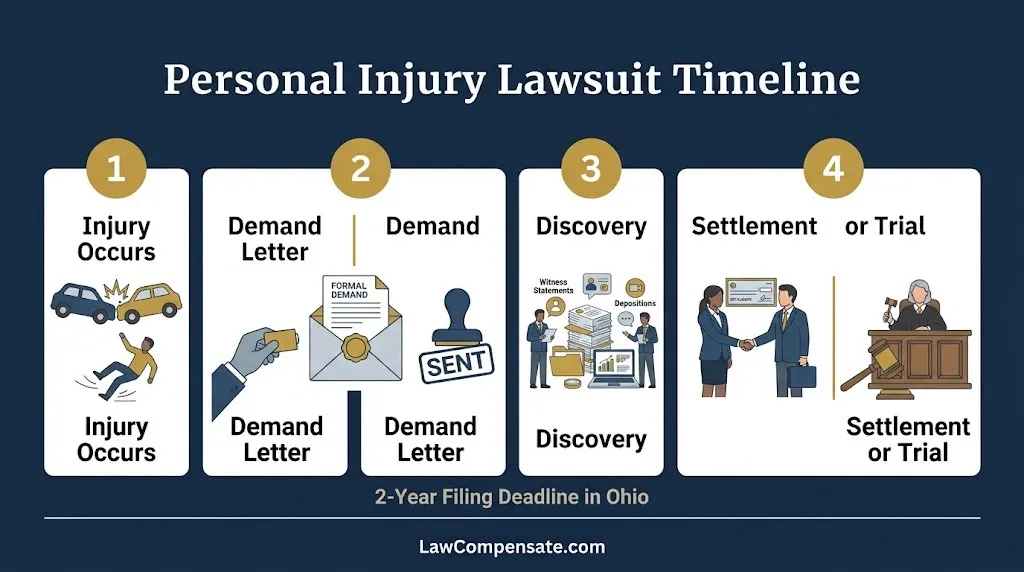
You start a personal injury lawsuit by hiring an attorney, gathering evidence, and filing a complaint in civil court. But most cases don’t reach that step. The pre-filing phase is where settlement happens.
Here are the steps:
- Get medical treatment. Your medical records are your case. No treatment, no proof of injury.
- Consult an attorney. Most personal injury lawyers offer free consultations .
- Investigate the facts. Your attorney collects police reports, witness statements, photos, and medical records .
- Send a demand letter. This document lays out liability, damages, and the settlement amount you’re seeking .
- Negotiate. The insurer counters. Your attorney counters back. This cycle can take weeks or months.
- File the complaint if talks fail. The complaint starts the formal lawsuit .
- Serve the defendant. They get formal notice and must respond .
The demand letter is critical. It sets the tone and the number. A well-documented demand backed by strong medical records pressures the insurer to respond seriously .
If the insurer rejects the demand or makes a lowball offer, litigation begins. That doesn’t mean trial. It means the case moves into the formal court system, where most cases still settle before a judge or jury ever hears them.
What happens during the discovery phase of a personal injury lawsuit?
Discovery is the formal exchange of evidence between both sides after a lawsuit is filed. It’s the longest phase of most litigated personal injury cases, often lasting six months to a year or more .
Discovery includes several tools:
| Discovery Tool | What It Does |
|---|---|
| Interrogatories | Written questions one side sends to the other, answered under oath |
| Requests for Production | Demands for documents, photos, medical records, and electronic data |
| Requests for Admission | Asks the other side to admit or deny specific facts |
| Depositions | Sworn testimony taken outside court, recorded by a court reporter |
Your attorney will question the defendant and any witnesses. The defense will question you. Expert witnesses, doctors, accident reconstruction specialists, and vocational experts may all be deposed .
Preparation for your deposition matters. Your attorney will go over the questions likely to come up and coach you on how to answer clearly and honestly. Guessing or speculating can hurt your case.
Discovery disputes happen. If one side refuses to cooperate, the other can file a motion to compel. Courts can impose sanctions for discovery violations, including barring evidence or even dismissing the case .
Reality Check: No one texts you settlement money first. If someone contacts you claiming you’re owed compensation from a personal injury lawsuit you never filed, that’s a scam. Real claims start with you hiring an attorney and building a case from medical records and evidence.
How is settlement value calculated in a personal injury case?
Settlement value is calculated by adding economic damages to non-economic damages, with the non-economic portion often determined by a multiplier applied to medical bills. The formula gives both sides a framework for negotiation .
Economic damages are the easy part:
- Medical bills (past and future)
- Lost wages and lost earning capacity
- Rehabilitation and therapy costs
- Out-of-pocket expenses like travel for treatment
Non-economic damages are harder to quantify:
- Pain and suffering
- Emotional distress
- Loss of enjoyment of life
- Scarring or disfigurement
Insurance adjusters start with medical special damages, multiply by 1.5 to 5 (or higher for severe injuries), then add lost income . That number becomes the opening negotiation position.
Never accept the first offer. Initial offers are designed to close the file cheaply. Insurers know that people in financial distress will take a low number just to move on .
Key Takeaway: Settlement negotiations are a back-and-forth, not a one-time offer. The first number is almost always lower than the case is worth.
How long does a personal injury lawsuit take?
Most personal injury lawsuits take between six months and three years to resolve, depending on whether the case settles or goes to trial. About 95 to 97 percent settle before trial .
| Case Type | Typical Timeline |
|---|---|
| Simple auto accident, clear fault | 6 to 9 months |
| Premises liability with surgery | 14 to 18 months |
| Medical malpractice through trial | 24 to 36 months |
| Complex product liability | 18 to 24+ months |
Several factors push cases longer:
- Disputed liability
- Multiple defendants
- Serious injuries requiring extended treatment
- Insurance company delays or bad faith
- Court backlogs in major metro areas
Cases settle faster when liability is clear, injuries are moderate, and one insurer is involved. Cases take longer when fault is disputed, injuries are catastrophic, or commercial defendants with high policy limits are involved .
Payout after settlement typically takes two to six weeks. You sign a release, the defendant funds the settlement, and your attorney resolves any liens before sending your share .
What happens if a personal injury lawsuit goes to trial?
If a personal injury lawsuit goes to trial, both sides present evidence to a judge or jury, who decides liability and damages. Trials are rare in personal injury cases, but they happen when settlement negotiations fail.
The trial process follows this order:
- Jury selection. Attorneys question potential jurors for bias.
- Opening statements. Each side outlines what they’ll prove.
- Presentation of evidence. Your attorney presents medical records, witness testimony, and expert opinions. The defense cross-examines and presents its own evidence.
- Closing arguments. Both sides summarize their case.
- Jury deliberation and verdict. The jury decides fault and damages.
- Appeals. The losing side can appeal legal errors, which can add months or years .
Trial carries risk. A jury could award more than the settlement offer, or it could award less. That uncertainty is why most attorneys push for settlement when the offer is fair .
If you go to trial, you’ll likely testify about the accident and how it affected your life. Your attorney will prepare you for that.
What happens after a personal injury settlement is reached?
After a settlement is reached, you sign a release, the defendant funds the settlement, and your attorney resolves liens and fees before sending you the remaining balance. This payout phase typically takes two to six weeks .
The steps:
- Finalize the settlement agreement. Both sides sign a release.
- Defendant funds the settlement. This can take days or weeks depending on the insurer.
- Resolve liens. Medicare, Medicaid, and health insurers may have claims against your recovery.
- Deduct attorney fees and costs. Contingency fees and case expenses come out.
- Disbursement. You receive your net share.
If a lawsuit was filed, the court may need to approve a minor’s settlement or a wrongful death allocation.
What happens next in the personal injury lawsuit process?
Immediately: Seek medical treatment and document everything.
Within days: Consult a personal injury attorney for a free evaluation.
Within weeks to months: Your attorney investigates and sends a demand letter.
Within 1 to 4 months: Settlement negotiations occur. Most cases resolve here.
If negotiations fail: A lawsuit is filed, and discovery begins.
6 to 18 months after filing: The case may settle in mediation or proceed toward trial.
Trial (if necessary): 18 to 36 months from the injury date.
Frequently Asked Questions
How long do I have to file a personal injury lawsuit in Ohio?
Two years from the date of injury for most claims under Ohio Revised Code Section 2305.10. Medical malpractice and government claims have shorter deadlines.
Do most personal injury cases go to trial?
No. About 95 to 97 percent settle before trial. Trials happen when liability is disputed or settlement offers are unreasonably low.
How much does a personal injury lawyer cost?
Most work on contingency, meaning you pay nothing upfront. The fee is typically 33 1/3 percent of the recovery, deducted after settlement.
What is a demand letter in a personal injury case?
A demand letter is a formal document your attorney sends to the insurance company outlining liability, damages, and the settlement amount you’re seeking. It starts negotiations.
What happens during discovery in a personal injury lawsuit?
Both sides exchange evidence through interrogatories, document requests, and depositions. Discovery can last six months to a year or more.
Can I settle my personal injury case without a lawyer?
Yes, but the data shows unrepresented claimants receive much lower settlements. One survey found attorney-represented plaintiffs received an average of $77,600 versus $17,600 for those without representation .
What is maximum medical improvement?
Maximum medical improvement is the point when your doctor confirms your condition is stable and unlikely to improve further. Settling before MMI risks undervaluing future medical costs.
What happens if I miss the statute of limitations?
Your case will likely be dismissed. Courts rarely make exceptions, though the discovery rule can extend deadlines in limited situations.
The Bottom Line
The personal injury lawsuit process is long, but most cases settle without a trial. The two-year statute of limitations in Ohio is the deadline that matters most. Miss it, and you lose your right to sue.
Your medical records are your case. Get treatment, document everything, and talk to an attorney before accepting any settlement offer. The first offer is rarely the best one.