How to Find Class Action Attorneys in 2026: Fees, Filing, and What to Ask First
Quick Answer
- Class action attorneys work on contingency and take 20% to 35% of a settlement, subject to court approval.
- No case name or fund applies here. This is a rights and process guide, not a specific settlement.
- Courts require named plaintiffs to meet Federal Rule of Civil Procedure 23 tests before any attorney gets appointed.
You typed “class action attorneys” because something happened, a bad product, a data breach, an overcharge, and you want to know who actually handles these cases and what it costs you. The short answer: you pay nothing upfront, and the lawyer only gets paid if the case wins.
This guide covers real numbers most sites skip: what percentage attorneys actually take, how courts pick which law firm leads a case, and what state bar resources exist in Colorado and California specifically. One detail most people don’t expect: lead plaintiffs sometimes get separate bonus payments, and whether that’s even legal depends entirely on which federal circuit you’re in.
Everything below comes from federal court rules, bar association resources, and legal fee studies published in 2025 and 2026, cited by name.
The Facts
| Governing framework | Federal Rule of Civil Procedure 23, plus state class action rules |
| Typical attorney fee | 20% to 35% of gross settlement, court-approved |
| Common benchmark | 25% is the federal court starting point, per multiple fee studies |
| Fee methods | Percentage-of-fund or lodestar (hours times rate) |
| Cost to join a class | Free. Class action lawyers front all costs on contingency |
| Lead plaintiff bonus | $5,000 to $25,000 typical, legal in most circuits, banned in the 11th Circuit |
| Court oversight | Judge must approve fees under Rule 23(h) before payment |
| Where to search | State bar “find a lawyer” tools, certified lawyer referral services |
Nothing above is a guess. Where practices vary by circuit or case, the table says so.
Is a Class Action Attorney Free to Contact?
Yes, contacting and hiring a class action attorney costs you nothing upfront in almost every case. These attorneys work on contingency, meaning they only get paid from a settlement or judgment.
If a case doesn’t win, you generally owe the attorney nothing. That’s a real financial protection, not marketing language.
Key Takeaway: You don’t pay a class action lawyer out of pocket. Their fee comes out of the settlement fund itself, after a judge signs off.
How Much Do Class Action Attorneys Actually Charge?
Class action attorneys typically take 20% to 35% of the gross settlement, with federal courts using 25% as a common starting benchmark. The exact percentage depends on case size, complexity, and how long the litigation runs.
A study of federal class settlements from 2009 to 2013 found the average fee sat at 27% of gross recovery, and most fee requests landed between 25% and 34%.
| Settlement Size | Typical Fee Range | Why |
|---|---|---|
| Under $1 million | Often 30% to 35% | Smaller cases carry proportionally higher work-to-recovery ratio |
| $1 million to $10 million | Roughly 25% to 30% | Standard federal court benchmark applies |
| $100 million or more | Often well below 25% | Courts scrutinize “megafund” fees more heavily |
Courts reduce the percentage as settlements grow larger. A 25% fee on a $500 million fund would hand attorneys $125 million, and judges routinely find that disproportionate.
Class Action Law Firm vs. Solo Attorney: What’s the Difference?
A class action law firm typically has more resources to front litigation costs than a solo practitioner, which matters because class actions can run for years. Courts weigh this directly when appointing lead counsel.
Under Rule 23(g), a judge considers four factors before naming class counsel:
- What work the firm already did investigating the claims
- The firm’s experience handling class actions specifically
- The firm’s knowledge of the relevant law
- The resources the firm is willing to commit
A solo attorney can still qualify, but must show comparable capacity. Larger firms often have an edge in multi-year, multi-plaintiff cases simply because of staffing depth.
Key Takeaway: Courts don’t just pick any lawyer who applies. They evaluate resources and track record before appointing class counsel.
What Does a Lawyer for a Lawsuit Actually Do in a Class Action?
A class action attorney investigates the claim, files the complaint, seeks class certification, and negotiates or litigates toward a settlement or verdict. This is a longer process than a typical individual lawsuit.
The attorney’s core responsibilities include:
- Identifying whether enough people share the same claim to justify a class
- Filing a motion for class certification under Rule 23
- Handling discovery, depositions, and motions over months or years
- Negotiating settlement terms, or trying the case if it doesn’t settle
- Petitioning the court for approval of both the settlement and the attorney fee
Class counsel represents the entire class, not just the named plaintiff. That’s a legal duty enforced directly by the judge overseeing the case.
How Do You Become the Lead Plaintiff in a Class Action Lawsuit?
You become a lead plaintiff by having a claim typical of the class and by a court finding you can fairly represent everyone in it. This isn’t a role you apply for casually.
Federal Rule 23(a) requires four things before any class, or its representative, gets approved:
| Requirement | What It Means |
|---|---|
| Numerosity | The group must be too large to sue individually, often 40+ people |
| Commonality | A shared legal or factual question affects the whole class |
| Typicality | The lead plaintiff’s claim must resemble the class’s claims |
| Adequacy | The lead plaintiff must fairly protect the class’s interests |
If you’re serving as lead plaintiff, expect real time commitment: depositions, document production, and responding to the defense’s questions. Total time investment often runs 50 to 150 hours across a case that can last two to five years.
Do Lead Plaintiffs Get Paid Extra?
Lead plaintiffs sometimes receive an incentive award, separate from the standard class payout, but this is legal in some federal circuits and not others. This is one of the more contested issues in class action law right now.
Incentive awards typically range from $5,000 to $25,000, paid from the settlement fund and subject to judge approval. In 2020, the 11th Circuit ruled in Johnson v. NPAS Solutions that these awards may be unlawful under 19th-century Supreme Court precedent.
Since then, the 1st, 2nd, 7th, 9th, and Federal Circuits have all rejected that ruling and allowed incentive awards to continue. As of 2026, the 11th Circuit, covering Florida, Georgia, and Alabama, remains the outlier.
Reality Check: No legitimate class action attorney asks you to pay a fee before winning your case. If someone claims you must pay upfront to “join” a class action, that’s a red flag, not standard practice. Filing a claim or joining a class is always free.
How to Find a Class Action Lawsuit Lawyer Near You
You can find a class action attorney through your state bar’s certified referral service, which vets attorneys for licensing and experience before connecting you.
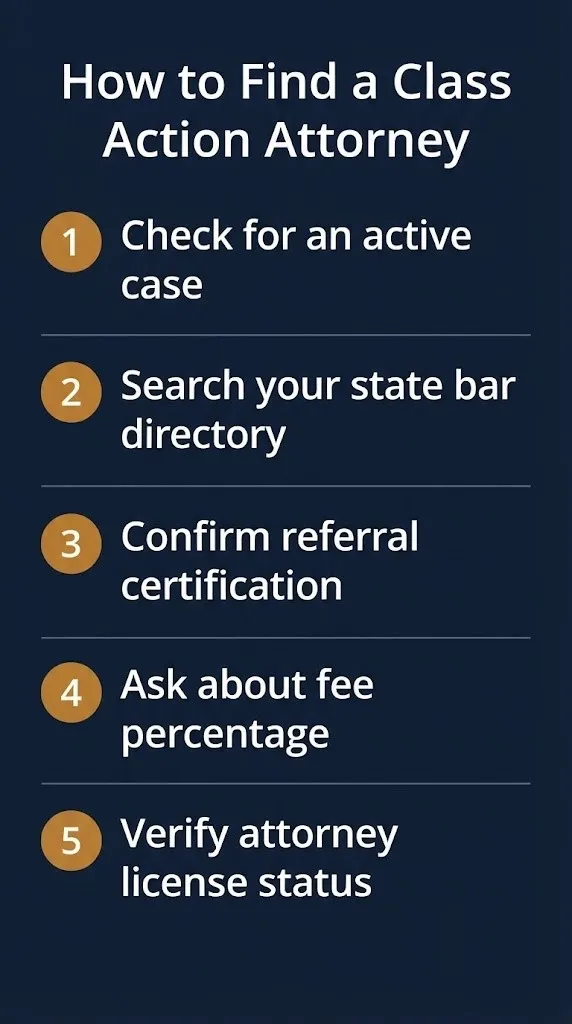
Follow these steps to find a legitimate one:
- Check whether an active class action already exists related to your issue.
- Search your state bar association’s official lawyer directory or referral service.
- Confirm the referral service is certified, not just a paid directory listing.
- Ask any attorney you contact about their specific class action experience.
- Request their fee structure in writing before signing anything.
- Verify the attorney’s license status directly through your state bar.
- Get a second opinion if the case involves a large or complex claim.
State bar referral programs typically charge you a small processing fee, if any, for an initial consultation, not for the referral itself.
Where to Find Class Action Lawyers in California
California residents can search for a class action attorney through the State Bar of California’s certified lawyer referral service directory. These services are certified to meet standards approved by the California Supreme Court.
Certified referral services must show their State Bar certification number in all advertising. Attorneys referred through these services are required to carry professional liability insurance and be in good standing.
The State Bar also runs a certified legal specialist search, letting you confirm whether an attorney has additional certification in a specific practice area. That’s a useful check before signing a retainer agreement for a large case.
Where to Find Class Action Lawyers in Colorado
Colorado residents can start with the Colorado Bar Association’s “Find a Lawyer” program, which lets you search by practice area and county. This is a free directory tool, separate from paid referral services.
Colorado also has regional options:
| Service | Coverage Area |
|---|---|
| Colorado Bar Association Find-a-Lawyer | Statewide |
| Metropolitan Lawyer Referral Service | Denver, Adams, Arapahoe, Boulder, Jefferson, Douglas, and more |
| El Paso County Bar Association Referral | El Paso and Teller counties |
Not every licensed Colorado attorney belongs to the Colorado Bar Association, since membership is voluntary. If a search there comes up thin, the Colorado Supreme Court’s attorney search tool lets you verify any specific lawyer’s license status directly.
Key Takeaway: Every state has a bar-certified referral option, and using it is safer than picking a name from an ad with no license verification.
What Should You Ask an Attorney Before Signing On?
You should ask about their specific class action experience, their exact fee percentage, and how they calculate it, before signing any agreement. These answers separate an experienced litigator from a general practice firm dabbling in class claims.
Questions worth asking directly:
- How many class actions have you personally handled to settlement or verdict?
- Is your fee based on percentage-of-fund or the lodestar method?
- What costs, if any, get deducted before I see a payout?
- Who else is working on this case, and what’s your role?
- What’s the realistic timeline for a case like mine?
Think of this the way you’d interview a contractor before a major home repair. A vague answer to a direct question is worth noting before you commit.
What Happens After You Hire a Class Action Attorney?
After you hire counsel, the case typically moves through filing, class certification, discovery, and either settlement or trial, a process that can take years. This isn’t a fast process, and any attorney promising a quick payout should raise questions.
- Filing: The complaint is filed and the defendant is served.
- Certification: The court decides whether the case can proceed as a class action under Rule 23.
- Discovery: Both sides exchange evidence, often over many months.
- Settlement or trial: Most cases settle, but some proceed to a verdict.
- Fee approval: The judge reviews and approves attorney fees under Rule 23(h) before any payout.
Class members are notified at key stages, particularly once a class is certified and again if a settlement is reached.
What Happens Next
Ongoing: Federal courts continue applying Rule 23(a) and 23(g) standards to every new class certification motion filed.
2026, developing: The circuit split over lead plaintiff incentive awards continues, with the Federal Circuit joining the majority allowing them earlier this year.
Expected, ongoing: State bar referral services continue processing individual attorney matches on a rolling basis, with no fixed timeline.
As needed: If you’re weighing a specific claim, the fastest next step is confirming whether an active class action already covers it before hiring separate counsel.
Frequently Asked Questions
Do I have to pay a class action attorney upfront?
No, class action attorneys almost always work on contingency.
You pay nothing unless the case results in a settlement or judgment.
The fee comes out of the recovery fund, not your pocket directly.
How much do class action lawyers really take from a settlement?
Typically 20% to 35% of the gross settlement, with 25% used as a common federal benchmark.
Larger settlements often see lower percentages due to court scrutiny.
A judge must approve the exact figure before any payment happens.
Can I be part of more than one class action at a time?
Yes, if the claims involve different issues or companies, you can generally join more than one.
Each case is evaluated separately for eligibility.
Overlapping claims from the same incident are handled differently, and an attorney can clarify specifics.
What’s the difference between a class member and a lead plaintiff?
A class member is anyone covered by the class definition who doesn’t have to actively litigate.
A lead plaintiff is the named representative who works directly with the attorneys throughout the case.
Lead plaintiffs may qualify for a separate incentive award, depending on the circuit.
How long does a class action lawsuit usually take?
Most class actions take two to five years from filing to final resolution.
Complex cases with multiple appeals can run longer.
Simple, well-documented claims sometimes resolve faster through early settlement.
Is a class action lawyer referral service really free?
Referral itself is typically free or low cost through state bar certified services.
The attorney’s actual legal fees are separate and disclosed after your initial consultation.
Always confirm a referral service carries state bar certification before using it.
What happens if my class action case doesn’t win?
If the case loses, contingency-fee attorneys generally don’t collect a fee from you.
You usually won’t owe attorney costs, since the firm assumed that financial risk upfront.
Confirm this in writing in your retainer agreement before signing.
Can I switch class action attorneys if I’m unhappy?
Yes, you generally have the right to change attorneys during a case.
This is true whether you’re a lead plaintiff or represented individually.
Discuss any concerns with your current attorney first, since switching can affect case timing.
Bottom Line
Start with your state bar’s certified referral directory, not a random search ad, when looking for real class action counsel. Ask about fee structure and experience before signing anything.
If you’re already part of a specific settlement, check that case’s official administrator site directly. For general legal help, a verified bar association tool remains the safest starting point in 2026.