Best Compensation Plan 2026: What Actually Works, What It Costs, and Why the “Best” Plan Is the One You Can Defend
Quick Answer
- The best compensation plan in 2026 balances base pay, performance-gated incentives, and scarce equity, not one single element.
- There is no fixed payout or claim amount. What you earn depends on your role, market, and company performance.
- The key deadline is your annual planning cycle, with merit budgets typically locked in the fall for the following year.
You searched for the best compensation plan because you are building one, fixing one, or trying to understand why yours is not working. The honest answer is that the “best” plan is not a template you copy. It is the plan your company can explain, afford, and defend when a top performer asks why they are paid what they are paid.
The 2026 data shows a market in retreat from the growth-at-all-costs era. Mercer’s survey of 756 employers found actual merit increases of 3.1% and total increases of 3.4%, both below October 2025 projections . Sequoia’s 2026 report found that large equity refreshes, once nearly half the market in 2023, have plummeted to under 8% today .
The number that matters most is 3.1%. That is your baseline merit budget in 2026. Anything above it requires a business case, not a market assumption.
This article breaks down what compensation planning actually is, the plan types that exist, the 2026 trends reshaping pay, how to build a plan step by step, and the mistakes that turn a good plan into a lawsuit or a resignation wave.
The Facts
| Item | Detail |
|---|---|
| Plan Type | Total rewards strategy covering base pay, incentives, benefits, and equity |
| Who Qualifies | All employees, with differentiation by role, performance, and market |
| Typical Merit Budget | 3.1% actual in 2026, per Mercer |
| Typical Total Increase | 3.4% actual in 2026 |
| Key Deadline | Annual planning cycle, typically locked in fall for next year |
| Administrator | Not applicable. This is an employer process, not a settlement |
| Proof Needed | Not applicable |
Is the Best Compensation Plan a Real Thing or a Myth?
There is no single best compensation plan, and any page claiming to sell you “the” best plan is selling a template, not a strategy. Compensation planning is the process of designing a total rewards package that attracts, retains, and motivates employees while staying within budget and legal boundaries .
What exists are better and worse plans for specific companies, at specific stages, in specific labor markets. A startup competing for AI talent needs a different mix than a hospital system retaining nurses. A company with a strong employer brand can pay at the 50th percentile and still hire well. A company with a weak brand may need to lead the market on base pay.
The myth is that one formula works everywhere. The reality is that the plan must fit the business strategy, the labor market, and the company’s ability to pay.
Key Takeaway: The best compensation plan is not a universal template. It is the plan that aligns with your business, your market, and your budget, and that you can explain clearly to employees.
How Much Does a Compensation Plan Cost?
There is no fixed cost for a compensation plan, but the dominant cost is your total rewards budget, which is typically the largest operating expense for most companies. Mercer’s 2026 data gives you the benchmark: merit budgets of 3.1% and total increase budgets of 3.4% .
The cost varies by what you include. Base pay is the fixed cost. Incentives are variable and tied to performance. Benefits are indirect but competitive. Equity is ownership, and in 2026 it is scarcer than it was three years ago .
| Component | Cost Type | 2026 Trend |
|---|---|---|
| Base pay | Fixed | Primary retention tool as equity shrinks |
| Merit increase | Fixed | 3.1% actual average |
| Incentives/bonuses | Variable | More common but gated by performance |
| Benefits | Indirect | Baseline expectation, not a differentiator |
| Equity | Long-term | Large refreshes under 8% of market |
Not yet determined: Your specific budget. It depends on headcount, industry, geography, and financial health.
Reality Check
Reality Check: No compensation plan pays you money for nothing. The “best” plan is not a secret formula you can buy, and no one texts you a bonus from a compensation survey. If a page promises a guaranteed raise, a free equity grant, or a “compensation settlement” payout, it is selling a fantasy. Real plans are built by HR and finance teams, reviewed by legal, and communicated to employees. There is no claim form, no administrator, and no public fund.
What Is Compensation Planning and Why Does It Matter?
Compensation planning is the systematic process of developing and implementing a total rewards strategy for employees, covering how they are paid and what benefits they receive . It is not a one-time event. It is an annual cycle that aligns pay with business objectives, market conditions, and budget.
The process matters because pay is the most visible signal of how a company values its people. A plan that is competitive, equitable, and clearly communicated reduces turnover and legal risk. A plan that is not creates resentment, discrimination claims, and the slow bleed of top talent to competitors.
Mercer’s 2026 survey found that 89% of organizations cited individual performance as a key driver for increases, followed by salary level relative to market (79%) and internal equity (68%) . Those three factors are the backbone of any defensible plan.
What Are the Main Types of Compensation Plans?
The main types of compensation plans are base pay, incentives, benefits, and equity, and most companies use a mix rather than a single approach . The right blend depends on the role, the industry, and what the company is trying to reward.
| Plan Type | What It Rewards | Best For |
|---|---|---|
| Base pay | Role, skills, market rate | All employees; stability |
| Incentives/bonuses | Performance, results | Sales, leadership, goal-driven roles |
| Benefits | Well-being, security | All employees; retention baseline |
| Equity | Long-term ownership, retention | Startups, tech, growth companies |
| Hybrid | Mixed objectives | Most modern organizations |
Base pay plans provide stability. Incentive plans drive behavior. Benefits support well-being. Equity aligns employees with long-term success. The plan that works is the one that mixes these elements deliberately, not accidentally.
Key Takeaway: There is no single best plan type. The best compensation plan is a deliberate mix of base pay, incentives, benefits, and equity that matches what the business needs and what the market pays.
What Are the Biggest Compensation Trends in 2026?
The biggest compensation trends in 2026 are the equity squeeze, performance-gated bonuses, fast merit cycles at startups, and a widening gap for AI talent. Sequoia’s report described the shift as “discipline and intent,” with companies becoming surgical about how they mix pay, bonuses, and equity .
Large equity refreshes have collapsed from nearly half the market in 2023 to under 8% in 2026 . Short-term incentives are more common but harder to earn, with many companies using performance gates that pay nothing if the business misses its numbers . Base salary has become the primary retention tool as equity tightens .
The AI exception is real. Firms competing for AI and machine learning talent are still aggressive with equity and offering merit increases as high as 7%, far above the 3.1% average . If you are in AI, the rules do not apply. If you are not, they do.
How Do You Build a Compensation Plan Step by Step?
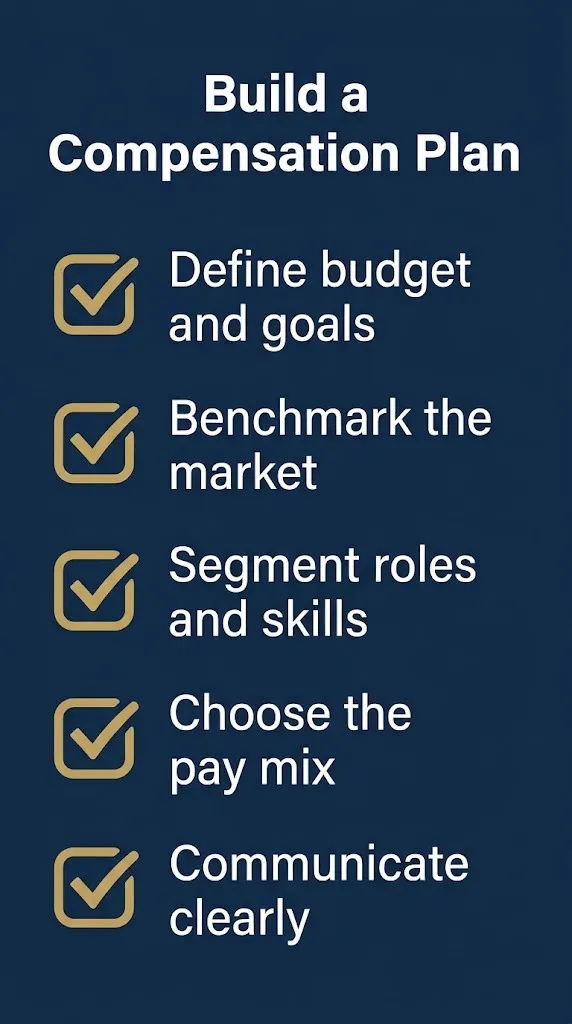
You build a compensation plan by defining objectives, benchmarking the market, segmenting roles, choosing the pay mix, checking compliance, and communicating clearly. Salary.com’s framework lists these steps in order, and skipping any of them creates risk .
Here is the sequence:
- Define business objectives and budget. Know what you can afford and what you are trying to reward.
- Benchmark the market. Use reliable survey data to set salary ranges.
- Segment employees. Group by role, skills, or performance to differentiate pay.
- Choose the pay mix. Decide how much is base, incentive, benefits, and equity.
- Check compliance and pay equity. Audit for disparities before you launch.
- Communicate the plan. Employees who do not understand the plan will not trust it.
- Monitor and adjust. Review the plan annually and fix what is not working.
The plan is not finished when the spreadsheet is done. It is finished when employees understand it and managers can explain it without reading from a script.
What Mistakes Ruin a Compensation Plan?
The mistakes that ruin a compensation plan are unclear criteria, pay inequity, ignoring the market, and poor communication. A plan that looks good on paper can fail if employees do not believe it is fair or if managers cannot explain it.
Pay inequity is the most dangerous mistake. A structured plan with clear salary ranges and regular audits reduces the risk of discrimination claims . A plan without those safeguards creates legal exposure and erodes trust.
Ignoring the market is the second most common failure. Mercer’s data shows that salary budgets are tightening, and companies that assume they can pay below market without consequences will lose talent to competitors who are paying attention .
Poor communication is the third. Employees who do not understand how their pay is determined will assume the worst. A clear plan, explained honestly, is better than a generous plan that no one understands.
What Happens Next in the 2026 Compensation Cycle?
The compensation cycle is predictable, and the next major data points are already scheduled.
October 2025: Mercer’s projections put merit increases at 3.2% and total increases at 3.5% .
March to May 2026: Survey participation window for Mercer’s main US compensation surveys.
April 2026: Actual results published: 3.1% merit, 3.4% total .
Expected late 2026: October planning surveys open for 2027 budgets.
Ongoing: Companies adjust salary structures and communicate changes, with just under 60% planning structure adjustments averaging 2.6% .
Frequently Asked Questions
What is the best compensation plan?
There is no single best plan. The best plan aligns base pay, incentives, benefits, and equity with your business objectives, market data, and budget.
What is compensation planning?
It is the systematic process of designing and implementing a total rewards strategy that attracts, retains, and motivates employees while staying within budget and legal boundaries.
How much should merit increases be in 2026?
Mercer’s 2026 survey found actual merit increases averaged 3.1%, slightly below the 3.2% projected in October 2025 .
What are the main types of compensation plans?
The main types are base pay, incentives and bonuses, benefits, and equity. Most companies use a mix of all four.
Why is equity shrinking in 2026?
Companies are becoming more surgical with equity, shifting it from a broad retention tool to a targeted performance tool. Large refreshes have dropped sharply since 2023 .
How do I know if my compensation plan is competitive?
Benchmark against reliable survey data for your industry, role, and geography. Mercer, Salary.com, and Pearl Meyer are common sources.
What is the biggest mistake in compensation planning?
Pay inequity. A plan without clear ranges and regular audits creates legal risk and erodes employee trust.
Who is the best compensation plan for?
There is no universal answer. A tech startup competing for AI talent needs a different plan than a hospital retaining nurses. The best plan fits the specific business and market.
The Bottom Line
The best compensation plan in 2026 is not a template. It is a disciplined mix of base pay, performance-gated incentives, benefits, and scarce equity, built on market data and explained clearly. Mercer’s 3.1% merit increase is your baseline. Sequoia’s equity squeeze is your warning. Build the plan you can defend, and communicate it before employees ask.