Litigation Process in 2026: The Real Timeline, the Real Costs, and What Happens Before Trial
Quick Answer
- What it is: Litigation is the full process of resolving a legal dispute, from a demand letter through trial and appeal.
- How long? There is no fixed timeline. Federal cases often take a year or more before trial, and many settle first.
- Most important number: A defendant generally has 21 days to answer a federal complaint after being served.
If you’re searching for “litigation process,” you’re likely facing a dispute, a demand letter, or a court notice. You want to know what happens next, in what order, and how long it takes.
Here’s the direct answer. Litigation is not a single event. It is a sequence of steps, each with its own deadline and cost. The process starts before a courtroom is ever involved and often ends before a trial ever begins.
This article walks through the stages in plain order. It covers filing, answering, discovery, settlement, trial, and appeal. It also flags where the rules are firm and where the timeline is a guess.
The Facts
| The Facts | |
|---|---|
| What it is | The process of enforcing or defending legal rights through a court-supervised dispute |
| Where it starts | A complaint filed with a court, then served on the defendant |
| First deadline | 21 days for a federal defendant to answer after service |
| Discovery | Written questions, document demands, and sworn depositions before trial |
| Most common ending | Settlement before trial, not a jury verdict |
| Trial standard | Preponderance of the evidence in most civil cases |
| Appeal window | Varies by court, often 30 days after judgment in federal cases |
What Is the Litigation Process?
The litigation process is the series of court-supervised steps used to resolve a civil dispute, from filing a complaint through discovery, motions, trial, and appeal. It is broader than a lawsuit. A lawsuit is one filing. Litigation is the whole machinery around it.
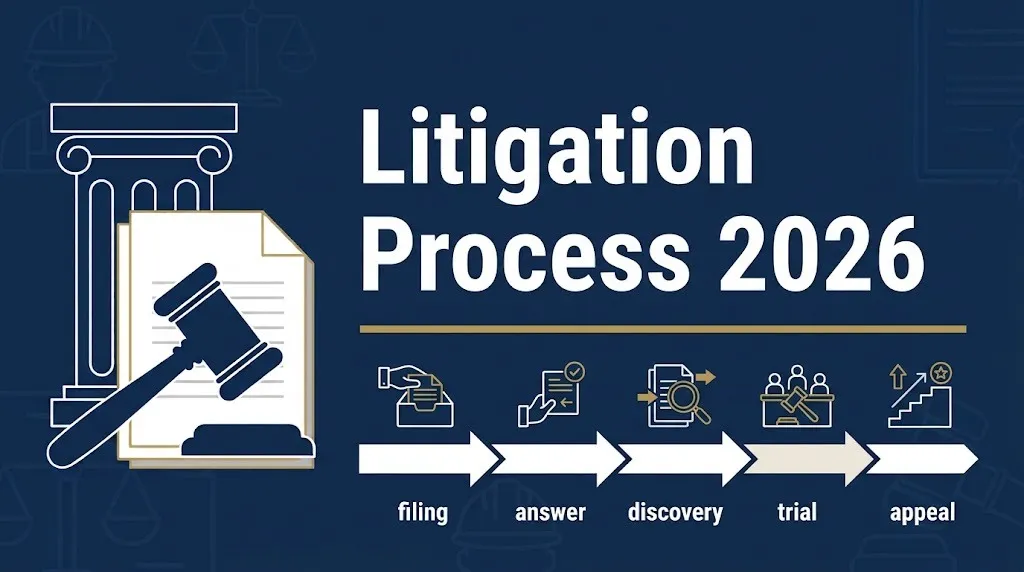
The word comes from the Latin for dispute. In practice, it covers pre-suit demand letters, the complaint, the answer, evidence exchange, settlement talks, and any trial or appeal that follows .
A useful comparison: a lawsuit is like filing a warranty claim. Litigation is everything from the first phone call to the repair shop through the final decision on whether they fix it, replace it, or deny you.
Most disputes settle. The American Bar Association notes that relatively few lawsuits go through the full range of procedures to trial . That doesn’t mean the process is short. It means the pressure to resolve builds long before a jury is seated.
How Long Does the Litigation Process Take?
There is no fixed length, and anyone quoting a single number is guessing. Timelines depend on the court, the complexity of the facts, how many parties are involved, and whether either side files delay motions.
In federal court, the judge sets a scheduling order that controls discovery cutoff dates, motion deadlines, and a trial date. That schedule can be extended, and often is.
A 2026 docket in the Central District of California shows how schedules shift. A trial originally set for March 2026 was pushed to June, then proposed for October. Fact discovery moved from October 2025 to January 2026, then to April 2026 .
Those aren’t unusual delays. They are the normal friction of a contested case.
For a simple uncontested matter, months. For a contested case with expert witnesses and multiple claims, a year or more before trial is common. Appeals add further time after judgment.
How Much Does Litigation Cost?
Litigation costs depend on the fee structure, the court, and how long the case runs. There is no single national figure, and no court publishes an average.
Common fee models include hourly billing, flat fees for specific stages, and contingency fees where the lawyer takes a percentage of any recovery. Contingency arrangements are common in personal injury and consumer cases. Hourly billing is more common in business disputes.
Court filing fees are separate. In federal court, a plaintiff pays a filing fee when the complaint is submitted. A plaintiff who cannot afford it can request to proceed in forma pauperis, and the fee may be waived .
The cost driver is discovery. Document review, depositions, and expert reports are the expensive parts. A case that settles before discovery opens costs far less than one that runs through expert discovery and trial.
How Do You Start the Litigation Process?
You start the litigation process by filing a complaint with the correct court and serving it on the defendant. The complaint states what the defendant did, what harm it caused, why the court has jurisdiction, and what relief you want.
The plaintiff is the party filing. The defendant is the party responding .
Relief comes in three main forms. Money damages compensate for a loss. An injunction orders the defendant to do or stop doing something. A declaratory judgment states the parties’ rights without ordering action .
The federal rules require the complaint to show jurisdiction. Federal courts hear cases involving federal law, the Constitution, disputes between states with more than $75,000 at stake, and cases where the U.S. government is a party .
State courts have their own rules, but the basic structure is the same. File, serve, wait for a response.
What Happens After the Complaint Is Filed?
After the complaint is served, the defendant has a set time to respond, generally 21 days in federal court. The response can be an answer or a motion to dismiss.
An answer admits or denies the factual allegations. It can also raise defenses, including that the plaintiff waited too long to file .
A motion to dismiss argues the case should end before discovery. Common grounds include lack of jurisdiction, defective service, failure to state a claim, or lack of standing . If the motion fails, the defendant must answer.
If the motion succeeds, the case may be dismissed with or without prejudice. Dismissal with prejudice means it cannot be refiled. Without prejudice means it can.
Once the pleadings are settled, the case moves to the evidence-gathering phase.
Key Takeaway: The first 21 days after service set the tone for everything that follows, and a motion to dismiss can end a case before discovery ever begins.
What Is Discovery in Litigation?
Discovery is the pretrial process where each side must share information and evidence with the other. It is the longest and most expensive part of most cases.
The main tools are interrogatories, requests for production of documents, requests for admission, and depositions .
Interrogatories are written questions answered under oath. Document requests require the other side to produce relevant records. Requests for admission ask a party to admit or deny specific statements. Depositions are live questions asked under oath before a court reporter, who produces a transcript .
Discovery has deadlines. A party who ignores a discovery request can face sanctions, including dismissal of the case or a judgment against them .
The purpose is not to win at this stage. It is to assemble the evidence so both sides can evaluate the case honestly. Most settlements happen after discovery, when the strengths and weaknesses become clear.
What Is a Motion for Summary Judgment?
A motion for summary judgment asks the judge to decide the case without a trial because the key facts are not in dispute. It is governed by Rule 56 of the Federal Rules of Civil Procedure .
The standard is high. The court grants summary judgment only if there is no genuine dispute about a material fact and the moving party is entitled to judgment as a matter of law .
Defendants file most summary judgment motions. A successful plaintiff motion is uncommon . If the motion succeeds on the whole case, the case ends. If it succeeds on one claim, the rest can proceed.
Summary judgment is the last major off-ramp before trial. If it fails, the case moves to a pretrial conference and then to trial or settlement.
How Do Most Civil Cases End?
Most civil cases end in settlement, not trial. The parties reach an agreement, often with the judge’s encouragement, and the case closes without a verdict.
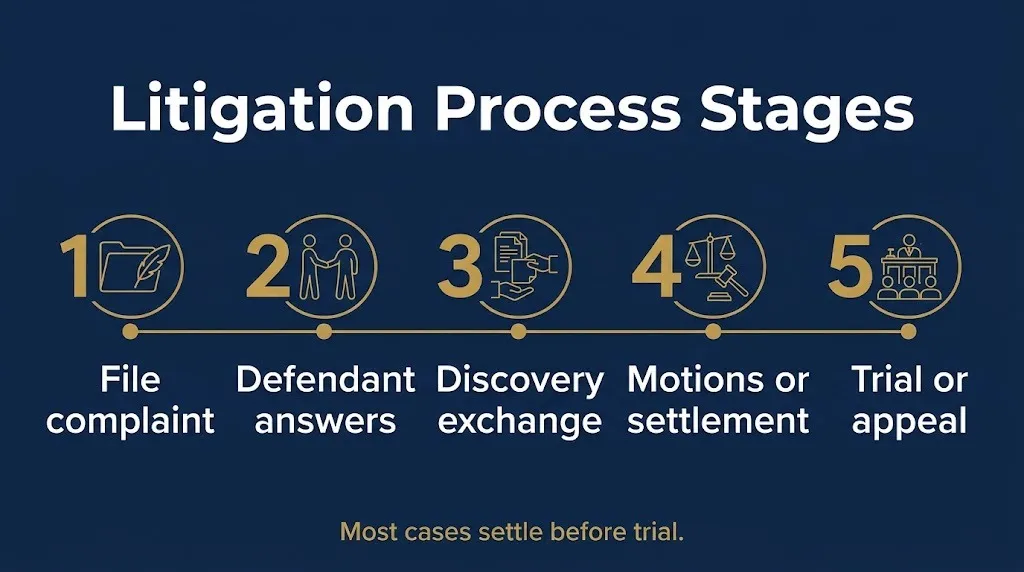
Settlements can happen at any point. Before a suit is filed, after the complaint, during discovery, during trial, or even while the jury is deliberating . A settlement usually does not state that anyone was right or wrong.
Courts encourage mediation and other forms of alternative dispute resolution to avoid the expense and delay of trial . A judge may order the parties to attend a settlement conference.
The settlement is a contract. If one side fails to pay, the other can enforce it. But the terms are private unless the parties file them with the court.
For the reader, the practical point is this: the trial you see on television is the exception. The settlement conference is the norm.
What Happens at a Civil Trial?
A civil trial is the formal presentation of evidence to a judge or jury, followed by a decision on liability and damages. It begins with jury selection if a jury was requested.
The plaintiff presents first because the plaintiff carries the burden of proof. In most civil cases, that burden is a preponderance of the evidence, meaning more likely than not .
Each side gives an opening statement, then presents witnesses and exhibits. The opposing side can object to questions and evidence. The judge rules on the objections .
After the plaintiff’s evidence, the defendant can move for judgment as a matter of law, arguing the plaintiff failed to present enough evidence for a reasonable jury to rule in their favor .
If that motion fails, the defendant presents evidence. Then come closing arguments. The judge instructs the jury on the law. The jury deliberates and returns a verdict. In federal court, the jury must be unanimous .
A bench trial skips the jury. The judge decides both facts and law.
What Happens After a Trial Verdict?
After a verdict, the court enters a judgment stating the outcome and the remedy. The losing party can file post-judgment motions or appeal.
In federal court, a notice of appeal is generally due within 30 days of the judgment. The appeal goes to the circuit court of appeals. The appeals court reviews the trial record for legal errors, not for new facts.
The appeal does not automatically stop enforcement of the judgment unless the appellant posts a bond or obtains a stay.
If no appeal is filed, the judgment becomes final. The winning party can then collect. Collection may require wage garnishment, bank levies, or property liens if the losing party does not pay voluntarily.
What Happens Next
Ongoing: Every federal case runs on a scheduling order set by the judge, with discovery deadlines and a trial date that can move.
Within 21 days of service: The defendant must answer or move to dismiss.
After discovery closes: Either side may file a motion for summary judgment, which can end the case without trial.
Before trial: The judge will hold a final pretrial conference and push the parties toward settlement.
After judgment: The losing party has a short window, often 30 days in federal court, to appeal.
Frequently Asked Questions
What is the difference between litigation and a lawsuit?
A lawsuit is the formal filing. Litigation is the entire process around it, from pre-suit demands through appeal.
How long does litigation take?
There is no fixed timeline. Simple cases can resolve in months. Contested cases with discovery and trial often take a year or more.
Do most civil cases go to trial?
No. Most civil cases settle before trial. The American Bar Association notes that relatively few lawsuits run the full procedure to a verdict.
What is discovery in a lawsuit?
Discovery is the evidence-sharing phase. It includes written questions, document demands, and sworn depositions before trial.
What happens if the defendant ignores a lawsuit?
If the defendant is properly served and does not respond, the plaintiff can seek a default judgment.
Can you appeal a civil verdict?
Yes. The losing party can appeal to a higher court, generally within 30 days of judgment in federal cases.
What is summary judgment?
It is a request for the judge to decide the case without trial because the key facts are not disputed.
Who pays attorney fees in litigation?
Generally each side pays its own attorney, unless a statute or contract says otherwise.
The One Thing to Do Now
Write down the date you were served or the date you filed. Count forward 21 days if you’re the defendant in federal court. Put that date where you’ll see it.
The litigation process rewards the party that tracks deadlines. The first one, the answer date, sets the rest in motion.