Chicago Business Litigation Lawyer in 2026: What Cases Cost, Who Handles Them, and How to Vet a Firm
Quick Answer
- A Chicago business litigation lawyer handles commercial disputes in Cook County, state and federal court.
- Hourly rates run about $250 to $600, with flat fees available for discrete tasks.
- The key date is your filing deadline, and Illinois legal malpractice claims carry a two-year statute of limitations.
A Chicago business litigation lawyer is an attorney who represents companies and business owners in commercial disputes, from breach of contract to partnership fights. The work happens in Cook County Circuit Court, the Northern District of Illinois, and arbitration forums.
This affects business owners, shareholders, and LLC members facing a dispute that has escalated past negotiation. The number that matters most is the hourly rate, and Chicago business lawyers typically charge between $250 and $600 per hour, with flat fees available for specific services .
This article covers what these lawyers actually do, verified firm rankings, how Cook County assigns commercial cases, cost structures, and the statute of limitations trap that ends otherwise valid claims. One detail most competitors miss: Illinois appellate courts clarified in January 2026 that the adverse domination doctrine is a rebuttable presumption, and a minority owner’s earlier demand letter can start the clock on a malpractice claim .
The Facts
| Item | Verified Detail |
|---|---|
| Typical hourly rate | $250 to $600 per hour in Chicago |
| Cook County venue | Law Division, Commercial Calendar Section |
| Federal venue | Northern District of Illinois |
| Chambers Band 1 firm | Winston Taylor LLP (Litigation: General Commercial, Illinois) |
| Chambers Band 2 attorney | Tina M. Tabacchi, Jones Day |
| Chambers Band 4 firm | Much Shelist, P.C. |
| Chambers Band 4 firm | Barack Ferrazzano |
| Legal malpractice deadline | Two years from discovery under 735 ILCS 5/13-214.3(b) |
| Settlement fund | Not applicable; this is a legal service, not a lawsuit |
Is a Chicago business litigation lawyer legit or a scam?
A Chicago business litigation lawyer is legitimate when the attorney is licensed in Illinois and has verifiable commercial litigation experience. The scam risk sits with anyone who guarantees a specific outcome or demands a large retainer without a written engagement letter.

The legitimate signal is public record. Chambers ranks Winston Taylor in Band 1 for Illinois general commercial litigation, citing its deep bench and trial experience in Cook County and federal courts . The same guide ranks Much Shelist in Band 4, noting the firm is regularly engaged by both plaintiffs and defendants in high stakes civil trials .
The scam version has tells. No ethical attorney promises a win before reviewing the facts. No legitimate firm asks for a wire transfer to a personal account. And no attorney can tell you what your case is worth without seeing your contracts, your emails, and your damages records.
A simple comparison: hiring a business litigator is like hiring an accountant for a tax audit. The review comes first. The strategy and the price follow.
How much does a Chicago business litigation lawyer cost?
A Chicago business litigation lawyer costs between $250 and $600 per hour for most commercial work, with more experienced or niche lawyers charging above that range . Some firms offer flat rates for discrete tasks like contract drafting or entity formation.
The cost drivers are concrete:
- Hourly rate: The primary driver, based on attorney experience and firm size.
- Retainer: Most firms require an upfront deposit that gets drawn down as work is billed.
- Complexity: A single-contract dispute costs less than a multi-party partnership fight.
- Venue: Federal court litigation tends to involve more procedural work than state court.
- Expert witnesses: Experts bill separately and can run thousands of dollars.
Not yet determined: No public database reports average total litigation costs for Chicago commercial cases. The rate range is verified, but total case costs depend on how far the dispute goes.
One verified data point exists on individual billing. Attorney John S. Monical lists a fixed hourly rate of $410 per hour on his Martindale-Hubbell profile, with free initial consultation and fixed fees available . That sits in the middle of the market range.
Who are the top-ranked Chicago business litigation lawyers in 2026?
The top-ranked Chicago business litigation lawyers in 2026 include Winston Taylor’s Band 1 team, Tina M. Tabacchi of Jones Day in Band 2, and the Band 4 teams at Much Shelist and Barack Ferrazzano. Rankings come from Chambers USA 2026.
Here are the verified rankings:
| Firm or Attorney | Chambers Ranking | Notable Detail |
|---|---|---|
| Winston Taylor LLP | Band 1, Illinois | Dan K. Webb named Star Individual; Linda Coberly ranked Band 1 for appellate work |
| Tina M. Tabacchi, Jones Day | Band 2, Illinois | Partner-in-Charge of Chicago office; health care and life sciences focus |
| Much Shelist, P.C. | Band 4, Illinois | Steven Blonder ranked Band 2; firm handles both plaintiff and defense work |
| Barack Ferrazzano | Band 4, Illinois | Maile Hitomi Solís co-chairs litigation; firm known for lean trial teams |
| Winston Taylor | Star Individual | Dan K. Webb, civil and criminal trial capabilities |
Chambers also ranks Linda T. Coberly of Winston Taylor in Band 1 for appellate work, noting her experience at both state and federal levels . That matters because business disputes often end up on appeal.
The rankings are not a complete list. Many capable Chicago litigators practice at smaller firms that Chambers does not cover.
Reality Check: No one texts you about a business lawsuit or asks for a fee to “release” litigation funds. Business litigation is filed in court by licensed attorneys, and court filing fees go to the clerk, not to a stranger. If someone contacts you claiming to handle your commercial dispute for an upfront wire transfer, verify the attorney through the Illinois Attorney Registration and Disciplinary Commission before paying anything.
What types of cases does a Chicago business litigation lawyer handle?
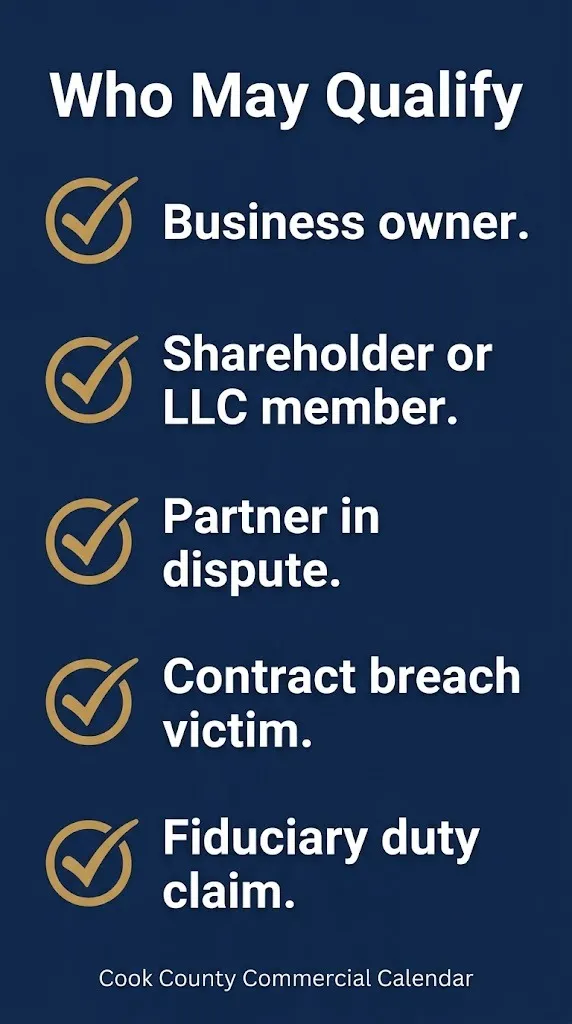
A Chicago business litigation lawyer handles breach of contract, partnership and shareholder disputes, fiduciary duty claims, non-compete fights, trade secret claims, and business torts. The Cook County Commercial Calendar Section defines its jurisdiction as cases involving a commercial relationship between the parties .
The verified categories from Chambers firm profiles show the range. Winston Taylor handles antitrust, securities, intellectual property, product liability, and class action defense . Much Shelist handles complex insurance coverage litigation and antitrust matters . Barack Ferrazzano handles BIPA defense, financial institutions litigation, and class actions .
Here is a practical checklist of common case types:
- Breach of contract: A vendor did not deliver, or a buyer did not pay.
- Partnership disputes: Owners disagree on control, distributions, or exit.
- Fiduciary duty: A manager or member acted against the company’s interest.
- Non-compete and trade secrets: A former employee or partner took clients or confidential information.
- Business torts: Fraud, tortious interference, or deceptive trade practices.
The Cook County Commercial Calendar Section assigns cases to specific judges who oversee them from start to finish, similar to federal court . That continuity matters because you keep the same judge throughout the case.
How does Cook County assign business litigation cases in 2026?
Cook County assigns business litigation cases to the Commercial Calendar Section of the Law Division when the plaintiff identifies the case as commercial litigation on the cover sheet. The section has eight judges hearing commercial matters as of 2026 .
The assignment process works like this. The plaintiff files a Law Division Cover Sheet identifying the case type. If the cover sheet says “Commercial Litigation,” the case is almost certainly assigned to the Commercial Calendar Section . Cases there get a single judge who oversees the case from filing through trial.
The judges currently assigned to Commercial Calendars include Jonathan Clark Green, James Hanlon, Stephen Swedlow, Jerry A. Esrig, Jack Hagerty, Anthony Swanagan, Bernadette Barrett, and John Tully Jr. .
If the case is identified as personal injury or wrongful death, it goes to the Motion Section instead, where a motion judge handles pretrial matters and a different judge handles trial . The distinction is procedural, but it affects how your case moves.
How do you file a business lawsuit in Chicago?
Filing a business lawsuit in Chicago requires five steps, starting with identifying the correct venue and ending with service on the defendant. The sequence matters because deadlines and procedural rules vary by court.
- Identify whether the case belongs in Cook County Circuit Court or the Northern District of Illinois.
- File the complaint and the Law Division Cover Sheet identifying the case as commercial litigation .
- Pay the filing fee to the clerk of the court.
- Serve the defendant according to Illinois or federal rules.
- Calendar the response deadline and any scheduling conference.
- Preserve documents and issue litigation holds immediately.
The cover sheet step is easy to overlook, but it drives assignment. If you mark the case as personal injury when it is really a contract dispute, you may end up in the Motion Section instead of the Commercial Calendar Section.
In federal court, the Northern District of Illinois has its own procedures. Judge Lindsay C. Jenkins encourages settlement conferences with the assigned magistrate judge, and the court strongly discourages live video testimony at trial . Judge Marvin E. Aspen requires compliance with Local Rule 37.2 before filing discovery motions . Those details affect how your lawyer prepares.
What is the statute of limitations for a business dispute in Illinois?
The statute of limitations for a business dispute in Illinois depends on the claim type, and legal malpractice claims carry a two-year deadline from discovery under 735 ILCS 5/13-214.3(b) . Breach of contract claims generally carry longer windows, but you should not assume.
The 2026 appellate ruling in Davie & Associates v. Reditus Healthcare clarified how the adverse domination doctrine works in Illinois. The doctrine tolls the statute of limitations when a company is controlled by wrongdoers who cannot be expected to sue themselves. But it is a rebuttable presumption .
The court held that the presumption was rebutted because a company member had already filed suit and sent a demand letter accusing the attorneys of malpractice more than two years before the receiver filed the later action . That earlier knowledge started the clock.
The practical lesson is direct. If you suspect a fiduciary or malpractice claim, the clock may start when you have enough information to inquire, not when you have full proof. Waiting for certainty can cost you the claim.
Key Takeaway: The two-year malpractice deadline in Illinois can start before you have all the facts, and a demand letter or earlier lawsuit can trigger it.
What happens next in a Chicago business litigation case in 2026?
The next stages in a Chicago business litigation case follow the court’s scheduling order, with discovery, dispositive motions, and trial as the main milestones. No settlement fund exists, and no public payout follows.
At filing: The case is assigned to the Commercial Calendar Section or another section based on the cover sheet .
Within months: The parties exchange initial disclosures and begin discovery.
Mid-case: Dispositive motions are filed, and the court may refer the parties to a magistrate judge for settlement .
Before trial: The court enters a scheduling order setting pretrial deadlines under Federal Rule 16 or the Illinois equivalent .
At trial: The assigned judge presides, and post-trial motions follow if either side challenges the outcome.
Frequently Asked Questions
How much does a Chicago business litigation lawyer charge per hour?
Most charge $250 to $600 per hour, with niche or highly experienced lawyers charging more .
One verified Chicago attorney lists $410 per hour .
Flat fees are available for discrete tasks.
Who are the top business litigation firms in Chicago for 2026?
Chambers ranks Winston Taylor in Band 1 for Illinois commercial litigation .
Jones Day’s Tina Tabacchi is ranked Band 2 .
Much Shelist and Barack Ferrazzano are ranked Band 4 .
Where are business lawsuits filed in Chicago?
Commercial cases are typically filed in the Cook County Circuit Court Law Division, Commercial Calendar Section .
Federal claims go to the Northern District of Illinois.
The cover sheet determines assignment.
What is the statute of limitations for legal malpractice in Illinois?
Two years from the time you knew or reasonably should have known of the injury .
The adverse domination doctrine can toll the deadline in some cases, but it is rebuttable .
Do not wait to investigate a suspected claim.
Can a Chicago business litigation lawyer handle a partnership dispute?
Yes, partnership and shareholder disputes are core commercial litigation work.
Firms like Much Shelist handle fiduciary duty and business divorce matters .
The Commercial Calendar Section hears these cases regularly.
Does an Illinois business lawsuit automatically go to trial?
No, most cases settle or resolve on motion.
Chambers notes that nearly 99% of cases settle before trial .
But trial-ready lawyers often get better settlement leverage.
What is the Commercial Calendar Section in Cook County?
It is a section of the Law Division that hears cases involving a commercial relationship between the parties .
Eight judges are assigned to Commercial Calendars as of 2026 .
Cases get one judge from filing through trial.
The date to put on your calendar
Find the date you first knew or should have known about the business injury. If a malpractice or fiduciary claim is possible, the two-year clock under Illinois law may already be running . Call a Chicago business litigation lawyer before that window closes, and bring your contracts, emails, and any demand letters you have sent or received.