Workers Compensation Insurance NC 2026: Requirements, Costs, and Filing Rules
Quick Answer:
- Workers compensation insurance in North Carolina is real, required by law, and enforced by the North Carolina Industrial Commission.
- Costs vary by industry, payroll size, and claims history, with no flat statewide rate.
- Coverage must be in place before employees start work, not after an injury occurs.
North Carolina workers compensation insurance is a state-mandated coverage system that pays medical bills and lost wages when employees get hurt or sick on the job.
If you are a business owner in North Carolina, you need to know one thing: the law requires coverage for any business with three or more employees. That number drops to one if you operate in certain industries like farming with migrant labor.
This article covers what is verified about coverage requirements, cost factors, exemption rules, and what happens if you do not carry it. One surprising detail: corporate officers can opt out, but sole proprietors cannot cover themselves under a standard policy.
The Facts
| Case | North Carolina Workers Compensation Act |
| Status | Active statutory system, enforced |
| Fund Size | Not applicable, private insurance market |
| Est. Per Person | Varies by claim type and wage |
| Claim Deadline | 2 years from injury date (report within 30 days) |
| Administrator | North Carolina Industrial Commission |
| Proof Needed | Medical records, incident report, wage documentation |
Is Workers Compensation Insurance Required in North Carolina?
Workers compensation insurance is legally required in North Carolina for most employers with three or more employees.
The North Carolina Workers Compensation Act mandates coverage. The law applies to full-time, part-time, seasonal, and temporary workers when counting toward the three-employee threshold.
Certain industries face stricter rules. Any agricultural employer with 10 or more full-time non-seasonal workers must carry coverage. Domestic household employers are generally exempt unless they employ a worker for 20 or more hours per week.
Corporate officers and LLC members count as employees for the threshold calculation. However, they may elect to exclude themselves from coverage by filing a written waiver with the insurance carrier.
The penalty for noncompliance is serious. The North Carolina Industrial Commission can fine employers up to $100 per day for each day coverage was required but not maintained. Criminal penalties may apply in extreme cases.
The system is not a government-run insurance pool for most employers. Private insurance companies write the policies. The North Carolina Rate Bureau sets baseline rates that insurers then modify.
Key Takeaway: Coverage is mandatory, penalties are steep, and the three-employee rule is stricter than many owners realize.
How Much Does Workers Compensation Insurance Cost in NC?
Workers compensation insurance costs in North Carolina vary significantly by industry classification, payroll size, and claims history.
There is no flat rate. The North Carolina Rate Bureau publishes base rates for hundreds of class codes. Each code corresponds to a specific type of work and carries its own risk level.
A roofing company pays a much higher rate per $100 of payroll than an accounting firm. The difference reflects the likelihood and severity of workplace injuries in each industry.
Rates are typically expressed as a dollar amount per $100 of payroll. For example, a rate of $2.00 means you pay $2.00 for every $100 of payroll. A $100,000 annual payroll would cost $2,000 before discounts or surcharges.
Several factors modify your final premium:
- Experience modification factor, which compares your claims history to similar businesses
- Premium discounts for small businesses or safety programs
- Deductible choices that shift some risk back to you
- Payroll audits that adjust premiums after the policy year ends
The average cost for a small business with low-risk work may run between $500 and $2,000 annually. High-risk industries like construction or manufacturing can pay $10,000 or more.
You cannot legally operate without coverage to save on premium costs. The fines exceed what most policies would cost.
Reality Check: No one can quote you an accurate workers compensation premium without knowing your specific payroll, industry, and claims history. Any service promising a fixed low rate before asking those questions is selling a lead, not a policy.
Who Is Exempt from Workers Compensation in North Carolina?
Certain workers and business owners are exempt from mandatory workers compensation coverage in North Carolina.
Sole proprietors are not required to cover themselves under a standard workers compensation policy. They may choose to purchase coverage voluntarily, but the law does not force it.
Partners in a partnership are similarly excluded from mandatory coverage. They can elect coverage through an endorsement if they want protection.
Corporate officers may opt out of coverage by filing a written waiver. Each officer must sign the waiver individually. The exclusion applies only to the officer, not to other employees.
LLC members are treated like corporate officers for workers compensation purposes in most cases. They may waive coverage if the operating agreement permits it.
Certain worker categories fall outside the system entirely:
- Independent contractors who meet the legal test for true independence
- Domestic household workers employed less than 20 hours per week
- Federal government employees, who fall under federal workers compensation laws
- Railroad employees, covered by the Federal Employers Liability Act
- Agricultural workers on farms with fewer than 10 full-time non-seasonal employees
Misclassifying an employee as an independent contractor does not exempt you. The North Carolina Industrial Commission investigates misclassification claims. Penalties include back premiums and fines.
Key Takeaway: Owner exemptions exist, but they never extend to misclassified workers who should be covered employees.
How to File a Workers Compensation Claim in North Carolina
Filing a workers compensation claim in North Carolina involves specific steps and strict deadlines.
Here is the step-by-step process:
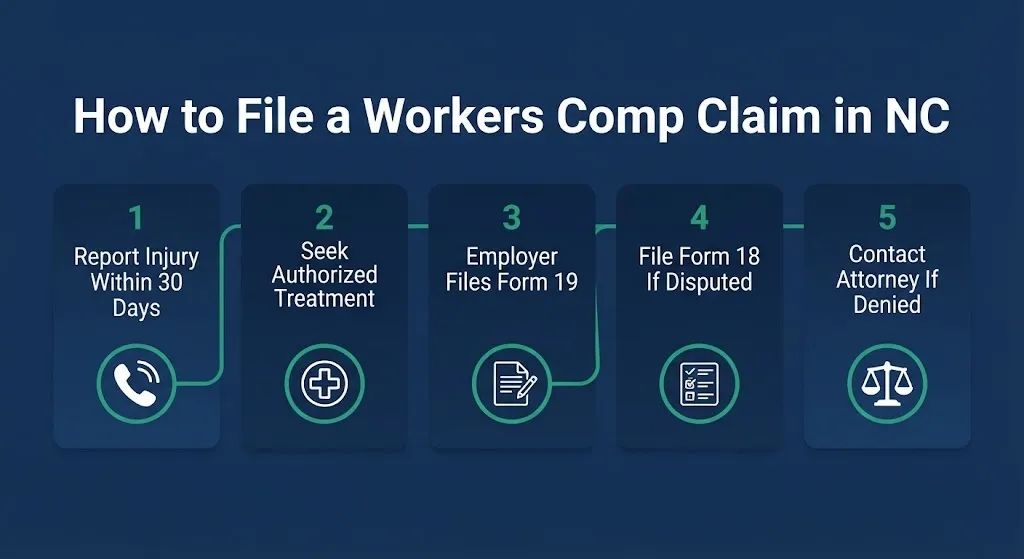
- Report the injury to your employer immediately, ideally in writing.
- Seek medical treatment from an authorized provider if your employer designates one.
- Your employer must file Form 19 with the North Carolina Industrial Commission within five days of learning of the injury.
- Complete Form 18 if your employer disputes the claim or fails to file.
- Keep copies of all medical records, work restrictions, and wage documentation.
- Follow all treatment recommendations from authorized physicians.
- Contact an attorney if your claim is denied or benefits are cut off.
The report deadline matters. You must report the injury to your employer within 30 days. Failure to report within 30 days can bar your claim entirely.
The formal filing deadline is two years from the date of injury. For occupational diseases, the two-year clock starts when you knew or should have known the condition was work-related.
Medical treatment is typically covered at 100 percent with no copay or deductible when the claim is accepted. You must treat with an authorized provider unless the commission approves a change.
The process is similar to filing a warranty claim on a defective appliance. You need documentation of the problem, prompt notice, and cooperation with the authorized repair process.
What Is the North Carolina Industrial Commission?
The North Carolina Industrial Commission is the state agency that administers and enforces workers compensation laws.
The commission operates as a court-like body with commissioners who hear disputes and issue rulings. It is not a typical regulatory agency. It functions more like a specialized court system.
The commission has several roles:
- Reviews disputed claims and holds hearings
- Approves settlements in workers compensation cases
- Maintains records of coverage and claims
- Enforces compliance with coverage requirements
- Processes appeals from initial decisions
There are two levels of review within the commission. Deputy commissioners hear cases first. Full commission panels hear appeals. Further appeals go to the North Carolina Court of Appeals.
The commission does not write insurance policies or pay claims directly. Insurance carriers and self-insured employers make payments. The commission resolves disputes when they arise.
If your claim is denied, you have the right to request a hearing before a deputy commissioner. The hearing operates like a trial, with evidence, witnesses, and legal arguments.
Most workers navigate the system without an attorney at the start. But denied claims or disputes over permanent disability ratings often require legal representation.
Key Takeaway: The Industrial Commission is the referee, not the payer. It resolves disputes when employers and carriers do not pay what the law requires.
How Long Does a Workers Comp Settlement Take in NC?
A workers compensation settlement in North Carolina can take anywhere from a few months to over a year, depending on whether the claim is disputed.
Accepted claims with clear medical evidence and no disagreement about disability ratings often settle within three to six months. The parties must reach an agreement, submit it to the commission, and receive approval.
Disputed claims take longer. If the carrier denies the injury happened at work or disputes the extent of disability, a hearing may be necessary. Hearings are typically scheduled several months after the request.
The settlement approval process adds time. The North Carolina Industrial Commission must review and approve every settlement agreement. This review ensures the settlement is fair and the worker understands the terms.
Several types of settlements exist:
- Medical-only settlements close out future medical treatment
- Indemnity settlements close out wage loss benefits
- Full and final settlements close out everything
Clincher agreements are common in North Carolina. These are full settlements that resolve the entire claim for a lump sum. The name comes from the fact that they close, or clinch, the claim permanently.
A comparison to a delayed tax refund fits here. You know the money is coming eventually, but the exact timing depends on processing queues and whether anyone flags your file for review.
What Does Workers Comp Pay in North Carolina?
Workers compensation in North Carolina pays medical benefits at 100 percent and wage loss benefits at 66.67 percent of your average weekly wage.
The wage loss calculation uses your average weekly wage from the 52 weeks before the injury. The maximum weekly benefit is set annually by the commission.
For 2026, the maximum weekly workers compensation benefit is $1,254.00. The minimum weekly benefit is $30.00.
Here is the standard payout structure:
| Benefit Type | Amount |
| Temporary Total Disability | 66.67% of average weekly wage, up to $1,254.00 weekly |
| Temporary Partial Disability | 66.67% of wage loss difference |
| Permanent Total Disability | 66.67% of average weekly wage, ongoing |
| Permanent Partial Disability | Based on body part and impairment rating |
| Medical Benefits | 100% covered, no copay |
| Death Benefits | 66.67% of wages to dependents, plus burial allowance |
Temporary total disability applies when you cannot work at all during recovery. Temporary partial applies when you return to light duty at lower pay.
Permanent partial disability uses a schedule for specific body parts. A hand, arm, leg, or foot injury has a set number of weeks assigned. Your impairment rating determines the payout.
The wage replacement sounds lower than your take-home pay, but the benefit is not subject to federal or state income tax. Many workers receive close to their after-tax earnings.
Key Takeaway: Medical care is fully covered, but wage replacement is roughly two-thirds of your pre-injury gross earnings, capped by state maximums.
What Happens If an Employer Does Not Have Workers Comp in NC?
An employer without required workers compensation coverage in North Carolina faces financial penalties, personal liability, and potential criminal charges.
The North Carolina Industrial Commission enforces coverage requirements through its compliance division. Penalties start at $100 per day for each day coverage was required but not maintained.
The employer is personally liable for all medical bills and wage loss benefits for any injured worker. This liability is not limited by the caps that would apply under an insurance policy.
The commission can issue a stop-work order that shuts down business operations until coverage is obtained. Defying a stop-work order carries additional penalties.
Criminal penalties apply in certain cases. An employer who knowingly and willfully fails to secure coverage can face misdemeanor charges. Repeat violations may escalate to felonies.
Injured workers are not left without options. North Carolina has an Uninsured Employers Fund that pays benefits to workers whose employers lacked coverage. The fund then pursues reimbursement from the employer.
The comparison to driving without car insurance is apt. You might save money in the short term, but an accident creates liability that far exceeds what the insurance would have cost.
Key Takeaway: Operating without coverage exposes an employer to daily fines, unlimited personal liability, and shutdown orders.
Can You Sue Your Employer Instead of Filing Workers Comp in NC?
In most cases, you cannot sue your employer for a workplace injury in North Carolina. Workers compensation is your exclusive remedy.
The exclusive remedy doctrine is the core trade-off of workers compensation. Workers give up the right to sue in exchange for guaranteed benefits regardless of fault.
There are narrow exceptions. You may sue outside the workers compensation system if:
- The employer intentionally caused the injury
- The employer failed to carry required coverage
- A third party, not your employer, caused the injury
- The injury involved a defective product made by another company
Third-party claims are common. If you are injured in a car accident while driving for work, you may have both a workers compensation claim and a personal injury claim against the other driver.
If you receive a third-party settlement, the workers compensation carrier has a lien on the recovery. The lien prevents double recovery for the same medical bills and wage loss.
The intentional injury exception is extremely narrow. Ordinary negligence, even gross negligence, does not defeat the exclusive remedy rule.
This limitation surprises many workers. They assume they can sue for pain and suffering. But the system trades that right for guaranteed benefits without proving fault.
How Do I Check If My Employer Has Workers Comp in NC?
You can check if your employer has workers compensation coverage in North Carolina through the Industrial Commission’s online coverage verification system.
The commission maintains a searchable database of employers with active coverage. You can search by employer name to verify current insurance status.
The database shows the insurance carrier name and policy effective dates. This information helps you know where to file a claim if you are injured.
You can also ask your employer directly. North Carolina law requires employers to post a notice that includes workers compensation information. The notice must be visible in the workplace.
If your employer refuses to provide coverage information, contact the commission’s compliance division. They will investigate and take enforcement action if coverage is missing.
The verification process matters before an injury, not after. Knowing your employer has coverage means knowing where to seek treatment and who will pay your bills.
The search is similar to checking whether a contractor has a valid license before hiring them. A few minutes of verification can prevent weeks of uncertainty after an accident.
Key Takeaway: The commission’s database gives you free, immediate confirmation of your employer’s coverage status.
What Is the North Carolina Rate Bureau?
The North Carolina Rate Bureau is a nonprofit organization that sets baseline workers compensation insurance rates for the state.
The Rate Bureau operates under the oversight of the North Carolina Department of Insurance. It does not sell insurance policies. It establishes the rates that insurers use as starting points.
Every year, the Rate Bureau files proposed rate changes with the Department of Insurance. The department reviews the proposal, holds hearings if needed, and approves or modifies the rates.
Insurers may deviate from the bureau rates within certain limits. Most apply schedule credits or debits based on the specific employer’s characteristics.
The Rate Bureau also manages the assigned risk pool, now called the North Carolina Reinsurance Facility. This pool provides coverage for employers who cannot find insurance in the voluntary market.
Assignment to the pool is not a punishment. It is a safety net that ensures every employer can obtain required coverage. Pool rates are typically higher than voluntary market rates.
The Rate Bureau does not handle claims or disputes. Those functions belong to the insurance carriers and the Industrial Commission.
Understanding the Rate Bureau explains why your premium changes year to year. The bureau’s annual filings ripple through every workers compensation policy in the state.
How to Buy Workers Compensation Insurance in NC
Buying workers compensation insurance in North Carolina involves working with a licensed agent or broker to obtain quotes from multiple carriers.
Here is the step-by-step process:
- Determine your employee count and whether you must carry coverage.
- Gather payroll information broken down by job classification.
- Contact a licensed insurance agent who handles commercial policies.
- Obtain quotes from at least three carriers.
- Compare rates, coverage terms, and carrier financial ratings.
- Submit an application with accurate payroll estimates.
- Pay the initial premium and obtain a certificate of insurance.
- Prepare for a year-end payroll audit.
The application requires your business entity type, industry, payroll by class code, and claims history. Inaccurate information creates problems at audit time.
The policy renews annually. Your experience modification factor adjusts based on your claims compared to similar businesses in your industry.
You cannot buy workers compensation as part of a personal insurance package. It is a commercial policy that requires a business entity.
Most small businesses can obtain quotes within a week. The binding process moves faster if you have clean records and accurate payroll data.
The comparison to shopping for a mortgage applies. Rates vary between lenders, and small differences compound over time.
Key Takeaway: Work with an independent agent who can access multiple carriers, not just one captive insurer.
What Happens Next for North Carolina Workers Comp in 2026?
Here is the expected timeline for workers compensation developments in North Carolina during 2026:
January to March 2026: The Rate Bureau submits its annual rate filing for the 2027 policy year.
Spring 2026: The Department of Insurance reviews the filing and may schedule public hearings.
Mid-2026: The Industrial Commission issues updated maximum weekly benefit rates for 2027.
Late 2026: Approved rate changes are published and insurers update their pricing.
Ongoing: Compliance enforcement continues through the commission’s investigative division.
The maximum weekly benefit adjusts annually based on the state’s average weekly wage. The 2026 maximum of $1,254.00 will likely increase for 2027.
No major legislative overhaul is pending as of January 2026. The system operates under the Workers Compensation Act with periodic adjustments.
The single most important date for employers is the renewal date on your current policy. Missing that date creates a coverage gap that triggers daily fines.
Frequently Asked Questions
Is workers compensation insurance mandatory in North Carolina?
Yes, workers compensation insurance is mandatory for most employers with three or more employees.
How many employees before workers comp is required in NC?
Three employees triggers the requirement in North Carolina, with lower thresholds for certain industries.
Can a sole proprietor get workers comp in NC?
Yes, a sole proprietor can purchase coverage voluntarily but is not required to cover themselves.
What is the maximum workers comp benefit in NC for 2026?
The maximum weekly benefit is $1,254.00 for 2026.
How long do you have to report a work injury in NC?
You must report a work injury to your employer within 30 days.
What is the statute of limitations for workers comp in NC?
You have two years from the injury date to file a formal claim.
Can I see my own doctor for a workers comp injury in NC?
Only if your employer does not designate an authorized provider or the commission approves a change.
What happens if my workers comp claim is denied in NC?
You can request a hearing before a deputy commissioner at the Industrial Commission.
If you are an employer, verify your coverage is active and your employee count is accurate. If you are a worker, know your rights and the 30-day reporting rule.
The most important number to remember is 30. Report any workplace injury within 30 days or risk losing your right to benefits entirely.