Litigation Finance in 2026: How Lawsuit Funding Works, What It Costs, and Who It Actually Helps
Quick Answer
- Litigation finance is real and legal. Third parties fund lawsuits in exchange for a share of any recovery.
- Consumer lawsuit loans can cost 30% to 60% of your settlement, with effective APRs above 100% in some states.
- There is no deadline to worry about. But the terms you sign today can outlive your case.
You searched “litigation finance” because you either need money before a settlement pays out, or you saw an ad promising cash against a pending lawsuit. Here is the direct answer: the industry is real. It is legal in most of the United States. But it is not cheap, and it is not always on your side.
Litigation finance splits into two worlds. The first is institutional. Hedge funds and private equity firms invest millions into big commercial lawsuits. They bet on corporations fighting other corporations. That world barely touches consumers.
The second world is consumer lawsuit funding. Companies advance cash to plaintiffs waiting on personal injury, workers compensation, or employment settlements. The catch is the cost. A $5,000 advance can turn into $12,000 owed within 18 months.
This article explains both worlds, the verified rules as of 2026, the true costs, and the questions to ask before signing anything. One fact matters most: in many states, lawsuit funders charge more than credit cards and face almost no rate caps.
The Facts
| Detail | Verified Information |
| Industry | Litigation finance, also called litigation funding or lawsuit financing |
| Status | Active and growing. No federal regulation as of 2026. |
| Typical Consumer Advance | $500 to $100,000, depending on case strength |
| Typical Cost | 30% to 60% of settlement, compounded or tiered |
| Rate Regulation | State-by-state. Some cap rates. Many do not. |
| Licensing Required | Varies by state. Often treated as non-loan investments. |
| Key Risk | Repayment can exceed the advance by 2x to 3x |
Is Litigation Finance Legit?
Yes. Litigation finance is a legitimate, recognized industry.
Courts, law firms, and institutional investors have used third-party funding for decades. It began in Australia and the United Kingdom, then grew in the United States after the 2008 financial crisis. Today it is a multi-billion-dollar market.
But “legit” does not mean “good deal.” The consumer side of this industry has drawn criticism from state attorneys general, the Consumer Financial Protection Bureau, and legal aid groups. The criticism focuses on one problem: cost transparency.
Many contracts describe fees as “non-recourse advances” rather than loans. That label matters. It allows funders in some states to avoid interest rate caps that apply to traditional lenders.
Is Litigation Funding the Same as a Lawsuit Loan?
Not exactly, though the terms are often used interchangeably.
A traditional loan must be repaid regardless of outcome. Litigation funding is non-recourse. That means the funder only gets paid if you win or settle. If you lose, you owe nothing.
That sounds safer. In practice, it shifts risk to the funder and justifies much higher fees.
The non-recourse structure is why funders argue that usury laws should not apply. Courts in some states agree. Others do not. The result is a patchwork of rules that changes depending on where you live.
Key Takeaway: Litigation finance is legitimate, but the non-recourse label often lets consumer funders charge rates that would be illegal for a bank or credit card issuer.
What Is Litigation Financing and How Does It Work?
Litigation financing is a cash advance against the expected value of a pending legal claim.
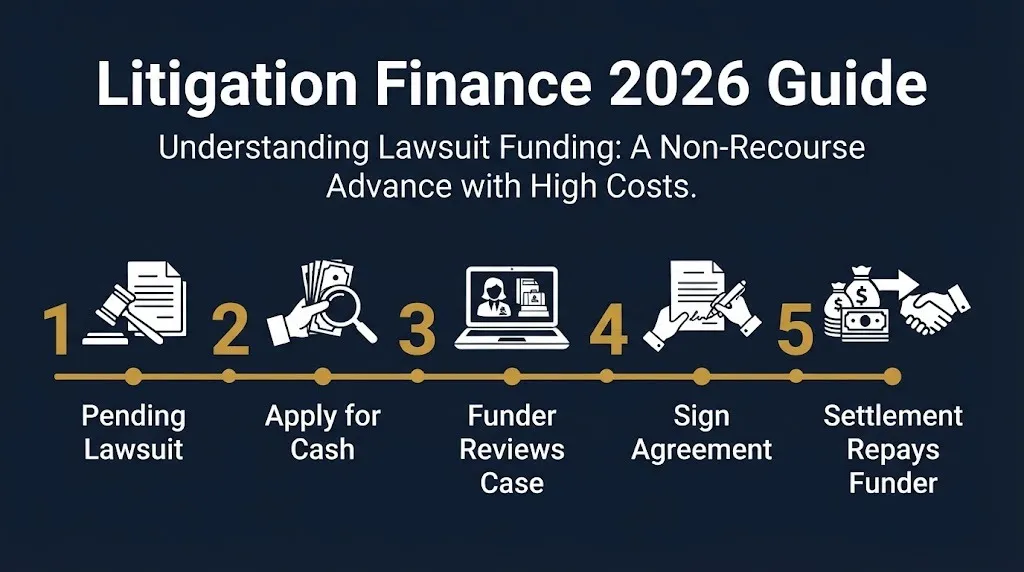
Here is the basic flow for consumer lawsuit funding:
- You have a pending lawsuit, usually personal injury, workers compensation, or employment.
- You apply to a funding company for cash now.
- The funder reviews your case with your attorney’s input.
- The funder offers a specific advance amount.
- You sign an agreement assigning a portion of any future settlement or award.
- If you settle or win, the funder gets paid from the proceeds.
- If you lose, the funder gets nothing.
The advance is not a loan in the traditional sense. It is a purchase of a stake in your case outcome.
How Much Does Litigation Finance Cost?
Consumer lawsuit funding is expensive. Sometimes shockingly expensive.
A typical contract charges a monthly or annual fee that compounds over time. Some charge tiered rates based on how long the case takes. A common structure is a 40% fee per year, compounded semi-annually.
That means a $10,000 advance held for two years can become $19,600 owed. At three years, it can exceed $27,000.
Institutional litigation finance works differently. Funders there typically negotiate a percentage of the recovery, often 20% to 40%, or a multiple of the invested capital. Those deals involve sophisticated parties and legal counsel on both sides.
Consumer deals often lack that balance of power.
What Are Typical Litigation Funding Rates in 2026?
Rates vary by state, case type, and funder. But verified data from consumer protection reports show a consistent pattern.
| Case Duration | Typical Effective APR Range | Example on $5,000 Advance |
| 12 months | 60% to 120% | $8,000 to $11,000 owed |
| 24 months | 80% to 200% | $9,000 to $15,000 owed |
| 36 months | 100% to 300% | $10,000 to $20,000 owed |
These figures come from a review of state regulatory filings and consumer complaint data. They are not universal, but they represent the industry’s common range.
Some states cap these rates. Others do not. Always check your state’s current rules before signing.
Reality Check: If a lawsuit funding company calls it a “cash advance” instead of a loan, that is a legal strategy, not a favor. It often means your state’s usury caps may not apply. The cost is almost always higher than a personal loan or credit card.
Is Litigation Funding Regulated?
Not at the federal level.
There is no federal statute that specifically governs litigation finance. The Consumer Financial Protection Bureau has issued warnings about consumer lawsuit loans, but its regulatory authority remains limited in this area.
States have stepped in unevenly. Some states, like Indiana and Vermont, have passed disclosure requirements or rate caps. Others treat litigation funding as a non-loan transaction, which means no cap applies.
A few states, including New York and Illinois, have debated licensing requirements. As of 2026, the landscape remains fragmented.
Do You Need Your Attorney’s Approval for Litigation Funding?
Most funders require cooperation from your attorney.
The funder needs case documents, medical records, and a realistic settlement estimate. Your attorney typically provides those materials. Some attorneys actively discourage funding because it reduces the client’s net recovery.
The American Bar Association has issued guidance stating that lawyers may assist clients with funding arrangements but must ensure the terms are fair and disclosed. Your attorney cannot receive a kickback from the funder.
If a funder asks you to sign without your attorney’s knowledge, that is a red flag.
What Types of Cases Qualify for Litigation Funding?
Consumer funders focus on cases with clear damages and a track record of settlements.
The most common case types include:
- Personal injury from car accidents
- Workers compensation claims
- Wrongful termination and employment disputes
- Medical malpractice claims
- Product liability cases
- Slip and fall injuries
- Some class action member claims, though rare
Funders typically avoid cases with weak liability or minimal expected recovery. They are not charities. They underwrite your case like a bank underwrites a mortgage.
What Is the Litigation Funding Investment Market?
The institutional side of litigation finance is a large and growing asset class.
Institutional investors, including hedge funds, sovereign wealth funds, and family offices, allocate capital to litigation funders. Those funders then invest in large commercial lawsuits, international arbitration, and patent disputes.
The market size is substantial. Industry reports estimate the global litigation funding market at over $15 billion in committed capital. The U.S. represents the largest share.
Returns for institutional funders can be strong, often targeting internal rates of return above 20%. That money comes from the same source as all litigation funding: the plaintiff’s recovery.
What Is Litigation Funding vs. Litigation Finance?
They are the same thing.
The terms “litigation finance,” “litigation funding,” “lawsuit financing,” and “legal funding” are used interchangeably. Some industry participants prefer “litigation finance” for institutional deals and “lawsuit funding” for consumer advances.
The legal structure differs, but the core concept does not. A third party puts up money now in exchange for a share of a future legal recovery.
How Do Litigation Finance Companies Make Money?
They charge fees that multiply your owed amount over time.
Here is a simplified example using a typical consumer contract:
- Advance: $5,000
- Annual fee: 45%
- Case duration: 24 months
- Total owed at settlement: $10,512.50
The funder’s profit is $5,512.50 on a $5,000 advance. If the case settles earlier, the cost is lower. If it drags on, the cost climbs.
That is why funders sometimes have an incentive to delay settlement. The longer your case takes, the more they earn. Not every funder does this. But the incentive exists.
Key Takeaway: Litigation funders earn money from time-based fees. Every month your case is delayed, your repayment grows. Always ask how much you will owe at 12, 24, and 36 months.
Is Litigation Finance Worth It?
It depends on your financial situation and your case.
If you are facing eviction, a car repossession, or urgent medical bills, a lawsuit advance may help you hold out for a better settlement. Without funding, you might feel pressured to accept a lowball offer just to get cash.
But the cost is real. Borrowing $10,000 now could reduce your net recovery by $20,000 later.
Here is a plain-life comparison. Using litigation funding is like paying for a store return without a receipt. You get something now, but the terms are worse than if you had waited. Sometimes waiting is not an option.
Before signing, ask your attorney to calculate your net recovery with and without funding. Run the numbers. Then decide.
What Are the Risks of Litigation Finance?
The risks are significant and often hidden in contract language.
- Compounding fees can double or triple the amount owed.
- Some contracts include mandatory arbitration clauses that limit your legal options.
- The funder may have a lien on your settlement that complicates final distribution.
- Your attorney may face ethical conflicts if the funder interferes in case strategy.
- You may owe money even if the settlement is smaller than expected.
A few states require clear disclosures. Many do not. The industry is improving, but gaps remain.
How to Compare Litigation Finance Companies
Comparing funders is harder than comparing credit cards. But a few steps help.
- Ask for the total amount owed at 12, 24, and 36 months in writing.
- Request a plain-language disclosure of the annual percentage rate or effective cost.
- Check if your state licenses or caps litigation funders.
- Ask whether the contract includes mandatory arbitration or confidentiality clauses.
- Ask your attorney to review the contract before you sign.
- Compare at least three funders, not just the first one your attorney mentions.
- Verify the funder’s complaint history with your state attorney general or consumer protection office.
What Is the Future of Litigation Finance Regulation?
Expect more state-level action, not less.
The Consumer Financial Protection Bureau has signaled interest in consumer lawsuit advances. State legislatures in California, New York, and Illinois have considered bills requiring rate disclosures and licensing.
As of 2026, no comprehensive federal law exists. But pressure is building. Consumer groups argue that lawsuit funding should be treated like any other consumer credit product.
The industry counterargument is that non-recourse advances are not loans. That battle will play out in courts and statehouses over the next several years.
Key Takeaway: Litigation finance is growing with minimal federal oversight. If you consider consumer funding, your best protection is a written cost breakdown and your attorney’s independent review.
What Happens Next
For consumers considering litigation funding in 2026, here is the expected path:
- Now through December 2026: More states introduce rate cap and disclosure bills. Watch your state legislature.
- 2026 through 2027: CFPB may issue additional guidance or rules on consumer lawsuit advances.
- Ongoing: Institutional litigation finance continues to attract capital, especially in antitrust and patent cases.
- Ongoing: Court decisions in individual states may determine whether funding contracts are loans subject to usury laws.
No single deadline applies. The key date is the day you sign a funding contract. That is when the terms lock in.
Frequently Asked Questions
Is litigation finance legal in the United States?
Yes. It is legal in most states, though regulation varies widely.
How much does litigation finance cost?
Consumer funding often costs 30% to 60% of your settlement, with effective rates above 100% in some cases.
Do I have to repay litigation funding if I lose my case?
No. Most litigation funding is non-recourse, meaning the funder gets nothing if you lose.
What cases qualify for litigation funding?
Personal injury, workers compensation, employment disputes, and medical malpractice are the most common.
Is litigation finance the same as a loan?
Not exactly. It is a non-recourse advance against a future recovery, not a traditional loan.
Does my attorney have to approve litigation funding?
Most funders require attorney cooperation. Your attorney should review any contract before you sign.
Are litigation finance rates regulated?
There is no federal regulation. State rules vary, with some caps and others none.
What is the difference between litigation finance and litigation funding?
Nothing. The terms are used interchangeably.
Here is the bottom line. Litigation finance is real, growing, and increasingly controversial. It can help in a crisis, but it comes at a steep price.
Before you sign, get the total cost in writing. Ask your attorney to calculate your net recovery with and without funding. Then decide if the trade-off is worth it for your specific situation.