Securities Litigation Attorney 2026: How to Find, Vet, and Hire the Right Lawyer
Quick Answer:
- A securities litigation attorney handles disputes over stocks, bonds, investment fraud, and shareholder rights.
- Fees vary by case type, with class actions often on contingency and defense work on hourly billing.
- The most important deadline is the statute of limitations for securities fraud, which can be as short as two years.
If you lost money on an investment and suspect fraud, or if your company is facing a shareholder lawsuit, you need a securities litigation attorney. This is a specialized practice area. Not every lawyer can handle a securities case. The rules are complex, the stakes are high, and the opposing counsel is usually sophisticated.
The people searching this term include individual investors who lost savings to a bad stock tip, employees with stock options caught in a corporate scandal, and small companies facing SEC scrutiny. The single most important deadline is the statute of limitations for securities fraud claims, which under federal law can be as short as two years from discovery.
This article covers what securities litigation attorneys do, how to find one, what they cost, and how to verify their credentials. One surprising detail: many securities fraud cases never go to trial. They resolve through SEC enforcement, class action settlements, or confidential arbitration.
| The Facts | |
|---|---|
| Practice Area | Securities litigation and enforcement |
| Governing Laws | Securities Act of 1933, Exchange Act of 1934 |
| Key Regulator | Securities and Exchange Commission |
| Client Types | Investors, companies, executives |
| Fee Structures | Contingency, hourly, or hybrid |
| License Verification | State bar, FINRA, SEC records |
| Common Deadlines | 2 to 5 years depending on claim type |
Is a Securities Litigation Attorney Legitimate?
Yes, a securities litigation attorney is a legitimate licensed legal professional. These lawyers specialize in disputes involving securities, which include stocks, bonds, mutual funds, and other investment products. The practice area is regulated by state bar associations and federal securities laws.
The Securities and Exchange Commission oversees the securities industry. Attorneys who practice before the SEC must follow specific rules. State bar associations license all attorneys, and you can verify any lawyer’s license through the state bar directory.
Securities litigation is not a scam. It is a specialized field that handles real disputes: shareholder class actions, SEC enforcement defense, insider trading cases, and broker misconduct claims. The attorneys on both sides are typically experienced litigators with finance backgrounds.
The confusion arises because securities cases sometimes produce class action settlements. Investors receive notices about settlements and wonder if they need a lawyer. In most settled class actions, you do not need to hire your own attorney. The class counsel represents you.
How Much Does a Securities Litigation Attorney Cost?
The cost of a securities litigation attorney depends on the case type and the lawyer’s role. Plaintiffs’ attorneys in securities class actions and investor claims often work on contingency. Defense attorneys representing companies typically bill hourly.
Contingency fees in securities cases range from 25% to 40% of the recovery. In large class actions, the court must approve the fee. The fee comes out of the settlement fund before distribution to class members.
| Fee Structure | Typical Use |
|---|---|
| Contingency | Investor claims, class actions |
| Hourly | Company defense, SEC investigations |
| Hybrid | Reduced hourly plus success fee |
| Flat fee | Limited scope representation |
Hourly rates for securities litigators are high. Big-firm partners in major markets charge $800 to $1,500 per hour. Associates charge $400 to $800. The total cost of defending a securities class action can run into millions of dollars.
Individual investors with smaller claims may struggle to find contingency representation. Lawyers take cases they can win and that justify the cost. A $10,000 loss may not attract a contingency lawyer unless the case has class action potential.
How Do You Find a Securities Litigation Attorney?
Finding a securities litigation attorney starts with referrals and directories. The best source is often another lawyer. If you have a business attorney or a personal injury lawyer, ask for a referral to a securities specialist.
Bar association directories are the next stop. The American Bar Association and state bar associations maintain searchable databases of licensed attorneys. Filter by practice area and location.
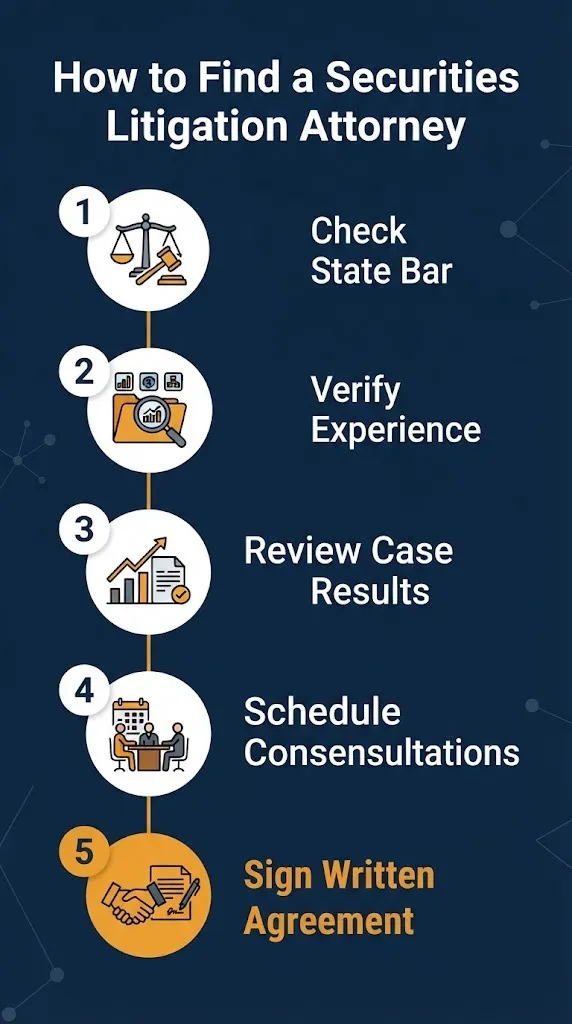
Here is a practical search process:
- Ask for referrals from lawyers you already know.
- Search state bar directories for securities litigation specialists.
- Check law firm websites for securities practice groups.
- Read attorney profiles for experience and case results.
- Verify the license through the state bar.
- Check disciplinary records for red flags.
- Schedule consultations with two or three candidates.
- Compare experience, fee structures, and communication style.
The consultation is critical. Securities cases are complex. You need a lawyer who can explain the case clearly and who has handled similar matters before.
What Does a Securities Litigation Attorney Do?
A securities litigation attorney handles disputes arising from investment transactions. The work splits into two broad categories: plaintiff-side and defense-side.
Plaintiff-side attorneys represent investors who lost money due to fraud, misrepresentation, or broker misconduct. They file class actions, individual lawsuits, and FINRA arbitration claims. Their goal is to recover losses.
Defense-side attorneys represent companies, executives, and brokers accused of securities violations. They defend against SEC enforcement actions, class actions, and shareholder derivative suits. Their goal is to minimize liability and penalties.
| Attorney Role | Typical Client |
|---|---|
| Plaintiff class action | Institutional investors, pension funds |
| Individual investor claim | Retail investors |
| SEC defense | Companies, executives |
| Shareholder derivative | Corporate boards |
| FINRA arbitration | Brokers, investors |
The skill sets overlap but the perspectives differ. A good securities litigator understands both sides and uses that knowledge to anticipate the opponent’s moves.
What Types of Cases Do Securities Litigation Attorneys Handle?
Securities litigation attorneys handle a range of case types. The most common are securities fraud class actions, where shareholders allege that a company made false statements that inflated the stock price.
SEC enforcement defense is another major category. When the SEC investigates a company or executive for insider trading, accounting fraud, or disclosure violations, securities litigators represent the targets.
| Case Type | What It Involves |
|---|---|
| Securities fraud class action | False statements inflated stock price |
| Shareholder derivative suit | Board breached fiduciary duty |
| SEC enforcement defense | Agency investigation and penalties |
| FINRA arbitration | Broker-investor disputes |
| Merger litigation | Shareholders challenge deal terms |
| Insider trading | Criminal or civil charges |
Each case type has its own procedural rules and deadlines. The Private Securities Litigation Reform Act governs many class actions. FINRA rules govern broker disputes. SEC rules govern enforcement actions.
What Is the Deadline for Securities Fraud Claims?
The deadline for securities fraud claims depends on the claim type. Federal securities fraud claims under the Exchange Act have a two-year statute of limitations from discovery and a five-year statute of repose from the violation.
State securities laws, known as blue sky laws, have their own deadlines. Most range from one to five years depending on the state and the specific claim.
| Claim Type | Typical Deadline |
|---|---|
| Federal securities fraud | 2 years from discovery, 5 years max |
| SEC enforcement | 5 years for civil penalties |
| FINRA arbitration | 6 years from the event |
| State securities fraud | 1 to 5 years, varies by state |
| Breach of fiduciary duty | Varies by state |
The statute of repose is absolute. Even if you did not discover the fraud until later, the five-year federal repose period bars the claim. This is stricter than most personal injury deadlines.
Do not wait. The clock may already be running. A securities litigation attorney can calculate your deadline based on the specific facts.
Key Takeaway: Securities litigation attorneys handle investor fraud claims, SEC defense, and shareholder disputes, with federal fraud claims subject to a strict five-year statute of repose.
How Do Securities Class Actions Work?
Securities class actions follow a specific path. The Private Securities Litigation Reform Act, or PSLRA, sets the rules. The process starts when a shareholder files a complaint alleging the company made false statements.
The court appoints a lead plaintiff, usually the investor with the largest financial stake. The lead plaintiff selects lead counsel. The case proceeds through motion practice, discovery, and eventually settlement or trial.
| Class Action Stage | What Happens |
|---|---|
| Complaint filed | Shareholder alleges fraud |
| Lead plaintiff appointed | Largest investor takes control |
| Motion to dismiss | Company challenges the claims |
| Class certification | Court approves the class |
| Settlement or trial | Case resolves |
Most securities class actions settle. The settlement fund compensates class members who bought stock during the class period. The amount each investor receives depends on their losses and the fund size.
What Is the Difference Between a Securities Litigation Attorney and a Class Action Lawyer?
A securities litigation attorney is a specialist within the broader category of class action lawyers. All securities litigators handle investment disputes. Not all class action lawyers handle securities cases.
Class action lawyers handle many types of cases: consumer fraud, product liability, employment disputes, and antitrust. Securities class actions are a specific subset requiring knowledge of securities laws, financial markets, and the PSLRA.
| Lawyer Type | Focus |
|---|---|
| Securities litigator | Stocks, bonds, investment fraud |
| Consumer class action lawyer | Defective products, deceptive practices |
| Employment class action lawyer | Wage theft, discrimination |
| Antitrust lawyer | Price fixing, monopolization |
If your case involves an investment loss, you need a securities specialist, not a general class action lawyer. The legal standards and procedural rules are different.
How Do You Vet a Securities Litigation Attorney?
Vetting a securities litigation attorney requires checking credentials, experience, and disciplinary history. The state bar directory is the starting point for license verification.
The next step is experience. Ask how many securities cases the lawyer has handled. Ask about outcomes. A lawyer with 20 years of general litigation experience but no securities cases is the wrong choice.
| Vetting Factor | What to Check |
|---|---|
| License status | Active and in good standing |
| Disciplinary record | No suspensions or disbarments |
| Securities experience | Similar cases handled |
| Case results | Verdicts and settlements |
| Client reviews | Feedback from prior clients |
| Firm resources | Capacity to litigate complex cases |
Securities litigation is resource-intensive. Solo practitioners can handle small FINRA arbitrations. Major class actions require firms with teams of lawyers, financial experts, and litigation funding.
Key Takeaway: Securities fraud deadlines can be as short as two years from discovery, and the five-year statute of repose under federal law bars even undiscovered claims.
What Is the SEC and How Does It Affect Securities Litigation?
The SEC is the Securities and Exchange Commission, the federal agency that regulates securities markets. The SEC investigates potential violations, files enforcement actions, and imposes penalties.
SEC enforcement often runs parallel to private securities litigation. A company facing an SEC investigation may also face shareholder class actions. The SEC’s findings can strengthen or weaken the private case.
| SEC Action | Impact on Private Litigation |
|---|---|
| Investigation opened | Signals potential wrongdoing |
| Enforcement filed | Provides evidence for plaintiffs |
| Settlement reached | May include admissions |
| No action | Weakens private claims |
The SEC does not represent individual investors. It acts in the public interest. Private attorneys represent individual or institutional investors seeking recovery.
Reality Check: A Lawyer Cannot Guarantee a Securities Recovery
Reality Check: Any lawyer who guarantees a securities litigation outcome is lying. Securities cases are complex, expensive, and unpredictable. A legitimate lawyer evaluates the evidence, explains the risks, and lets you decide. No ethical attorney promises a specific dollar figure. If the promise sounds too good, it is.
How Does FINRA Arbitration Differ From Securities Litigation?
FINRA arbitration is a private dispute resolution process for broker-investor conflicts. It is not court litigation. Most brokerage account agreements require arbitration instead of court.
FINRA arbitration is faster than court litigation and less formal. A panel of arbitrators hears the case and issues a binding decision. Discovery is limited, and the rules of evidence are relaxed.
| Forum | Key Feature |
|---|---|
| Federal court | Securities class actions, SEC cases |
| State court | State securities claims |
| FINRA arbitration | Broker-investor disputes |
| SEC administrative | Agency enforcement proceedings |
The choice of forum matters. A securities litigation attorney can advise whether your case belongs in court or arbitration. The deadline for FINRA claims is generally six years from the event.
What Happens Next If You Need a Securities Litigation Attorney
| Expected Timing | Milestone |
|---|---|
| Immediately | Gather investment records and account statements |
| This week | Search bar directories for securities specialists |
| At the consultation | Discuss your case and the fee structure |
| After hiring | Lawyer evaluates the claim and deadlines |
| Within months | Complaint filed or arbitration initiated |
| 1 to 3 years | Resolution through settlement, arbitration, or trial |
The timeline varies by case type. FINRA arbitrations resolve faster than federal class actions. SEC investigations can take years.
The most important action is early. Securities deadlines are strict. The statute of limitations and the statute of repose do not pause while you shop for a lawyer.
Frequently Asked Questions
How much does a securities litigation attorney cost?
Plaintiff-side securities lawyers often work on contingency.
Defense lawyers bill hourly at high rates.
The fee structure depends on your role in the case.
Do I need a securities litigation attorney for a class action?
No, class action settlements do not require hiring your own lawyer.
The class counsel represents all class members.
You only need your own lawyer for individual claims.
What is the deadline to file a securities fraud lawsuit?
Federal securities fraud has a two-year limit from discovery.
The five-year statute of repose is an absolute bar.
State deadlines vary.
Can a securities litigation attorney help with an SEC investigation?
Yes, defense attorneys represent companies and individuals facing SEC scrutiny.
Early representation can reduce penalties.
Do not wait until charges are filed.
How do I know if I have a securities fraud case?
A lawyer must evaluate your specific facts.
You need evidence of a false statement or omission.
The false statement must have caused your investment loss.
What is the difference between a securities lawyer and a securities litigator?
A securities lawyer handles transactional and regulatory work.
A securities litigator handles disputes and lawsuits.
Some lawyers do both, but most specialize.
Can I sue my broker for investment losses?
Yes, through FINRA arbitration in most cases.
The claim must allege broker misconduct.
The deadline is generally six years from the event.
How long does securities litigation take?
FINRA arbitration often takes 12 to 18 months.
Federal class actions take two to five years.
SEC investigations can take years.
Securities litigation is a specialized field with strict deadlines and high stakes. If you lost money on an investment and suspect fraud, the action is to gather your records and consult a specialist. Verify the license. Ask about experience. Understand the fee structure. The federal statute of repose is running, and it does not care whether you knew about the fraud. August 25, 2026 is the date this information was verified. The date that matters most to you is your filing deadline, and only a securities litigation attorney can tell you what that is.