Workers Compensation Codes 2026: What They Are, How They Work, and Why Your Premium Depends on Them
Quick Answer
- Workers compensation codes are four-digit numbers that classify job types by risk level.
- Your employer’s code determines the premium rate, which affects claim costs but not your benefit amount.
- Codes come from the NCCI or state-specific bureaus, not from individual insurance companies.
You are not an insurance professional. You are a business owner, a payroll manager, or maybe an injured worker who saw a four-digit code on a claim form and wondered what it meant. The code matters. It controls pricing. It can be wrong. And when it is wrong, someone pays too much.
This article explains what workers compensation codes are, how they are assigned, how to find yours, and what to do if the code on your policy looks wrong. It is written for regular people who need the answer without the industry jargon.
No class action. No settlement. No claim deadline. Just the plain facts about a system that touches every employer and every injured worker in the country.
The Facts
| Fact | Verified Value |
|---|---|
| System | Workers compensation classification coding |
| Governing Body | NCCI in most states, independent bureaus in others |
| Code Format | Four digits, sometimes with a two-digit state suffix |
| Code Purpose | Assign premium rates by job risk |
| Number of Codes | Over 700 active codes in the NCCI system |
| Where to Find Yours | Policy declarations page or NCCI lookup tool |
What are workers compensation codes?
Workers compensation codes are four-digit numbers used to classify businesses by the type of work their employees perform. Each code corresponds to a risk category. The code drives the premium an employer pays for workers compensation insurance.
The system is not arbitrary. It is maintained by the National Council on Compensation Insurance, called NCCI, in most states. Other states use their own bureaus, like the California Workers Compensation Insurance Rating Bureau or the New York Compensation Insurance Rating Board.
Each code carries a rate. The rate reflects the likelihood and cost of workplace injuries in that job category. A roofing company pays more than an accounting firm. The codes capture that difference.
The codes cover nearly every occupation. Clerical office workers fall under one code. Restaurant servers fall under another. Construction workers have dozens of codes depending on the specific trade.
How do workers compensation class codes work?
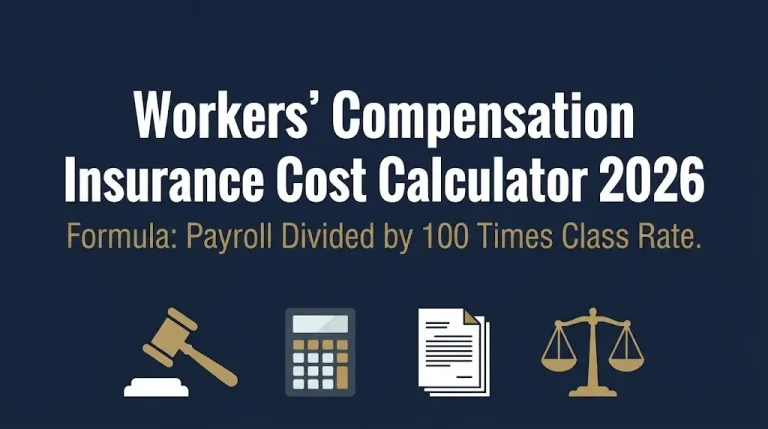
Each code groups similar jobs with similar risks. The insurer applies a rate per $100 of payroll for each code. Your total premium is the payroll multiplied by the rate, adjusted for experience modifiers and other factors.
For example, a clerical worker might be code 8810. A restaurant worker might be code 9082. The rates differ because the risk differs. A clerical worker rarely gets injured on the job. A restaurant worker faces burns, slips, and cuts.
The system is like a store return policy with a restocking fee. Some products are more likely to come back than others. The store charges more for the ones that cost more to handle. Workers compensation codes do the same for job risks.
Key Takeaway: The code is not a label. It is a pricing tool that insurers use to match premium to risk.
What is the NCCI workers compensation code system?
The NCCI is the largest rating bureau. It manages the classification system for about 38 states. The remaining states use independent bureaus but often follow similar coding logic.
The NCCI publishes a manual called the Scopes Manual. It lists every code, describes the work covered by each code, and explains the rules for assigning codes. Employers and insurers use the manual to determine the right classification.
The NCCI does not set the final premium. Insurers set rates based on the NCCI’s loss costs and their own business factors. But the code is the foundation. If the code is wrong, the premium is wrong.
Here is how the system works in practice:
- The employer describes the business operations.
- The insurer or auditor assigns one or more codes.
- Each code has a rate per $100 of payroll.
- The payroll for each code determines the base premium.
- Experience modifiers and discounts adjust the final price.
What is the difference between NCCI and state-specific codes?
Most states use NCCI codes. A few states have their own systems. The monopolistic states, like Ohio and Washington, run their own workers compensation funds and use different coding structures.
California uses its own bureau but the codes are similar to NCCI. New York also uses an independent board. The differences are usually in the rates, not the code numbers themselves.
If you operate in multiple states, you may see different codes or rates for the same work. That is normal. Each state has its own regulatory structure.
The important thing is to check which system applies to your state. Your policy declarations page will show the code and the bureau that issued it.
How do I find my workers compensation code?
Your code appears on your insurance policy. Look for the declarations page, sometimes called the dec page. It lists the classification code next to the payroll and rate.
If you do not have the policy handy, you can use the NCCI’s online lookup tool. It lets you search by keyword or industry description. The tool is free and public.
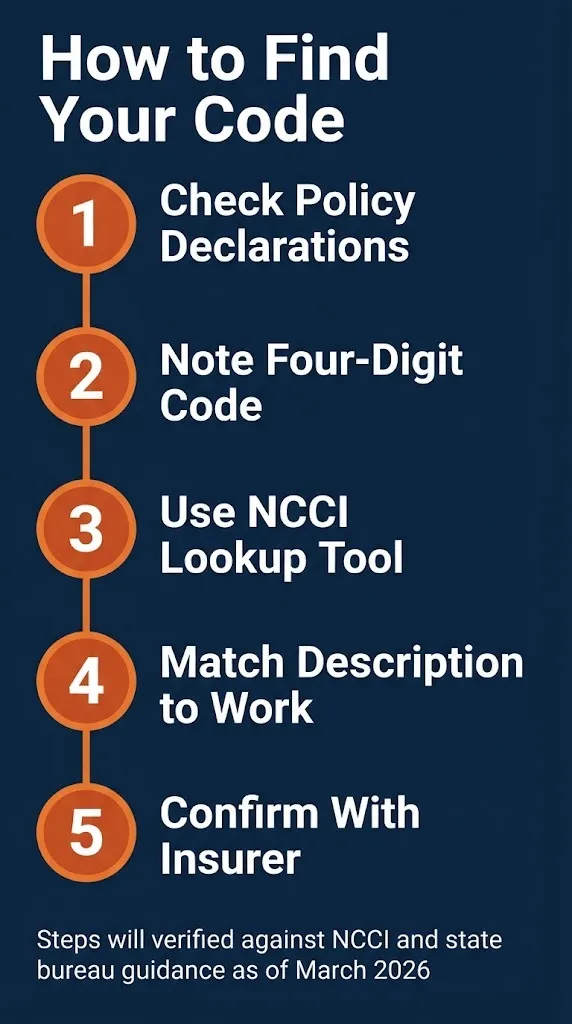
Here are the steps to find your code:
- Pull up your workers compensation policy declarations page.
- Look for a four-digit number in the classification section.
- Match that number to the description on your policy.
- If you do not have the policy, contact your insurance agent.
- Use the NCCI lookup tool for a general search by occupation.
- Verify the code matches the actual work your employees do.
What happens if my workers compensation code is wrong?
A wrong code can cost you real money. If your code is too high, you overpay premium. If your code is too low, you risk a surprise audit bill and potential fines.
The insurer conducts audits, usually annually. The auditor reviews your payroll and your actual operations. If the auditor finds that your code does not match the work, the insurer reclassifies you and adjusts the premium retroactively.
A retroactive increase can be brutal. You may owe thousands of dollars in back premium. That is why it matters to get the code right from the start.
You can dispute a classification. Each state has an appeals process. You can file a grievance with the rating bureau or your state insurance department. The process takes time but may save you money if the code is genuinely wrong.
Key Takeaway: The code on your policy is not permanent. It can change at audit, and the change can cost you.
How are workers compensation codes assigned?
Codes are assigned based on the primary business operation. The governing classification rule says the code should reflect the work that generates the most revenue or occupies the most employees.
Some businesses have multiple operations. A single company may have clerical staff, delivery drivers, and warehouse workers. Each operation may get its own code, with payroll assigned to each.
The assignment process starts when you buy the policy. The insurer asks what your business does. The underwriter assigns codes based on your description. The audit later verifies that the assignment was correct.
Here are the common assignment scenarios:
- Single operation: one code for all employees.
- Multiple operations: separate codes for each type of work.
- Standard exceptions: clerical and outside sales often get separate codes.
- Governing classification: the main business code applies to all unless a separate rule applies.
What are the most common workers compensation codes?
Some codes appear in nearly every policy. Clerical office employees, outside salespeople, and drivers are common classifications.
Here is a verified table of common NCCI codes:
| Code | Description |
|---|---|
| 8810 | Clerical Office Employees |
| 8742 | Outside Salespersons |
| 9082 | Restaurant NOC |
| 5645 | Carpentry |
| 5403 | Carpentry NOC |
| 5183 | Plumbing |
| 5190 | Electrical Wiring |
| 7380 | Drivers, Chauffeurs |
| 8017 | Retail Store NOC |
| 9063 | Fitness Center |
These codes are current as of the latest NCCI Scopes Manual. Rates vary by state and insurer.
What is a governing classification?
The governing classification is the code that best describes the primary business. It applies to all employees unless a specific exception allows a separate code.
For example, a plumbing company has plumbers as the governing class. The office secretary also works for the company. The secretary could be separately classified as clerical if the payroll is kept separate and the work qualifies.
The governing classification matters because it sets the baseline. If the governing class is wrong, everything downstream is wrong.
Can an employer have multiple workers compensation codes?
Yes. Many employers have more than one code. The rule is that each distinct operation gets its own code, provided the payroll can be separated.
You cannot assign one employee to two codes for the same work. But you can assign different groups of employees to different codes if their work is genuinely different.
The auditor will verify the separation. If you claim a lower-risk code for a portion of your workforce, you need records to support that. Payroll records, job descriptions, and time-tracking data all help.
Key Takeaway: Multiple codes are allowed, but only if the work and payroll are actually separate.
How do workers compensation codes affect injured workers?
The code affects the employer’s premium, not the worker’s benefit amount. If you are injured, your benefits are calculated based on your wages and your state’s benefit formula, not the employer’s code.
The code may affect how the insurer handles the claim. Some codes are flagged for higher scrutiny. A code with a high fraud rate may trigger more investigation. But that is an internal insurer matter, not something that changes your legal rights.
If you are an injured worker, you do not need to know the code to file a claim. The claim process is about your injury, your wages, and your medical treatment.
What is the workers compensation code lookup process?
The lookup process is straightforward. You search by keyword, industry, or code number. The NCCI tool returns matching codes with descriptions.
You can also check your state bureau if you live in a non-NCCI state. California, New York, and a few others have their own lookup tools.
Here is how to use the lookup:
- Go to the NCCI classification lookup tool.
- Enter a keyword like “restaurant” or “plumbing.”
- Review the matching codes and descriptions.
- Open the detailed description to see what work is included.
- Note the code number and the payroll assignment rules.
- Compare the description to your actual operations.
- Confirm with your insurer before making changes.
What is the classification code appeal process?
If you believe your code is wrong, you can appeal. The process varies by state but generally follows the same path.
First, ask your insurer to review the classification. The insurer may correct the code without a formal appeal. If the insurer refuses, you can file a dispute with the rating bureau or the state insurance department.
The appeal requires evidence. You need to show what your employees actually do and why the assigned code does not fit. Job descriptions, photos, and payroll records all help.
The appeal can take months. But if you win, the correction applies retroactively to the start of the policy period. That can mean a refund.
Key Takeaway: The appeal is slow, but a wrong code is worth challenging. The refund can be substantial.
What is the difference between workers compensation codes and NAICS codes?
They are different systems. NAICS codes classify businesses for government statistical purposes. Workers compensation codes classify businesses for insurance pricing.
Do not confuse them. Your NAICS code is assigned by the Census Bureau. Your workers compensation code is assigned by the rating bureau. They may look similar, but they serve different purposes.
Your insurance policy uses the workers compensation code. Your tax forms may use the NAICS code. They are not interchangeable.
Reality Check
No one from a government agency will call you about a workers compensation code violation. The rating bureaus and insurance departments do not make collection calls. If someone calls claiming you owe money because of a wrong code, verify the claim in writing before paying anything. Legitimate premium adjustments come through your insurer, in writing, with a clear explanation of the code change and the payroll basis.
What Happens Next
| Timeline | Expected Stage |
|---|---|
| Now | Review your current policy declarations page |
| Within 30 days | Verify your code against the NCCI lookup tool |
| If wrong | Contact your insurer for a classification review |
| If disputed | File an appeal with the rating bureau or state |
| Annual audit | Confirm the code still matches your operations |
These steps are standard practice. No court order or filing deadline applies to a code correction.
Frequently Asked Questions
What are workers compensation codes?
They are four-digit numbers that classify job types by risk level for insurance pricing.
How do I find my workers compensation code?
Check your policy declarations page or use the NCCI online lookup tool.
Who assigns workers compensation codes?
Your insurer assigns the code, subject to verification by the rating bureau and annual audits.
Can I have more than one workers compensation code?
Yes, if your business has separate operations with separate payroll records.
What happens if my code is wrong?
Your premium may be adjusted retroactively, up or down, after an audit or appeal.
Do workers compensation codes affect my benefits?
No. Injured worker benefits are based on wages and state law, not the employer’s code.
How many workers compensation codes exist?
The NCCI system has over 700 active codes.
Can I appeal a workers compensation code?
Yes. You can request a review from your insurer and escalate to the rating bureau or state agency.
The Code Is Boring. The Mistake Is Expensive.
Nobody lies awake thinking about four-digit classification codes. But a wrong code is a quiet leak in your business budget. It drips every payroll period. Over a year, it becomes a flood.
Check your code. It takes five minutes. Then set a reminder to check it again at your annual audit. That habit is the difference between paying the right price and paying for someone else’s mistake.