Indiana Workers Compensation 2026: How Claims Work, What Benefits Pay, and Deadlines That Control Everything
Quick Answer
- Indiana workers compensation covers medical care and wage loss for work-related injuries, regardless of fault.
- Most Indiana employers with one or more employees must carry workers compensation insurance.
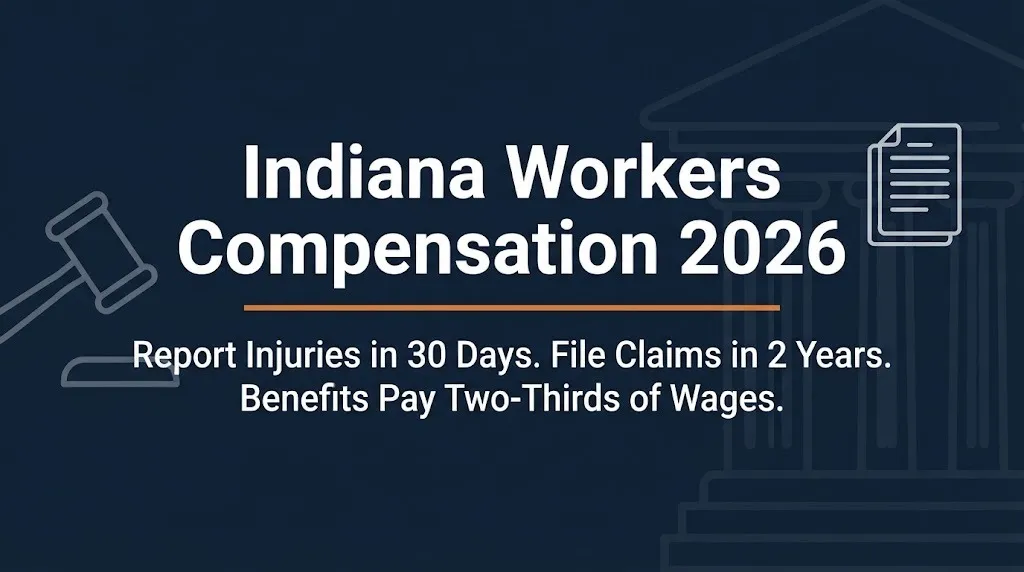
- Injured workers must report injuries within 30 days and file a claim with the Board within two years.
You got hurt at work in Indiana. You filed a report. Now you are dealing with the insurance company, the Board, and a system that feels complicated.
The Indiana Workers Compensation Board is the state agency that runs the system. It is not your advocate. It is the referee. The Board administers the rules, resolves disputes, and makes sure benefits are paid according to law.
This article explains how Indiana workers compensation works, what benefits you can receive, how to file a claim, and the deadlines that will end your case if you miss them.
The Facts
| Fact | Verified Value |
|---|---|
| Agency | Indiana Workers Compensation Board |
| Coverage Requirement | Most employers with one or more employees |
| Injury Reporting Deadline | 30 days |
| Claim Filing Deadline | 2 years from injury |
| Benefit Types | Medical, wage loss, disability, death |
| Dispute Resolution | Board hearings and appeals |
What is the Indiana Workers Compensation Board?
The Indiana Workers Compensation Board is the state agency that oversees the workers compensation system. It is headquartered in Indianapolis. The Board handles claims, resolves disputes, and enforces Indiana’s workers compensation law.
The Board does not pay benefits directly in most cases. The employer’s insurance carrier pays. The Board supervises the process and decides disputes.
The Board has administrative judges who hear contested cases. Those judges make findings and award benefits. Their decisions can be appealed through the Board and then to the Indiana courts.
Key Takeaway: The Board is the referee. It does not write the checks. It decides who gets them.
Who must carry workers compensation insurance in Indiana?
Indiana requires most employers with one or more employees to carry workers compensation insurance. The rule is broader than in some states. Even a single employee triggers the requirement.
There are exceptions. Some agricultural employers, certain casual workers, and independent contractors are not covered. But the general rule is broad.
If your employer tells you there is no coverage, verify with the Board. Some employers misclassify workers or ignore the requirement. The Board can investigate.
Here is the coverage breakdown:
| Employer Type | Coverage Requirement |
|---|---|
| 1 or more employees | Required |
| Sole proprietor with no employees | Not required |
| Agricultural employers | Exemptions may apply |
| Independent contractors | Generally not covered |
| Domestic workers | Limited coverage |
Key Takeaway: Most Indiana workers are covered. Do not assume you are not.
What injuries are covered under Indiana workers compensation?
Workers compensation covers injuries that arise out of and in the course of employment. The injury must be work-related. Fault does not matter.
Covered injuries include:
- Sudden accidents like falls, cuts, and equipment injuries.
- Repetitive motion injuries like carpal tunnel syndrome.
- Occupational diseases caused by workplace exposure.
- Injuries that aggravate a pre-existing condition.
- Mental injuries in limited circumstances.
Injuries that happen while commuting to and from work are generally not covered. Injuries caused by intoxication or intentional self-harm are not covered.
Key Takeaway: Fault does not matter. The injury must be work-related. That is the test.
What benefits does Indiana workers compensation pay?
Indiana workers compensation pays several types of benefits. The main categories are medical benefits, wage loss benefits, disability benefits, and death benefits.
Medical benefits cover all reasonable and necessary treatment for the work injury. That includes doctor visits, surgery, hospitalization, prescriptions, and rehabilitation. There is no copay or deductible for the injured worker.
Wage loss benefits replace a portion of your lost income. Indiana pays temporary total disability at two-thirds of your average weekly wage, subject to a state maximum.
Here is the benefit breakdown:
| Benefit Type | What It Covers |
|---|---|
| Medical | All reasonable treatment |
| Temporary total disability | Two-thirds of average weekly wage |
| Permanent partial impairment | Based on impairment rating |
| Permanent total disability | Long-term wage replacement |
| Death benefits | Payments to surviving dependents |
The state maximum for weekly benefits changes periodically. Check the Board’s current rate schedule.
How do I file a workers compensation claim in Indiana?
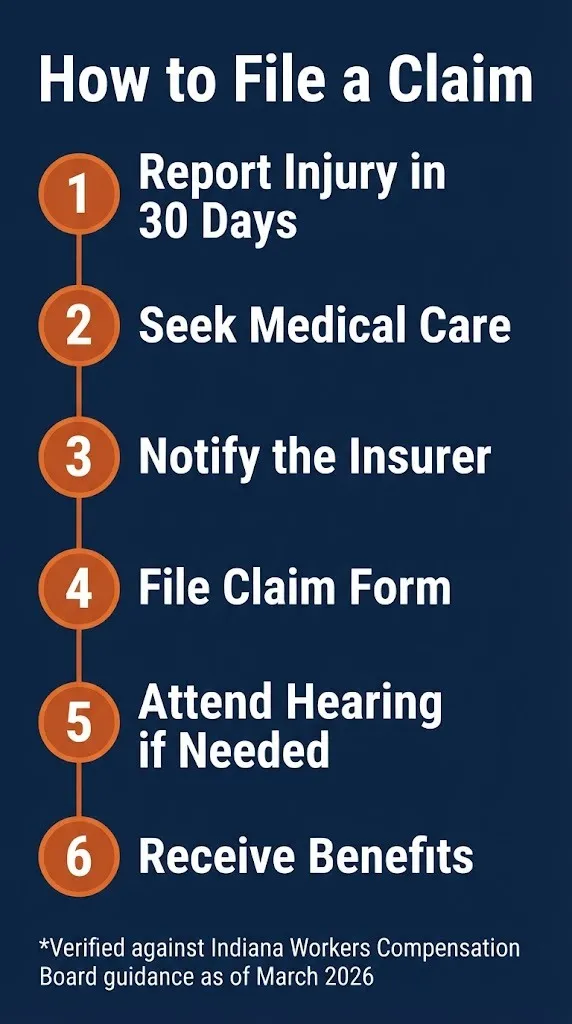
The process starts with reporting your injury. You must report it to your employer within 30 days. The employer then notifies its insurance carrier.
Here are the steps:
- Report the injury to your employer immediately, no later than 30 days.
- Seek medical treatment from an approved provider.
- Complete a claim form if your employer or insurer disputes the claim.
- File the form with the Indiana Workers Compensation Board.
- Keep records of all medical treatment and missed work.
- Consult a workers compensation lawyer if your claim is denied.
- File a formal claim with the Board within two years of the injury.
The 30-day reporting deadline is strict. Miss it, and you may lose your right to benefits. The two-year filing deadline is the outer limit for filing a formal claim.
Key Takeaway: Report early. The 30-day clock starts on the injury date.
What is the deadline for filing an Indiana workers compensation claim?
You have two years from the date of injury to file a formal claim with the Board. That is the statute of limitations for workers compensation in Indiana.
The two-year deadline is not the same as the 30-day reporting requirement. The 30-day rule is about notifying your employer. The two-year rule is about filing with the Board.
If your claim is being paid voluntarily, you may not need to file a formal claim. But if benefits are denied or stopped, the two-year clock matters. Do not wait two years to act.
There are limited exceptions. If the employer paid benefits voluntarily, the deadline may be extended. If the injury was not immediately discoverable, a discovery rule may apply. Do not guess. Get legal advice.
How are Indiana workers compensation disputes resolved?
Disputes go before an administrative judge at the Board. The judge holds a hearing, reviews evidence, and issues a decision. The decision can award benefits, deny the claim, or modify the benefit amount.
Either side can appeal the judge’s decision to the full Board. The full Board reviews the record and issues its own ruling. Further appeals go to the Indiana Court of Appeals.
The process is slower than most people expect. A contested claim can take months or years to resolve. That is why many cases settle before a hearing.
Here is the dispute path:
- Claim filed with the Board.
- Attempt at informal resolution.
- Hearing before an administrative judge.
- Decision issued.
- Appeal to the full Board.
- Appeal to state court if necessary.
Key Takeaway: Disputes take time. The hearing is not the first step. It is the last step before an appeal.
What are Indiana workers compensation settlements?
A settlement is an agreement to resolve the claim for a lump sum or structured payments. Settlements are common in workers compensation. They provide certainty for both sides.
In Indiana, settlements must be approved by the Board. The Board reviews the settlement to ensure it is fair and in the injured worker’s interest.
A settlement may close out your right to future medical benefits. Or it may leave medical benefits open while settling only the wage loss portion. The terms matter.
Here are the common settlement types:
| Settlement Type | What It Covers |
|---|---|
| Full and final | Closes the entire claim |
| Medical only | Settles medical benefits only |
| Indemnity only | Settles wage loss, leaves medical open |
| Structured | Payments over time instead of lump sum |
Do not settle until you understand what you are giving up. A lawyer can help you evaluate the offer.
How much are Indiana workers compensation settlements worth?
There is no fixed amount. The value depends on your injury, your wage loss, your medical needs, and your impairment rating.
A minor injury with a quick recovery may settle for a few thousand dollars. A serious injury with permanent impairment may settle for six figures. The range is wide.
Here are the factors that drive settlement value:
- The severity of your injury.
- Whether you need future surgery.
- Your average weekly wage.
- Your permanent impairment rating.
- Whether you can return to work.
- The strength of your medical evidence.
The insurance company will not offer its best number first. Negotiation is expected.
Key Takeaway: The settlement is a negotiation. Your medical records and wage history are your leverage.
Do I need a lawyer for an Indiana workers compensation claim?
Not for every claim. A simple injury with a quick approval may not need a lawyer. But you need a lawyer if your claim is denied, your benefits stop, or a settlement offer seems low.
Workers compensation lawyers in Indiana work on contingency. You pay nothing upfront. The lawyer takes a percentage of the recovery, usually 20 percent depending on the stage.
A lawyer can help with:
- Filing deadlines and paperwork.
- Gathering medical evidence.
- Negotiating a settlement.
- Representing you at a hearing.
- Appealing an adverse decision.
Key Takeaway: The system is designed for lawyers. You are not required to have one, but you are at a disadvantage without one.
What is the Indiana workers compensation insurance requirement?
Indiana requires most employers with one or more employees to carry workers compensation insurance. The insurance pays benefits when a worker is injured.
The employer can buy insurance from a private carrier or through the state’s assigned risk pool. Large employers may self-insure if they meet financial requirements.
If your employer tells you there is no coverage, verify with the Board. Some employers misclassify workers or ignore the requirement. The Board can investigate.
What happens if my employer does not have workers compensation insurance?
If your employer should have coverage but does not, the employer faces penalties. The state can fine the employer and issue a stop-work order.
You may still have a claim. Indiana has a mechanism for uninsured employer claims. You may also have a personal injury lawsuit against the employer.
The path is different when the employer is uninsured. A lawyer can explain your options. Do not assume you have no rights.
Reality Check
No one from the Board will call you to demand payment for your claim. The Board does not charge filing fees to injured workers. If someone asks you to pay to process a workers compensation claim, it is a scam. Legitimate claims are handled through the Board and the insurance carrier, not through third-party claim helpers.
What Happens Next
| Timeline | Expected Stage |
|---|---|
| Day 1 to 30 | Report injury to employer |
| Day 1 onward | Seek medical treatment |
| If denied | File formal claim with the Board |
| Before 2 years | File before the statute of limitations expires |
| If disputed | Hearing before an administrative judge |
These steps are standard for Indiana workers compensation claims. Your specific case may differ.
Frequently Asked Questions
What is the Indiana Workers Compensation Board?
The state agency that oversees workers compensation claims and disputes.
Who must carry workers compensation in Indiana?
Most employers with one or more employees.
What is the deadline to report a work injury?
30 days from the injury date.
What is the deadline to file a claim?
Two years from the injury date.
How much are workers compensation benefits?
Temporary total disability pays two-thirds of your average weekly wage, up to the state maximum.
Can I settle my Indiana workers compensation claim?
Yes, settlements are common and must be approved by the Board.
Do I need a lawyer for a workers compensation claim?
Not for simple claims. Yes for denied or disputed claims.
What if my employer does not have insurance?
You may still have a claim through the uninsured employer process.
The 30-Day Rule Is the First Gate
Indiana workers compensation starts with a report. The 30-day reporting deadline is the first gate. Miss it, and the path gets harder.
Report the injury. Document everything. Meet the deadlines. The Board is there to resolve disputes, but it cannot help you if you do not follow the process.