What Is a Civil Litigation Attorney in 2026: Role, Costs, and When You Need One
Quick Answer:
- A civil litigation attorney represents clients in non-criminal legal disputes, from contract breaches to personal injury claims.
- Most civil litigation attorneys charge hourly rates or contingency fees depending on the case type.
- You need one when a dispute cannot be resolved through negotiation and court action becomes necessary.
You got sued. Or you need to sue someone. The dispute is not criminal. It involves money, property, a contract, or an injury. You keep hearing the term “civil litigation attorney” and wonder what that actually means.
The short answer: a civil litigation attorney is a lawyer who handles lawsuits that are not criminal cases. They represent people and businesses in court fights over money, rights, and obligations.
This article explains what these lawyers actually do, what they cost, how they differ from other attorneys, and how to know when you need one in 2026.
The most surprising verified fact: the vast majority of civil lawsuits never reach trial. More than 90 percent settle before a judge or jury decides the case. That means a civil litigation attorney spends most of their time negotiating, not arguing in court.
The Facts
| Detail | Verified Information |
|---|---|
| Role | Represents clients in non-criminal legal disputes |
| Practice Areas | Contracts, personal injury, property, employment, business disputes |
| Fee Structures | Hourly, contingency, flat fee, or hybrid |
| Settlement Rate | More than 90 percent of civil cases settle before trial |
| Court Involvement | Federal and state civil courts |
| Typical Timeline | Months to years depending on complexity |
| Key Skill | Negotiation, discovery, motion practice, trial advocacy |
What is a civil litigation attorney?
A civil litigation attorney is a lawyer who represents clients in non-criminal legal disputes that may end up in court.
The term “civil litigation” covers a huge range of legal conflicts. Contract disputes. Personal injury claims. Employment discrimination cases. Property fights. Business partnership breakups. Any legal disagreement that is not a criminal prosecution falls under civil litigation.
The attorney’s job is to advocate for their client throughout the entire dispute process. That starts with evaluating the case, continues through investigation and negotiation, and may end in trial or settlement.
Here is what a civil litigation attorney typically does:
- Evaluates whether the client has a viable legal claim or defense.
- Investigates the facts and gathers evidence.
- Drafts legal documents, including complaints, answers, and motions.
- Conducts discovery, which means exchanging information with the other side.
- Negotiates settlements at every stage of the case.
- Represents the client in court hearings and at trial.
- Appeals unfavorable decisions when warranted.
The lawyer is both a strategist and an advocate. They think several moves ahead, but they also fight hard in the courtroom when necessary.
What is the difference between a civil litigation attorney and other lawyers?
The difference comes down to what the lawyer does with the dispute.
Some lawyers only advise. They draft contracts, review documents, and tell clients what the law says. They never set foot in court. Those are transactional lawyers.
A civil litigation attorney handles disputes. They get involved when a deal breaks down, an injury occurs, or a right is violated. Their job is to resolve the conflict, through negotiation or through court.
Here is the comparison:
| Lawyer Type | What They Do |
|---|---|
| Civil litigation attorney | Handles disputes that may go to court |
| Transactional attorney | Drafts contracts and advises on deals |
| Criminal defense attorney | Defends clients against criminal charges |
| Estate planning attorney | Prepares wills and trusts |
| Family law attorney | Handles divorce, custody, and related matters |
Some lawyers do both transactional and litigation work. But in larger firms, the roles are often separate.
What types of cases does a civil litigation attorney handle?
A civil litigation attorney handles any non-criminal dispute that could end up in court.
The range is enormous. Here are the most common categories:
| Case Type | Examples |
|---|---|
| Contract disputes | Breach of contract, non-payment, defective work |
| Personal injury | Car accidents, slip and falls, product liability |
| Employment disputes | Discrimination, wrongful termination, wage claims |
| Real estate disputes | Boundary fights, easements, landlord-tenant issues |
| Business litigation | Partnership breakups, shareholder disputes |
| Intellectual property | Trademark, copyright, patent infringement |
| Consumer protection | Deceptive practices, fraud, unfair billing |
If the case is not a criminal prosecution, it is likely a civil litigation matter. The attorney’s job is to win money, enforce a right, or stop harmful conduct.
How much does a civil litigation attorney cost?
Civil litigation attorneys charge in several ways, depending on the case type and the client’s situation.
The most common fee structures are:
| Fee Type | How It Works | Common Case Types |
|---|---|---|
| Hourly rate | You pay for every hour the lawyer works | Business disputes, contract cases |
| Contingency fee | The lawyer takes a percentage of your recovery | Personal injury, some employment cases |
| Flat fee | You pay a set amount for the entire case | Simple disputes, certain motions |
| Hybrid | A reduced hourly rate plus a bonus for success | Various |
Hourly rates vary widely. Small firm and solo attorneys charge less than large firm partners. Geographic location matters too. A civil litigation attorney in a major city charges more than one in a rural area.
Contingency fees are common in personal injury cases. The lawyer receives nothing upfront. If they win, they take about a third of the recovery. If they lose, they get nothing.
Key Takeaway: The fee structure depends on your case type. Personal injury plaintiffs usually pay nothing upfront. Business litigants usually pay hourly.
How much does a civil litigation lawyer charge per hour?
Hourly rates for civil litigation lawyers vary widely, from a few hundred dollars to over a thousand dollars per hour.
The rate depends on several factors. The lawyer’s experience. The firm’s size. The case’s complexity. The geographic market.
Here is a general framework:
| Experience Level | Typical Hourly Rate Range |
|---|---|
| Junior associate | $200 to $400 per hour |
| Senior associate | $300 to $600 per hour |
| Partner at mid-size firm | $400 to $800 per hour |
| Partner at large firm | $700 to $1,500 per hour |
These are not universal figures. A solo practitioner in a small town may charge $150 per hour. A top trial lawyer in New York may charge $2,000 per hour.
The cost of litigation is one reason most cases settle. The legal fees alone can exceed the amount in dispute.
Reality Check
Civil litigation is expensive and slow. Even a relatively simple case can take a year and cost tens of thousands of dollars in legal fees. Before you sue anyone, ask your lawyer whether the likely recovery justifies the cost. A good civil litigation attorney will tell you when a case is not worth pursuing. A bad one will take your money and litigate a losing battle.
What is civil litigation law?
Civil litigation law is the body of rules and procedures that governs non-criminal legal disputes in court.
It is not a single statute. It is a framework that includes procedural rules, evidentiary rules, and substantive law across every area of civil dispute.
Here is what civil litigation law covers:
| Component | What It Governs |
|---|---|
| Civil procedure | How cases move through the court system |
| Evidence | What proof can be presented |
| Substantive law | The actual legal rules for each type of dispute |
| Remedies | What a winning party can recover |
| Appeals | How to challenge an unfavorable decision |
The procedural rules are critical. A case can be won or lost on procedure alone, before the substance is ever considered.
What is a civil litigation lawyer’s role in a lawsuit?
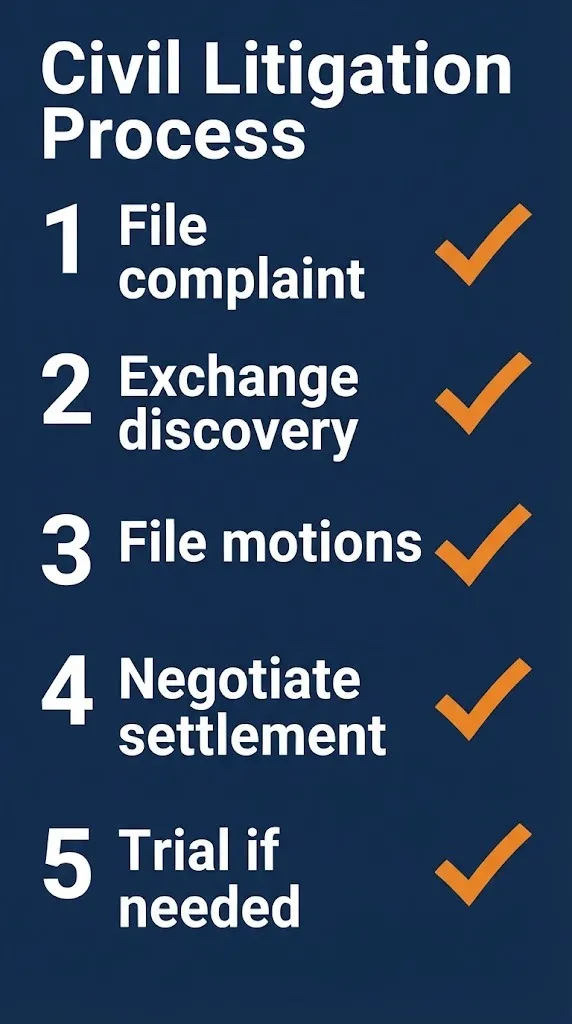
A civil litigation lawyer guides the case from the initial complaint through resolution, whether by settlement or trial.
The role shifts at each stage of the case. Here is the breakdown:
| Stage | What the Lawyer Does |
|---|---|
| Pre-litigation | Investigates, demands, negotiates |
| Filing | Drafts and files the complaint or answer |
| Discovery | Exchanges documents, takes depositions |
| Motions | Files legal arguments to narrow or resolve the case |
| Settlement | Negotiates and drafts settlement agreements |
| Trial | Presents evidence and arguments to judge or jury |
| Appeal | Challenges errors after trial if necessary |
The lawyer is not just a courtroom advocate. They are a strategist who positions the case for the best possible outcome at every stage.
What is attorney civil litigation practice?
Attorney civil litigation practice means the lawyer’s day-to-day work focuses on handling disputes through the court system.
A civil litigation attorney does not just try cases. Most of their work happens outside the courtroom.
Here is what the practice actually looks like:
- Meeting with clients to understand the dispute.
- Researching the law and evaluating the case.
- Drafting pleadings, motions, and discovery requests.
- Reviewing documents produced by the other side.
- Taking and defending depositions.
- Negotiating with opposing counsel.
- Preparing for and attending court hearings.
- Trying cases when settlement fails.
The work is document-heavy. A typical litigation case produces thousands of pages of records. Managing that volume is a core part of the job.
What is a civil litigation lawyer versus a trial lawyer?
A civil litigation lawyer handles all stages of a dispute. A trial lawyer specializes in the courtroom portion.
The terms overlap but are not identical. Every trial lawyer is a litigator. Not every litigator is a trial lawyer.
Here is the distinction:
| Role | Focus |
|---|---|
| Civil litigation attorney | Entire dispute process, from filing to resolution |
| Trial lawyer | Courtroom advocacy, jury selection, witness examination |
Many civil litigation attorneys rarely go to trial because most cases settle. A trial lawyer, by contrast, spends significant time in court.
For most clients, the distinction matters less than the lawyer’s overall competence and experience with the specific type of dispute.
What happens next in a civil litigation case?
Here is the typical timeline for a civil lawsuit in 2026:
- Month 1: Complaint filed, defendant served, answer due.
- Months 2 to 6: Initial disclosures, discovery planning, early motions.
- Months 6 to 18: Document discovery, depositions, expert reports.
- Months 12 to 24: Summary judgment motions, settlement negotiations.
- Months 18 to 36: Trial, if no settlement is reached.
These timelines vary widely by case complexity and court backlog. The key point: civil litigation is not fast. Patience is required.
Frequently Asked Questions
What is a civil litigation attorney?
A civil litigation attorney is a lawyer who handles non-criminal legal disputes that may go to court.
What is the difference between civil litigation and criminal law?
Civil litigation involves disputes between private parties over money or rights. Criminal law involves prosecution by the government for crimes.
How much does a civil litigation attorney cost?
Costs vary. Hourly rates, contingency fees, and flat fees are all used depending on the case type.
When do I need a civil litigation attorney?
You need one when a dispute cannot be resolved through negotiation and court action becomes necessary or likely.
What types of cases do civil litigation attorneys handle?
They handle contract disputes, personal injury, employment cases, real estate fights, business disputes, and more.
Do most civil cases go to trial?
No, more than 90 percent of civil cases settle before trial.
What is the difference between a litigator and a trial lawyer?
A litigator handles all stages of a dispute. A trial lawyer specializes in courtroom advocacy.
Can a civil litigation attorney represent me in any state?
No, lawyers must be licensed in the state where they practice, though some cases allow pro hac vice admission.
Closing
The most important decision in any civil dispute is choosing the right attorney at the right time.
Do not wait until a lawsuit is filed against you. Consult a civil litigation attorney early, understand your position, and make an informed decision about whether to fight or settle.