What Percentage Does a Lawyer Take From a Settlement 2026: Fee Structures and Real Numbers
Quick Answer:
- Most personal injury lawyers take 33 to 40 percent of a settlement, with 33 percent being the most common.
- Attorney fees are deducted from the gross settlement before medical liens and case costs.
- You can negotiate the percentage, especially in clear-liability cases that settle quickly.
A lawyer’s percentage from a settlement in 2026 depends on the case type, the fee agreement you signed, and whether the case settles before or after a lawsuit is filed. Most personal injury lawyers work on contingency, meaning they get paid only if you win. That percentage is usually 33 percent, but it can range from 25 to 40 percent depending on the circumstances.
If you’re searching this term, you probably got a settlement offer or you’re about to sign a fee agreement. The number in that agreement controls how much of your settlement stays in your pocket.
This article breaks down the standard percentages, the variables that change them, and how to calculate what you actually take home after fees, costs, and medical liens.
The Facts
| Item | Verified Details |
|---|---|
| Standard Personal Injury Fee | 33% before lawsuit, 40% after filing |
| Typical Range | 25% to 40% |
| Workers Compensation Fee | State-capped, often 20% to 25% |
| Class Action Fee | Court-approved, typically 25% to 33% |
| Fee Basis | Contingency, paid only if you win |
| Deduction Order | Fee first, then costs, then liens |
| Negotiable | Yes, especially in clear-liability cases |
Is a 33 percent lawyer fee standard?
Yes, a 33 percent contingency fee is the standard for most personal injury cases in 2026. That means the lawyer receives one-third of your gross settlement if your case settles before a lawsuit is filed.
The percentage typically increases to 40 percent if the lawyer has to file a lawsuit and litigate the case. That jump reflects the additional work, risk, and expense of court proceedings. Some firms use a sliding scale instead, charging 33 percent for pre-lawsuit settlements, 40 percent for cases that settle during litigation, and 50 percent for cases that go to trial.
The American Bar Association does not set fee schedules. Each lawyer sets their own percentage, subject to ethical rules that prohibit unreasonable fees. What’s standard in one state or practice area may differ in another.
How are contingency fees calculated?
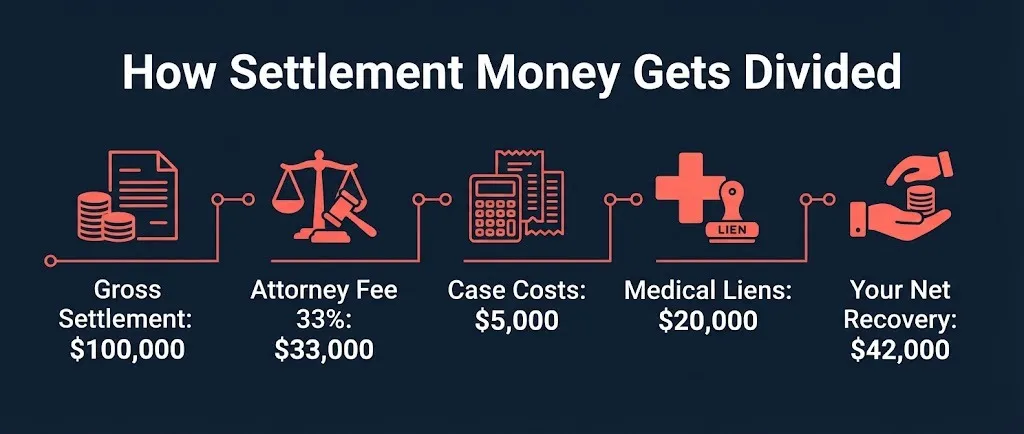
Contingency fees are calculated from the gross settlement amount before any deductions. The lawyer’s percentage comes off the top, then case costs and medical liens are subtracted from your remaining share.
Here’s how the math works on a $100,000 settlement with a 33 percent fee:
| Item | Amount |
|---|---|
| Gross settlement | $100,000 |
| Attorney fee (33%) | $33,000 |
| Case costs | $5,000 |
| Medical liens | $20,000 |
| Your net recovery | $42,000 |
The fee is calculated before costs and liens, not after. That detail surprises many clients. The lawyer’s percentage applies to the entire settlement, even though you never see the money that goes to medical providers or case expenses.
Key Takeaway: The attorney fee comes off the gross settlement first, then costs and liens reduce what remains; your net recovery is often far less than the headline number.
What percentage do lawyers take in different case types?
Lawyer percentages vary by case type. Personal injury cases use the standard 33 to 40 percent model. Other cases follow different rules.
Here’s the breakdown by case type:
| Case Type | Typical Percentage |
|---|---|
| Personal injury pre-lawsuit | 33% |
| Personal injury after filing | 40% |
| Personal injury trial | 40% to 50% |
| Workers compensation | 20% to 25%, state-capped |
| Medical malpractice | 33% to 40%, sometimes state-capped |
| Class action | 25% to 33%, court-approved |
| Employment discrimination | 33% to 40% |
| Social Security disability | 25% or $7,200, whichever is less |
Some states cap contingency fees in specific case types. Medical malpractice and workers compensation often have statutory limits. Check your state’s rules before signing.
Can you negotiate a lower lawyer percentage?
Yes, you can negotiate a lower lawyer percentage, especially in clear-liability cases that are likely to settle quickly. The standard 33 percent is not a legal requirement.
Lawyers are more willing to reduce their fee when the case is strong, the insurance policy limits are clear, and the work involved is minimal. A rear-end collision with a police report and clear fault may justify a 25 percent fee. A complex medical malpractice case may not.
Negotiate before you sign the fee agreement, not after. Once the contract is signed, changing the percentage requires the lawyer’s consent.
Key Takeaway: Fee percentages are negotiable upfront; strong, simple cases give you leverage to ask for 25 percent instead of 33 percent.
What are case costs and who pays them?
Case costs are expenses the lawyer advances to pursue your claim. They include filing fees, expert witness charges, medical record requests, deposition costs, and investigation expenses.
You pay case costs from your settlement share, even if the lawyer also charges a contingency fee. The lawyer typically advances these costs during the case and recovers them from the settlement before you receive your portion.
Here’s what common costs look like:
| Expense | Typical Range |
|---|---|
| Court filing fee | $200 to $500 |
| Medical records | $100 to $1,000 |
| Expert witness | $2,000 to $10,000+ |
| Deposition costs | $1,000 to $5,000 |
| Investigation | $500 to $2,500 |
In a $100,000 settlement with $5,000 in costs, those costs come out of your share after the attorney fee. The lawyer does not absorb them unless the case loses and the fee agreement says so.
Do lawyers get paid if you lose?
Lawyers working on contingency do not get paid if you lose. The contingency fee means no recovery, no fee.
But case costs are different. Some fee agreements require you to reimburse costs even if you lose. Others say the lawyer absorbs costs on a loss. Read the agreement carefully before signing. This one clause can mean the difference between owing nothing and owing thousands after an unsuccessful case.
The standard in personal injury is that the client does not owe costs on a loss, but that standard is not universal. Confirm it in writing.
Reality Check: No legitimate contingency fee lawyer will ask for money upfront. If a lawyer demands a retainer for a personal injury case, that’s a red flag. The contingency model exists precisely so injured people can afford representation.
How do workers compensation fees differ?
Workers compensation fees differ from personal injury fees because they are capped by state law. Most states limit workers comp attorney fees to 20 to 25 percent of the recovery, and some require fee approval from the workers compensation commission or board.
Here’s the breakdown for selected states:
| State | Workers Comp Fee Cap |
|---|---|
| California | 9% to 15%, judge-approved |
| Texas | 25%, state-approved |
| New York | 15% to 20%, board-approved |
| Florida | 20% to 25%, judge-approved |
| Illinois | 20%, commission-approved |
These caps apply to disputed benefits and settlements. Benefits the insurer paid voluntarily before a dispute generally have no fee attached.
What percentage do class action lawyers take?
Class action lawyers take a court-approved percentage of the settlement fund, typically 25 to 33 percent. The judge reviews the fee request and determines whether it’s reasonable based on the work performed and the result achieved.
Class action fees come out of the settlement fund before class members receive their shares. A $100 million settlement with a 30 percent fee leaves $70 million for the class after fees and costs.
The judge considers several factors, including the risk the lawyers took, the time spent, the complexity of the case, and the benefit to class members. Fee awards are often challenged by objectors who argue the lawyers are taking too much.
Key Takeaway: Class action fees are court-controlled and typically range from 25 to 33 percent of the fund, deducted before class member payments.
How do I calculate my net settlement after fees?
Calculating your net settlement after fees requires subtracting the attorney fee, case costs, and medical liens in the correct order. The order matters.
Follow these steps:
- Start with the gross settlement amount.
- Subtract the attorney fee percentage.
- Subtract case costs the lawyer advanced.
- Subtract medical liens and subrogation claims.
- Subtract any other legal obligations.
- The remainder is your net recovery.
For a $100,000 settlement with a 33 percent fee, $5,000 in costs, and $20,000 in medical liens, your net is $42,000. That’s 42 percent of the gross. Knowing this before you settle helps you evaluate whether the offer is actually fair.
What should I look for in a fee agreement?
A fee agreement should spell out the percentage, how costs are handled, and what happens if you lose. Read every line before signing.
Here’s what to check:
- The exact percentage for pre-lawsuit and post-lawsuit stages.
- Whether costs are your responsibility on a loss.
- Whether the fee is calculated on gross or net recovery.
- Whether medical liens are negotiated before or after the fee.
- The process for changing lawyers if you’re unsatisfied.
- Whether the agreement complies with your state’s ethics rules.
- The arbitration or dispute resolution clause.
A clear fee agreement prevents arguments later. If anything is vague, ask for clarification in writing.
What percentage do lawyers take from a settlement before trial?
Lawyers typically take 33 percent of a settlement reached before a lawsuit is filed. Some take 25 percent for very simple cases, and some charge 40 percent even before litigation.
The pre-lawsuit percentage is almost always lower than the post-lawsuit percentage because the work is less. A case that settles after a demand letter and negotiation costs less in time and expense than one that goes through discovery and depositions.
Ask your lawyer what percentage applies at each stage. The answer should match what’s written in your fee agreement.
What percentage do lawyers take from a settlement after a lawsuit is filed?
Lawyers typically take 40 percent of a settlement reached after a lawsuit is filed. Some charge 45 to 50 percent if the case goes to trial.
The higher percentage reflects the additional work and risk. Filing a lawsuit means drafting complaints, responding to motions, attending hearings, and preparing for trial. Each step adds hours and costs.
The 40 percent figure is standard but not universal. Some firms use a flat 33 percent regardless of stage. Others use a graduated scale that only reaches 40 percent after trial.
What happens next after you sign a fee agreement?
After you sign a fee agreement, the lawyer begins work on your case. The fee percentage locks in, and your relationship with the lawyer becomes a contractual one.
Here’s the typical timeline:
Week 1 to 4: Lawyer investigates your case and requests records.
Month 1 to 6: Lawyer communicates with insurers and builds the claim.
Month 3 to 12: Settlement negotiation or lawsuit filing.
Month 6 to 24: Settlement approval and fee deduction.
Month 9 to 30: Payment distribution after liens and costs.
The fee percentage applies at whatever stage your case resolves.
Frequently Asked Questions
What is the average lawyer percentage for a settlement?
The average is 33 percent for pre-lawsuit settlements and 40 percent after filing.
Can a lawyer take 50 percent of a settlement?
Yes, some lawyers charge 50 percent for cases that go to trial.
The fee must be reasonable under state ethics rules.
Do lawyers take a percentage of medical bills?
No, lawyers take a percentage of the gross settlement, not just medical bills.
Medical liens are separate deductions from your share.
What percentage does a lawyer take in a workers comp case?
Workers comp fees are state-capped, typically 20 to 25 percent.
Some states require judge approval of the fee.
Are attorney fees negotiable?
Yes, attorney fees are negotiable before you sign the fee agreement.
Strong, simple cases give you more leverage.
Do I have to pay taxes on my settlement after lawyer fees?
Most personal injury settlements for physical injuries are not taxable.
A tax professional can confirm your specific situation.
What happens to the lawyer fee if I fire my lawyer?
Your lawyer may have a lien on the settlement for work already performed.
The new lawyer and old lawyer typically split the fee.
Can I settle without a lawyer and avoid fees?
Yes, you can settle without a lawyer and keep the full amount.
But represented claimants often receive higher settlements, even after fees.
Closing
The percentage a lawyer takes from your settlement is negotiable before you sign. The standard is 33 percent, but strong cases can justify 25 percent, and complex cases may require 40 percent.
Before you sign any fee agreement, ask three questions: what percentage applies at each stage, who pays costs if you lose, and what your net recovery will be after fees, costs, and liens. The answer to the third question is the only number that matters.