Colorado Workers Compensation 2026: Benefit Rates, Deadlines, and Division of Workers Compensation Guide
Quick Answer
- What it is: A no-fault insurance system covering medical bills and partial wage replacement for work injuries.
- How much: Benefits pay 66.67% of your average weekly wage, capped at $1,396.85 per week.
- Deadline: Report to your employer in writing within 4 working days. File a formal claim within 2 years.
If you were hurt on the job in Colorado, the clock starts ticking immediately. The state’s workers’ compensation system is designed to get you medical care and partial wage replacement without a lawsuit, but the deadlines are strict and the paperwork matters.
Colorado’s Division of Workers’ Compensation (DWC) oversees the system. Employers must carry coverage, and the cost is paid entirely by the employer, not deducted from your wages . The system covers nearly 28,000 injured workers who file claims each year .
This article covers what is confirmed as of September 2026: the 2026 benefit rates, the reporting and filing deadlines, how to file a claim with the DWC, the difference between temporary total and temporary partial disability, and the role of the Uninsured Employer Fund. Everything here traces to the Colorado DWC, the Division of Insurance, and published legal guides.
What are the Colorado workers compensation benefit rates for 2026?
Colorado workers compensation benefits pay two-thirds of your average weekly wage, capped at a maximum of $1,396.85 per week for the 2025-2026 injury year. The minimum weekly benefit is $263.
The rate is set at 66.67% of your average weekly wage (AWW) . If you earn $1,200 per week, your benefit is $800 per week. If you earn $3,000 per week, your benefit caps at $1,396.85.

| Benefit Rate | 2026 Amount |
|---|---|
| Maximum weekly benefit | $1,396.85 |
| Minimum weekly benefit | $263 |
| Benefit percentage | 66.67% of AWW |
| Waiting period | 3 days |
| Retroactive pay after | 14 days |
| Max TTD duration | 104 weeks |
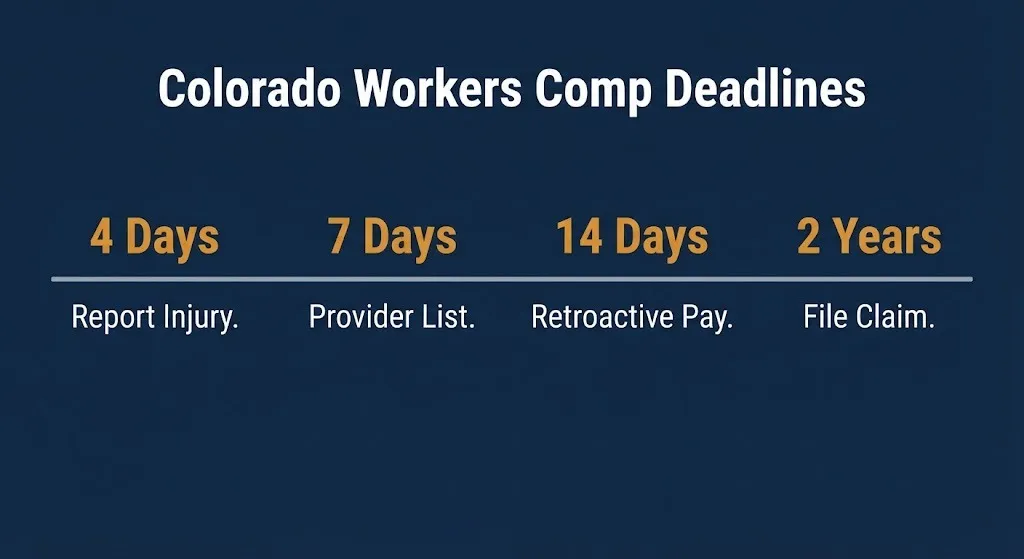
Colorado has a 3-day waiting period before benefits begin. If your disability lasts longer than 14 days, those first three days are paid retroactively .
The maximum rate is recalculated each July based on the state’s average weekly wage . The current rate applies to injuries occurring between July 1, 2025, and June 30, 2026. A new rate will take effect July 1, 2026, and should be confirmed on the DWC website.
All workers’ compensation benefits in Colorado are tax-free .
What is the deadline to report a work injury in Colorado?
You must report a work injury to your employer in writing within four working days of the injury. Missing this deadline can cost you one day of compensation for each day of delay.
The four-day reporting rule comes from Colorado workers’ compensation law. Even if you told your supervisor verbally, you should follow up in writing . Email works. Describe the injury, when it happened, what you were doing, and any witnesses. Keep a copy.
If you are physically or mentally unable to file a written report within four days, another person who has notice of your injury can file it on your behalf .
Your employer must provide a written list of designated medical providers within seven business days after you report the injury . You must seek treatment from that list in a non-emergency situation, or your claim may be denied.
Key Takeaway: The four-day reporting deadline is the single most important date in your Colorado workers’ comp case. A written report protects you from the most common denial reason: late notice.
What is the deadline to file a Colorado workers compensation claim?
You have two years from the date of injury to file a formal workers’ compensation claim with the Colorado Division of Workers’ Compensation. This is the statute of limitations for most claims .
For occupational diseases that develop over time, the clock starts from the date you discovered or reasonably should have discovered that the condition was caused by work . Common examples include carpal tunnel syndrome, hearing loss from prolonged noise exposure, and contact dermatitis.
If you miss the two-year deadline, your claim is usually time-barred. The insurance carrier will deny it, and a judge will almost always uphold the denial . There are narrow exceptions for employer fraud, minor status at the time of injury, and mental or physical incapacity.
The formal claim form is the Worker’s Claim for Compensation (WC15). You file it with the DWC Customer Service Unit at 707 17th Street, Suite 2300, Denver, CO 80202-3404 . You should mail or deliver two copies.
Filing the WC15 protects your rights even if the insurance carrier has been paying benefits voluntarily . It puts the DWC on notice and starts the formal process if a dispute arises.
How do you file a Colorado workers compensation claim?
Filing a Colorado workers compensation claim starts with a written report to your employer, then a formal claim with the DWC if benefits are denied or disputed. The process has specific steps and forms.
Here is the step-by-step process:
- Report the injury in writing to your employer within 4 working days. Keep a copy of the written notice.
- Get the designated provider list. Your employer must provide it within 7 business days.
- Seek treatment from a designated provider. Emergency care goes to the nearest hospital.
- File the Worker’s Claim for Compensation (WC15) with the DWC. Mail two copies to the address on the form.
- Keep your contact information updated with the DWC and the adjuster. Call 303-318-8700 or email [email protected] .
- Attend all medical appointments and follow treatment recommendations.
- Request a hearing if benefits are denied. The DWC schedules a hearing before an Administrative Law Judge.
Your immigration status is not a factor in determining eligibility for workers’ compensation benefits . All employees have the right to pursue a claim.
If you hire an attorney, the insurance adjuster cannot communicate with you directly . You can still contact the DWC customer service line with questions.
What is the difference between TTD and TPD in Colorado?
Temporary Total Disability (TTD) pays when you cannot work at all. Temporary Partial Disability (TPD) pays when you return to light-duty work at reduced wages.
TTD pays two-thirds of your average weekly wage, up to the $1,396.85 maximum, for up to 104 weeks . You receive TTD when your doctor says you cannot work in any capacity.
TPD pays two-thirds of the difference between your pre-injury wage and your current light-duty earnings under C.R.S. § 8-42-106 . If you earned $900 per week before the injury and now earn $600 per week in light duty, the wage loss is $300, and TPD pays about $200 per week .
TPD lasts as long as your temporary partial wage loss continues. There is no fixed durational limit in Colorado, but it ends when you reach maximum medical improvement (MMI) .
Both TTD and TPD are subject to the same statewide maximum tied to the average weekly wage. The cap is recalculated each July .
What is the Colorado Uninsured Employer Fund?
The Colorado Uninsured Employer (CUE) Fund provides financial assistance to workers injured while employed by an employer that did not carry workers’ compensation insurance. Not all employers in Colorado are covered, and the CUE Fund exists as a backstop.
If you were injured and your employer had no coverage, you must first file a Worker’s Claim for Compensation (WC15) with the DWC . You must attend a hearing and obtain a judge’s order awarding you workers’ compensation benefits. After that, you may apply for admission into the CUE Fund.
The DWC provides a tool to verify your employer’s coverage status . Checking coverage is a smart first step if you suspect your employer might be uninsured.
Colorado has seen 12 straight years of decreasing workers’ compensation loss costs, with a 6.9% reduction approved for 2026 alone . That trend reflects improving workplace safety, but it does not change the coverage requirements for employers.
How does the Colorado Division of Workers Compensation oversee claims?
The Colorado Division of Workers Compensation (DWC) is the state agency that administers the workers’ compensation system, oversees claims, and resolves disputes. It operates under the Colorado Department of Labor and Employment (CDLE).
The DWC’s responsibilities include claims management, coverage enforcement, medical policy, and cost containment . The Division Director is Paul Tauriello, who has led the agency since 2010 .
The DWC updates its rules of procedure annually. Rule 18, the Medical Fee Schedule, was effective January 1, 2026, along with exhibits covering evaluation and management guidelines, hospital rates, and dental fees . HIPAA X12 electronic billing became mandatory for all medical providers treating injured workers starting January 1, 2026 .
Mileage reimbursement for medical travel increased to $0.63 per mile as of January 1, 2026 . Keep track of your travel to medical appointments. That reimbursement adds up.
The DWC’s customer service line is 303-318-8700 or 1-888-390-7936. The email is [email protected] .
What should you do after a workplace injury in Colorado?
What you do in the first week after a workplace injury often determines whether your claim succeeds. The documentation you create now is the foundation of your case.
Here are the steps to protect your claim:
- Report the injury in writing within 4 working days. Send an email to your supervisor and HR. Keep a copy.
- Get the designated provider list from your employer. They must provide it within 7 business days.
- Seek treatment from a designated provider. Going outside the list can result in nonpayment of medical benefits .
- Document everything. Keep copies of medical records, work restrictions, and communications.
- Track your mileage to medical appointments. You can claim $0.63 per mile for 2026 .
- Do not give a recorded statement to the insurer without legal advice. What you say can be used to reduce or deny benefits.
- File the WC15 with the DWC if your claim is denied or disputed. The deadline is two years from injury.
If you use marijuana, be aware that Colorado employers can enforce drug-free workplace policies. If marijuana use contributed to your injury, your claim could be denied . Workers’ compensation insurers are not required to pay for medical marijuana.
What happens next in a Colorado workers compensation case?
The timeline for a Colorado workers’ compensation case depends on whether the claim is accepted or disputed. Most accepted claims resolve within a few months. Disputed claims can take a year or more.
Here is the expected sequence:
Day 0: Injury occurs. Report in writing within 4 working days.
Week 1-2: Employer provides designated provider list. You seek treatment.
Week 2-4: Insurance carrier accepts or denies the claim. If accepted, TTD or TPD benefits begin.
Month 2-6: Ongoing treatment and benefit payments. Maximum TTD duration is 104 weeks.
If disputed: File WC15 with DWC. The Division schedules a hearing before an Administrative Law Judge.
At MMI: Doctor determines you have reached maximum medical improvement. Permanent disability benefits may apply.
Settlement: Many cases resolve through a lump sum settlement or ongoing periodic payments .
The $1,396.85 maximum weekly rate applies to injuries in the current benefit year. Check the DWC website for the rate that applies to your injury date.
Frequently Asked Questions
What is the maximum workers comp benefit in Colorado for 2026?
The maximum temporary total disability benefit is $1,396.85 per week for injuries occurring between July 1, 2025, and June 30, 2026. The rate is recalculated each July.
How long do I have to report a work injury in Colorado?
You must report the injury to your employer in writing within 4 working days. Missing this deadline can cost you one day of compensation for each day of delay.
What is the statute of limitations for workers comp in Colorado?
You have two years from the date of injury to file a formal claim with the Division of Workers’ Compensation. For occupational diseases, the clock starts from the date you discovered the work connection.
Can I choose my own doctor for a workers comp injury in Colorado?
You must seek treatment from your employer’s designated provider list in non-emergency situations. Going outside the list can result in nonpayment of medical benefits. Colorado expanded worker rights to choose a treating physician in more circumstances in 2026.
What if my employer doesn’t have workers compensation insurance in Colorado?
The Colorado Uninsured Employer Fund provides financial assistance. You must first file a WC15 with the DWC, attend a hearing, and obtain a judge’s order awarding benefits before applying to the fund.
How long can I receive temporary total disability benefits in Colorado?
TTD benefits can last up to 104 weeks. TPD benefits last as long as your temporary partial wage loss continues and end at maximum medical improvement.
Are workers compensation benefits taxable in Colorado?
No. All workers’ compensation benefits in Colorado are tax-free.
The Bottom Line for Colorado Workers Compensation Claims
Colorado’s workers’ compensation system pays two-thirds of your average weekly wage, capped at $1,396.85 per week for the current injury year. The system is no-fault, meaning you do not have to prove your employer was negligent to receive benefits.
The two deadlines that matter most are the 4-working-day reporting requirement and the 2-year filing deadline. Report your injury in writing today, even if you think it is minor. The written report is your strongest protection against a late-notice denial.
If your claim is denied or your employer is uninsured, the DWC and the Uninsured Employer Fund provide paths forward. Check the official DWC website for the current benefit rate and forms.