Louisiana Workers Compensation 2026: Benefit Rates, Deadlines, and How the System Works
Quick Answer
- What it is: A no-fault insurance system covering medical care and partial wage replacement for work injuries in Louisiana.
- How much: Benefits pay two-thirds of your average weekly wage, capped at $881 or $903 depending on injury date.
- Deadline: Report your injury to your employer within 30 days. File a formal claim within one year.
If you were hurt on the job in Louisiana, the state’s workers’ compensation system is designed to get you medical care and partial wage replacement without requiring you to prove your employer was at fault. Louisiana requires nearly all employers to carry coverage . The system covers medical bills, wage replacement, vocational rehabilitation, and death benefits for surviving family members.
The Louisiana Office of Workers’ Compensation Administration (OWCA) oversees the system under the Louisiana Workforce Commission . Claims are handled administratively, not through the civil court system, unless a dispute escalates. The process moves faster than a personal injury lawsuit, but the deadlines are strict and the paperwork matters.
This article covers what is confirmed as of September 2026: the 2026 benefit rates, the reporting and filing deadlines, how to file a disputed claim, the difference between temporary total and supplemental earnings benefits, and a pending legislative study that could reshape coverage for gig workers and independent contractors.
What is Louisiana workers compensation and who is eligible?
Louisiana workers’ compensation is a state-mandated insurance program that pays medical bills and partial lost wages for employees injured on the job. It is a no-fault system, meaning you do not have to prove your employer was negligent to receive benefits .

To qualify for benefits, you must meet basic requirements:
- You must be an employee, not an independent contractor
- Your employer must have workers’ compensation insurance coverage
- Your injury or illness must have happened while performing work duties
- You must report the injury and file a claim according to Louisiana law
Independent contractors are generally not eligible for coverage. However, there is an important exception. If a substantial part of your work involves manual labor that is core to the hiring company’s trade or business, you may still qualify for benefits. Courts look at the level of control the company has over your work, the terms of your contract, and the nature of the tasks involved .
Louisiana law excludes independent contractors and single-member business entities from coverage, with certain exceptions. A single-member entity with no employees is not required to carry workers’ comp for itself .
How much are Louisiana workers compensation benefits in 2026?
Louisiana workers’ compensation benefits pay 66.67% of your average weekly wage, capped at a maximum that adjusts annually. For injuries occurring between September 1, 2026, and August 31, 2027, the maximum weekly benefit is $903 and the minimum is $241 .
For injuries occurring before September 1, 2026, the maximum was $881 and the minimum was $176 .
| Benefit Rate | Before Sept 1, 2026 | After Sept 1, 2026 |
|---|---|---|
| Maximum weekly benefit | $881 | $903 |
| Minimum weekly benefit | $176 | $241 |
| Benefit percentage | 66.67% of AWW | 66.67% of AWW |
| Waiting period | 7 days | 7 days |
| Retroactive after | 14 days | 14 days |
| Max TTD duration | 104 weeks | 104 weeks |
If you earn $1,200 per week, your benefit is $1,200 multiplied by 66.67%, which equals $800 per week. Since $800 is below the maximum, you receive the full $800 .
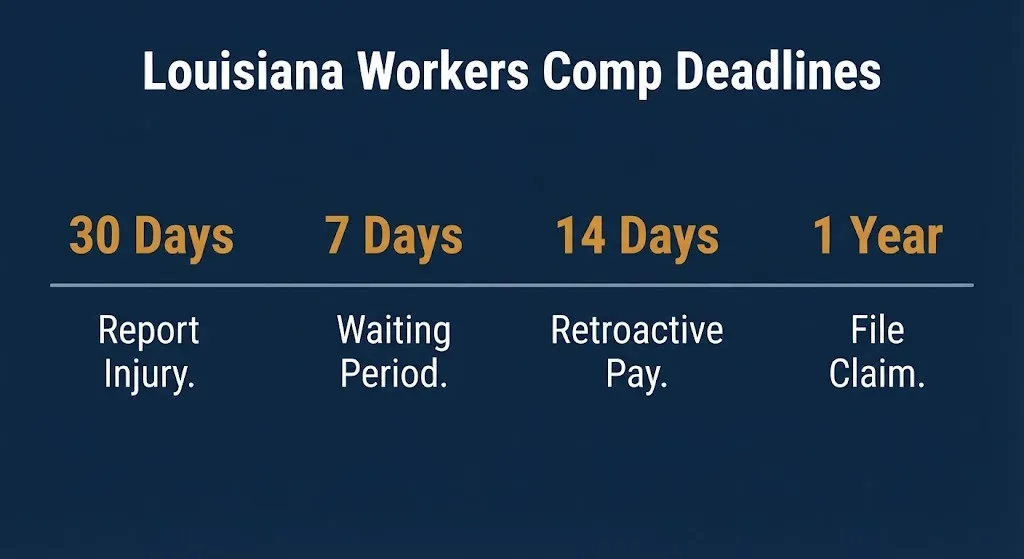
Louisiana has a 7-day waiting period before benefits begin. If your disability lasts more than 14 days, those first 7 days are paid retroactively .
All workers’ compensation benefits in Louisiana are tax-free.
Key Takeaway: The annual adjustment to benefit rates on September 1 means the maximum weekly benefit changes for new injuries. Verify which rate applies to your injury date before calculating your expected benefit.
What is the deadline to report a work injury in Louisiana?
You must report a work injury to your employer within 30 days of the accident or within 30 days of when you realized the injury was work-related. After that, you have up to one full year to file a formal workers’ compensation claim .
The 30-day reporting requirement is the first deadline. You should tell your supervisor or HR immediately, in writing if possible. Describe the injury, when it happened, what you were doing, and any witnesses. Keep a copy for your records.
The one-year filing deadline applies to the formal claim. You file a Disputed Claim for Compensation, Form LW-WC-1008, with the OWCA if benefits are denied or disputed . If your claim is accepted and benefits are being paid, you may not need to file a formal disputed claim unless a problem develops.
A Louisiana Supreme Court case from 2025 addressed the prescriptive period in a situation where an employer accommodated an injured worker with continued full-time employment at full salary. The court found that under La. R.S. 23:1209, the one-year prescriptive period still applies even when there is no initial loss of wages .
How do you file a Louisiana workers compensation claim?
Filing a Louisiana workers compensation claim starts with reporting the injury to your employer, then filing a formal disputed claim with the OWCA if benefits are denied or disputed. The process has specific steps and forms.
Here is the step-by-step process:
- Report the injury to your employer within 30 days. Give written notice if possible. Keep a copy.
- Seek medical treatment. Louisiana employees can choose their own treating physician .
- Submit medical bills to the employer or insurer. Medical benefits cover all reasonable and necessary treatment with no copays or deductibles .
- File Form LW-WC-1008 if benefits are denied or disputed. This is the Disputed Claim for Compensation .
- Attend the mediation conference if scheduled. OWCA offers mediation to resolve disputes .
- Prepare for a hearing before a workers’ compensation judge if mediation fails.
- Keep your contact information updated with the OWCA and the adjuster.
The OWCA process could take six to nine months, or longer if the case is appealed . You are not required to have an attorney, but you may contact one at any time during the process.
What is the difference between TTD and SEB in Louisiana?
Temporary Total Disability (TTD) pays when you cannot work at all. Supplemental Earnings Benefits (SEB) pay when you return to work but earn less than 90% of your pre-injury wages .
TTD pays 66.67% of your average weekly wage, up to the maximum, for up to 104 weeks . You receive TTD when your doctor says you cannot work in any capacity.
SEB kicks in if you return to work but cannot earn at least 90% of your pre-injury wages . The benefit is calculated based on the difference between your pre-injury wage and your current earnings.
For example, if you earned $900 per week before the injury and now earn $600 per week in light duty, the wage loss is $300. SEB would pay a portion of that difference, subject to the same statewide maximum.
Both TTD and SEB are subject to the same maximum tied to the statewide average weekly wage. The cap is recalculated each September 1 .
What is the Louisiana Workers’ Compensation Corporation?
The Louisiana Workers’ Compensation Corporation (LWCC) is a private, nonprofit mutual insurance company that serves as a carrier for Louisiana businesses. It was created in the 1980s as a market of last resort for businesses that could not get coverage from private insurers .
LWCC is not a state agency. It is a mutual insurance company rated A (Excellent) by AM Best with a long-term issuer credit rating of a+ as of June 2025 . It operates in a competitive market alongside private carriers.
Louisiana has 263 companies writing workers’ compensation insurance, producing a competitive market . Workers’ compensation rates in Louisiana have fallen consistently over two decades. The cumulative drop was -37% over the last five years, -49% over ten years, and -66% over 20 years as of December 2023 .
The total Louisiana workers’ compensation insurance market in 2023 was estimated at about $950 million in written premium .
What is the pending Louisiana gig worker coverage study?
Louisiana Senate Resolution 132, enrolled during the 2026 Regular Session, requests the Louisiana State Law Institute to study whether gig workers, 1099 contractors, and solo LLCs should be required to carry workers’ compensation or occupational accident insurance .
The resolution points to a workforce that no longer fits the old employer-employee model. It flags sole proprietors, independent contractors, owner-operators, gig workers, and single-member entities in transportation, construction, logistics, delivery, and home services as workers currently sitting outside the system .
The Senate’s concern is that the current setup may create gaps in coverage, increased uncompensated medical costs, and inconsistent treatment among similarly situated workers .
The study will examine whether occupational accident insurance, already offered in various states and industries as an alternative for independent contractors, should be treated as an acceptable substitute or supplement to workers’ compensation. The resolution also flags whether occupational accident products can lawfully be offered under existing Louisiana insurance and labor laws .
Important: Senate Resolution 132 does not change Louisiana law. It sets up a possible rewrite of how the state classifies and covers nontraditional workers. The Law Institute must deliver a written report to the House and Senate committees on labor and industrial relations by January 1, 2027 .
What should you do after a workplace injury in Louisiana?
What you do in the first 30 days after a workplace injury often determines whether your claim succeeds. The documentation you create now is the foundation of your case.
Here are the steps to protect your claim:
- Report the injury in writing within 30 days. Send an email to your supervisor and HR. Keep a copy.
- Choose your treating physician. Louisiana employees have the right to select their own doctor .
- Submit all medical bills to the employer or insurer. Medical benefits cover treatment with no copays .
- Document everything. Keep copies of medical records, work restrictions, and communications.
- Track your mileage to medical appointments. You can claim reimbursement at $0.725 per mile effective January 1, 2026 .
- Do not give a recorded statement to the insurer without legal advice. What you say can be used to reduce or deny benefits.
- Watch the one-year deadline. If your claim is denied or benefits stop, you have one year from the injury to file Form LW-WC-1008 with the OWCA.
Reality Check: Louisiana law prohibits employers from retaliating against workers who file workers’ comp claims. However, your employer does not have to keep a job open for you or make one available when you are able to return to work . Filing a claim protects your benefits, but it does not guarantee your job.
What happens next in a Louisiana workers compensation case?
The timeline for a Louisiana workers’ compensation case depends on whether the claim is accepted or disputed. Most accepted claims resolve within a few months. Disputed claims that go to a hearing can take six to nine months or longer .
Here is the expected sequence:
Day 0: Injury occurs. Report in writing within 30 days.
Day 14: First compensation check should be paid on the fourteenth day after your employer has knowledge of your injury resulting in loss of income .
Week 2-4: Insurance carrier accepts or denies the claim. If accepted, TTD benefits begin.
Month 2-6: Ongoing treatment and benefit payments. Maximum TTD duration is 104 weeks.
If disputed: File Form LW-WC-1008 with the OWCA. The process could take six to nine months .
At MMI: Doctor determines you have reached maximum medical improvement. Permanent disability benefits may apply.
Settlement: Many cases resolve through a lump sum settlement. There is no formula for establishing a settlement value. It depends on your compensation at the time of your injury .
The $903 maximum weekly rate applies to injuries occurring on or after September 1, 2026. Check the OWCA website for the rate that applies to your injury date.
Frequently Asked Questions
What is the maximum workers comp benefit in Louisiana for 2026?
The maximum weekly benefit is $903 for injuries occurring between September 1, 2026, and August 31, 2027. For injuries before that date, the maximum was $881 .
How long do I have to report a work injury in Louisiana?
You must report the injury to your employer within 30 days of the accident or within 30 days of when you realized the injury was work-related. You then have one year to file a formal claim .
Can I choose my own doctor for a workers comp injury in Louisiana?
Yes. Louisiana employees have the right to select their own treating physician for a workers’ compensation injury .
What if my employer doesn’t have workers compensation insurance in Louisiana?
Louisiana law requires most employers to carry coverage. If your employer is not covered and you get hurt, you can still pursue benefits. You may have the right to file a direct lawsuit against your employer in civil court, which opens the door to damages beyond what workers’ comp typically allows .
How long can I receive temporary total disability benefits in Louisiana?
TTD benefits can last up to 104 weeks. SEB benefits last as long as your temporary partial wage loss continues and end at maximum medical improvement .
Are workers compensation benefits taxable in Louisiana?
No. All workers’ compensation benefits in Louisiana are tax-free.
What is the mileage reimbursement rate for Louisiana workers compensation?
The mileage reimbursement rate is $0.725 per mile effective January 1, 2026, under La. R.S. 23:1203(D) .
The Bottom Line for Louisiana Workers Compensation Claims
Louisiana’s workers’ compensation system pays two-thirds of your average weekly wage, capped at $903 per week for injuries occurring on or after September 1, 2026. The system is no-fault, meaning you do not have to prove your employer was negligent to receive benefits.
The two deadlines that matter most are the 30-day reporting requirement and the one-year filing deadline. Report your injury in writing today, even if you think it is minor. The written report is your strongest protection against a late-notice denial.
Louisiana’s rates have fallen significantly over two decades, and the market is competitive with 263 carriers. The pending Senate Resolution 132 study could reshape coverage for gig workers and independent contractors by January 2027, but it does not change current law. Check the official OWCA website for current benefit rates and forms.