Are Lawsuit Settlements Taxable in 2026? The Full IRS Breakdown
Quick Answer
- Physical injury, physical sickness, and workers’ comp settlements are generally tax-free under IRC Section 104.
- Lost wages, punitive damages, interest, and emotional distress without a physical injury are taxable as ordinary income.
- Legal fee deductions for most taxable settlements stayed dead in 2026 after the One Big Beautiful Bill Act made the TCJA’s ban permanent.
Getting a settlement check feels like the hard part is over. Then tax season shows up, and you’re staring at a form wondering if the IRS gets a cut. The honest answer: it depends on what the money was actually paid for, not what the lawsuit was called.
This hits everyone from a car accident victim to a laid-off employee who just won a discrimination claim. The single most important fact right now: a law signed in July 2025 permanently closed a deduction that was supposed to come back in 2026, and most articles online still haven’t caught up to that change.
This guide walks through every settlement type, what gets taxed, what doesn’t, how to report it, and the one legal fee rule that’s still misunderstood going into the 2026 tax year. One detail surprises almost everyone: punitive damages are taxable even in a settlement that’s otherwise completely tax-free.
The Facts
| Topic | General federal tax treatment of lawsuit and insurance settlements, not one specific case |
| Governing Law | IRC Section 104(a)(2), IRS Publication 4345, IRC Section 61 |
| Current Status | Confirmed unchanged for 2026, per IRS guidance and the One Big Beautiful Bill Act (OBBBA), signed July 4, 2025 |
| Physical Injury Settlements | Generally tax-free |
| Lost Wages, Punitive Damages, Interest | Taxable as ordinary income |
| Attorney Fee Deduction (most cases) | Permanently unavailable starting 2026, per OBBBA |
| Filing Deadline | Standard 2026 tax year deadline: April 15, 2027 |
| Reporting Threshold | Payers must issue Form 1099 for $600 or more in taxable settlement proceeds |
Not yet confirmed: how individual states will treat any future federal tax law changes, since a small number of states carry their own settlement-specific rules. Check your state revenue department if your settlement is large.
Are Lawsuit Settlements Taxable in 2026?
Some are, some aren’t, and most settlements are actually a mix of both. The IRS taxes settlement money based on what it replaces, not what the case was called.
This comes from a principle called the “origin of the claim” doctrine. If a lawsuit sought to recover something that would have been taxable, like lost wages, the settlement is taxable too.
If the claim was for something the IRS never taxes, like compensation for a broken bone, the settlement generally isn’t taxed either.
Here’s the breakdown at a glance:
| Settlement Type | Generally Taxable? |
|---|---|
| Physical injury or physical sickness | No |
| Emotional distress from a physical injury | No |
| Emotional distress with no physical injury | Yes |
| Lost wages or back pay | Yes |
| Punitive damages | Yes, always |
| Property damage (up to your basis) | No |
| Interest on a settlement | Yes |
| Workers’ compensation | No |
Nobody gets one flat tax rate on a settlement. The IRS looks at each piece separately, even within the same check.
Is Settlement Money Taxable?
It depends entirely on the reason you got the money, not the size of the check. A $10,000 settlement and a $500,000 settlement follow the exact same rules.
The core law is IRC Section 104(a)(2), which excludes from gross income the amount of any damages, other than punitive, received on account of personal physical injuries or physical sickness. That’s the whole ballgame for most personal injury cases.
But settlement agreements almost never cover just one thing. A single payout might blend:
- Medical expense reimbursement (tax-free, usually)
- Lost income (taxable)
- Emotional distress (depends on the source)
- Attorney fees (part of your taxable income even if paid directly to your lawyer)
Key Takeaway: A settlement isn’t one taxable event, it’s a bundle of separate payments the IRS taxes individually based on what each piece was meant to replace.
Is a Personal Injury Settlement Taxable?
Generally, no, as long as the injury is physical. This is the clearest and most reader-friendly rule in the entire tax code section on settlements.
Car accidents, slip and falls, medical malpractice, and product injury cases almost always qualify if there’s observable bodily harm tied to the claim. You don’t report this portion on your tax return at all.
There’s one catch worth flagging early: if you deducted medical expenses related to the injury in a prior tax year, and that deduction actually reduced your taxes, the portion of the new settlement that reimburses those specific expenses becomes taxable. The IRS calls this the tax-benefit rule, and it only applies to the extent the earlier deduction actually helped you.
Quick checklist for personal injury settlements:
- Confirm the injury is physical, not purely emotional.
- Check if any medical costs tied to it were deducted in prior years.
- Separate any punitive damages, which stay taxable regardless.
- Keep the settlement agreement, it’s your proof if the IRS asks.
Is a Car Accident Settlement Taxable Income?
No, in almost every case, as long as the payout compensates for physical injury or vehicle damage. This is one of the most searched versions of this question, and the answer is straightforward.
Compensation for your injuries, pain, and suffering tied to the crash is excluded under Section 104. Property damage payments are also tax-free, up to the amount you originally paid for the car.
Two exceptions to watch:
- If your settlement includes punitive damages against a reckless driver, that portion is taxed.
- If the payout for your vehicle exceeds what you paid for it (unlikely but possible with a classic car), the excess counts as a taxable gain.
Most everyday fender-bender and injury settlements clear these hurdles easily and owe nothing.
Is an Insurance Settlement Taxable?
Insurance settlements follow the same IRS rules as lawsuit settlements, and this applies to auto, homeowners, liability, and other insurance claims. There’s no separate “insurance” category in the tax code.
A homeowners insurance payout for storm damage to your house is generally not taxable, since it’s reimbursing a loss, not creating new income. The same goes for a payout after a car accident that covers medical bills or vehicle repair.
Where it gets taxable is if the insurance payment includes:
- Interest for a delayed claim
- Compensation for lost business income
- Bad-faith or punitive damages against the insurer
Key Takeaway: Insurance money that simply restores what you lost is tax-free, but any portion labeled as interest, lost income, or punishment against the insurer gets taxed.
Is a Wrongful Death Settlement Taxable?
Generally no for the family receiving it, since these settlements compensate for the loss of a loved one, not for new income. Wrongful death settlements paid to surviving family members are generally non-taxable under IRC Section 104.
This covers compensation for loss of companionship, funeral costs, and the underlying physical injury that caused the death. Most state wrongful death statutes are built around compensatory, not punitive, damages.
There’s a narrow exception. Some states only allow punitive damages in wrongful death claims, and IRC Section 104(c) allows those punitive damages to stay excluded from gross income in that specific situation. This is state-specific, so check how your state’s wrongful death statute is written.
Do You Get Taxed on Settlement Money? Breaking Down What’s Taxable and What’s Not
Yes, on certain portions, and understanding which ones is the whole point of this guide. Think of your settlement check like a grocery receipt: some items are taxed, some aren’t, and it depends on what’s actually in the cart.
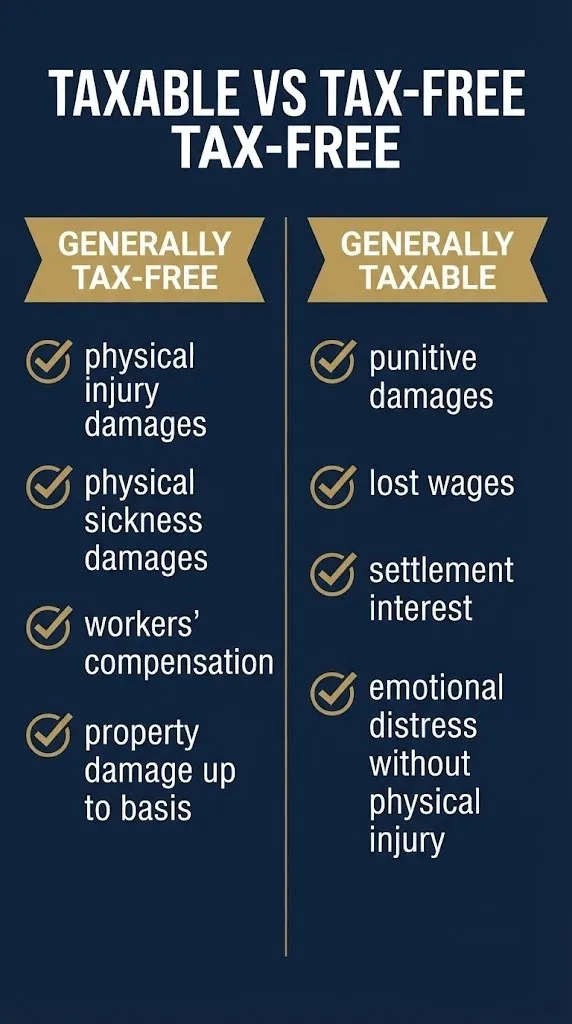
Always taxable, no matter the case type:
| Component | Why It’s Taxed |
|---|---|
| Punitive damages | Meant to punish, not compensate |
| Interest on the award | Treated as investment-style income |
| Lost wages / back pay | Would have been taxed if earned normally |
| Emotional distress (no physical injury) | Not covered by Section 104 |
Generally tax-free:
| Component | Why It’s Excluded |
|---|---|
| Physical injury / sickness damages | Directly excluded under Section 104 |
| Emotional distress from a physical injury | Treated the same as the physical injury itself |
| Property damage, up to basis | Considered a reimbursement, not income |
| Workers’ comp | Separately excluded under 104(a)(1) |
Reality Check: No legitimate settlement administrator or defendant texts you out of the blue asking for a fee to “release” your settlement money. Filing a claim or receiving a court-ordered payout is always free, and anyone asking for upfront payment to speed up a real settlement is running a scam.
Is Emotional Distress Settlement Money Taxable?
Yes, unless the distress came directly from a physical injury or sickness. This is one of the most misunderstood rules in settlement taxation.
Proceeds received for emotional distress or mental anguish originating from a personal physical injury are treated the same as proceeds for the physical injury itself, meaning they’re tax-free. But standalone emotional distress, like from workplace harassment with no physical component, is fully taxable.
There’s a small offset available. You can reduce the taxable amount by unreimbursed medical expenses tied to that emotional distress that you haven’t already deducted.
Example: a $50,000 settlement for pure emotional distress, with $4,000 in previously undeducted therapy costs, means only $46,000 counts as taxable income. Small relief, but real.
Are Punitive Damages Taxable?
Yes, always, with almost no exceptions. This is the one rule that never bends, even when the rest of your settlement is completely tax-free.
Punitive damages are taxable and should be reported as Other Income on Schedule 1 of Form 1040, even if received in a settlement for personal physical injuries or physical sickness. The IRS treats them as pure financial gain, not compensation for a loss.
The only narrow exception applies in a handful of states where wrongful death statutes allow only punitive damages by law. In those specific cases, IRC Section 104(c) lets that portion stay excluded.
If your settlement agreement doesn’t clearly separate compensatory from punitive damages, the defendant or their insurer may end up reporting more of your payout as taxable than necessary. Push for a clear breakdown before you sign.
Key Takeaway: Punitive damages get taxed even inside an otherwise tax-free physical injury settlement, so a clean written allocation in your agreement matters more than people realize.
How to Avoid Paying Taxes on Settlement Money (Legally)
You can’t legally avoid tax on money that’s genuinely taxable, but you can avoid overpaying through smart structuring. The difference between the two matters a lot here.
Legitimate strategies people actually use:
- Push for clear allocation language in the settlement agreement itself.
- Confirm any medical expense portions were never previously deducted.
- Ask your attorney to separate compensatory from punitive damages in writing.
- Consider a structured settlement (periodic payments) for large taxable awards, which can spread tax liability across years.
- Track any deductible medical costs tied to emotional distress claims.
- Talk to a CPA before you sign, not after the check arrives.
What doesn’t work: hiding income, mislabeling wages as “damages,” or paying a third-party “settlement helper” who promises to make your payout tax-free. You cannot legally avoid paying applicable taxes on a lawsuit settlement, but you can legally reduce them through proper structuring, and you can avoid overpaying on non-taxable components.
Will I Get a 1099 for a Lawsuit Settlement?
Only if part of your settlement is taxable. Fully tax-free physical injury settlements often don’t trigger a 1099 at all.
Defendants or settlement administrators who pay $600 or more in taxable settlement proceeds are required to issue a 1099-MISC to the recipient, and that form goes to the IRS too. If your entire award qualifies for the physical injury exclusion, you may never see one.
Common forms tied to settlements:
- 1099-MISC: general taxable settlement proceeds
- 1099-INT: any interest portion of your award
- 1099-NEC: rare, used for certain contractor-style payments
This form reports the payment to both you and the IRS, creating a record that you received the funds. Not getting one doesn’t automatically mean the money is tax-free, so don’t assume silence equals exclusion.
How to Report a Taxable Settlement on Your Tax Return
You report the taxable portion as ordinary income, generally on Schedule 1 of Form 1040, not as a special settlement category. There’s no separate settlement tax rate.
Steps to file correctly:
- Separate your settlement agreement into taxable and non-taxable components.
- Gather any 1099 forms you received from the payer.
- Report punitive damages, interest, and taxable wages as Other Income.
- Report the gross settlement amount, even the part that went straight to your attorney.
- Set aside funds for estimated taxes if you expect to owe $1,000 or more.
- File by the standard deadline for that tax year.
You must report the full, gross amount of the taxable settlement on your tax return, even the portion that went to your attorney for fees. That last point trips up a lot of people who assume attorney fees simply disappear from their taxable total.
Reality Check: If you’re not sure how to split a mixed settlement, don’t guess. A CPA reviewing your actual settlement agreement is worth the cost compared to an IRS notice two years later.
Can You Deduct Attorney Fees on a Settlement in 2026?
For most people, still no, and this is the detail a lot of 2026 guides are getting wrong. The rule didn’t just stay suspended, it got permanently killed.
Here’s what happened. The 2017 Tax Cuts and Jobs Act suspended the miscellaneous itemized deduction that let plaintiffs deduct legal fees on taxable settlements, for tax years 2018 through 2025. Many tax planners expected that deduction to automatically return in 2026 once the TCJA sunset.
That didn’t happen. With the signing of the One Big Beautiful Bill Act on July 4, 2025, the miscellaneous itemized deductions previously subject to the 2% AGI floor were permanently eliminated. The TCJA suspended most miscellaneous itemized deductions for 2018 through 2025, and the OBBBA made the elimination permanent, so these deductions won’t return in 2026.
That means if you win a taxable settlement in 2026, say for breach of contract or a non-physical injury claim, you generally still can’t deduct the attorney fees you paid, even though you have to report the full gross settlement amount as income.
There’s one important exception that survived. The above-the-line deduction for unlawful-discrimination and whistleblower cases under IRC Section 62(a)(20) and (21) was not touched by the new law. This deduction is taken in computing adjusted gross income rather than as an itemized deduction, which is why it survived where other legal fee deductions didn’t.
Who still qualifies for this narrower deduction:
- Employment discrimination claims (Title VII, ADA, ADEA, and similar)
- Certain whistleblower and False Claims Act cases
- Some ERISA benefits disputes tied to employment
Key Takeaway: Most settlement plaintiffs still can’t deduct attorney fees in 2026, since the OBBBA made that ban permanent, but employment discrimination and whistleblower plaintiffs kept a narrow above-the-line exception.
Do Lawsuit Settlements Get Taxed by States Too?
Usually yes, but it depends on your state’s income tax rules and whether it follows the federal exclusion. Most states with income tax mirror the federal Section 104 framework closely.
States with no personal income tax, like Texas, Florida, and Nevada, obviously don’t tax settlement income at the state level regardless of federal treatment. States with income tax generally follow the same taxable versus non-taxable split the IRS uses.
A small number of states carry their own quirks on specific settlement types, particularly around punitive damages or interest. If your settlement is large, a quick check with your state’s department of revenue, or a CPA licensed in your state, is worth the phone call.
Why Does the IRS Tax Some Settlements and Not Others?
Because the tax code treats a settlement as a replacement for whatever it’s compensating you for, not as automatic new wealth. This is the underlying logic behind every rule in this article.
If a settlement replaces something that would have been tax-free anyway, like your physical health, the payment stays tax-free. If it replaces something that would have been taxed, like your paycheck, the settlement gets taxed the same way.
Think of it like a broken phone under warranty. A store replacing your phone isn’t income, it’s restoring what you already had. A store paying you extra on top, as a goodwill bonus, is new money, and that part would show up on your taxes.
That’s essentially the entire framework Congress built into Section 104, which allows taxpayers to exclude personal injury compensation from gross income, while everything replacing taxable income stays taxable.
What Is IRC Section 104 and Why Does It Matter?
It’s the specific tax code section that decides whether your physical injury settlement is taxed, and it’s the single most cited law in every settlement tax dispute. Nearly every “is my settlement taxable” answer traces back to this one section.
Before August 21, 1996, Section 104(a)(2) didn’t contain the word “physical” regarding personal injuries, but the law was amended to exclude only damages received on account of personal physical injuries or physical sickness. That single word change is why purely emotional claims lost their automatic exclusion.
Three things Section 104 controls directly:
- What counts as a “physical” injury or sickness
- Whether emotional distress qualifies for exclusion
- The narrow wrongful death punitive damages exception in subsection (c)
If you remember one legal citation from this entire article, make it this one. It’s the anchor for almost every court ruling and IRS letter on settlement taxation.
What Happens Next: Your 2026 Settlement Tax Timeline
When you receive the settlement: Ask for a written breakdown separating taxable from non-taxable components before you sign anything.
Within 30 days of receiving funds: Set aside a portion of any taxable amount for estimated taxes if you expect to owe $1,000 or more.
By January 31, 2027: Payers must send any required 1099 forms for taxable settlement income received in 2026.
By April 15, 2027: File your 2026 federal tax return reporting the taxable portion of your settlement.
Ongoing: Keep your settlement agreement and any 1099s for at least three years in case of an IRS inquiry.
Frequently Asked Questions
Is a lawsuit settlement taxable if it’s for a car accident?
Generally no, if it compensates for physical injury or vehicle damage.
Punitive damages within the same settlement are still taxable.
Keep your settlement paperwork in case the IRS requests documentation.
Do you have to pay taxes on a personal injury settlement?
No, in most cases, as long as the injury is physical.
Emotional distress without a physical injury is the main exception.
Punitive damages inside the settlement remain taxable regardless.
Is money won in a lawsuit taxable?
It depends entirely on what the money was awarded for, not the word “won.”
Compensatory damages for physical harm are generally tax-free.
Punitive damages and lost wage awards are almost always taxable.
Do you have to pay taxes on an insurance settlement?
Only on portions beyond simple reimbursement for a loss.
Payments for property repair or physical injury are generally tax-free.
Interest and bad-faith or punitive amounts from the insurer are taxable.
Is emotional distress settlement money taxable?
Yes, unless the distress stems directly from a physical injury or sickness.
You can offset it slightly with undeducted medical costs tied to the distress.
Get a written allocation in your settlement agreement to avoid confusion.
Can I deduct attorney fees from a taxable settlement in 2026?
Generally no, for most plaintiffs, since the OBBBA made that ban permanent.
Employment discrimination and whistleblower cases kept a narrower above-the-line deduction.
Check IRC Section 62(a)(20) and (21) if your case involves workplace discrimination.
Will I get a 1099 for my settlement?
Only if part of the payout is taxable and totals $600 or more.
Fully tax-free physical injury settlements often generate no 1099 at all.
Not receiving one doesn’t automatically mean the money is tax-free.
Is a wrongful death settlement taxable to the family?
Generally no, since it compensates for loss rather than creating new income.
A narrow exception applies in states where only punitive damages are allowed by statute.
Funeral costs and loss of companionship damages are typically excluded.
Every settlement is really several smaller payments bundled into one check, and the IRS taxes each piece on its own terms. Before you spend a dollar, separate what’s compensation from what’s income, and confirm your specific numbers with a CPA who’s actually read your settlement agreement.
The one date to calendar right now: April 15, 2027, the filing deadline for any taxable settlement income you receive in 2026.