Workers Compensation Massachusetts 2026: Benefits, Filing Deadlines, and Claim Rules
Quick Answer
- Massachusetts workers comp is a no-fault system covering medical bills and partial lost wages after a job injury.
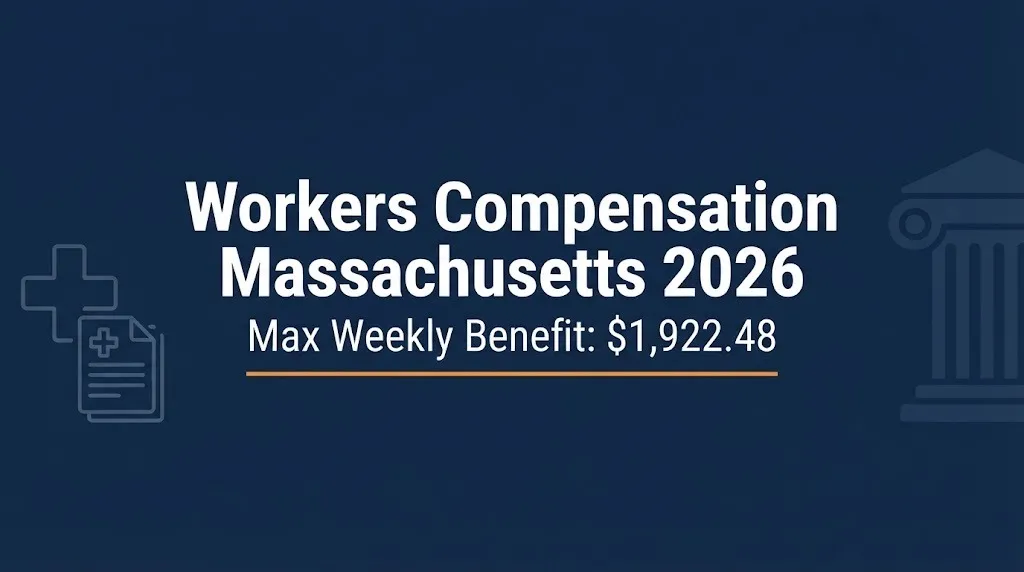
- For injuries on or after October 1, 2025, weekly checks max out at $1,922.48 and the minimum is $384.50.
- You have 4 years from the date you realize your injury is work-related to file a claim with the insurer.
If you got hurt on the job in Massachusetts, you’re probably wondering what you can collect and how long you have to claim it. The system is real, it’s state-administered, and it has strict deadlines. Miss them, and you lose your right to benefits.
Workers compensation in Massachusetts operates as a no-fault system. You don’t have to prove your employer did anything wrong. You just have to show your injury happened at work or because of your job. The trade-off is you can’t sue your employer for pain and suffering in most cases.
The most important number to remember: 4 years. That’s your filing window from the date you connect your injury to your work. The most important dollar figure: $1,922.48 per week, the maximum weekly benefit for current injuries. This article walks through everything you need to know about the Massachusetts workers compensation system in 2026.
The Facts
| Case | Massachusetts Workers’ Compensation System |
| Status | Active, state-administered by the DIA |
| Fund Size | Employer-funded insurance or the Workers’ Compensation Trust Fund |
| Est. Per Person | 60% of average weekly wage, max $1,922.48/week |
| Claim Deadline | 4 years from discovery of work connection |
| Administrator | Department of Industrial Accidents (DIA) |
| Proof Needed | Medical reports linking injury to work, Form 110 if disputed |
Is Workers Compensation in Massachusetts Legit or a Scam?
Massachusetts workers compensation is a legitimate, state-run system overseen by the Department of Industrial Accidents (DIA). It’s not a scam, and it’s not optional for most employers. State law requires nearly every employer to carry workers compensation insurance.
The system paid benefits to injured workers in 110 cases filed at conciliation in December 2025 alone, and 82% of cases that reached hearing resulted in benefits for claimants. The DIA processed 15,185 first reports of injury in the first half of fiscal year 2026.
Scammers do target injured workers, though. Anyone who calls or texts claiming to “process” your workers comp claim for an upfront fee is running a con. Filing is free. The DIA doesn’t charge you to file Form 110. Attorneys in workers comp cases are typically paid from the insurer, not your pocket, and only after they win benefits for you.
How Much Does Workers Comp Pay in Massachusetts?
Massachusetts workers compensation pays 60% of your average weekly wage (AWW) for temporary total disability, capped at the state maximum. For injuries on or after October 1, 2025, that cap is $1,922.48 per week. The minimum weekly benefit is $384.50.
Your actual check depends on what you earned before the injury. Here’s how the tiers work:
| Your Situation | Weekly Benefit |
|---|---|
| AWW below minimum threshold | $384.50 minimum |
| AWW gives 60% between min and max | 60% of your AWW |
| AWW gives 60% above state max | $1,922.48 maximum |
If you earned $3,800 per week before your injury, 60% is $2,280. But the cap limits you to $1,922.48 per week. If you earned $500 per week, 60% is $300, but the minimum kicks in at $384.50.
Dependents can increase benefits. If someone relies on your income, you may qualify for additional weekly payments up to certain limits.
Key Takeaway: Massachusetts workers comp pays 60% of your average weekly wage, with a hard cap of $1,922.48 per week for current injuries.
Can I Get a Lump Sum Settlement in Massachusetts?
Yes, you can settle a Massachusetts workers compensation claim for a lump sum, but settlements require DIA approval. A lump sum agreement ends some or all of your future rights to benefits in exchange for one payment.
Settlements don’t happen automatically. They’re negotiated after you’ve completed most medical treatment, or after disputes arise about disability or future care. The parties evaluate injury severity, permanent impairment, wage loss, future earning capacity, and ongoing medical needs.
Before a settlement becomes final, the DIA reviews it to ensure you understand the terms and what rights you’re giving up. Once approved, it’s binding.
The proposed House Bill HD.3337 would change employer notification rules for lump sum agreements, giving employers 30 days to object and allowing settlements to proceed without consent if no objection is filed. As of September 2026, this bill has not become law.
Reality Check: A lump sum settlement is not free money. It’s an advance on benefits you might otherwise receive over time. Settling too early, before your medical condition stabilizes, can leave you without coverage for future treatment. Always review the agreement carefully before signing.
Who Qualifies for Workers Compensation in Massachusetts?
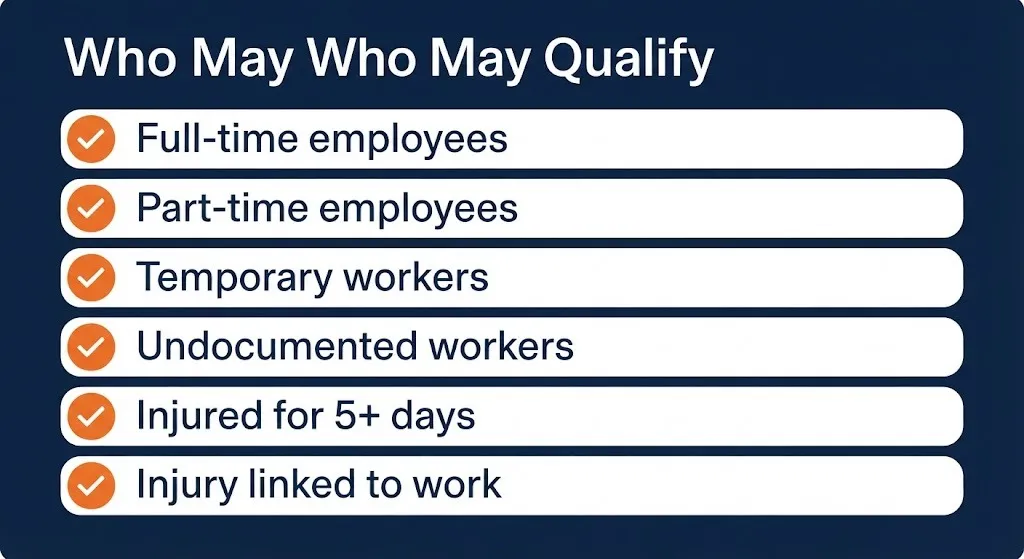
Nearly every worker in Massachusetts qualifies for workers compensation coverage, regardless of job title, work schedule, or immigration status. State law requires coverage for full-time, part-time, and temporary workers.
| Worker Type | Covered? |
|---|---|
| Full-time employees | Yes |
| Part-time employees | Yes |
| Temporary workers | Yes |
| Undocumented workers | Yes |
| Independent contractors | Only if they buy their own policy |
| Domestic workers | Limited coverage rules apply |
You qualify for benefits if you suffer a work-related injury or illness and you’re incapacitated for 5 or more calendar days. The first 5 days of missed work aren’t compensated unless you’re out for 21 calendar days or more, at which point the first 5 days become retroactive.
You must report your injury to your employer immediately. If your employer fails to notify the insurance company within 30 days, you can file directly with the insurer or file Form 110 with the DIA.
How to File a Workers Compensation Claim in Massachusetts
Filing a Massachusetts workers compensation claim means notifying your employer immediately, then filing Form 110 with the DIA if the insurer denies your claim or your employer fails to report it. Most claims start with your employer reporting the injury to their insurer.
Follow these steps:
- Report your injury to your employer immediately. Do it in writing if possible.
- Tell your doctor it’s a work injury. Give them your employer’s insurance information.
- Confirm your employer’s insurer. Use the DIA’s online verification tool or call their Office of Insurance.
- File Form 110 if the insurer denies you or 30 days pass without action.
- Attach medical reports that link your injury to your work.
- Send a copy to the insurer by certified mail. Keep proof of mailing.
- Keep a copy for yourself. You’ll need it for the conciliation.
- Attend your conciliation. This is an informal meeting with a DIA conciliator.
Once the DIA receives Form 110 and your medical documentation, you’ll get a conciliation date within about 14 days. The conciliation is the first step in the dispute resolution process.
When Does Workers Comp Start Paying in Massachusetts?
Workers compensation checks typically start within 3 to 4 weeks of your injury or illness. The insurer has 14 days from receiving your employer’s report to investigate and decide whether to pay benefits.
Massachusetts uses a Pay-Without-Prejudice (PWOP) period that lasts 180 days. During this window, the insurer can pay you weekly benefits while continuing to investigate. They can stop or reduce payments with 7 days’ written notice for any reason, without admitting liability.
Before the 180 days end, the insurer must either formally accept your claim or issue a denial. If they keep paying past PWOP, they need a judge’s permission to stop or reduce your benefits.
If you haven’t received a response 14 days after reporting your injury, that’s a red flag. Massachusetts law sets strict deadlines, and unnecessary delays often require intervention through the DIA.
What Is the Deadline to File a Workers Compensation Claim in Massachusetts?
The deadline to file a workers compensation claim in Massachusetts is 4 years from the date you become aware of a connection between your injury or illness and your employment. This is the statute of limitations under MGL c. 152, Section 41.
For injuries on or after January 1, 1986, the 4-year clock applies. For injuries before that date, the deadline is 1 year. If you receive a Form 104 denial, you have 4 years from the date you received the denial to appeal it.
The waiting period for benefits is 5 calendar days of incapacity. You won’t be paid for those first 5 days unless you’re out for 21 days or more, at which point the first 5 days are retroactive.
The most common reason claims get rejected by the DIA is incorrect information on Form 110. Wrong insurance carrier, unchecked benefit types, or missing the 1st and 5th day of disability will get your form sent back.
What If Your Employer Doesn’t Have Workers Compensation Insurance?
If your employer doesn’t have workers compensation insurance, you can file a claim against the Workers’ Compensation Trust Fund (WCTF). The WCTF is part of the DIA and pays benefits when an employer fails to carry required coverage.
The DIA issued 973 stop work orders and collected $523,648 in fines through April 2026 from employers operating without coverage. As of April 30, 2026, 90 uninsured injuries were reported to the WCTF for fiscal year 2026.
To file against the WCTF, you need:
- A Certification of No Insurance from the DIA’s Office of Insurance
- Form 110 (Employee Claim)
- Form 170 (Affidavit of Employee in Application for Trust Fund Benefits)
- Medical documentation linking your incapacity to the work injury
You can file online or by mail. The DIA will assign a claims representative and investigator, then schedule a conciliation.
How to Check the Status of Your Massachusetts Workers Comp Claim
You can check your Massachusetts workers compensation claim status through the DIA, your employer’s HR department, or the insurance carrier’s online portal. The DIA is the official record-keeper but doesn’t have day-to-day updates.
| Source | What They Can Tell You |
|---|---|
| Insurance adjuster | Real-time claim status, payment history, next steps |
| Online portal | Claim received date, current status, payment history |
| DIA | Confirmation claim is on file, hearing and conciliation dates |
| Employer HR | Whether claim was filed, insurer name, adjuster contact |
Common claim statuses include Pending (insurer received claim, gathering records), Accepted (insurer agrees injury is work-related, will pay), Denied (insurer won’t pay voluntarily), and Under Investigation (insurer looking closer at a specific issue).
If you’re unsure whether your insurer has a portal, ask your adjuster. The information may be generic, so a direct conversation is often necessary for complex questions.
What Happens Next
October 2026: New state average weekly wage figures may take effect for injuries occurring on or after October 1, 2026.
Fall 2026: Public comment period expected on proposed medical reimbursement rate regulations.
July 2027: New DIA medical reimbursement regulations expected to take effect.
Ongoing: Conference queue wait times currently average 8 to 16 weeks depending on region.
Frequently Asked Questions
How much does workers comp pay in Massachusetts?
Massachusetts workers comp pays 60% of your average weekly wage, up to $1,922.48 per week for injuries on or after October 1, 2025. The minimum weekly benefit is $384.50.
What is the deadline to file a workers comp claim in Massachusetts?
You have 4 years from the date you become aware of a connection between your injury and your job. For injuries before January 1, 1986, the deadline is 1 year.
Can I choose my own doctor for workers comp in Massachusetts?
Yes, you may select your own medical provider. Medical treatment that is reasonable, necessary, and related to your work injury will be paid by the insurer.
How long do I have to report a work injury to my employer?
Report your injury immediately. Massachusetts law recommends employers report claims to their insurer within 5 days of knowledge of the injury.
What happens if my workers comp claim is denied?
You have the right to file Form 110 with the DIA to appeal. The DIA will schedule a conciliation within about 14 days of receiving your claim and medical documentation.
Can I get fired for filing a workers comp claim in Massachusetts?
No. It is against Massachusetts law for an employer to fire you for filing a workers compensation claim.
How long does it take to get workers comp checks in Massachusetts?
In most cases, checks start within 3 to 4 weeks of your injury. The insurer has 14 days from receiving your employer’s report to investigate and decide.
What if my employer doesn’t have workers comp insurance?
You can file a claim against the Workers Compensation Trust Fund with the DIA. You’ll need a Certification of No Insurance, Form 110, and Form 170.
Your Next Move
If you were hurt at work, report it to your employer immediately. Get medical treatment and tell your doctor it’s a work injury. Save every medical record, bill, and pay stub.
The single most important deadline: 4 years from the date you realize your injury is work-related. But waiting even weeks can complicate your claim. The insurer has strict timelines, and so do you. If your claim is denied, file Form 110 with the DIA. Don’t let a paperwork error cost you benefits you’ve earned.