Just Compensation in 2026: Definition, How It’s Calculated, and What You Can Claim
Quick Answer
- Just compensation is the full and perfect equivalent in money for property taken by the government for public use.
- In the U.S., fair market value is the default measure, but tax sales use surplus proceeds as the baseline.
- In Pakistan, courts now require market value, future potential, and inflation adjustments, not just government-notified rates.
What Is Just Compensation?
Just compensation is the constitutional requirement that the government pay a property owner the full monetary equivalent when it takes private property for public use. The term appears in the Fifth Amendment of the U.S. Constitution and Article 24 of Pakistan’s Constitution.
The U.S. Supreme Court has held that just compensation provides a “full and perfect equivalent for the property taken” . That means the owner should be made whole financially, not punished and not enriched.

In Pakistan, Article 24(2) prohibits compulsory acquisition of property except for a public purpose and under a law that provides for compensation . The Supreme Court has described the power as “eminent domain,” an inherent attribute of sovereignty .
For ordinary people, the concept matters most in two situations. First, when a government agency wants your land for a road, canal, or transmission line. Second, when a tax authority sells your property for unpaid taxes and keeps more than it was owed.
Key Takeaway: Just compensation is a constitutional right, not a government favor. It requires payment that reflects what you actually lost, not what the government prefers to pay.
How Is Just Compensation Calculated in the United States?
In the United States, just compensation is generally calculated using fair market value, which is what a willing buyer would pay a willing seller when neither is forced to act. The Supreme Court has described this as the standard measure in ordinary eminent domain cases .
But the Court carved out a significant exception in June 2026. In Pung v. Isabella County, the justices held that when property is seized and sold to collect unpaid taxes, the proper baseline is the auction sale price, not the property’s hypothetical fair market value .
| Taking Type | Measure of Just Compensation |
|---|---|
| Ordinary eminent domain | Fair market value |
| Tax sale (fairly conducted) | Surplus sale proceeds |
| Special use property | Alternative valuation methods |
| Wartime or price-controlled goods | Government-fixed ceiling price |
The Pung case involved a Michigan family that owed $2,241.93 in property taxes. Their home was sold at auction for $76,008. The Supreme Court held they were entitled to the surplus proceeds, not the property’s assessed value of $194,400 .
The Court reasoned that tax sales have a unique history and function. Requiring local governments to pay fair market value after every tax sale could make the mechanism impractical or a net loss .
How Is Just Compensation Calculated in Pakistan?
In Pakistan, just compensation is calculated using a broader standard than simple market value. The Supreme Court has repeatedly held that “compensation” is conceptually broader than “market value” under the Land Acquisition Act 1894 .
In a July 2026 judgment, Justice Muhammad Ali Mazhar ruled that compensation cannot be determined solely on government-notified rates. The court must also consider market value, future potential, and development prospects .
The court articulated the principle as “gold for gold, not copper.” That phrase means the affected owner should receive compensation reflecting the real value of the land and providing complete financial justice .
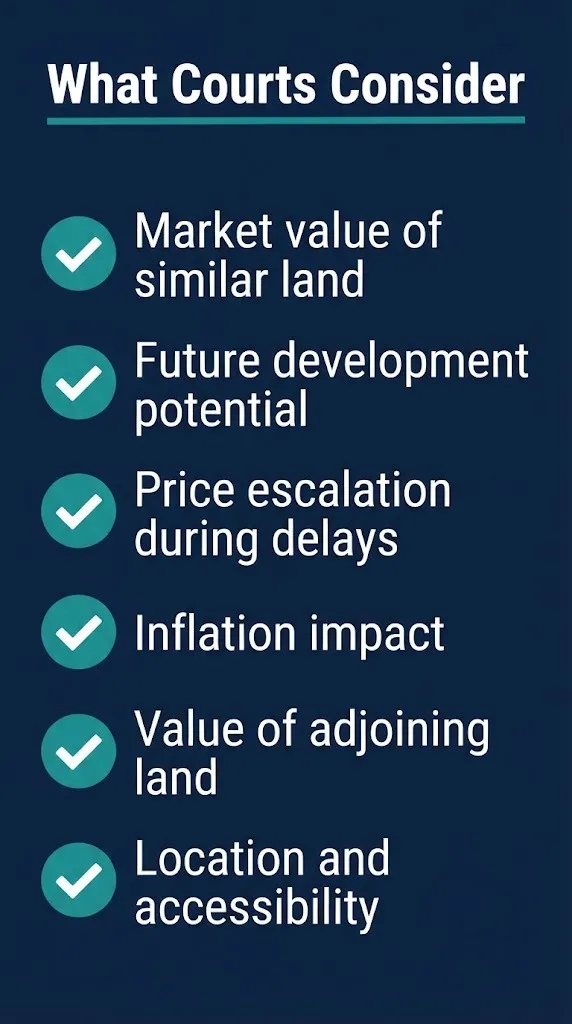
Here are the factors Pakistani courts must consider:
- Market value of similar land in the vicinity
- Future potential and development prospects
- Price escalation during the acquisition process
- Inflation impact from delays in payment
- Value of adjoining land acquired simultaneously
- Location and accessibility factors
The Swabi canal case that produced the July 2026 ruling involved landowners who challenged government compensation as inadequate. Both the Reference Court and Peshawar High Court had increased the awards. The Supreme Court dismissed the government’s appeals .
What Evidence Proves Just Compensation in Court?
Proving just compensation requires evidence of what the property is actually worth. Courts rely on comparable sales, expert testimony, and sometimes oral testimony from local property dealers.
In U.S. courts, the comparable sales approach is the most frequently used method. It compares the subject property to similar properties sold recently in similar circumstances .
Pakistani courts have taken an even broader approach. The Peshawar High Court has held that past sales alone are not an accurate measure. The court may examine local property dealers as witnesses to determine what the property would fetch in the open market .
| Evidence Type | Weight in Court |
|---|---|
| Recent comparable sales | Strong, especially if similar in size and location |
| Expert appraisal | Strong, but subject to cross-examination |
| Oral testimony from dealers | Acceptable in appropriate cases |
| Government-notified rates | Not conclusive, one factor among many |
| Revenue record classification | Not conclusive on its own |
One practical problem courts have acknowledged: people often under-declare property prices in sale deeds to avoid stamp duty and capital gains tax. That means recorded sale prices may be lower than what was actually paid .
Because of that, Pakistani courts have held that oral testimony from knowledgeable local witnesses can be considered even when documentary evidence is thin .
Reality Check
No government agency will contact you offering “just compensation” if you are entitled to it. If your land is being acquired, you will receive a formal notice under the Land Acquisition Act. If your property was sold at a tax sale and a surplus exists, you must usually claim it. Filing a claim for surplus proceeds is free. Anyone charging you a fee to recover money the government already owes you is not legitimate.
How Do You Claim Just Compensation for Land Acquisition?
Claiming just compensation for land acquisition starts with responding to the formal notice and participating in the award process. If you disagree with the amount, you can challenge it in court.
Here are the steps in Pakistan under the Land Acquisition Act 1894:
- Receive notice under Section 4 that land may be needed for a public purpose.
- File objections if you have any to the acquisition or the boundaries.
- Participate in the award inquiry where the Collector determines compensation.
- Receive the award and decide whether to accept or challenge it.
- File a reference to the Referee Court if you dispute the amount.
- Present evidence of market value, potential, and comparable sales.
- Appeal to the High Court if the Referee Court’s decision is unsatisfactory.
For tax sale surplus claims in the U.S., the process varies by state. You typically file a claim with the county or the court that handled the foreclosure. You will need to prove you were the former owner and that a surplus exists.
What Deadlines Apply to Just Compensation Claims?
Deadlines for just compensation claims depend on the type of taking and the jurisdiction. Missing a deadline usually means losing the right to compensation entirely.
In Pakistan, the Land Acquisition Act does not set a single deadline for challenging an award. But the general limitation period for civil suits applies, and courts have dismissed claims filed after unreasonable delays.
For additional compensation under Section 34 of the Act, interest accrues from the date of notification under Section 4 until payment is actually made . The rate is 15% per annum on the compensation amount.
In the U.S., tax sale surplus claims have varying deadlines. Some states require claims within one year of the sale. Others allow longer periods. The Pung case did not set a universal deadline, leaving that to state law.
| Claim Type | Typical Deadline |
|---|---|
| Land acquisition reference | Varies, but generally within 6 weeks to 6 months of award |
| Section 34 additional compensation | Accrues automatically from Section 4 notification |
| Tax sale surplus claim | Varies by state, often 1 year from sale |
What Happens Next in Just Compensation Law?
The legal landscape for just compensation continues to develop in both the U.S. and Pakistan. Here are the key developments to watch:
Ongoing 2026: U.S. states are adjusting tax sale procedures in response to Pung v. Isabella County. Some may revise notice requirements and surplus claim processes.
Ongoing 2026: Pakistan’s provinces are considering reforms to the Land Acquisition Act 1894. Stakeholders have called for modernization of the colonial-era law .
Expected 2027: More Pakistani court decisions will apply the July 2026 Swabi principles to other acquisition cases, refining how “future potential” is calculated.
Ongoing: U.S. courts will continue to hear cases about what constitutes a “fairly conducted” tax sale under the Pung standard.
Frequently Asked Questions
What is just compensation in simple terms?
Just compensation is the money the government must pay you when it takes your property for public use. It should equal what you lost, not what the government wants to pay.
Is just compensation always fair market value?
No. Fair market value is the default in ordinary eminent domain cases. But tax sales use surplus proceeds as the baseline, and special use property may require other valuation methods.
How does Pakistan calculate just compensation?
Pakistani courts require market value, future potential, development prospects, and inflation adjustments. Government-notified rates alone are not sufficient.
What does “gold for gold, not copper” mean?
It is a Pakistani legal principle meaning compensation must fully indemnify the owner. You should get the real value of what you lost, not a discounted substitute.
Can I challenge the government’s compensation offer?
Yes. In Pakistan, you can file a reference to the Referee Court. In the U.S., you can negotiate or litigate the amount in court.
What is the Pung v. Isabella County ruling about?
It held that for tax sales, just compensation means surplus sale proceeds, not the property’s fair market value. The Supreme Court decided it on June 23, 2026.
How long do I have to claim just compensation?
Deadlines vary by jurisdiction and type of taking. In Pakistan, Section 34 interest accrues automatically. In the U.S., tax sale surplus claims often have one-year deadlines.
Do I need a lawyer to claim just compensation?
You can navigate simple claims yourself, but land acquisition and tax sale disputes often involve complex valuation issues. A lawyer can help present evidence and challenge low offers.