Patent Litigation Lawyer 2026: What to Know Before You Hire One
Quick Answer
- Is it legit? Yes, patent litigation is a real federal court process governed by the U.S. Patent Act.
- How much? Costs routinely run into millions; jury verdicts in 2026 have hit $50M and $56M.
- Key deadline? If sued, you typically have 21 days to respond to the complaint.
Patent litigation lawyers handle disputes where one party claims another infringed its patent. That’s the whole ballgame. If you own a patent and someone is using your invention without permission, or if you’ve been accused of infringing someone else’s patent, this is the lawyer you call.
The stakes are enormous. In 2026 alone, a federal jury in Delaware awarded Beckman Coulter $56 million against Cytek Biosciences for infringing single-cell analysis technology. Another jury in Wilmington handed Green Mountain Glass a $50.3 million verdict against Ardagh Glass, with a final payment of $64.5 million after appeal. These aren’t small claims court numbers.
This guide covers what patent litigation lawyers actually do, what they cost, how to pick one, and what the 2026 landscape looks like for both patent owners and accused infringers.
The Facts
| Case Type | Federal district court patent infringement (civil) |
|---|---|
| Typical Timeline | 18 to 36 months from complaint to trial, longer in some venues |
| Recent Verdict Range | $50.3 million to $64.5 million (2026 examples) |
| Response Deadline | 21 days from service of complaint |
| Venue Examples | District of Delaware, Eastern/Western District of Texas, ITC |
| Key Agencies | USPTO, PTAB, International Trade Commission |
| Cost Range | Millions of dollars through trial |
What Does a Patent Litigation Lawyer Actually Do?
A patent litigation lawyer represents either the patent owner trying to enforce rights or the accused party defending against infringement claims. The work spans federal district courts, the International Trade Commission, and the Patent Trial and Appeal Board.
The job is not just arguing in court. Most of the work happens before trial: managing discovery, taking depositions, drafting motions, and navigating the claim construction process. That’s the stage where a judge interprets what the patent’s language actually means, and it often decides the case.
For patent owners, the lawyer’s job is proving two things: that the patent is valid and that the accused product or process meets every element of at least one claim. For defendants, the job is poking holes in either or both of those requirements. Common defenses include non-infringement (the product simply doesn’t do what the patent claims) and invalidity (the patent never should have been granted).
Defendants often go on the offensive too, filing counterclaims that the plaintiff’s own patents are invalid or not infringed. This shifts leverage and opens the door to cross-licensing deals.
Key Takeaway: Patent litigation lawyers spend most of their time on discovery and claim construction, not courtroom theatrics, and the early procedural choices often decide who wins.
How Much Does a Patent Litigation Lawyer Cost in 2026?
Patent litigation costs run into the millions of dollars through trial, and there is no way to sugarcoat that number. Legal fees and expenses (expert witnesses, e-discovery, court reporters) typically both fall into seven figures for a case that goes the distance.
The exact cost depends on several factors. An aggressive opponent can drive up motion practice and correspondence, inflating fees. Suing a competitor can trigger counterclaims, adding expense and risk. If the defendant has its own patents, you might find yourself defending as well as suing.
Some firms offer alternative billing arrangements. Straight hourly billing is standard, but capped billing and other structures exist. The choice often depends on whether the case is strategic (worth fighting regardless of cost) or purely financial (the settlement value must justify the spend).
For smaller companies or individual inventors, the math can be brutal. That’s why many cases settle before trial. The question becomes whether the expected recovery justifies the cost of getting there.
Key Takeaway: Budget millions for a patent case through trial, and understand that aggressive defense or counterclaims can push costs higher than your initial estimate.
How Do You Choose a Patent Litigation Attorney?
Choose a lawyer with specific experience in your technology area and the venues where your case will be heard. Patent litigation is not a general practice skill. The technical subject matter and specialized procedures require someone who does this regularly.
Look for attorneys who have handled cases involving technology similar to yours. A lawyer who litigates pharmaceutical patents may not be the right fit for a software or semiconductor dispute. The key factors include whether the case is strategic, the risk of injunction or large damages, and whether the lawyer shares your views on case management and budgeting.
Venue experience matters enormously. The Western District of Texas had an average time to trial of 2.3 years in 2021, while the District of New Jersey averaged 6.5 years. Some districts have local patent rules that structure every phase on a defined schedule. A lawyer who knows those rules can exploit them.
Institutional relationships matter too. Large companies often stick with the same firms for repeat patent work, which can make it hard for new clients to get attention. Smaller boutiques may offer more partner-level focus, but with less bench depth.
Key Takeaway: Match the lawyer to your technology and your venue, not just to the biggest firm name you recognize.
Patent Litigation Attorneys and the ITC: What’s Different?
Patent litigation attorneys who practice before the International Trade Commission handle cases involving imported products that allegedly infringe U.S. patents. The ITC can ban infringing imports from entering the country, a powerful remedy not available in district court.
The ITC process moves faster than district court litigation. In 2026, the Full Commission upheld a Final Determination banning Innoscience’s GaN products from the U.S. market after finding infringement of an Infineon patent. The ruling came after a Presidential Review Period, and parallel German court decisions also went against Innoscience.
ITC cases often run alongside district court litigation involving the same patents. A lawyer with ITC experience knows how to coordinate both tracks, using the ITC’s speed to create leverage while the district court case develops. The ITC cannot award money damages, only exclusion orders and cease-and-desist orders, so plaintiffs often pursue both forums.
For defendants, an ITC exclusion order can be catastrophic. Losing access to the U.S. market is a business-ending outcome for some companies. That’s why ITC defense requires lawyers who understand the unique procedures and the accelerated timeline.
How Long Does Patent Litigation Take in 2026?
Patent cases through trial can run 18 to 36 months from complaint to verdict, with appellate review adding more time. The variance is real and venue-dependent.
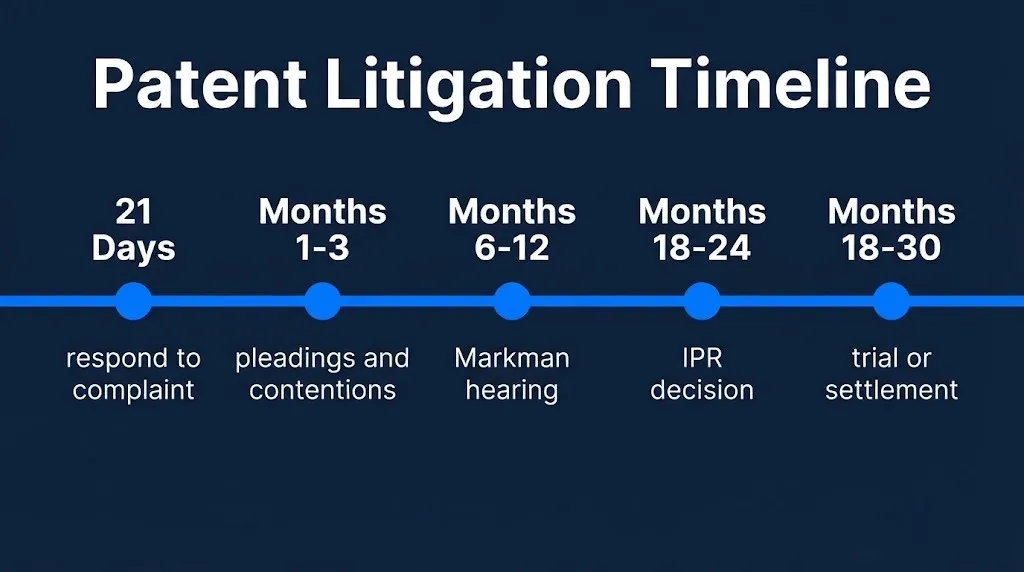
The high-level path runs through pleadings (months 1-3), infringement and invalidity contentions (months 3-6), claim construction discovery and Markman briefing (months 6-12), fact discovery (months 6-15), expert discovery (months 12-18), summary judgment (months 15-20), and trial (months 20-30).
An inter partes review (IPR) filed at the PTAB in months 3-6, if instituted, often runs to a Final Written Decision in months 18-24. That can land ahead of or during trial, creating pressure to settle.
Settlement windows open at every transition: after the answer, after Markman, after invalidity contentions are exchanged, and on the eve of summary judgment. Many cases never reach a jury. The threat of trial and the cost of getting there drive resolution.
Key Takeaway: Plan for two to three years if your case goes to trial, and know that IPR proceedings can accelerate or complicate the timeline.
What Happens Next: The Patent Litigation Timeline
Months 1-3: Complaint filed, defendant responds within 21 days, early motions filed.
Months 3-6: Infringement and invalidity contentions exchanged; IPR decision point.
Months 6-12: Claim construction discovery and Markman hearing; key settlement window.
Months 12-18: Expert discovery; damages and validity reports exchanged.
Months 18-30: Summary judgment motions, pretrial motions, trial, or settlement.
Does My Case Qualify for Patent Litigation?
Your case may qualify if you own a valid patent that another party is making, using, selling, or importing without permission, or if you’ve been accused of infringing someone else’s patent. Patent owners must prove ownership of a valid patent and that the accused product meets every element of at least one claim.
Defendants need to assess exposure quickly. The first 30 days involve preserving documents, identifying witnesses, and analyzing venue and the patent’s strength. The choice of forum, defenses, and timing shape the next two years.
Patent litigation is common in pharmaceuticals, biotechnology, medical devices, software, electronics, and mechanical devices. If your industry relies on patented technology, you’re in the zone where these disputes happen.
Key Takeaway: If you own a patent being infringed or face an infringement accusation, you likely need a patent litigation lawyer, and the first month’s decisions matter enormously.
Frequently Asked Questions
Do I need a patent litigation lawyer or a patent agent?
You need a lawyer for litigation. Patent agents handle prosecution (getting patents granted) but cannot represent you in court.
How much does it cost to defend a patent lawsuit?
Millions through trial, though early settlement can reduce costs significantly. Budget depends on the opponent’s aggressiveness and case complexity.
Can I file a patent lawsuit without a lawyer?
Technically yes, but patent litigation involves complex procedures and technical claim construction. Pro se representation is extremely risky.
What is a Markman hearing?
A pretrial proceeding where the judge interprets disputed patent claim terms. The rulings often decide the case.
How long do I have to respond to a patent infringement complaint?
Typically 21 days from service under Federal Rule of Civil Procedure 12(a)(1)(A)(i).
Can a patent case settle before trial?
Yes, most do. Settlement windows open after the answer, after Markman, and before summary judgment.
What is the PTAB and why does it matter?
The Patent Trial and Appeal Board handles post-grant validity challenges. An IPR can invalidate patent claims faster than district court.
Do I need a lawyer with technical background?
Not necessarily. Many first-chair patent litigators lack technical degrees but excel at managing experts and explaining complex issues to juries.