The Class Action Guide 2026: How Settlements Actually Work, Who Gets Paid, and What the Fine Print Hides
Quick Answer
- Is there a real process? Yes. A class action must survive court certification, settlement approval, and a claims process before anyone gets paid.
- How much will you get? Amounts vary wildly. A pro rata split after fees and expenses, often a few dollars to a few hundred.
- What is the deadline? Every settlement sets its own claim deadline. Miss it and you get nothing, even if you qualify.
You searched for a class action guide because a notice showed up in your mailbox or inbox, or because you want to know how these cases actually pay out. The honest answer is that the process is more mechanical than mysterious. Courts approve settlements, administrators send notices, and class members file claims.
The rules come from Rule 23 of the Federal Rules of Civil Procedure. That rule governs certification, notice, opt-outs, and final approval. It does not guarantee you a check. It guarantees you a process.
This article explains who actually qualifies, how the money gets split, why so many people never file, and the one deadline in every settlement that decides whether you get paid at all.
The Facts
| Item | Verified Detail |
| Governing Rule | Federal Rule of Civil Procedure 23 (certification, notice, settlement approval) |
| Status | Active process. Settlements are approved and paid continuously. |
| Fund Size | Varies by case. No single fund. |
| Est. Per Person | Pro rata share after attorneys’ fees, costs, and service awards |
| Claim Deadline | Set by each settlement. No universal deadline. |
| Administrator | Court-appointed, named in the settlement notice |
| Proof Needed | Varies. Some require receipts, some accept attestation. |
Is the class action guide real or just marketing?
The class action process is real, and it is governed by published federal rules. Rule 23 lays out the requirements for certification, the notice that must go to class members, the opt-out right, and the court’s role in approving settlements.
What is not real is any single “official guide” that ranks settlements or tells you which ones to join. Courts do not publish consumer guides. Settlement administrators publish notices for specific cases. The rules are public, but the application varies case by case.
Scams imitate the process. A fake notice will ask for payment or sensitive data upfront. A real notice tells you the case name, the court, the claim deadline, and the administrator’s contact information. If a notice does not name a court and a case number, treat it as suspect.
Key Takeaway: The class action process is real and rule-bound, but no official guide ranks settlements, and every legitimate notice names a court, a case number, and a deadline.
How much money do you actually get from a class action?
Your payout is a pro rata share of whatever remains in the settlement fund after attorneys’ fees, administrative costs, and service awards for the named plaintiffs. There is no fixed amount, and no one can tell you your check size until all claims are counted.
The math works like this. The court approves a total fund. Attorneys’ fees come out, often one-third of the fund in consumer cases. Administrative costs come out. Service awards for the class representatives come out. The remainder is divided among valid claimants, usually in proportion to their recognized loss.
| Factor | Effect on Your Payout |
| Total fund size | Larger fund, larger potential pool. |
| Attorneys’ fees | Typically one-third of the fund in consumer cases. |
| Number of claimants | More valid claims mean smaller individual shares. |
| Your documented loss | Some settlements pay more to class members with larger losses. |
| Claim rate | Low claim rates can mean larger shares for those who file. |
Typical consumer settlement checks range from a few dollars to a few hundred dollars. Securities and antitrust settlements can pay more, but they also take longer and involve more complex proof.
Reality Check: No one will text you a settlement link and ask for a fee to “release” your money. Filing a claim is free. The settlement administrator is paid from the fund, not by you. Any third party charging an upfront fee to file a class action claim is unnecessary, and any message demanding payment before you receive a payout is a scam.
Who qualifies for a class action settlement?
You qualify if you fit the class definition the court approved. The definition is written in the settlement notice, and it is specific. It names a time period, a product or conduct, and often a geographic limit.
Common class definitions require proof of purchase, use of a service during a date range, or residency in a particular state. Some settlements allow you to self-certify without receipts. Others require documentation.
| Qualifying Factor | What the Notice Usually Says |
| Time period | You bought or used something between specific dates. |
| Product or conduct | You were affected by the conduct described in the lawsuit. |
| Geography | Some classes are limited to certain states or regions. |
| Proof | Some require receipts, some accept a signed declaration. |
You do not need to have sued anyone. You do not need to know the case existed. If you fit the definition and the court approves the settlement, you are bound by it unless you opt out.
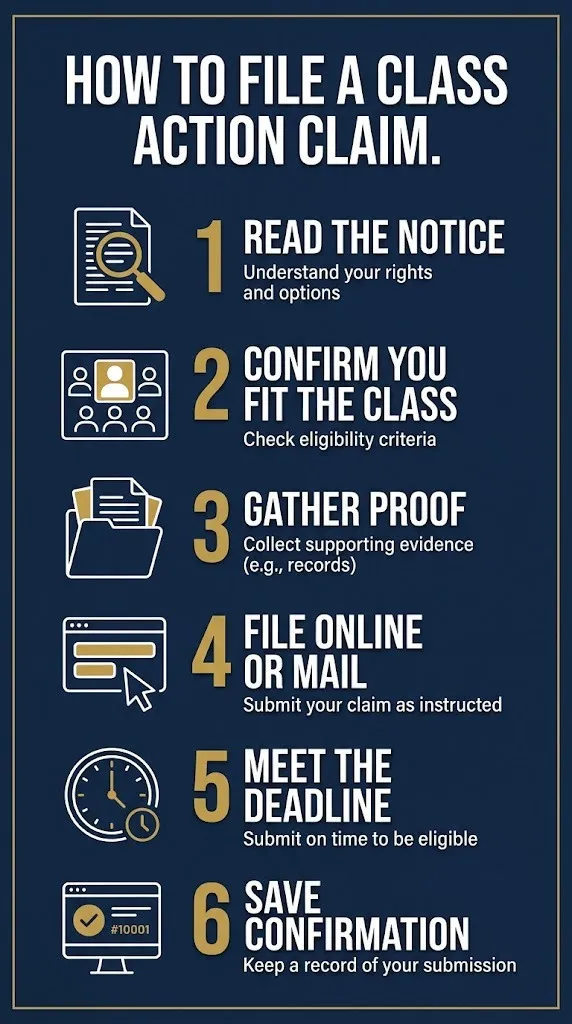
How do you file a class action claim?
You file a claim by following the instructions in the settlement notice. Most settlements allow online filing, and some allow mail. The notice names the administrator and the deadline.
Here are the steps:
- Read the notice. Find the class definition, the claim deadline, and the administrator’s website.
- Confirm you fit the class. Check the dates, the product, and any geographic limits.
- Gather proof if required. Receipts, account numbers, or other documentation the notice asks for.
- File online or by mail. The form asks for your contact information and your claim details.
- Submit before the deadline. Late claims are rejected, even if you qualify.
- Keep your confirmation. Save the claim number or email confirmation.
- Wait. The administrator reviews claims after the deadline, then distributes funds after final approval.
Filing is free. The administrator does not charge you. If a website asks for payment to file, it is not the official site.
Key Takeaway: Filing a claim is free and deadline-driven, and the notice you receive names the only administrator authorized to process it.
What happens if you do nothing after receiving a settlement notice?
If you do nothing, you remain in the class and you give up your right to sue separately over the same claims. But you may not receive any money unless you file a claim. Many settlements require an affirmative claim.
This is the trap that catches most people. They assume a check will arrive automatically. In many consumer settlements, it will not. You must file.
The exception is settlements where the defendant already has your information and the court approves an automatic distribution. Those are less common in consumer cases and more common in securities or employment settlements.
| Your Choice | What Happens |
| File a claim | You may receive a pro rata payment. |
| Do nothing | You are bound by the settlement but may receive nothing. |
| Opt out | You keep your right to sue separately, but you get no settlement money. |
What is the deadline to file a class action claim?
There is no universal deadline. Each settlement sets its own claim deadline in the notice approved by the court. Some give you 60 days. Some give you six months. Some give you more.
The deadline is not flexible. Administrators reject late claims as a matter of course. If you miss it, you cannot revive your claim by calling or emailing after the cutoff.
Opt-out deadlines are separate and often earlier than claim deadlines. If you want to keep your right to sue separately, you must opt out by the date in the notice. If you opt out, you cannot also file a claim in the settlement.
What happens to unclaimed class action money?
Unclaimed money goes to one of four places, depending on the settlement agreement and the court’s approval. The most common destinations are a second distribution to claimants who did file, a cy pres award to a nonprofit, or a reversion to the defendant.
A secondary pro rata distribution increases the checks of people who filed. That is one reason claim rates matter. When fewer people file, the ones who do can receive more.
Cy pres distributions send residual funds to organizations whose work relates to the class’s interests. Courts scrutinize these more closely than they used to, and some settlements now avoid cy pres-only structures because of that scrutiny.
Reversion returns money to the defendant. Some states restrict it, and courts often prefer other options.
What happens next in a class action settlement?
The sequence is predictable, even if the timeline is not. The court grants preliminary approval, the administrator sends notice, the claim deadline passes, and the court holds a final approval hearing.
- Preliminary approval: The court reviews the settlement terms and authorizes notice.
- Notice period: Class members receive notice and the claim deadline is set.
- Claim deadline: The last day to file. Late claims are rejected.
- Final approval hearing: The court decides whether the settlement is fair.
- Distribution: The administrator pays valid claims after any appeals resolve.
Appeals can delay distribution by months or longer. Most settlements do not get appealed, but some do.
Frequently Asked Questions
How much money do you get from a class action lawsuit?
It depends on the fund size, the number of valid claims, and the fees deducted. Most consumer payouts are a few dollars to a few hundred.
Do you have to file a claim to get money?
Usually yes. Many settlements require an affirmative claim. If you do nothing, you may be bound but receive nothing.
What happens if you miss the class action deadline?
You lose your right to payment. Administrators reject late claims. The deadline is set by the court and is not flexible.
Is it worth opting out of a class action?
Rarely. Most individual claims are too small to justify a separate lawsuit. Opting out makes sense only if your losses are large and you have a realistic path to individual recovery.
Who pays the settlement administrator?
The administrator is paid from the settlement fund, not by class members. Filing a claim is free.
How long does it take to get a class action check?
It varies. Some settlements pay within months of final approval. Others take a year or more, especially if there is an appeal.
What is cy pres in a class action?
Cy pres is the doctrine that sends unclaimed funds to nonprofits whose work relates to the class. Courts must approve the recipient.
Can you join a class action after the deadline?
No. If the claim deadline has passed, you cannot file. Some settlements reopen claims after appeals, but that is rare.
What You Should Do Now
If you received a settlement notice, read it today. Find the claim deadline and the administrator’s website. If you fit the class definition, file a claim before the deadline. If you are unsure, check the official settlement website, not a third-party link.
The one date that matters most is the claim deadline printed on your notice. That date does not move, and missing it means missing the money.