Contractors Workers Compensation 2026: The 1099 Subcontractor Trap That Puts the Bill on You
Quick Answer
- Contractors with W-2 employees need workers’ comp in nearly every state. Solo contractors with no employees can often opt out, but some high-risk trades require coverage anyway.
- There is no flat national premium. Small general contractors paid a median of $196 per month for workers’ comp as of July 2026, per Insureon data.
- Uninsured 1099 subs are the biggest hidden risk. If a sub is deemed your employee, you can be billed for their full medical and disability costs at audit.
Contractors workers compensation is the insurance that pays medical bills and lost wages when a worker is hurt on the job. For a contractor, the rules depend on who is on your payroll, what state you work in, and whether your subs carry their own coverage. The legal obligation follows the worker, not the title on the invoice.
This matters most for general contractors and specialty trades who hire 1099 labor. A sub without insurance is a sub whose injury can become your claim. The same factors that decide a worker classification audit also decide who pays for a jobsite injury .
This article covers the coverage thresholds by state, the real 2026 premium data, the 1099 subcontractor trap, the filing deadlines that end claims, and the steps to protect your business. One detail worth knowing upfront: California requires many licensed contractors to carry workers’ comp even with zero employees, phased in with extensions through 2028 for some trades .
The Facts
| Item | Verified Detail |
|---|---|
| Coverage Trigger | W-2 employees in nearly every state |
| Solo Contractor Rule | Optional in most states, mandatory for some trades |
| Median Small GC Premium | $196 per month, $2,348 per year (Insureon, July 2026) |
| 1099 Sub Risk | Uninsured subs can be charged to your policy at audit |
| Shortest Filing Deadline | Nevada, 90 days from injury |
| Longest Filing Deadline | Wisconsin, Utah, Vermont, 6 years |
Is contractors workers compensation required in 2026?
Contractors workers compensation is required in nearly every state once you have W-2 employees. The threshold is usually one employee, though a handful of states allow two or three before the requirement kicks in.
The solo contractor picture is different. If you have no employees, coverage is optional in most states. But some high-risk trades require it anyway. California mandates coverage at one employee under Labor Code §3700, and some licensed contractors in roofing, HVAC, and concrete must carry it even with no payroll .
Here are the state variations that matter:
| State | Coverage Trigger | Notes |
|---|---|---|
| California | 1 employee | Some licensed trades require coverage even solo, phased through 2028 |
| Georgia | 3 employees | Lower threshold for construction |
| Florida | Construction: stricter | Non-construction threshold higher |
| Texas | Voluntary | Most GCs still require it on subs |
| Ohio, Washington, North Dakota, Wyoming | Monopolistic state funds | No private market for the statutory layer |
If you operate across state lines, verify your policy lists every state where you have payroll. A multi-state audit can back-bill years of premium .
Key Takeaway: W-2 employees trigger the requirement in nearly every state. Solo contractors can often opt out, but high-risk trades and cross-state work change the answer.
How much does contractors workers compensation cost in 2026?
Contractors workers compensation costs a median of $196 per month for small general contractors, or about $2,348 per year, according to Insureon data updated July 31, 2026 . That figure covers firms with fewer than five employees. Larger payrolls and higher-risk trades pay more.
The cost is priced per $100 of payroll, adjusted by your class code and experience modification factor. A clerical worker might cost under $1 per $100 of payroll. A roofing crew can cost $20 or more per $100 . The trade code is the single largest factor.
Here are verified median workers’ comp premiums by trade from Insureon:
| Trade | Workers’ Comp per Month |
|---|---|
| Electricians | $140 |
| Handyman | $108 |
| All construction trades | $175 |
| HVAC contractors | $182 |
| Plumbers | $179 |
| General contractors | $196 |
Roofers did not have a separately published workers’ comp figure in the Insureon data, but roofing is the highest-risk trade classification in virtually every state .
Key Takeaway: The median small GC pays about $196 per month. Your actual premium depends on trade, payroll, state, and claims history. Roofing and high-risk trades pay more.
What happens if a 1099 subcontractor gets hurt on your job?
If a 1099 subcontractor gets hurt on your job and lacks their own workers’ comp, their injury claim can land on your policy. The legal question is whether the sub is truly independent or is actually your employee under state law.
True independent contractors control how the work is done, use their own tools, and carry their own insurance . If they meet those criteria, they generally need their own policy. If they are misclassified employees, their injury claim becomes your liability.
The audit is where this bites. Carriers rate the work you sub out. Uninsured subs can be charged to your policy at audit . The contractors who collect and verify sub certificates of insurance in real time close their audits clean. Those who treat sub verification as a year-end task face the largest single workers’ comp surprise on the audit schedule .
California makes this especially clear. Under Labor Code section 2750.5, there is a rebuttable presumption that a worker performing services for which a license is required is an employee, not an independent contractor. If the hirer cannot prove independent contractor status, the general contractor can be liable for the injury .
Reality Check: A 1099 form does not make a worker an independent contractor. The label on the invoice is not the legal test. If the worker takes direction, uses your equipment, and works your schedule, a state auditor may reclassify them. That reclassification moves the injury claim to your policy.
How do you verify subcontractor coverage?
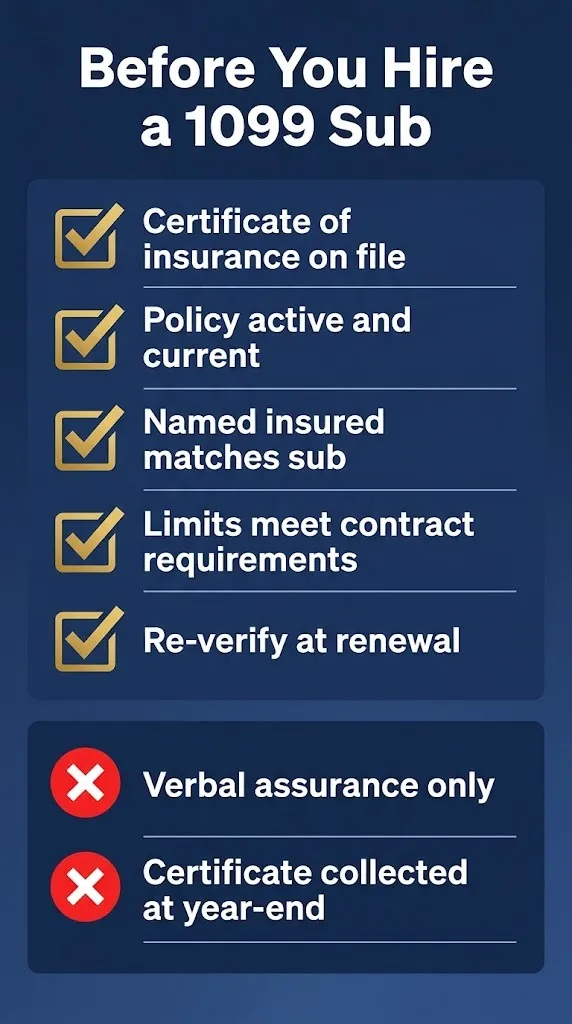
You verify subcontractor coverage by collecting a current certificate of insurance before the sub starts work, confirming the policy is active, and keeping the file current through the project.
Here are the steps:
- Request a certificate of insurance before work begins. Do not accept a promise to send it later.
- Confirm the policy is active. Call the carrier if the certificate looks altered or expired.
- Check the coverage limits. Some GC contracts require specific minimums.
- Match the named insured to the sub. A certificate in another company’s name does not cover your sub.
- Re-verify at renewal. Policies lapse. A certificate from six months ago may be expired.
- Document the file. If an audit comes, your records are your defense.
Some states are creating new coverage options for independent contractors. Louisiana’s SB 358 would allow independent contractors to buy occupational accident coverage that satisfies statutory employer requirements, with minimum medical benefits of $1,000,000 per occurrence . That bill was introduced in the 2026 session. Check whether it passed before relying on it.
Key Takeaway: A certificate of insurance collected at the start of the job is the only proof that matters. Verbal assurances and year-end collection leave you exposed at audit.
What are the workers compensation filing deadlines for contractors?
The workers compensation filing deadline for an injured worker ranges from 90 days in Nevada to 6 years in Wisconsin, Utah, and Vermont. Most states fall between one and three years. The reporting deadline to the employer is usually much shorter, anywhere from 24 hours to 90 days .
For a contractor, the deadlines matter in two directions. Your own workers have deadlines to file. Your subs’ workers have deadlines if they try to claim against you.
Here are the reporting deadlines for common states:
| State | Report to Employer | File Claim |
|---|---|---|
| California | 30 days | Varies |
| Texas | 30 days | Varies |
| New York | 30 days | Varies |
| Florida | 30 days | Varies |
| Illinois | 45 days | 3 years |
| Pennsylvania | 120 days | Varies |
| Georgia | 30 days | Varies |
| Nevada | Not specified | 90 days |
Source: WorkCompCalc state deadline guide, 2026 .
Illinois gives injured workers three years to file a claim with the Commission, but only 45 days to notify the employer . Virginia requires the employer’s first report of injury within 10 days of knowledge of the accident .
Key Takeaway: The reporting deadline is the real deadline for most workers. Report every injury immediately, and track whether your carrier files the first report on time.
What happens next if you are a contractor without coverage?
Here is what to expect if you operate without required workers’ comp:
- Now: Check your state’s coverage threshold. Confirm whether your trade requires coverage even without employees.
- Before your next hire: Get a policy in place before the first W-2 employee starts work.
- Before your next subcontract: Collect and verify the sub’s certificate of insurance. Do not pay until it is on file.
- At renewal: Review your experience modification factor. A clean claims record lowers your premium.
- At audit: Reconcile your payroll and sub costs. Uninsured subs charged to your policy at audit are the most common surprise bill .
Frequently Asked Questions
Do contractors need workers compensation?
Contractors with W-2 employees need workers’ comp in nearly every state. Solo contractors with no employees can often opt out, but some high-risk trades require coverage regardless of payroll.
How much does workers comp cost for a small contractor?
Insureon data shows a median of $196 per month for small general contractors, or about $2,348 per year, as of July 2026. Electricians paid a median of $140 per month. Handymen paid $108.
What happens if my 1099 subcontractor gets hurt?
If the sub lacks their own workers’ comp and is deemed your employee, the injury claim can land on your policy. You can be billed for medical costs and lost wages at audit.
Is a 1099 worker covered by my workers comp policy?
Generally no. Independent contractors are not covered under your policy unless they are misclassified employees. True independent contractors need their own coverage.
What state has the shortest workers comp deadline?
Nevada has the shortest filing deadline at 90 days from the date of injury. Kansas is second at 200 days.
Can I be fined for not carrying workers comp?
Yes. Penalties include daily fines, stop-work orders, and personal liability for an injured worker’s medical bills and lost wages. Some states strip your legal defenses if you were uninsured.
Does an LLC or S-corp change the requirement?
An LLC or S-corp with W-2 employees is generally required to carry coverage. The entity type does not exempt you once you have payroll.
What is the experience modification factor?
The experience mod is a multiplier based on your claims history compared to other contractors in your class code. A mod below 1.0 lowers your premium. A mod above 1.0 raises it. Claims affect the mod for multiple years.
Check your state threshold today. Collect certificates of insurance before your next subcontractor starts work. And if you have W-2 employees and no policy, get one before the next payroll cycle. The audit bill for an uninsured injury is the one contractors workers compensation mistake that does not stay small.