Massachusetts Workers Compensation Law 2026: Benefits, Deadlines, and What You Actually Get
Quick Answer
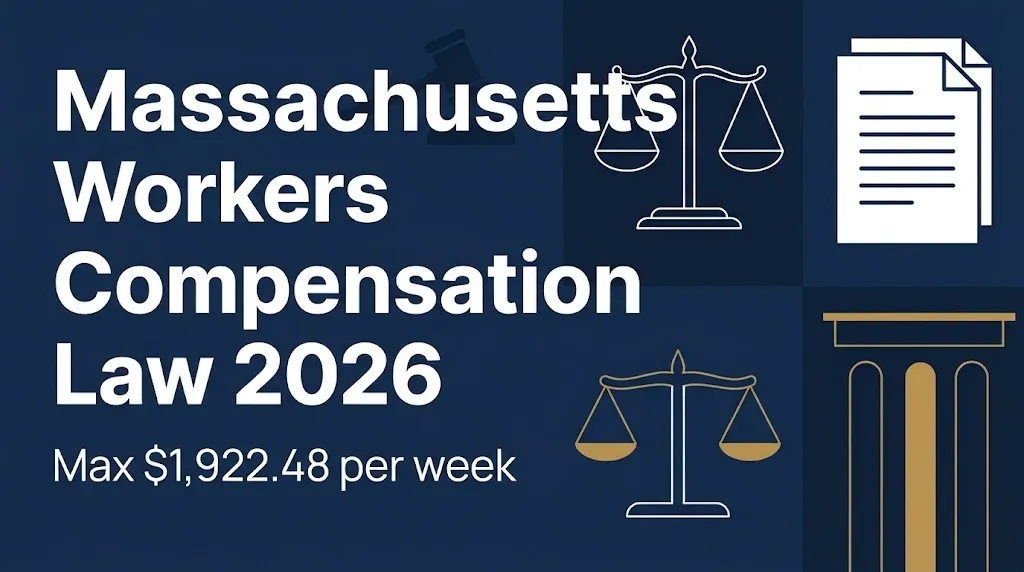
- Massachusetts workers’ comp pays 60% of your average weekly wage, capped at $1,922.48 per week for the current injury period .
- You have 4 years from the injury or realization to file a claim, but you must be disabled for at least 5 full or partial calendar days to qualify .
- Attorney fees are paid by the insurance company, not deducted from your benefits, under the DIA fee schedule .
If you were hurt on the job in Massachusetts, you are dealing with a system that has specific numbers and hard deadlines. The Department of Industrial Accidents (DIA) oversees the process, and the benefit rate is set at 60% of your average weekly wage . The maximum weekly check for the current benefit year is $1,922.48, which is higher than most states in the region . But the number that matters most is not the maximum. It is the four-year filing window and the five-day disability threshold, because missing either one can end your claim before it starts.
The most misunderstood part of Massachusetts workers’ comp is the attorney fee structure. Under the law, your lawyer’s fees are paid by the insurance company in most cases, not taken out of your weekly benefits . That changes the math on whether to hire representation. This article breaks down the 2026 rates, the filing process, the settlement rules, and the mistakes that cost injured workers money in Massachusetts.
The Facts
| Item | What to Know |
|---|---|
| Governing Law | M.G.L. c. 152, Massachusetts Workers’ Compensation Act |
| Agency | Department of Industrial Accidents (DIA) |
| Benefit Rate | 60% of average weekly wage |
| 2025-2026 Maximum Weekly | $1,922.48 |
| 2025-2026 Minimum Weekly | $384.50 |
| Filing Deadline | 4 years from injury or realization |
| Disability Threshold | 5 full or partial calendar days |
| Attorney Fees | Paid by insurer per DIA schedule, not deducted from benefits |
Is Massachusetts Workers Compensation a Real System or a Scam Risk?
Massachusetts workers’ compensation is a real, statutory insurance system, and the scam risk comes from people who pretend to help you navigate it for a fee. Every employer in Massachusetts with employees must carry workers’ comp coverage or be approved for self-insurance . The DIA adjudicates disputes, approves settlements, and publishes the fee schedule that governs attorney compensation . This is a government program with published rules, not a private settlement fund.
The scam pattern here involves “claim advisors” who charge upfront fees to file forms you can file yourself for free. Filing Form 110 costs nothing. The DIA does not charge a filing fee. If someone asks for payment to submit your claim, walk away and contact the DIA directly. The Department of Industrial Accidents offers guidance for injured workers at no cost, and the official Mass.gov pages explain the process step by step .
Key Takeaway: Massachusetts workers’ comp is a free government process, and anyone charging you a filing fee is not part of it.
How Much Does Massachusetts Workers Compensation Pay Per Week in 2026?
Massachusetts workers’ compensation pays 60% of your average weekly wage, subject to a maximum of $1,922.48 per week and a minimum of $384.50 per week for injuries occurring between October 1, 2025 and September 30, 2026 . The rate adjusts every October 1 based on the State Average Weekly Wage. The applicable cap depends on your date of injury, not the date your checks start .
The math is straightforward. If you earned $1,500 per week before the injury, your benefit is $900 per week (60% of $1,500). That is below the cap, so you receive the full $900. If you earned $4,000 per week, 60% would be $2,400, but the cap cuts it to $1,922.48. If you earned $500 per week, 60% would be $300, but the minimum raises it to $384.50.
| Average Weekly Wage | 60% Benefit | Capped or Floored? |
|---|---|---|
| $500 | $300 | Raised to $384.50 |
| $900 | $540 | No |
| $1,500 | $900 | No |
| $2,500 | $1,500 | No |
| $4,000 | $2,400 | Reduced to $1,922.48 |
The benefit cap is not the only limit. Temporary total disability benefits are capped at 156 weeks under the statute . After that, other benefit categories may apply depending on your medical status and impairment rating.
Key Takeaway: The 2025-2026 cap is $1,922.48 per week, and it applies to the 60% calculation, not your gross wage.
Reality Check: No legitimate workers’ comp representative texts you a settlement amount and asks for your bank details. Settlement offers come from the employer’s insurer, and lump-sum agreements must be approved by the DIA before anyone gets paid. If a message promises fast cash for a fee, it is a scam.
What Is the Deadline to File a Massachusetts Workers Compensation Claim?
The deadline to file a Massachusetts workers’ compensation claim is 4 years from the date of injury or the date you realized the injury was work-related . But there is a shorter practical deadline that catches people: you must be disabled for 5 full or partial calendar days before you can file a claim for lost wages . If you are disabled for fewer than 5 days, you can still file a “medical only” claim, which goes to the insurer, not the DIA .
The 4-year window sounds generous. It is not, in practice. Memories fade, witnesses move, and medical records get harder to obtain. If you are near the deadline, file now and sort out the details later. The DIA will schedule a conciliation within approximately 14 days of receiving your Form 110 and medical documents .
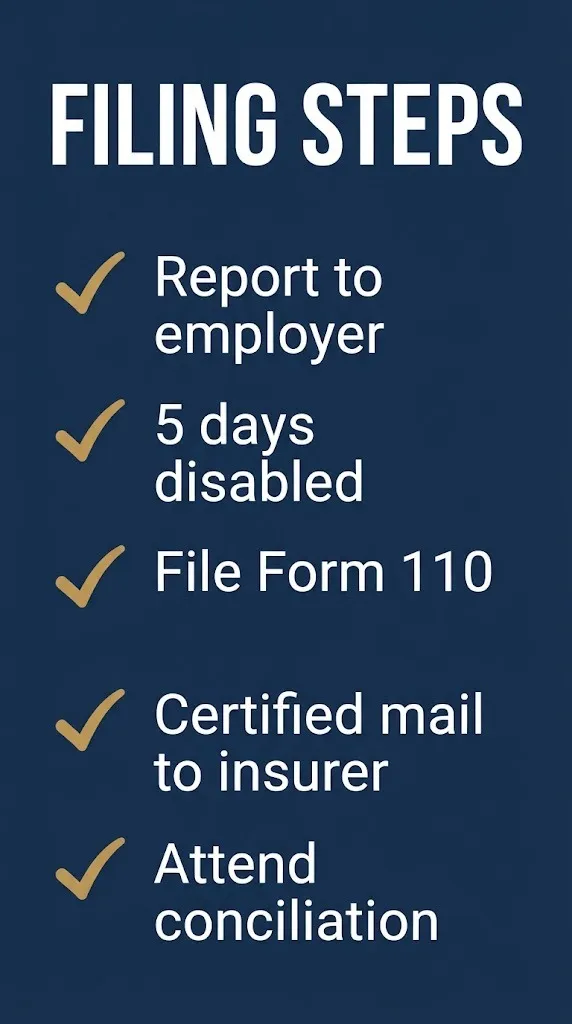
Here is the filing sequence:
- Report the injury to your employer as soon as possible.
- Confirm you have been disabled for at least 5 full or partial calendar days .
- File Form 110 – Employee Claim with the DIA within 4 years of the injury .
- Send a copy of Form 110 to the workers’ compensation carrier by certified mail.
- Keep a copy for your records.
- Attend the conciliation, which is the first step in the DIA process .
- If the claim is denied, request a conference before an administrative judge.
How Do You File a Massachusetts Workers Compensation Claim?
You file a Massachusetts workers’ compensation claim by submitting Form 110 – Employee Claim to the Department of Industrial Accidents, and the process starts with your employer, not the agency. The DIA requires three copies of the form and all supporting documents: one for the DIA, one for the insurance carrier by certified mail, and one for your records .
The steps are not complicated, but the details matter. Most claims get rejected because the insurance carrier is incorrect, the benefit types are not checked off, or the first and fifth days of disability are missing . If you do not know the carrier’s name, you can look on any insurer form you received, especially the Form 104 denial notice, or call the DIA’s Office of Insurance for help .
Here is what you need to file:
- Your date of injury or illness.
- The first calendar day of work you missed.
- The fifth calendar day of work you missed.
- The workers’ compensation insurance carrier.
- The body parts injured and the type of injury.
- The benefits you are seeking.
- Where you first received treatment.
- Your current treating doctor.
You must attach at least one supporting document, such as unpaid medical bills, medical reports, or witness statements . If you are represented by an attorney, the attorney files Form 110 through an online account. If you are filing yourself, you mail or bring the form to the DIA office in Boston.
Who Qualifies for Massachusetts Workers Compensation Benefits?
You may qualify for Massachusetts workers’ compensation benefits if you are an employee who suffered a work-related injury or illness and you have been disabled for at least 5 full or partial calendar days . Almost all employees are covered, including part-time workers and seasonal workers. Independent contractors are not covered, but Massachusetts uses a strict ABC test to determine whether a worker is truly an independent contractor or misclassified employee .
The qualifying questions are:
- Were you an employee, not a true independent contractor?
- Did the injury or illness arise out of and in the course of your employment?
- Were you disabled for at least 5 full or partial calendar days?
- Did you file within the 4-year window?
Public-sector employees in Massachusetts are covered by the same workers’ compensation law, though the reporting process may go through a designated agent in your agency rather than directly to the DIA . If you work for a private employer, your employer’s insurer is responsible for the claim. If your employer has no insurance, you may file against the Workers’ Compensation Trust Fund .
How Much Is a Massachusetts Workers Compensation Settlement?
There is no published average settlement for Massachusetts workers’ compensation because every lump-sum agreement is negotiated privately and approved by the DIA. A Massachusetts Lawyers Weekly report on one approved settlement shows the structure: an employee received approximately six months of Section 34 benefits plus an estimated $11,000 under Section 36 for a finger amputation . The legal fee in that case was $3,600 on a $29,000 settlement, leaving the worker $25,400 net .
That is one case, not an average. Settlement value depends on your weekly rate, your impairment rating, future medical costs, and whether the claim is disputed. A minor injury with a quick return to work will settle lower than a permanent impairment with ongoing treatment. The DIA must approve any lump-sum settlement to ensure it is in your best interest.
| Settlement Component | What It Covers |
|---|---|
| Section 34 (temporary total) | Lost wages during recovery |
| Section 35 (temporary partial) | Wage loss if you return to lighter work |
| Section 36 (permanent loss) | Specific impairment rating for body parts |
| Future medical | Reasonable and necessary treatment related to the injury |
Not yet determined for your specific case until the DIA reviews your medical records and the insurer makes an offer.
What Is the Maximum Weekly Rate for Massachusetts Workers Compensation in 2026?
The maximum weekly rate for Massachusetts workers’ compensation in 2026 depends on your date of injury. For injuries occurring between October 1, 2025 and September 30, 2026, the maximum is $1,922.48 and the minimum is $384.50 . For injuries in the prior benefit year, from October 1, 2024 to September 30, 2025, the maximum was $1,829.13 and the minimum was $365.83 .
Be careful with third-party calculator sites that list a different number. One calculator site claims a $1,811 cap for 2026 . That figure does not match the DIA’s published 2025-2026 limits. The official numbers from the Massachusetts workers’ compensation system are $1,922.48 for injuries on or after October 1, 2025 . Use the date of injury to determine which cap applies, not the date you file.
| Injury Period | Maximum Weekly | Minimum Weekly |
|---|---|---|
| 10/1/2024 to 9/30/2025 | $1,829.13 | $365.83 |
| 10/1/2025 to 9/30/2026 | $1,922.48 | $384.50 |
Key Takeaway: The correct 2025-2026 cap is $1,922.48, and the rate is tied to your date of injury, not the filing date.
How Are Attorney Fees Handled in Massachusetts Workers Compensation?
Attorney fees in Massachusetts workers’ compensation are paid by the insurance company in most cases, not deducted from your benefits. The DIA publishes a fee schedule under M.G.L. c. 152 § 13A that sets specific dollar amounts for different stages of a case . For example, when an insurer refuses to pay within 21 days but agrees to pay before a conference, the fee is $1,375.37 plus expenses. When the insurer contests and the employee prevails at a hearing, the fee is $6,876.85 plus expenses .
This is different from most other legal contexts, where the client pays the lawyer. In Massachusetts workers’ comp, the insurer pays the employee’s attorney fees according to the schedule. In a lump-sum settlement, the fee may be negotiated as a percentage of the settlement, but it still must be approved by the DIA. In the reported settlement case, the fee was $3,600 on a $29,000 settlement, which is about 12.4% .
| Stage | Fee Amount (2025-2026) |
|---|---|
| Insurer pays before conference | $1,375.37 |
| Insurer ordered to pay at conference | $1,964.82 |
| Employee prevails at hearing | $6,876.85 |
| Employee prevails on appeal | $1,964.82 |
Key Takeaway: You do not pay your lawyer out of your weekly benefits in most Massachusetts workers’ comp cases; the insurer pays under the DIA schedule.
What Happens Next
Immediate: Report the injury to your employer and confirm you have been disabled for at least 5 full or partial days.
Within days: Gather medical records, the insurance carrier’s name, and the dates of missed work.
Within weeks: File Form 110 with the DIA and send a copy to the carrier by certified mail; a conciliation will be scheduled within about 14 days .
If denied: Request a conference before an administrative judge; the insurer may be ordered to pay your attorney fees.
Settlement stage: Any lump-sum agreement requires DIA approval before payment; no fixed timeline exists for approval.
Frequently Asked Questions
What is the maximum Massachusetts workers comp rate for 2026?
The maximum weekly rate is $1,922.48 for injuries between October 1, 2025 and September 30, 2026. The minimum is $384.50 .
How long do I have to file a workers comp claim in Massachusetts?
You have 4 years from the injury or realization that it was work-related. You must also be disabled for at least 5 full or partial calendar days .
How much does Massachusetts workers comp pay per week?
It pays 60% of your average weekly wage, capped at $1,922.48 and floored at $384.50 for the current injury period .
Do I have to pay my lawyer in a Massachusetts workers comp case?
No, in most cases. Attorney fees are paid by the insurance company according to the DIA fee schedule, not deducted from your benefits .
Can I file a claim if my employer does not have workers comp insurance?
Yes. You may file a claim against the Workers’ Compensation Trust Fund, which is part of the DIA .
What is the 5-day waiting period in Massachusetts workers comp?
You must be disabled for 5 full or partial calendar days before you can file a claim for lost wages. The days do not need to be consecutive .
How long can I receive temporary total disability benefits?
Temporary total disability benefits are capped at 156 weeks under the statute .