Business Litigation Attorney Dallas 2026: Costs, Courts, and the New Summary Judgment Rules
Quick Answer
- A Dallas business litigation attorney handles contract disputes, partnership breakups, and fraud claims in Dallas County district courts or the Texas Business Court.
- Costs range from $25,000 for simpler disputes to over $1,000,000 for complex trials, usually billed hourly.
- The biggest 2026 change is Rule 166a: responses are due 21 days after the motion is filed, not before the hearing.
Hiring a business litigation attorney in Dallas means retaining counsel who practices in Dallas County’s civil district courts or the Texas Business Court, First Division, and who has absorbed the most significant procedural shakeup in Texas civil practice in nearly 30 years. The rewritten Rule 166a took effect March 1, 2026, and it changes how summary judgment motions are filed, briefed, and decided .
The rule change matters to you because it compresses the timeline for dispositive motions. Under the old rule, a nonmovant’s response was due seven days before the hearing. Now it is due 21 days after the motion is filed, regardless of when the hearing is set . If you are a business owner facing a summary judgment motion, that is a shorter runway than you had last year.
This article covers what Dallas business litigation actually costs, where the cases get filed, which firms the legal directories rank, and the specific 2026 deadlines that will shape your case. It also flags what no attorney can promise you, because litigation budgets are estimates, not guarantees.
The Facts
| Item | Detail |
|---|---|
| Primary Courts | Dallas County Civil District Courts (14th, 44th, 68th, 95th, 101st, 116th, 134th, 160th, 162nd, 191st, 192nd, 193rd, 298th) |
| Business Court | Texas Business Court, First Division (Dallas) |
| Key 2026 Rule | Amended Texas Rule of Civil Procedure 166a, effective March 1, 2026 |
| Response Deadline | 21 days after motion filed |
| Hearing Window | 35 to 60 days after filing (extendable to 90) |
| Typical Cost Range | $25,000 to $1,000,000+ |
| Common Fee Structure | Hourly, with hybrid options in some cases |
| Fee Shifting | Texas Civil Practice and Remedies Code Chapter 38 (contract claims) |
Is Hiring a Business Litigation Attorney in Dallas Legit or a Scam?
Hiring a Dallas business litigation attorney is legitimate and standard practice for companies facing contract disputes, partnership conflicts, or fraud claims. It is not a scam, and no legitimate firm promises a specific outcome before reviewing your documents.
The scam risk sits in how some services market themselves. No real Dallas litigation firm cold-calls you guaranteeing a win or a specific settlement figure. The State Bar of Texas regulates attorney advertising, and firms that practice before the Dallas district courts have verifiable records. You can check a firm’s standing through the State Bar before you sign anything.
You may not need a litigator for every business dispute. A demand letter and a negotiation can resolve many contract disagreements. But once the other side files suit, or once a partner starts diverting funds, the procedural rules take over. That is when the Dallas court system, and its 2026 deadlines, become your problem whether you hire counsel or not.
How Much Does a Business Litigation Attorney in Dallas Cost?
A Dallas business litigation attorney costs between $25,000 for a focused dispute and more than $1,000,000 for a complex case that goes to trial, and most cases are billed hourly. The range is wide because the work varies enormously .
Here is how the cost breaks down by case complexity:
| Case Type | Typical Cost | Timeline |
|---|---|---|
| Simpler disputes (limited documents, single issue) | $25,000 to $100,000 | 9 to 12 months |
| Standard cases (full discovery, experts, mediation) | $100,000 to $300,000 | 12 to 18 months |
| Complex cases (multi-party, extensive discovery, trial) | $300,000 to $1,000,000+ | 18 months or longer |
The fee structure matters as much as the total. Most Dallas business litigation runs on hourly billing, with rates that vary by attorney experience and firm size . Contingency arrangements are less common in business disputes because recoveries often come as structured buyouts or restructured relationships rather than clean cash damages. Some cases support hybrid arrangements, where a reduced hourly rate is paired with a contingency percentage on the back end .
One recovery factor can change the math. Texas Civil Practice and Remedies Code Chapter 38 allows a prevailing party to recover attorney’s fees in certain contract claims . If your case qualifies and you win, the fee award can offset your litigation spend. That is not a guarantee, and it depends on the contract language and the court’s discretion.
Key Takeaway: Dallas business litigation is expensive by design because discovery and expert work drive the cost. The Chapter 38 fee-shifting statute is the single biggest variable that can change what you actually pay out of pocket.
Reality Check: What Dallas Litigation Attorneys Cannot Promise
Reality Check: No Dallas business litigation attorney can tell you what your case is worth before reviewing your contracts, your emails, and your financial records. No one can promise a trial date, a summary judgment win, or a specific recovery. And no legitimate firm requires a cash retainer before an initial consultation. If a firm guarantees an outcome or pressures you to pay before it has seen your documents, walk away. Litigation budgets are estimates, and the other side’s conduct can blow past any estimate you are given.
What Does the New Texas Rule 166a Change for Dallas Business Cases?
The new Rule 166a changes when you must respond to a summary judgment motion, when the court must hear it, and when the judge must rule. It is the most important procedural change for Dallas business litigation in 2026 .
The key deadlines, effective March 1, 2026:
- Response due: 21 days after the motion is filed, not seven days before the hearing .
- Reply due: 7 days after the response is filed .
- Hearing window: No earlier than 35 days after filing, and no later than 60 days after filing (extendable to 90) .
- Court ruling: Within 90 days after the hearing or submission .
- Motion title: Must be labeled “Traditional,” “No-Evidence,” or “Combined” .
The practical effect is that courts can no longer let summary judgment motions sit indefinitely. A Dallas judge now has a mandatory window to set the hearing and a deadline to rule. For your case, that means dispositive motions will resolve faster, for better or worse.
The old tactic of filing a summary judgment motion before mediation without setting it for hearing is gone. The court must now set the motion on its own . If you are the nonmovant, your response clock starts on the filing date, not the hearing date. Calendar it the day the motion lands.
Where Do Dallas Business Litigation Cases Get Filed?
Dallas business litigation cases get filed in either the Dallas County Civil District Courts or the Texas Business Court, First Division, depending on the amount in controversy and the nature of the claim.
The Dallas County civil district courts handle the bulk of business disputes. The courts include the 14th, 44th, 68th, 95th, 101st, 116th, 134th, 160th, 162nd, 191st, 192nd, 193rd, and 298th District Courts . These courts hear contract disputes, partnership conflicts, fraud claims, and other commercial matters.
The Texas Business Court, First Division, sits in Dallas and handles certain qualifying business disputes under the statute that created it. Its April 2026 docket included a dispute between the Dallas Mavericks and Dallas Stars ownership groups over arena operating rights . The court issued an opinion on April 2, 2026, in that case, applying Texas contract law to a redemption dispute .
Which court your case lands in depends on jurisdiction, the amount in controversy, and the claims you plead. A Dallas litigator will assess venue before filing, because the choice affects the pace and the judge.
Which Dallas Business Litigation Firms Do the Directories Rank?
Chambers USA’s 2026 spotlight guide ranks several Dallas commercial litigation practices, and the rankings give you a starting point for vetting counsel. The firms listed are not the only options, but they have been reviewed by the directory.
Two Dallas firms appear in the 2026 Chambers spotlight for general commercial litigation:
- Estes Thorne Ewing & Payne PLLC: A women-owned boutique known for contract disputes, business divorces, fraud, and Texas Deceptive Trade Practices claims. Dawn Estes is the key contact .
- Shackelford, McKinley & Norton LLP: A regional firm with a Dallas commercial litigation team focused on breach of contract, fraud, unfair competition, and non-compete matters. Timothy Zeiger is the key contact .
The directory descriptions are marketing-adjacent, and you should read them with that in mind. A Chambers ranking is a signal, not a guarantee. What matters more is whether the firm has handled a case like yours in a Dallas court, and whether the attorney who pitches you will be the one doing the work.
What Should You Ask Before Hiring a Dallas Business Litigation Attorney?
You should ask five specific questions before you sign a retainer with a Dallas business litigator. The answers tell you whether the firm fits your case and whether the relationship will work after the honeymoon phase.
Ask these in the consultation:
- How many cases have you tried in Dallas County district courts? Local trial experience matters because the judges and the docket are specific.
- Who will handle my file day to day? Some firms pitch a partner and staff the work with associates.
- What is your budget estimate, and what would change it? A firm that refuses to give a range is telling you something.
- How do you handle the new Rule 166a deadlines? The answer should show the firm has updated its calendaring.
- What is your fee structure, and will you put it in writing? Hourly, hybrid, or contingency, get it documented.
A good litigator welcomes these questions. A firm that dodges them or promises a specific result before reading your contracts is telling you how it operates.
How Do You File a Business Lawsuit in Dallas?
You file a Dallas business lawsuit by preparing a petition, filing it with the Dallas County District Clerk, and serving the defendant. The process is governed by the Texas Rules of Civil Procedure.
Here are the steps in order:
- Assess venue and jurisdiction to confirm Dallas County is the right court.
- Draft the petition stating your claims and the relief you seek.
- File with the District Clerk and pay the filing fee.
- Serve the defendant according to the rules for service of process.
- Expect an answer within the deadline, typically 20 days after service in district court.
- Begin discovery and calendar the Rule 166a deadlines if dispositive motions are filed.
- Prepare for mediation because most Dallas business cases settle before trial.
The District Clerk’s office handles the filing, not the court itself. The case gets assigned to a district court after filing. Your attorney will know which courts have the capacity and which judges move cases at what pace.
How Long Does a Dallas Business Litigation Case Take?
A Dallas business litigation case takes 9 to 18 months for most disputes and can run longer for complex cases that go to trial. The timeline depends on discovery volume, expert work, and whether dispositive motions resolve the case.
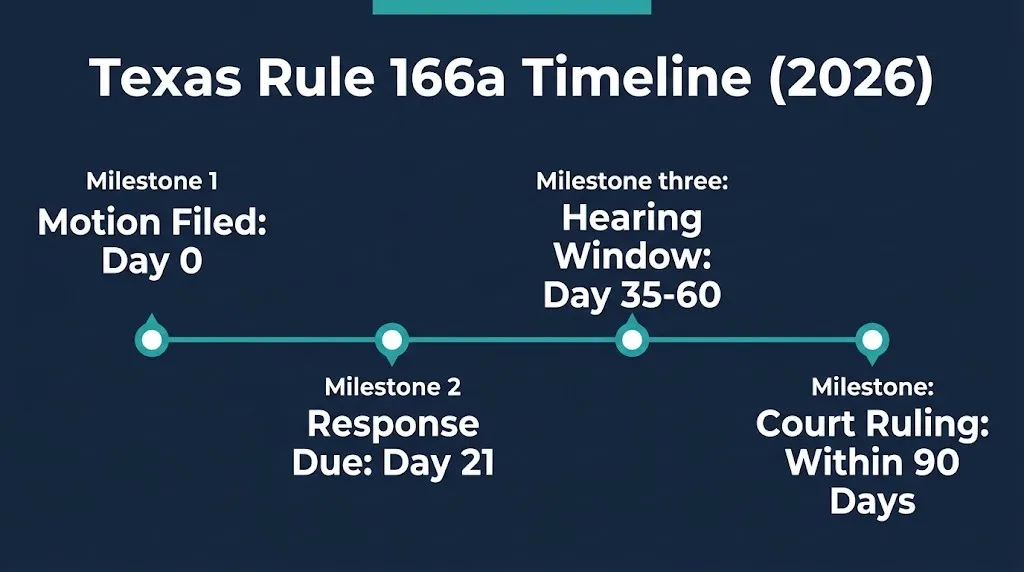
The new Rule 166a deadlines actually shorten one part of the timeline. A summary judgment motion now gets a hearing within 60 days of filing, with a ruling within 90 days after that . Under the old rule, a motion could sit for months without a hearing date.
The discovery phase still drives most of the schedule. Document production, depositions, and expert reports take time, and the other side’s cooperation, or lack of it, sets the pace. Think of it like a home renovation: the contract says eight weeks, but what you uncover behind the walls decides the real schedule.
Cases that go to trial take the longest. Trial preparation alone can consume months. Most Dallas business cases settle at mediation before that point, which is why the median case resolves in the ranges above.
What Happens Next for Dallas Business Litigation in 2026 and 2027?
The 2026 rule changes are locked in for all motions filed on or after March 1. The next developments will come from appellate decisions interpreting the new rule and from the courts adjusting their dockets to the mandatory deadlines.
October 2026: The amended Rule 166a applies to all new summary judgment motions. Dallas courts are operating under the 21-day response and 60-day hearing framework.
Expected late 2026: Appellate courts begin issuing decisions interpreting the new rule’s deadlines and title requirements. Specific rulings are not yet confirmed.
January 2027: New civil case filings begin under the 2027 court calendar. The Texas Business Court’s docket continues to develop.
Expected 2027: Dallas practitioners adjust calendaring and staffing to the faster summary judgment pace. Firms that have not updated their processes will feel the strain.
Frequently Asked Questions
How much does a business litigation attorney in Dallas cost?
Costs range from $25,000 for simpler disputes to over $1,000,000 for complex trials, mostly billed hourly. Hybrid arrangements are available in some cases .
Do I need a lawyer to sue a business partner in Texas?
Not technically, but partnership disputes involve complex financial and procedural issues. An attorney can assess venue, preserve claims, and manage the new Rule 166a deadlines.
What is the new summary judgment deadline in Texas for 2026?
The nonmovant’s response is due 21 days after the motion is filed, and the court must set a hearing within 60 days of filing .
Where are Dallas business lawsuits filed?
They are filed in the Dallas County Civil District Courts or the Texas Business Court, First Division, depending on jurisdiction and the amount in controversy .
Which Dallas firms does Chambers rank for commercial litigation?
Chambers USA’s 2026 spotlight lists Estes Thorne Ewing & Payne PLLC and Shackelford, McKinley & Norton LLP for Dallas general commercial litigation .
Can I recover attorney’s fees in a Texas business lawsuit?
Sometimes. Texas Civil Practice and Remedies Code Chapter 38 allows fee recovery in certain contract claims, and some partnership agreements include fee-shifting clauses .
How long does a Dallas business lawsuit take?
Most cases resolve in 9 to 18 months. Complex cases that go to trial can take longer .
What is the Texas Business Court?
It is a specialized court created by statute to handle qualifying business disputes. The First Division sits in Dallas and issued opinions in 2026 on contract and ownership disputes .
What You Should Do Before You Call a Dallas Business Litigator
Gather your contracts, your emails, and your financial records first. Write down the timeline of the dispute and the dollar amount at stake. Then call two or three Dallas firms and ask the five questions above.
Compare the answers, not the promises. The new Rule 166a deadlines mean your response window starts the day a motion is filed, so the attorney you hire needs to be someone who answers the phone after the retainer is signed. Calendar the 21-day deadline if you are ever served with a dispositive motion, and do not assume the old seven-day-before-hearing rule still applies.