Do you actually need a workers compensation lawyer
Quick Answer
- Most workers’ comp lawyers work on contingency, charging 10% to 25% of your settlement, with several states setting hard caps.
- You typically have 1 to 2 years from your injury date to file a claim, though this varies sharply by state.
- A free consultation is standard, and you owe nothing if your lawyer doesn’t recover benefits for you.
If you got hurt on the job and are searching for a workers’ compensation lawyer, the first thing to know is how they get paid. Nearly every state limits or reviews attorney fees in these cases, and most lawyers only collect if you win.
This affects anyone weighing whether to hire an attorney versus handling a claim alone. The single number that matters most is your state’s filing deadline, since missing it can end your case before a lawyer ever gets involved.
This guide covers costs, deadlines, and how to vet a workmans compensation attorney. One detail that surprises people: in some states, the insurance company, not you, ends up paying part of your lawyer’s fee.
The Facts
| Topic | Hiring a workers’ compensation lawyer (general legal process, not one case) |
| Typical Fee Structure | Contingency (no win, no fee) |
| Common Fee Range | 10% to 25% of settlement, higher in some states |
| Filing Deadline | Varies by state, typically 1 to 2 years from injury |
| Employer Notice Deadline | Often 30 to 90 days, shorter than the filing deadline |
| Fee Approval | Reviewed or capped by a state workers’ comp board or judge in most states |
| Upfront Cost | Not yet standard; most firms offer a free initial consultation |
Do you actually need a workers compensation lawyer
You don’t legally need one, but a lawyer becomes important once your claim is disputed, denied, or involves a serious injury.
Simple, undisputed claims with minor injuries sometimes resolve fine without an attorney. Insurance adjusters, however, represent the insurer’s interests, not yours.
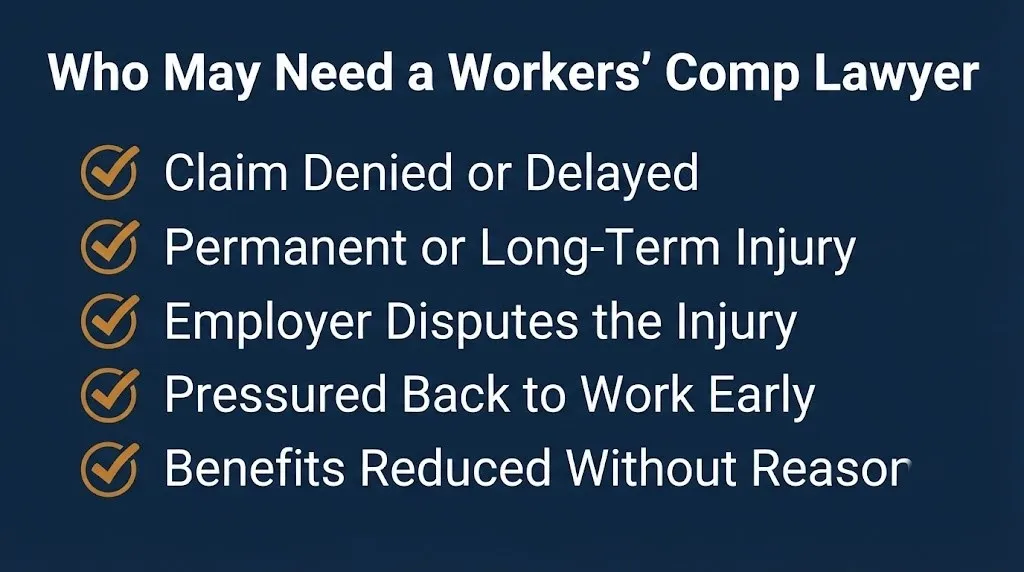
Consider hiring a lawyer if any of these apply:
- Your claim was denied or delayed without a clear reason
- You have a permanent injury or need long-term care
- Your employer disputes that the injury happened at work
- You’re being pressured to return to work before you’re ready
- Your benefits were reduced without explanation
Think of a straightforward claim like a simple insurance repair estimate, quick and low stakes. A disputed claim is closer to fighting a denied insurance claim after a major accident, where you need someone who knows the paperwork cold.
Is hiring a workmans compensation attorney worth the cost
Yes, in most disputed or serious cases, since attorneys work on contingency and you pay nothing if you don’t recover benefits.
That “no win, no fee” model means a lawyer only gets paid as a pre-agreed percentage of your settlement if they succeed. If they don’t win your case, you don’t owe them for the work.
One firm’s plain math example helps: a $30,000 settlement with a 25% contingency fee results in a $7,500 attorney fee, leaving you $22,500 before separate case costs. Compare that to handling a denied claim alone, where you risk getting nothing at all.
Key Takeaway: In most states, a workers’ comp lawyer only gets paid if you get paid, which limits your financial risk in hiring one.
How much does a workers compensation lawyer cost
Most workers’ comp lawyers charge a contingency fee of roughly 10% to 25% of your settlement or award, with state law often setting the cap.
This is not a flat, nationwide number. Percentages, what benefits count toward the fee, and how the fee is calculated all vary by state, and some states use fee schedules instead of a flat percentage.
| State (example) | Reported Fee Structure |
|---|---|
| Alabama | Fixed at 15% |
| Georgia | 25% |
| Tennessee | 20% |
| Florida | 25% |
| California | Often approved around 9% to 15%, judge-reviewed |
| Kentucky | 20% of first $25,000, 15% of next $25,000, 10% of remainder |
| Minnesota | 20% of first $130,000, capped around $26,000 |
Not yet confirmed: fee caps for every state, since some use case-by-case judicial approval rather than a published percentage. Ask any lawyer you’re considering to show you their state’s specific cap or rule in writing.
What percentage do workers comp lawyers take from your settlement
The percentage typically comes directly out of your settlement or award once it’s approved, not as a separate bill.
Most contingency agreements fall in the 10% to 25% range, though some sources cite fee ranges running as high as 9% to 33% depending on case complexity and whether the claim goes to trial.
Bold Fact: 20% to 25% is the most commonly cited contingency rate across the states checked for this guide.
A workers’ comp judge or commissioner typically has to approve the fee before it’s finalized. That review exists specifically to protect you from an inflated fee, not to protect the attorney.
Reality Check: No legitimate workers’ comp lawyer asks for a large upfront retainer or a fee before your case resolves. If someone asks for money before doing any work on a standard workers’ comp claim, treat that as a red flag and get a second opinion.
How to find the best lawyer for workers compensation
Start by looking for attorneys who focus specifically on workers’ compensation, not general personal injury.
Workers’ comp law is heavily state-specific, with its own boards, judges, and appeals process separate from civil court. A lawyer who handles these cases regularly will know your state’s fee caps and filing quirks cold.
- Search your state bar association’s lawyer directory for workers’ comp specialists.
- Ask for a free consultation before signing anything.
- Confirm the fee percentage and get it in writing.
- Ask how many workers’ comp cases they’ve handled in the last year.
- Ask whether they’ve argued cases before your state’s specific comp board.
- Check for state bar discipline records before hiring.
- Get a referral from a union, if you belong to one.
Questions to ask before hiring a workers compensation lawyer
Ask direct questions about fees, experience, and communication before you sign a retainer.
The strongest workers’ comp attorneys will answer these clearly, without hedging:
- What percentage will you charge, and is it capped by state law?
- Who pays case costs like medical records and expert reports?
- How many workers’ comp cases have you settled or won?
- Will you handle my appeal if my claim is denied?
- How often will you update me on my case?
Key Takeaway: A lawyer who won’t put their fee percentage in writing during a free consultation is not one you should hire.
How to file a workers compensation claim with a lawyer’s help
Filing typically starts with notifying your employer, then submitting a formal claim to your state’s workers’ comp agency.
A lawyer can handle most of this process for you once you’re a client, but the general steps look like this:
- Report the injury to your employer in writing as soon as possible.
- Seek medical treatment and document everything.
- Ask your employer for the First Report of Injury form.
- File the formal claim with your state’s workers’ comp board.
- Provide medical records and wage documentation to support the claim.
- Respond promptly if the insurer requests more information.
- Appeal within the deadline if your claim is denied.
Missing the employer notice deadline can hurt your case even if you later meet the formal filing deadline, since failing to report an injury on time can cost you your right to benefits even with clear documentation.
What is the deadline to file a workers compensation claim
The filing deadline, known as the statute of limitations, is set by your state and typically runs 1 to 2 years from your injury date.
That said, this varies more than most people expect. Nevada gives injured workers just 90 days, while Massachusetts allows four years to file. Ohio currently requires a claim within one year of the injury date, following a 2017 law that shortened its prior two-year window.
Separately, federal government employees generally must file within three years of the injury under federal workers’ comp law.
- Notice to employer: often 30 to 90 days
- Formal claim filing: often 1 to 2 years
- Occupational disease claims: often extended under a “discovery rule”
Not yet confirmed for every state in this guide: the exact deadline in your specific state. Confirm your state’s rule with a local attorney or your state’s workers’ comp board directly.
Current state fee caps and rules for workers comp attorneys in 2026
Most states still require a judge, commissioner, or board to review and approve attorney fees before they’re finalized.
This isn’t new for 2026, but it remains one of the most misunderstood parts of the process. Courts and state agencies review and approve the fee so it stays fair, rather than letting attorneys set fees unilaterally.
In Pennsylvania, for example, compensation agreements and settlements must be approved by courts before they’re final. In Kentucky, an administrative law judge must review and approve a workers’ comp lawyer’s fee to confirm it stays within state limits.
Key Takeaway: Because a judge or board reviews most workers’ comp attorney fees, you have a built-in check against being overcharged.
When should you hire a workmans compensation attorney after an injury
The earlier the better, especially if your claim gets disputed or your employer questions how the injury happened.
Waiting too long can cost you evidence, witness memory, and in some states, your entire right to file. A lawyer brought in early can also make sure you report the injury correctly the first time.
Strong signals to call a lawyer immediately:
- Your employer denies the injury happened at work
- You’ve been asked to sign anything from the insurance company
- Your claim has already been denied once
- You’re facing surgery or long-term disability
What does a workers compensation lawyer actually do for your case
A workers’ comp lawyer manages your claim’s paperwork, negotiates with the insurer, and represents you in disputes or appeals.
That includes gathering medical evidence, calculating the value of lost wages and future care, and pushing back when an insurer undervalues your claim. If your claim is denied, they handle the appeal process before your state’s workers’ comp board.
Lawyers also handle communication with the insurance adjuster directly, which limits the chances of you saying something that gets used against your claim later.
Why employers and insurers dispute so many workers comp claims
Insurers dispute claims to limit payouts, and employers sometimes dispute claims to control their insurance costs and premiums.
Common disputes include whether the injury actually happened at work, whether it’s connected to a pre-existing condition, or whether the worker can return to some form of duty sooner than claimed.
This is where legal representation earns its fee most clearly. An unrepresented worker facing a denial has to navigate an appeals process built and staffed by people who work for the insurer’s interests, not the worker’s.
What happens if you can’t afford a workers compensation lawyer
Most workers’ comp lawyers don’t require any money upfront, since hiring one typically costs nothing out of pocket under the standard contingency fee arrangement.
The fee only comes due if you recover benefits, and it’s deducted from that recovery, not billed separately. Initial consultations are commonly offered for free across firms that handle these cases.
Key Takeaway: Cost should rarely be the reason someone avoids hiring a workers’ comp lawyer, since the standard model requires no payment unless you win.
Other costs beyond attorney fees in a workers comp case
Separate from the attorney’s contingency fee, you may be responsible for case costs like medical records, expert reports, and filing fees.
Some firms advance these costs and deduct them from your final recovery instead of billing you directly. In California, insurance companies can sometimes be responsible for a separate category of fees, called 5710 fees, which can run as much as $500 per hour for tasks like deposition prep, without reducing your own settlement.
- Medical record retrieval fees
- Expert witness or medical evaluation costs
- Filing and administrative fees
- Deposition-related costs in disputed cases
Not yet determined: exact costs for your case, since these depend on how contested your claim becomes.
What happens next
Immediately after injury: Report the injury to your employer in writing.
Within 30 to 90 days (varies by state): Employer notice deadline typically applies.
Within 1 to 2 years (varies by state): Formal claim filing deadline typically applies.
If disputed: Appeal process begins before your state’s workers’ comp board.
Expected outcome: Settlement, award, or continued benefits, depending on your case and state rules.
Frequently Asked Questions
Do I need a lawyer for a workers’ comp claim?
Not always, but you likely need one if your claim is denied, disputed, or involves a serious injury.
Simple, undisputed claims sometimes resolve without an attorney.
How much does a workers’ comp lawyer cost?
Most work on contingency, charging roughly 10% to 25% of your settlement, capped or reviewed by state law in many states.
You typically pay nothing unless you win your case.
What is the deadline to file a workers’ comp claim?
Deadlines vary by state, but most fall between 1 and 2 years from your injury date.
Some states, like Nevada, allow as little as 90 days, so check your state’s rule directly.
Can I be charged a fee if I lose my case?
Under a standard contingency agreement, no, since the attorney only gets paid if you recover benefits.
Separate case costs like medical records may still apply in some agreements.
How do I know if my workers’ comp lawyer’s fee is fair?
Most states require a judge or workers’ comp board to review and approve the fee before it’s final.
Ask your lawyer to show you your state’s specific cap or fee rule in writing.
What’s the difference between a workers’ comp lawyer and a personal injury lawyer?
Workers’ comp lawyers focus specifically on state administrative claims and boards, not civil court.
A general personal injury lawyer may not know your state’s specific comp fee caps or filing deadlines.
Will hiring a lawyer slow down my claim?
Not typically, and a lawyer often speeds up disputed claims by handling paperwork and pushing back on delays.
Unrepresented claims that get denied can take longer overall due to appeal complexity.
If you’ve been hurt on the job, don’t wait to report it, since your state’s notice deadline is often far shorter than the formal filing deadline. Gather your medical records now and get a free consultation before any state deadline passes.
The single fact worth remembering: most workers’ comp lawyers only get paid if you do, so cost shouldn’t be the reason you go without help.