Life Settlement Broker 2026: How Payouts, Licensing, and Contracts Actually Work
Quick Answer
- Life settlement brokers are licensed and regulated in most states. Legitimate brokers owe you a fiduciary duty.
- LISA member data shows the average 2025 life settlement payout was $212,066, nearly 9 times the average insurer cash surrender value.
- There’s no federal claim deadline. State law typically requires a policy to exist at least two years before it can be sold.
A life settlement broker is a licensed professional who sells your life insurance policy to a third-party buyer on your behalf, for cash instead of letting the policy lapse or surrendering it back to the insurer. Brokers work exclusively for you, the policy owner, not the buyer.
This matters most to people over 65 holding a policy they no longer need or can’t afford. In 2025, industry data showed sellers received far more through a broker-led sale than through their insurer’s cash surrender offer.
This article covers how brokers are licensed, what payouts actually look like, and where the real risks sit. One number surprises most people: insurer surrender offers fell 27 percent in a single year while broker-facilitated sale prices kept climbing.
The Facts
| Category | Details |
|---|---|
| What it is | A licensed intermediary who sells your life insurance policy to a buyer, working only for you |
| Regulation status | Licensed and regulated in most states, based on the NAIC or NCOIL model act |
| 2025 market total (LISA members) | $626.6 million paid to consumers, up from $601 million in 2024 |
| Average payout | $212,066 per policy (LISA member data, 2025) |
| Typical payout range | 10 to 50 percent of face value, averaging around 20 to 25 percent |
| Waiting period | Most states require the policy to be in force at least 2 years before a sale |
| Licensing authority | State insurance department (broker license), plus FINRA oversight for variable policies |
| Documents needed | Policy details, medical authorization, signed disclosure forms, license verification |
Is a Life Settlement Broker Legitimate?
Yes, life settlement brokers are legal and regulated professionals in the large majority of U.S. states. Licensing is handled by each state’s department of insurance.
Most states base their rules on model legislation from the National Association of Insurance Commissioners (NAIC) or the National Conference of Insurance Legislators (NCOIL). These laws require brokers to hold a specific life settlement broker license, separate from a general insurance producer license.
By law in states like Vermont, Idaho, and Rhode Island, a licensed broker owes a fiduciary duty. That means the broker must act in your best interest and represent only you, never the buyer.
Quick legitimacy checklist:
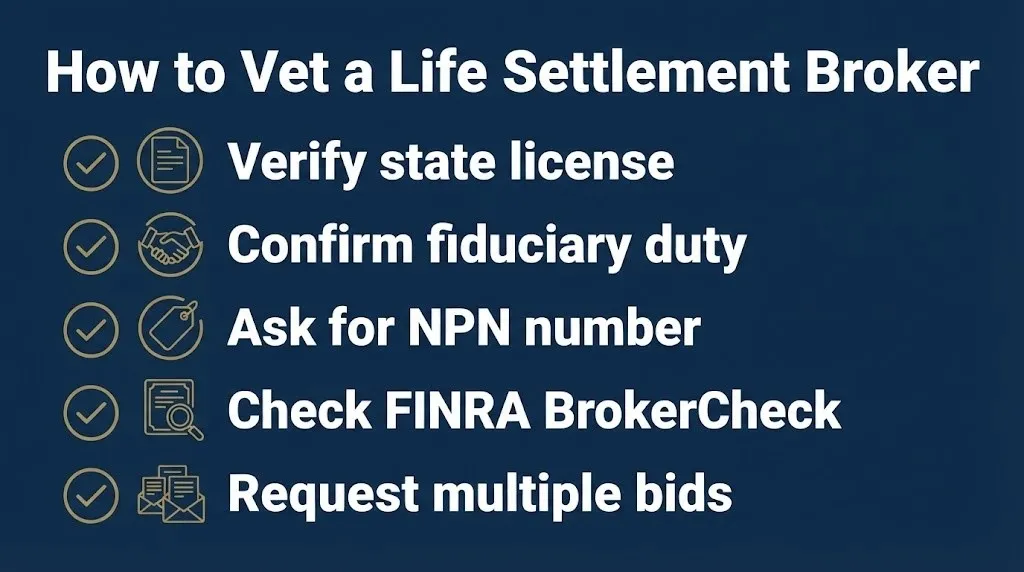
- Confirm the broker’s license through your state insurance department
- Ask for their National Producer Number and check FINRA BrokerCheck if variable life insurance is involved
- Confirm they disclose all offers received, not just one
Key Takeaway: A licensed life settlement broker legally represents only you, the seller, and must disclose every offer, not just the best one for the buyer.
Is Selling My Life Insurance Policy a Scam?
Selling a policy through a licensed broker is not a scam. The scam risk comes from unlicensed operators and a related, illegal practice called STOLI.
STOLI stands for stranger-originated life insurance. That’s when an outside investor funds a brand-new policy on someone else’s life purely to profit from the eventual death benefit. Most states treat STOLI as fraud, and it’s different from a legitimate life settlement on a policy you’ve owned for years.
Common red flags reported by state insurance departments and fraud watchdogs:
- Anyone asking you to take out a new policy specifically to sell it right away
- Pressure to sign quickly without an independent review period
- Requests for cash payments instead of documented transactions
- A “broker” who can’t produce a current state license number
Reality Check: No legitimate broker asks for upfront fees before finding a buyer, and no legitimate buyer pressures you to sign the same day. If someone rushes you or asks for cash, stop and call your state insurance department.
How Much Does a Life Settlement Broker Pay for a Policy?
There’s no fixed price. Payouts depend on your age, health, policy face value, and the annual premiums a buyer would still need to pay.
According to 2025 industry data from the Life Insurance Settlement Association, LISA members paid consumers an average of $212,066 per settled policy. That compares with an average insurer cash surrender value of just $24,360 the same year.
| Metric | 2024 | 2025 |
|---|---|---|
| LISA member payouts (total) | $601 million | $626.6 million |
| Settlements completed | Fewer (down 9.48% year over year) | 2,955 |
| Average insurer cash surrender value | $33,493 | $24,360 |
| Average life settlement payout | Not directly reported | $212,066 |
The gap between the two options is the whole reason this market exists. Selling through a licensed broker returned nearly 9 times more than surrendering the same policy back to the insurer.
What Percentage of Face Value Do Life Settlement Companies Pay?
Typical payouts run 10 to 50 percent of a policy’s face value, with most sellers landing near the 20 to 25 percent mark, according to LISA.
Where you land in that range depends on a few specific factors:
- Your age (older insureds generally receive a higher percentage)
- Health status and life expectancy estimates
- The size of remaining annual premiums the buyer must cover
- Policy type (universal life policies tend to trade differently than term)
- Current buyer demand in the secondary market
Think of it like an old car with a warranty still attached. A buyer isn’t just paying for the car. They’re pricing in how much more they’ll need to spend keeping it running before it pays off.
How Is My Life Settlement Payout Calculated?
Buyers calculate an offer by estimating your life expectancy, then discounting the eventual death benefit against the premiums they’ll need to keep paying until that point.
The math works against you the younger and healthier you are, since a buyer expects to pay premiums longer before collecting. It works in your favor if you’re older or the policy carries a chronic or terminal diagnosis noted in your medical records.
A broker’s job is to shop your policy to multiple providers and bring back competing bids, rather than accepting the first offer. That’s the entire value a broker adds over selling directly to one buyer.
Key Takeaway: Payout size depends almost entirely on age, health, and remaining premium cost, and a broker’s main job is generating competing bids, not setting a fixed price.
How Do I Find a Licensed Life Settlement Broker?
Start by verifying a license through your state insurance department before signing anything or sharing medical records.
Steps to vet a broker properly:
- Search your state department of insurance’s licensee lookup tool.
- Confirm the license category is specifically “life settlement broker,” not just general producer.
- Ask for their National Producer Number (NPR) for cross-reference.
- Check FINRA BrokerCheck if your policy is a variable life product.
- Request references or a portfolio of past transactions.
- Confirm in writing that they’ll solicit multiple provider bids, not just one.
- Read the compensation disclosure before signing an agreement.
Most states also require brokers to carry a surety bond. Vermont, for example, requires a bond starting at $25,000 for lower transaction volumes, scaling up with annual payouts handled.
What Documents Do I Need for a Life Settlement Contract?
You’ll typically need your policy documents, a signed medical records release, and government-issued identification to start the process.
A standard life settlement file usually includes:
- Copy of the life insurance policy and any riders
- Signed HIPAA authorization for medical record access
- Disclosure statement acknowledging you understand the transaction
- Proof of identity matching the policy owner
- Beneficiary change forms, if applicable, once a sale closes
State law generally gives you an absolute right to a review or rescission period after signing, so read that window carefully before finalizing anything.
How Do I Choose Between Multiple Life Settlement Companies?
Compare licensed providers on price, but also on transparency, since the highest bid isn’t always from the most reliable buyer.
Questions worth asking each provider or their broker:
- Is your license current and specific to life settlements in my state?
- Will you disclose every bid you receive, not just your recommendation?
- What fees, if any, come out of my payout?
- How long does closing typically take once I accept an offer?
- Can you provide your complaint history with the state insurance department?
Not yet determined: there’s no single national “best” life settlement company ranking, since market share and pricing shift year to year based on interest rates and buyer demand.
What Is Happening in the Life Settlement Market in 2026?
The secondary market for life insurance kept growing through 2025, driven partly by insurers offering far less on direct surrenders.
LISA’s 2025 annual report showed member payouts rising to $626.6 million, up from $601 million the year before, even as insurer surrender offers dropped 27 percent. That widening gap pushed more policyholders toward brokers and providers instead of surrendering coverage outright.
Separately, state legislatures continue tightening fraud rules. New York’s insurance code, for example, requires life settlement providers to file annual fraud prevention and special investigations unit reports by March 15 each year, a deadline that applied again in 2026.
Is the Life Settlement Industry Growing?
Yes, transaction volume and total payouts both grew in 2025, continuing a longer-term trend tied to an aging population and shrinking retirement savings.
LISA reported 2,955 completed settlements among its members in 2025, a 9.48 percent increase over the prior year. Broader industry estimates point to sustained growth as more seniors reassess policies they can no longer afford.
Key Takeaway: Broker-facilitated sales grew in both volume and dollar value in 2025, even as insurers cut their own surrender offers by more than a quarter.
What Is a Life Settlement?
A life settlement is the sale of an existing life insurance policy by its owner to a third-party buyer, in exchange for a lump-sum cash payment.
Instead of letting a policy lapse for nothing, or accepting a low cash surrender value from the insurer, the owner sells the policy on the open market. The buyer becomes the new policy owner and beneficiary, and takes over future premium payments.
This differs from a policy loan or a straightforward surrender, since ownership itself transfers to a new party rather than being canceled.
What Is the Difference Between a Life Settlement Broker and a Life Settlement Provider?
A broker represents you, the seller, while a provider is the buyer who actually purchases the policy, often on behalf of institutional investors.
| Role | Who They Represent | Compensation |
|---|---|---|
| Life settlement broker | The policy owner (seller) exclusively | Fee or commission, disclosed to seller |
| Life settlement provider | Buys policies for itself or investors | Profits from eventual death benefit, minus premiums paid |
State statutes, including Vermont’s, specifically bar brokers from representing the insurer or the provider. If someone claims to represent both sides of a life settlement transaction, that’s a licensing violation in most regulated states.
What Is a Viatical Settlement?
A viatical settlement is a life settlement involving a policyholder who is terminally or chronically ill, typically sold soon after the policy’s contestability period ends.
The term predates the broader “life settlement” market and originally applied almost exclusively to sales by people with terminal diagnoses. Regulators still treat viatical settlements as a distinct, more heavily scrutinized category because of historical fraud tied to falsified medical records.
Why Do People Sell Life Insurance Policies?
Most sellers no longer need or can’t afford a policy, and want more value than an insurer’s surrender offer provides.
Common reasons cited across industry and regulatory sources:
- Premiums have become unaffordable in retirement
- The original reason for the coverage (a mortgage, dependent children) no longer applies
- The policyholder needs funds for long-term care or medical costs
- The cash surrender value offered by the insurer is far below market value
What Is the Two-Year Rule for Life Settlement Contracts?
Most states prohibit selling a policy within two years of its issue date, except in specific hardship circumstances defined by state law.
Idaho’s statute, for example, bars settlement contracts within two years of issuance unless special circumstances apply. This waiting period exists to prevent STOLI arrangements, where a policy is originated purely to be flipped for profit.
If you’re shopping for a broker on a newer policy, ask directly whether your state’s exception categories, such as terminal illness, apply to your situation.
What to Expect Next
Ongoing through 2026: State legislatures continue refining life settlement fraud-prevention rules, including annual reporting deadlines for providers.
March 15, 2026 (recurring annual deadline): Life settlement providers in states like New York must file fraud prevention and special investigations unit reports.
Expected through 2026: Continued gap between insurer surrender offers and broker-facilitated market prices, based on the 2025 trend.
Ongoing: Multiple state insurance departments continue active enforcement against unlicensed brokers and STOLI schemes.
Frequently Asked Questions
Is a life settlement broker the same as a life insurance agent?
Not necessarily. A life settlement broker needs a separate, specific license in most states.
Some states allow licensed life insurance producers to add settlement authority after extra requirements.
How much does it cost to use a life settlement broker?
Brokers are typically paid a fee or commission built into the transaction, not billed separately upfront.
Legitimate brokers must disclose this compensation to you before you sign anything.
Can I sell a term life insurance policy through a life settlement?
Some term policies qualify if they’re convertible to permanent coverage, but eligibility varies by buyer and policy terms.
Ask a licensed broker to confirm whether your specific term policy qualifies before starting the process.
What happens to my beneficiaries if I sell my policy?
Once a sale closes, the buyer becomes the new owner and beneficiary of the death benefit.
Your original beneficiaries no longer have a claim on that policy after the transaction is finalized.
Is my life settlement payout taxable?
Tax treatment depends on your policy basis and the amount received, and can vary by individual circumstances.
Consult a tax advisor directly, since this article can’t provide personalized tax guidance.
How long does a life settlement transaction take?
Timelines vary by provider and case complexity, and no single confirmed industry-wide average exists.
Ask any broker or provider you’re considering for their typical closing timeline before signing.
Are life settlement companies regulated by the federal government?
Primarily no. Regulation happens mainly at the state level through insurance departments.
Variable life settlements are an exception, falling under FINRA and federal securities law.
If you’re considering selling a policy, verify any broker’s license through your state insurance department before sharing medical records or signing paperwork. Compare at least two offers, and remember the 2025 data: insurer surrender offers averaged just $24,360, against a $212,066 average through the broker-led secondary market.