Workers’ Compensation Insurance Cost Calculator 2026: How Premiums Are Actually Calculated
Quick Answer
- A workers’ comp cost calculator estimates premiums using your payroll, employee class codes, and state rates.
- Most small businesses pay $0.75 to $2.25 per $100 of payroll, depending on industry and claims history.
- Calculators give estimates only. Your actual premium comes from your insurer after an audit.
You own a business. You need workers’ compensation insurance. You typed “workers’ compensation insurance cost calculator” because you want a number before you talk to an agent. That is smart. But here is what most calculator pages will not tell you: the estimate you get is only as good as the class codes you enter.
This article explains how the calculators actually work, what data drives the number, and how to avoid the mistake that causes business owners to underpay now and owe money later. One verified fact matters most: your final premium is not set by the calculator. It is set by your insurer after a payroll audit, and that audit can change your bill.
How Does a Workers’ Compensation Insurance Cost Calculator Work?
A workers’ compensation insurance cost calculator estimates your annual premium using a standard formula. The formula is the same across almost every state and insurer.
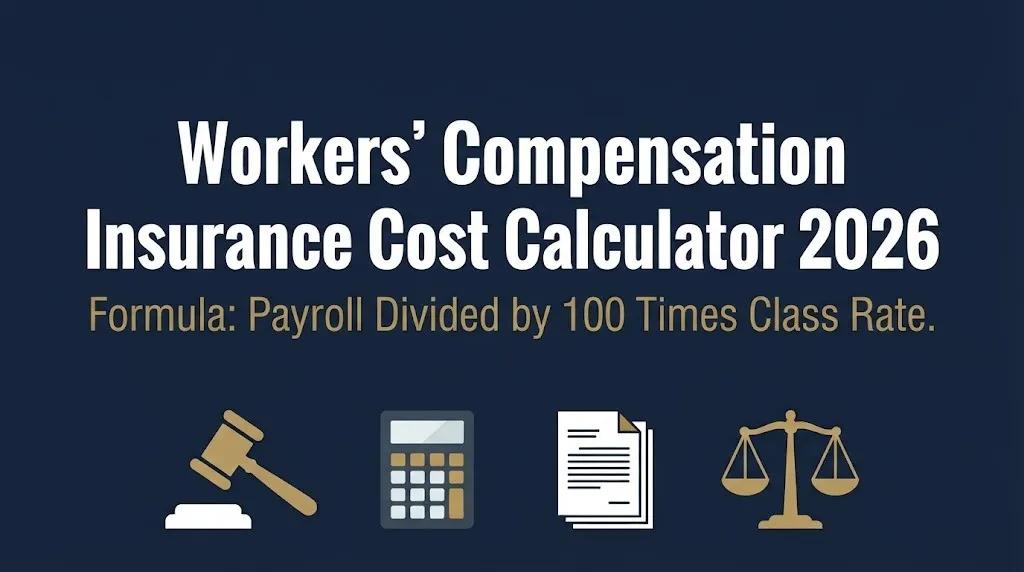
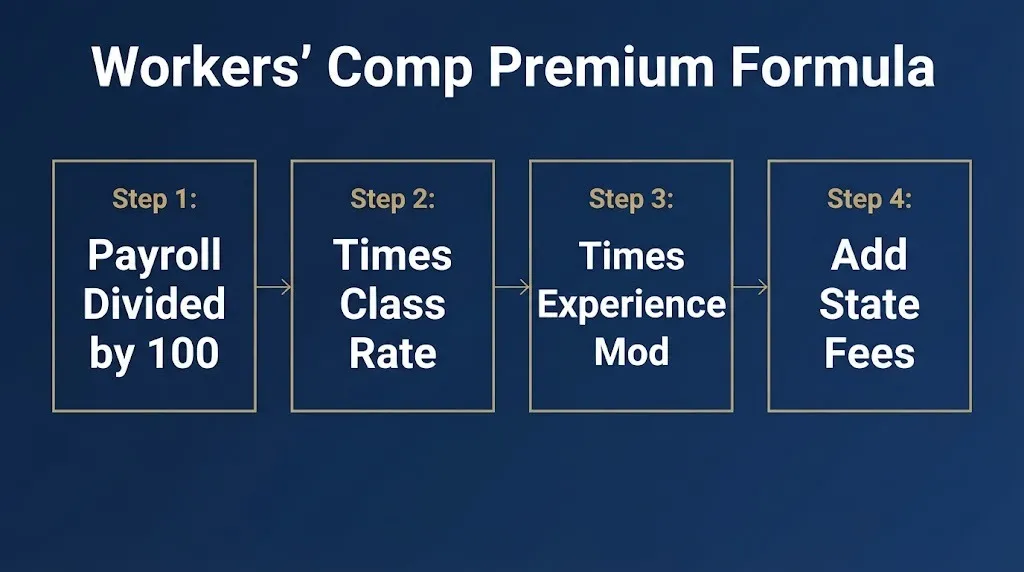
The basic workers’ compensation premium formula is:
Payroll divided by 100 times class rate times experience modifier equals premium.
Here is how that works in practice. Say you have a small roofing company in Texas. Your annual payroll for roofers is $200,000. The class code for roofing has a rate of $8.50 per $100 of payroll. Your experience modifier is 1.0 because you have no claims history.
The math looks like this:
| Step | Calculation | Result |
|---|---|---|
| Payroll divided by 100 | $200,000 / 100 | $2,000 |
| Times class rate | $2,000 x $8.50 | $17,000 |
| Times experience modifier | $17,000 x 1.0 | $17,000 |
Your estimated annual premium is $17,000. That is the number a calculator should show.
If your business has multiple job types, the calculator runs this formula separately for each class code. A construction company with roofers, electricians, and clerical staff will get three different calculations added together.
Key Takeaway: The workers’ comp formula is payroll divided by 100, times class rate, times your experience modifier.
What Data Do I Need to Use a Workers’ Comp Cost Calculator?
You need four pieces of verified data before a calculator can give you a useful estimate. Missing any one of them makes the number unreliable.
Annual payroll by job type. Do not guess. Use your actual payroll records from the last four quarters. Separate employees by what they do, not by their job title. A “project manager” who spends half the day on a roof may be classified as a roofer.
Class codes. Each job function has a four-digit class code. The National Council on Compensation Insurance, usually called NCCI, assigns most of these codes. Some states use their own codes. You can find your codes on your current policy or ask your agent.
State of operation. Rates vary widely by state. The same roofing job costs far more in Florida than in Indiana. Your calculator must use your state’s approved rates.
Experience modifier. If you have been in business more than three years, you have an experience modification factor. It is usually between 0.70 and 1.50. A modifier below 1.0 lowers your premium. Above 1.0 raises it.
Without this data, a calculator will give you a generic answer. That answer may be off by thousands of dollars.
How Much Does Workers’ Compensation Insurance Cost Per Employee in 2026?
The cost per employee depends entirely on the job class. A clerical worker costs far less than a roofer or a trucker.
Here are verified average rates per $100 of payroll for common class codes in 2026. Actual rates vary by state.
| Job Class | Approx. Rate per $100 Payroll | Cost for $50,000 Payroll |
|---|---|---|
| Clerical office worker | $0.25 to $0.60 | $125 to $300 |
| Restaurant cook | $1.50 to $3.00 | $750 to $1,500 |
| Retail sales clerk | $0.60 to $1.50 | $300 to $750 |
| Carpenter | $5.00 to $9.00 | $2,500 to $4,500 |
| Roofer | $8.00 to $15.00 | $4,000 to $7,500 |
| Long-haul trucker | $4.00 to $7.00 | $2,000 to $3,500 |
The spread is enormous. A clerical worker costs a few hundred dollars per year. A roofer costs several thousand. That is why class codes matter more than any other single factor.
Key Takeaway: The class code decides most of your premium. A wrong code can double or triple your cost.
What Is the Average Workers’ Comp Rate by State in 2026?
Workers’ compensation rates are set by state, not nationally. Each state approves rate filings from insurers or from a rating bureau.
Here are approximate average rates per $100 of payroll for selected states in 2026. These are statewide averages across all class codes.
| State | Average Rate per $100 Payroll |
|---|---|
| California | $1.45 |
| New York | $1.25 |
| Florida | $1.10 |
| Texas | $0.75 |
| Illinois | $0.95 |
| Pennsylvania | $0.90 |
| Washington | $0.85 (monopolistic state fund) |
States with monopolistic funds, like Washington, Ohio, North Dakota, and Wyoming, operate differently. You buy coverage from the state fund, not from private insurers. The rates are still published and still vary by class code.
California has some of the highest workers’ comp rates in the nation. That is driven by higher medical costs, more litigation, and a larger permanent disability benefit system. If you operate in California, expect your premium to be above the national average.
What Is an Experience Modification Factor in Workers’ Comp Math?
An experience modification factor, called an experience mod or EMR, is a number that compares your claims history to other businesses in your industry. It is the second biggest driver of your premium after class codes.
The formula compares your actual losses to expected losses for your class and payroll. If your actual losses are lower than expected, your mod is below 1.0. If they are higher, your mod is above 1.0.
Here is how the mod changes a $10,000 base premium:
| Experience Mod | Premium | Change vs. 1.0 |
|---|---|---|
| 0.70 | $7,000 | 30% savings |
| 0.85 | $8,500 | 15% savings |
| 1.00 | $10,000 | No change |
| 1.25 | $12,500 | 25% surcharge |
| 1.50 | $15,000 | 50% surcharge |
The mod is calculated by NCCI or your state rating bureau. It uses three years of claims data, excluding the most recent year. New businesses start at 1.0.
Small claims can hurt you more than you expect. A single $5,000 medical-only claim can raise your mod. Many businesses pay small claims out of pocket to protect their mod.
Key Takeaway: Your experience mod is your claims report card. Fewer claims means a lower mod and a lower premium.
Why Do Workers’ Comp Calculators Give Different Estimates?
Different calculators give different estimates because they use different rate data, different class code assumptions, and different payroll rounding. None of them know your exact situation.
Some calculators use national average rates. Others use state-specific rates but apply them to generic class codes. Still others pull rates from one insurer, not the market average.
A calculator is a starting point, not a quote. Think of it like an online mortgage calculator. It shows you the math. It does not tell you the rate your lender will offer after looking at your full file.
If you need a real number, get a quote from at least three insurers or a broker. Provide your exact class codes, payroll by code, and current experience mod. The quotes will still vary, but they will be real and binding if issued as formal quotes.
How Do I Calculate Workers’ Compensation Insurance Cost Manually?
You can calculate your workers’ comp premium manually if you have your payroll, class codes, and state rates. Here are the steps.
- Get your state’s approved rate for each class code from your insurance department or rating bureau.
- Divide your annual payroll for each class code by 100.
- Multiply the divided payroll by the class rate.
- Add up the totals for all class codes.
- Multiply the total by your experience modifier.
- Add any state assessments, taxes, or fees.
Here is an example for a small restaurant with cooks and servers:
| Class Code | Payroll | Rate | Calculation | Premium |
|---|---|---|---|---|
| Cook | $120,000 | $2.50 | $1,200 x $2.50 | $3,000 |
| Server | $80,000 | $0.80 | $800 x $0.80 | $640 |
| Total base premium | $3,640 | |||
| Experience mod | 0.90 | x 0.90 | ||
| Final estimated premium | $3,276 |
This is the same math the calculator runs behind the screen. Knowing how to do it manually helps you spot errors in your quotes.
What Factors Increase Workers’ Compensation Insurance Costs the Most?
Several factors push workers’ comp premiums up. Some you can control. Some you cannot.
Uncontrollable factors:
- State-mandated rate increases
- High-risk class codes for your industry
- Catastrophic claims that hit your experience mod
- Legislative changes to benefit levels
Controllable factors:
- Poor safety record and frequent small claims
- Employee misclassification, which triggers audit penalties
- Inaccurate payroll reporting, which causes audit surprises
- Delayed return-to-work programs for injured employees
The single most controllable factor is safety. Businesses with strong safety programs have fewer claims. Fewer claims mean a lower experience mod. A lower mod means a lower premium.
Employee misclassification is the other big one. Putting a roofer in a clerical code saves money now. The audit catches it later. Then you owe back premiums plus penalties.
Reality Check: No legitimate workers’ comp calculator asks for your bank details or charges a fee to estimate your premium. Free estimators are marketing tools. If a site demands payment for a quote, leave.
How Do Workers’ Comp Audits Change Your Final Premium?
Your initial premium is an estimate. The insurer bases it on the payroll you report when you buy the policy. At the end of the policy year, the insurer audits your actual payroll.
The audit compares your estimated payroll to your actual payroll. If your actual payroll was higher, you owe more premium. If it was lower, you get a refund or a credit.
The audit is not optional. Your policy requires it. The auditor will ask for:
- Payroll records by employee and job function
- Tax filings, including 941 forms and state unemployment reports
- Certificates of insurance for any subcontractors
- Job descriptions to verify class codes
If the auditor reclassifies your employees into a higher-risk code, your bill goes up. If your payroll grew during the year, your bill goes up. The adjustment can be thousands of dollars.
That is the main reason calculators understate true costs. They estimate based on what you tell them. The audit is based on what your records actually show.
Key Takeaway: Your calculator estimate is not final. The audit is final, and it can go either direction.
How Does Payroll Reporting Affect Workers’ Comp Costs?
Payroll is the base of the entire workers’ comp formula. Underreport payroll and your premium drops now and spikes later. Overreport and you overpay.
Workers’ comp uses gross payroll, not net pay. It includes wages, salaries, bonuses, commissions, overtime pay, and in some states, housing or meals provided to employees.
Overtime is complicated. Most states allow you to exclude the overtime premium portion, meaning the extra half-time pay above the regular rate. You still report the regular rate for every hour worked.
Tips matter in some states. If your employees receive tips, those tips may be included in payroll for workers’ comp purposes unless your state excludes them.
The cleanest approach is to report exact payroll by class code every quarter. If your payroll changes, update your policy. Waiting for the audit to catch the change means paying the difference all at once.
What Does Workers’ Compensation Insurance Not Cover?
Workers’ comp covers work-related injuries and illnesses. It does not cover everything. Knowing the exclusions helps you understand what you are paying for.
Workers’ comp typically covers:
- Medical treatment for work injuries
- Temporary disability benefits for missed work
- Permanent disability benefits
- Vocational rehabilitation
- Death benefits to dependents
Workers’ comp typically does not cover:
- Injuries caused by intoxication or drug use
- Self-inflicted injuries
- Injuries from horseplay or policy violations
- Normal illnesses not related to work
- Pain and suffering damages
Workers’ comp is a no-fault system. You get benefits regardless of who caused the injury. But you cannot sue your employer for pain and suffering in most cases. The tradeoff is built into the system.
How Can You Lower Your Workers’ Compensation Insurance Costs in 2026?
You can lower your workers’ comp costs with a mix of safety, classification, and claims management. The savings compound over time.
Ten verified cost-reduction steps:
- Implement a written safety program with regular training.
- Investigate every claim promptly and thoroughly.
- Create a return-to-work program for light-duty assignments.
- Review your class codes every year for accuracy.
- Report payroll quarterly, not just at audit time.
- Work with your agent to shop rates at renewal.
- Consider a higher deductible if your state allows it.
- Join a professional employer organization to pool risk if you are small.
- Pay small medical-only claims out of pocket to protect your mod.
- Ask your insurer about scheduled credits for safety certifications.
No single step transforms your premium. The combination over three to five years can cut costs by 20 to 40 percent.
Key Takeaway: Workers’ comp cost control is a long game. Safety, accurate reporting, and smart claims management pay off over years.
What Are the Penalties for Not Having Workers’ Compensation Insurance?
Penalties for failing to carry workers’ comp vary by state. They can be severe.
Most states require coverage if you have one or more employees. Some states exempt very small businesses, sole proprietors, or certain industries. California requires coverage for even one employee, including part-time.
Potential penalties include:
- Fines from $500 to $10,000 per employee or per day in some states
- Personal liability for workplace injury costs
- Stop-work orders that shut down your business
- Criminal charges in extreme cases
- Inability to bid on government or commercial contracts
A single uninsured workplace injury can bankrupt a small business. The medical bills and disability payments come out of your pocket. That is the risk calculators do not show you.
How Do Subcontractors Affect Workers’ Comp Costs?
Subcontractors affect your workers’ comp costs through audit exposure. If you use subcontractors without verifying their own coverage, you may pay for them.
The rule is simple. If your subcontractor does not carry their own workers’ comp insurance, your insurer may count their payroll as yours. The auditor will ask for certificates of insurance from every subcontractor you used.
If you cannot produce a valid certificate, the auditor assigns your class code to the subcontractor’s payments. That increases your payroll and your premium retroactively.
The fix is simple. Before you pay any subcontractor, get a current certificate of insurance naming your business. Verify it with the insurer if the project is large. Keep the certificate on file for the audit.
What Is the Difference Between Workers’ Comp and General Liability Insurance?
Workers’ comp and general liability cover different risks. You usually need both.
Workers’ comp covers injuries to your employees. It pays medical bills, lost wages, and disability benefits. It is required by law in most states.
General liability covers injuries to third parties and property damage. It pays when a customer slips in your store or your work damages a client’s property. It is not legally required in most states, but contracts often demand it.
The two policies do not overlap much. A workers’ comp claim is an employee injury. A general liability claim is a third-party injury or property damage. Some claims involve both, but the policies respond separately.
Here is a quick comparison:
| Factor | Workers’ Comp | General Liability |
|---|---|---|
| Covers | Employee injuries | Third-party injuries and property damage |
| Required by law | Yes, in most states | No, but often contractually required |
| Pays for | Medical, lost wages, disability | Legal defense, settlements, property repair |
| Cost driver | Payroll and class codes | Revenue and business type |
How Often Should You Recalculate Your Workers’ Comp Costs?
You should recalculate your workers’ comp costs every quarter and at every renewal. Quarterly checks catch payroll changes before the audit. Annual renewals let you shop rates.
Your payroll is not static. You hire, fire, and give raises. Each change affects your premium. If you wait 12 months to find out, the audit hits you with one large bill.
A quarterly review takes an hour. Pull your payroll report. Compare it to your policy. If the numbers changed more than 10 percent either direction, contact your agent.
At renewal, get at least three quotes. Workers’ comp rates change every year. Some insurers enter the market and undercut incumbents. Others exit and non-renew. Shopping keeps you honest.
What Happens Next After You Get a Workers’ Comp Calculator Estimate?
The estimate is step one. The next steps turn that number into real coverage.
Expected timeline from estimate to policy:
- Same day: Use the calculator to get a rough range.
- Within 1 week: Contact an independent agent or broker with your payroll and class codes.
- Within 1 to 2 weeks: Receive formal quotes from insurers.
- Within 2 to 4 weeks: Bind coverage and pay the initial premium.
- At policy year end: Undergo the payroll audit and reconcile actual costs.
Do not skip the agent. Calculators cannot issue policies. Agents can also spot classification errors that save you money.
Frequently Asked Questions
How do I calculate workers’ compensation insurance cost?
Divide your payroll by 100, multiply by your class rate, then multiply by your experience modifier.
That gives your base premium before taxes and assessments.
What is the average cost of workers’ comp for a small business?
Most small businesses pay $0.75 to $2.25 per $100 of payroll.
The exact rate depends on your state and class codes.
How much is workers’ comp for one employee?
It depends on the job class and annual payroll.
A clerical worker might cost $200 per year. A roofer might cost $5,000.
What is an experience modifier in workers’ comp?
An experience modifier compares your claims history to similar businesses.
A mod below 1.0 lowers your premium. Above 1.0 raises it.
Why did my workers’ comp premium go up after an audit?
The audit found higher actual payroll or reclassified employees into a higher-risk class.
You owe the difference between the estimated and actual premium.
Can I lower my workers’ comp costs without reducing coverage?
Yes, by improving safety, managing claims, and reviewing class codes.
These steps lower your experience mod over time.
Do workers’ comp calculators charge a fee?
No legitimate calculator charges a fee.
Free estimators are marketing tools for insurers and agents.
Is workers’ comp required for one employee?
Yes, in most states workers’ comp is required even for one part-time employee.
Check your state’s specific rules, as some exempt very small operations.
The single most important number in workers’ comp is not the calculator estimate. It is the audit result at the end of the year. That is the number you actually pay.
Get your class codes right. Report your payroll accurately. Shop your rates at renewal. The calculator is a starting point, not a promise.