Minneapolis Workers Compensation Lawyer 2026: What They Cost, What They Do, and When You Need One
Quick Answer:
- Minneapolis workers compensation lawyers are real professionals who handle injury claims under Minnesota’s no-fault work injury system.
- Attorney fees are capped by law at 25 percent of disputed benefits, not your entire claim.
- You should contact a lawyer immediately if your claim is denied, your benefits stop, or your employer retaliates.
A Minneapolis workers compensation lawyer in 2026 helps injured workers navigate Minnesota’s work injury system. That system pays medical bills and partial wage replacement when you get hurt on the job. The lawyer’s job is to make sure the insurance company pays what the law requires.
If you’re searching this term, you probably got hurt at work, your claim hit a wall, or you want to know whether hiring a lawyer is worth the cost. The answer depends on your specific situation, but the fee structure is more predictable than most people expect.
This article covers what these lawyers actually do, what they cost under Minnesota’s fee caps, when hiring one makes sense, and how to find the right one.
The Facts
| Item | Verified Details |
|---|---|
| Governing Law | Minnesota Workers’ Compensation Act, Chapter 176 |
| Administering Agency | Minnesota Department of Labor and Industry |
| Attorney Fee Cap | 25% of disputed benefits, no fee on undisputed amounts |
| Injury Reporting Deadline | Within 30 days for most claims, but sooner is safer |
| Claim Filing Deadline | 3 years from injury for most claims, 6 years for some |
| Initial Consultation | Usually free |
| Average Settlement Range | $20,000 to $150,000 for represented claims |
Is hiring a Minneapolis workers compensation lawyer legitimate?
Yes, hiring a Minneapolis workers compensation lawyer is a legitimate and common step for injured workers. These attorneys specialize in Minnesota’s workers compensation system and represent employees, not employers or insurance companies.
The Minnesota Department of Labor and Industry oversees the system and maintains rules for attorney conduct and fees. Lawyers who practice in this area must follow those rules or face discipline from the state.

If you received a solicitation from a workers compensation attorney after your injury, that’s legal in Minnesota, though some firms are more aggressive than others. You have the right to choose any qualified attorney you want. You’re never required to hire the first firm that contacts you.
What does a workers compensation lawyer in Minnesota do?
A Minnesota workers compensation lawyer handles the legal side of your injury claim so you can focus on recovery. The work breaks down into several specific tasks.
The lawyer gathers medical records, communicates with the insurance carrier, files required forms with the state, and negotiates settlement offers. If the insurer denies your claim or stops payments, the lawyer files a claim petition and represents you at hearings.
Here’s what the work typically includes:
| Task | What It Involves |
|---|---|
| Case evaluation | Reviewing medical records and claim history |
| Benefit calculation | Determining correct weekly wage and disability rates |
| Dispute resolution | Filing petitions, responding to denials |
| Settlement negotiation | Demanding fair permanent partial disability values |
| Hearing representation | Arguing your case before a compensation judge |
| Appeal work | Taking cases to the Workers’ Compensation Court of Appeals |
Key Takeaway: A workers compensation lawyer handles disputes and negotiations; for straightforward claims with no denial, you may not need one.
How much does a workers compensation lawyer cost in Minneapolis?
A Minneapolis workers compensation lawyer works on a contingency fee, meaning they get paid only if you win benefits or a settlement. Minnesota law caps the fee at 25 percent of disputed benefits.
The key distinction is “disputed” versus “undisputed.” If the insurer voluntarily pays your medical bills and wage benefits without a fight, the lawyer cannot charge a fee on those amounts. The 25 percent applies only to money the lawyer actually had to fight for.
Here’s how that works in practice:
| Outcome | Attorney Fee |
|---|---|
| Insurer voluntarily pays $30,000 in benefits | No fee on that amount |
| Lawyer negotiates $50,000 settlement | 25% fee, $12,500 |
| Lawyer wins $40,000 in disputed back benefits | 25% fee, $10,000 |
| Court orders payment of disputed medical bills | 25% fee on recovered amount |
The fee comes out of your recovery, not out of pocket. You don’t write a check upfront.
Reality Check: No legitimate workers compensation lawyer in Minnesota will charge you a fee for an initial consultation or ask for money upfront. The contingency system means they only get paid if you do.
When do I need a Minneapolis workers compensation lawyer?
You need a Minneapolis workers compensation lawyer when your claim hits resistance. That resistance comes in specific forms.
Contact a lawyer immediately if your claim is denied, your benefits stop without explanation, your employer disputes that the injury happened at work, or you’re pressured to return to work before your doctor clears you. Those are the moments where legal help matters most.
Here’s a checklist of situations that call for a lawyer:
- Your claim is denied in writing.
- Your weekly benefits stop or are reduced without notice.
- Your employer refuses to report the injury.
- You’re fired or demoted after filing a claim.
- The insurer demands an independent medical exam with a doctor they chose.
- You’re offered a settlement and don’t know if it’s fair.
- Your injury prevents returning to your old job.
Key Takeaway: Straightforward claims with a cooperative insurer may not need a lawyer; any denial, delay, or retaliation changes that calculation immediately.
What is the workers compensation claim deadline in Minnesota?
Minnesota’s workers compensation claim filing deadline is generally 3 years from the injury date for most claims. For certain occupational diseases or injuries discovered later, the deadline extends to 6 years from discovery.
You must report the injury to your employer within 30 days for most claims, though the reporting deadline stretches to 180 days for some occupational injuries. Missing the reporting deadline can bar your claim, but exceptions exist if you can show the employer wasn’t harmed by the delay.
The filing deadline for a formal claim petition is different from the reporting deadline. You have up to 3 years to file a claim petition with the Minnesota Department of Labor and Industry if the insurer denies your claim or stops paying benefits.
What benefits does Minnesota workers compensation pay?
Minnesota workers compensation pays medical benefits, wage loss benefits, and permanent impairment benefits. The structure is more generous than many states.
Wage loss benefits fall into three categories: temporary total disability when you can’t work at all, temporary partial disability when you return to a lower-paying job, and permanent total disability for catastrophic injuries. Temporary total disability pays two-thirds of your gross weekly wage, subject to a state maximum.
Here’s the benefit structure:
| Benefit Type | Payment Rate |
|---|---|
| Temporary Total Disability | 66 2/3% of gross weekly wage, capped annually |
| Temporary Partial Disability | 66 2/3% of the wage difference |
| Permanent Total Disability | 66 2/3% of gross weekly wage, long-term |
| Permanent Partial Disability | Scheduled amount based on impairment rating |
| Medical Benefits | Full coverage of reasonable and necessary care |
The 2026 maximum weekly benefit rate for temporary total disability is $1,384.10, based on the state’s annual adjustment formula.
How do I choose the best workers compensation lawyer in Minneapolis?
Choosing the best workers compensation lawyer in Minneapolis requires checking specific factors, not just picking the biggest billboard or the first firm that calls you.
Start with experience in Minnesota workers compensation specifically, not general personal injury. The system has its own rules, deadlines, and judges. A lawyer who mostly handles car accidents may not know the nuances of Chapter 176.
Here’s what to check:
- Years of Minnesota workers compensation practice.
- Whether they represent injured workers only, never employers or insurers.
- Their fee structure in writing, confirming the 25 percent cap.
- Whether they’ve handled cases similar to yours.
- Client reviews from Minnesota-specific sources.
- Their willingness to take your case to hearing if needed.
- Whether you can reach them directly, not just a case manager.
Key Takeaway: The best lawyer is a Minnesota workers compensation specialist who represents only injured workers and puts the fee structure in writing.
Can I settle my workers comp case without a lawyer in Minnesota?
You can settle a workers comp case without a lawyer in Minnesota, but the risks are higher than most workers realize. Insurance companies negotiate settlements every day. You probably don’t.
Settlement negotiations involve valuing permanent partial disability, future medical needs, and vocational rehabilitation benefits. The insurer has data on what similar cases settle for. You likely don’t. That information asymmetry almost always favors the insurance company.
A Minnesota compensation judge must approve most settlements, but approval doesn’t mean the settlement is fair. The judge checks that the agreement meets legal requirements, not that you got the best possible deal.
What is the average workers comp settlement in Minnesota?
The average workers comp settlement in Minnesota varies widely by injury type, but represented claims typically settle between $20,000 and $150,000. Severe injuries with permanent disability and future medical needs can exceed $200,000.
Minnesota’s system pays permanent partial disability on a schedule, similar to other states. The scheduled amount depends on the body part and impairment rating. A 10 percent impairment to the back pays less than a 25 percent impairment to the spine.
These figures reflect the total settlement value, not what you pocket after attorney fees and medical liens. Your actual check depends on the fee arrangement, any outstanding medical bills, and whether the settlement includes future medical care or leaves those benefits open.
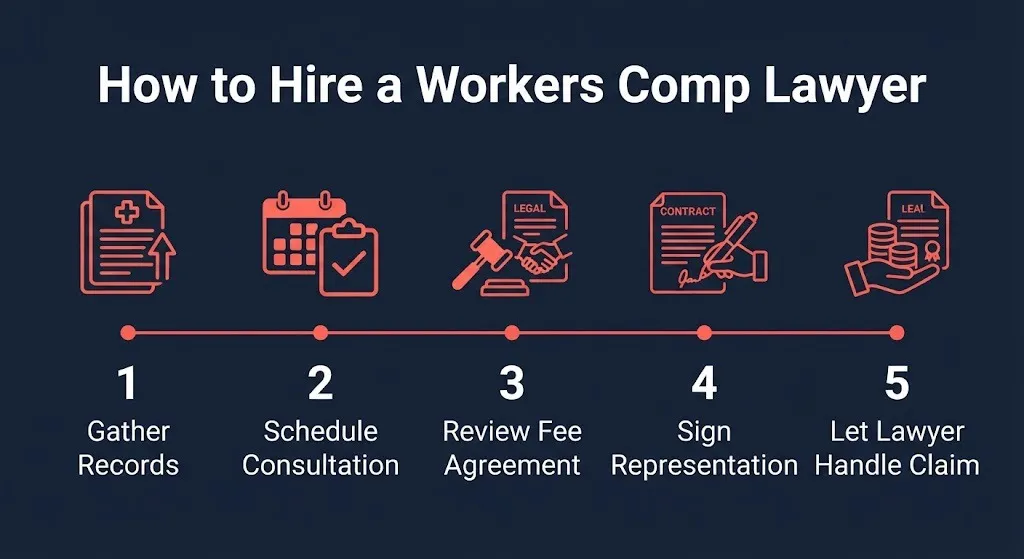
What happens after I hire a workers compensation lawyer?
After you hire a workers compensation lawyer, the case moves through a predictable sequence. The lawyer first gathers your medical records and claim history, then communicates with the insurance carrier about any disputes.
If the insurer won’t resolve the dispute voluntarily, the lawyer files a claim petition with the Minnesota Department of Labor and Industry. A compensation judge schedules a hearing. Most cases settle before the hearing, but having a hearing date often pushes the insurer toward a realistic offer.
Here’s the typical timeline:
Week 1 to 2: Lawyer requests records and files notice of representation.
Month 1 to 3: Lawyer identifies disputes and demands corrections.
Month 3 to 6: Settlement negotiations or claim petition filing.
Month 6 to 12: Hearing or settlement approval.
Month 9 to 18: Payment distribution if settlement approved.
What should I bring to a workers comp lawyer consultation?
The first consultation with a workers comp lawyer works best when you bring documents. The more complete your file, the better the lawyer can evaluate your case.
Bring these items:
- Any denial letters from the insurer.
- Medical records and treatment notes.
- A list of all medical providers you’ve seen.
- Pay stubs or wage statements from the year before your injury.
- The employer’s accident report or your written injury report.
- All correspondence from the insurance company.
- Names of any witnesses to the injury.
- A timeline of what happened and when.
The lawyer will review what you bring and tell you honestly whether you have a case worth pursuing. The consultation is usually free, and you’re under no obligation to hire.
Frequently Asked Questions
How much does a workers comp lawyer charge in Minnesota?
A workers comp lawyer charges 25 percent of disputed benefits, capped by state law.
No fee applies to benefits the insurer paid voluntarily.
When should I hire a workers compensation lawyer?
Hire a lawyer when your claim is denied, benefits stop, or your employer retaliates.
Straightforward claims with cooperative insurers may not need one.
What is the deadline to file a workers comp claim in Minnesota?
You generally have 3 years from the injury date to file a formal claim petition.
Some occupational diseases extend the deadline to 6 years.
Can I get fired for filing workers comp in Minnesota?
No, retaliation for filing a workers comp claim is illegal in Minnesota.
You can file a separate claim if your employer fires or demotes you.
What is the Minnesota workers comp maximum weekly benefit for 2026?
The 2026 maximum weekly benefit for temporary total disability is $1,384.10.
The figure adjusts annually based on the state’s average weekly wage.
Do I have to pay taxes on workers comp settlement in Minnesota?
Most workers compensation benefits are not taxable at the state or federal level.
A tax professional can confirm your specific situation.
Can I choose my own doctor for workers comp in Minnesota?
Minnesota allows you to choose your own treating physician after the initial emergency care.
Your employer may require treatment through a managed care plan in some cases.
What is permanent partial disability in Minnesota?
Permanent partial disability is compensation for lasting impairment to a body part or function.
The amount follows a schedule based on the impairment rating assigned by your doctor.
Closing
The single most important deadline in Minnesota workers comp is 3 years for filing a claim petition. Reporting the injury promptly matters too. Don’t wait to see if things get better.
If your claim is denied, benefits stop, or you’re offered a settlement you don’t understand, talk to a lawyer. The consultation is free, the fee is capped at 25 percent of disputed money, and the alternative is negotiating against professionals with more information than you.