Pharmaceutical Litigation Attorney 2026: What They Do, What They Cost, and How to Vet One Before You Sign
Quick Answer
- A pharmaceutical litigation attorney sues drug companies for injuries caused by prescription medications and devices.
- Most work on contingency, so you pay nothing upfront and the fee comes out of any recovery.
- The biggest risk is signing with a firm that is not actually handling your specific drug’s MDL.
You searched for a pharmaceutical litigation attorney because a medication hurt you or someone you love. Maybe it was a recalled blood pressure pill, a birth control shot linked to brain tumors, or a heartburn drug tied to cancer. You need a lawyer who knows this world, not a general personal injury firm.
The number that matters most is zero. That is what you should pay upfront. Pharmaceutical injury lawyers almost always work on contingency, meaning they front the costs and take a percentage of any settlement or verdict . If a firm asks for a retainer before reviewing your case, walk away.
This article explains what these attorneys actually do, how the fee structure works, what 2026 cases are active, how to vet a firm before you sign, and the red flags that separate real pharmaceutical litigators from lead-generation mills.
The Facts
| Item | Detail |
|---|---|
| Service Type | Legal representation for drug and device injury claims |
| Typical Fee | Contingency, roughly 33% to 40% of recovery |
| Upfront Cost | Usually $0 for case review and filing |
| Active 2026 Cases | Depo-Provera, GLP-1 drugs, Zantac remnants, others |
| Key Deadline | Varies by MDL; Depo-Provera registration closed Nov 30, 2026 |
| Proof Needed | Medical records, prescription history, diagnosis documentation |
| Administrator | Not applicable to hiring a lawyer |
What Does a Pharmaceutical Litigation Attorney Actually Do?
A pharmaceutical litigation attorney represents people injured by prescription drugs or medical devices in claims against the manufacturers. The work goes far beyond filing a complaint. It involves investigating the drug’s history, gathering medical evidence, and fighting in multidistrict litigation (MDL) or state court.
These lawyers spend years building cases around the same drug. They know the science, the regulatory history, and the defendant’s playbook. When you hire one, you are buying into a team that has already deposed the company’s experts and argued the causation issues.
The job includes coordinating with medical experts, preserving evidence before it disappears, and navigating settlement programs that can take years to resolve. A good pharmaceutical litigator will tell you upfront whether your claim fits an active MDL or whether it is a long shot.
Key Takeaway: Pharmaceutical litigation attorneys specialize in drug injury claims and work within MDLs or coordinated state proceedings, not general negligence cases.
How Much Does a Pharmaceutical Litigation Attorney Cost?
A pharmaceutical litigation attorney typically costs nothing upfront and takes a contingency fee of roughly 33% to 40% of any settlement or verdict . You do not pay hourly rates. The lawyer fronts the case costs, and those costs are usually repaid from your recovery.
The exact percentage depends on the firm and the stage of the case. Many agreements charge a lower rate if the case settles early and a higher rate if it goes to trial. Florida, for example, caps products liability fees at 33⅓% of the first $1 million if the case settles before an answer is filed, and 40% after that .
| Fee Structure | What It Means |
|---|---|
| Contingency | Lawyer gets paid only if you recover |
| Upfront retainer | Usually $0 for drug injury cases |
| Case costs | Advanced by the firm, repaid from recovery |
| Fee at trial | Often higher than settlement fee |
Not yet determined: Your specific fee depends on the firm and your agreement. Read the contract before signing.
Reality Check
Reality Check: No legitimate pharmaceutical litigation attorney asks for money before reviewing your case. The contingency model exists because injured people cannot afford hourly rates. If a firm demands a retainer for a drug injury claim, it is either not a real pharmaceutical litigator or it is not confident in your case. Filing a claim in an MDL is free, and your lawyer should carry the financial risk.
What Are the Biggest Pharmaceutical Lawsuits in 2026?
The biggest pharmaceutical lawsuits in 2026 center on Depo-Provera and its alleged link to brain tumors, along with ongoing GLP-1 litigation and a wave of Zantac remnants. The Depo-Provera settlement program alone could resolve thousands of claims.
In August 2026, Pfizer and plaintiffs’ leadership entered a settlement program for federal lawsuits alleging Depo-Provera caused intracranial meningiomas . The court reported 6,289 cases pending in the MDL. Financial terms are confidential, but one pre-settlement funding company estimated roughly 5,000 claims could resolve for more than $1.2 billion, averaging about $250,000 per claimant .
| Case | Status in 2026 |
|---|---|
| Depo-Provera meningioma | Settlement program active; registration closed Nov 30, 2026 |
| GLP-1 receptor agonists | MDL 3094 active in E.D. Pa. |
| Zantac cancer | MDL narrowed after defense causation wins |
| Hernia mesh | Multiple MDLs resolved or resolving |
Not yet confirmed: Final per-person amounts in Depo-Provera. The $250,000 figure is an estimate from a funding company, not a court-approved number.
How Do You Find a Qualified Pharmaceutical Litigation Attorney?
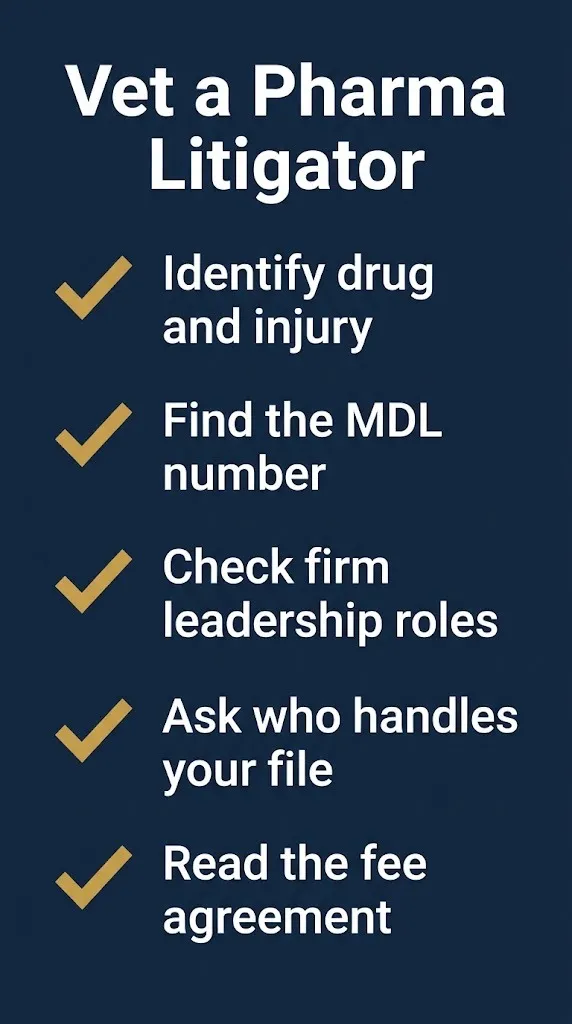
You find a qualified pharmaceutical litigation attorney by checking whether the firm actually handles your specific drug’s litigation, not just drug cases in general. Look for named leadership roles in MDLs, published case results, and attorneys who can explain the science without reading from a script.
Here are the steps that matter:
- Identify your drug and injury. Know the exact medication, dosage, and diagnosis.
- Search the MDL docket. Find the case number and see which firms are appointed to leadership.
- Check the firm’s actual experience. Ask for the specific MDL numbers they have worked on.
- Ask who will handle your file. A partner or an intake call center?
- Read the fee agreement before signing. Understand costs, fee percentages, and withdrawal terms.
- Avoid firms that guarantee outcomes. No honest lawyer promises a payout amount.
The strongest signal is a firm that can tell you the procedural posture of your drug’s litigation without looking it up.
Key Takeaway: The right pharmaceutical litigator has specific experience in your drug’s MDL, not just a general practice page about drug injuries.
What Is an MDL and Why Does It Matter?
An MDL is a multidistrict litigation, a procedural tool that consolidates federal cases involving the same drug or device before one judge for pretrial proceedings. It is not a class action. Your case remains your own, but it moves through a coordinated process.
MDLs matter because they determine timing, discovery, and settlement structure. If your drug has an active MDL, your lawyer will likely file there. If it does not, your case may proceed in state court or as an individual federal suit.
The Depo-Provera MDL is 3140 in the Northern District of Florida . The GLP-1 MDL is 3094 in the Eastern District of Pennsylvania . Knowing these numbers tells you whether a firm actually works in this space.
What Red Flags Should You Watch For in Pharmaceutical Attorney Ads?
The biggest red flag in pharmaceutical attorney ads is a guaranteed payout or a promise that you “definitely qualify.” Real lawyers do not know your diagnosis, your prescription history, or the strength of your case until they review records.
Other red flags include call centers that cannot name the MDL, pressure to sign immediately, and fees that are not explained in writing. Some lead-generation sites sell your information to whichever firm pays the most, and you may never speak to an actual lawyer.
If a page asks for your Social Security number before you have spoken to an attorney, close it. If a caller cannot tell you which court is handling your drug’s cases, hang up.
What Happens Next After You Hire a Pharmaceutical Litigation Attorney?
The process moves through case evaluation, filing, discovery, and either settlement or trial. It is not fast. Depo-Provera claimants faced a registration deadline of November 30, 2026, but payment timelines in mass torts often stretch for years .
Immediate: The firm reviews your medical records and prescription history.
Expected weeks to months: The firm files your case in the appropriate MDL or state court.
Expected months to years: Discovery, expert reports, and bellwether trials shape settlement values.
Not yet confirmed: Any specific payment date for your case.
Ongoing: Settlement administration and appeals can add more time.
Frequently Asked Questions
What does a pharmaceutical litigation attorney do?
A pharmaceutical litigation attorney sues drug makers on behalf of people injured by prescription medications or medical devices.
How much does a pharmaceutical litigation attorney cost?
Most work on contingency, with fees around 33% to 40% of any recovery and no upfront cost for case review.
Do I need a lawyer for a drug injury claim?
Yes, if you are pursuing compensation. Drug injury cases involve complex evidence, expert testimony, and strict deadlines that are difficult to handle alone.
What is the biggest pharmaceutical lawsuit in 2026?
The Depo-Provera meningioma litigation is among the largest active matters, with a settlement program announced in August 2026.
How long does a pharmaceutical lawsuit take?
It varies. Some cases settle in a few years. Others take five or more, especially if they go to trial or through appeals.
Can I join an MDL myself?
You can file a pro se case, but MDL practice is complex and nearly all claimants hire counsel.
What should I ask a pharmaceutical attorney before hiring?
Ask which MDLs they have worked on, who will handle your file, and for a written fee agreement.
Are pharmaceutical lawsuit ads trustworthy?
Some are, many are not. Verify the firm’s actual MDL experience and never pay an upfront fee for a drug injury case.
The Bottom Line
A pharmaceutical litigation attorney is your path into a drug injury case, and you should not pay one upfront. The fee comes from your recovery, not your wallet. The 2026 landscape includes major active settlements and MDLs, and the right lawyer knows the difference between a real case and a lead-generation pitch. Check the MDL, read the fee agreement, and do not sign under pressure.