Defamation Lawsuit 2026: How to Prove Your Case, What You Can Win, and the Deadline You Can’t Miss
Quick Answer:
- A defamation lawsuit is a civil claim for false statements that harmed your reputation, and it is a real legal right, not a scam.
- Payouts range from nominal damages of $1 to multimillion-dollar awards, with most settlements undisclosed.
- The statute of limitations deadline, typically one year from publication, is the single most important date to watch.
Someone posted something false about you or your business. You saw it. Others saw it. You lost a job, a client, or a relationship. Now you want to know whether you can sue, what it will cost, what you might recover, and how long you have to act. The answers live in a complicated intersection of constitutional law, state statutes, and hard-nosed litigation economics that many online guides either gloss over or get wrong.
This article is for the person who woke up to a damaging social media post, a false review, or a workplace accusation and typed “defamation lawsuit” into a search bar. It is not a general explainer. It is a 2026 roadmap built from verified legal standards, actual court filings, and the real questions people ask on forums and to intake attorneys.
One fact that surprises most readers: the majority of defamation cases never reach a jury. They die at the motion to dismiss stage because the plaintiff cannot plead actual facts showing the statement was false, or because the statement is constitutionally protected opinion. That early-stage failure is avoidable if you understand what courts actually require.
| The Facts | |
|---|---|
| Legal Standard | False statement of fact, published to a third party, causing reputational harm; public figures must also prove actual malice |
| Statute of Limitations | Varies by state; typically one to three years from date of publication |
| Key Supreme Court Cases | New York Times v. Sullivan (1964), Gertz v. Robert Welch (1974), Milkovich v. Lorain Journal (1990) |
| Damages Available | Actual damages, presumed damages (in per se cases), punitive damages |
| Average Settlement | No centralized data; settlements are almost always confidential |
| Filing Cost | $150 to $500 in court fees, plus attorney fees typically $300 to $800 per hour or contingency |
| Single Publication Rule | Statute of limitations runs from first publication, not each viewing |
Is a Defamation of Character Lawsuit Real and Worth Pursuing?
Yes, defamation lawsuits are a legitimate civil remedy available in all fifty states. People and businesses file them every day. Courts enter judgments for plaintiffs when the evidence supports the claim. The right to sue for injury to reputation is centuries old, and it remains alive and enforceable in 2026.
Whether it is worth pursuing is a different question entirely. The answer depends on three things the online guides rarely address in one place: what was said, who said it, and whether you can prove actual harm in dollars.
A false statement that you committed a crime? Courts treat that as defamation per se. You do not need to prove specific financial loss. A statement that your restaurant has bad service? That is opinion, not defamation, and a judge will likely dismiss it before discovery even starts. A statement from an anonymous social media account? You will need a court order to unmask the poster, and that costs money upfront.
The economics often surprise people. Defamation cases rarely settle for large sums unless the plaintiff is a business with provable lost revenue or a public figure with documented reputational damage. Individual plaintiffs who cannot show a lost job, lost contracts, or quantifiable harm frequently recover far less than their legal fees cost. This is not a reason to avoid suing. It is a reason to assess your case realistically.
How Much Is a Defamation Lawsuit Worth?
Defamation cases have no standard settlement value. The range spans from zero to tens of millions, and the average is a meaningless statistic because every case turns on its specific facts. What courts and insurers look at are the quantifiable damages, the defendant’s ability to pay, and the strength of the evidence on falsity.
Some reference points help. The Johnny Depp v. Amber Heard trial in 2022 resulted in a jury award of $10 million in compensatory damages and $5 million in punitive damages, later reduced to $350,000 punitive under Virginia’s statutory cap. That was a high-profile case involving a public figure with documented earnings losses. It is not a template for ordinary defamation claims.
Most defamation cases that survive a motion to dismiss and reach settlement do so in a range that rarely becomes public. Settlement agreements almost always include confidentiality clauses. Attorneys who practice in this area report, in bar association materials and continuing legal education seminars, that cases with provable economic damages in the low six figures might settle for $50,000 to $150,000. Cases without economic damages often settle for far less or are dropped.
The factors that drive settlement value include:
- Whether the statement is defamation per se (crime, loathsome disease, professional incompetence, unchastity) or per quod (requires proof of special damages).
- Whether the plaintiff can prove actual economic loss with documents, not just testimony.
- Whether the defendant has assets or insurance coverage to satisfy a judgment.
- Whether the plaintiff is a public figure, which raises the burden of proof to actual malice.
- The jurisdiction and its track record on defamation claims.
A defamation judgment is a piece of paper unless the defendant can pay. Suing someone with no assets and no insurance typically results in an uncollectible judgment. This is the harsh reality that intake attorneys assess before taking a case.
Key Takeaway: Defamation settlements range from nuisance-value payouts to multimillion-dollar awards; the single largest factor is provable economic loss, and the defendant’s ability to pay matters as much as the strength of the evidence.
What Are the Requirements to Prove a Defamation Case?
Every defamation plaintiff must prove four core elements. These are universal across American jurisdictions, though the specific phrasing varies by state.
The first element is a false statement of fact. Truth is an absolute defense in every state. If the statement is substantially true, the case fails regardless of how damaging it was. The burden of proving falsity falls on the plaintiff in most jurisdictions when the statement involves a matter of public concern, a rule affirmed by the Supreme Court in Philadelphia Newspapers v. Hepps.
The second element is publication to a third party. The statement must be communicated to someone other than the plaintiff. A private email to the plaintiff alone is not publication. A post on a public Facebook page is.
The third element is fault. Private figures must prove the defendant was at least negligent in publishing the false statement. Public figures and public officials must prove actual malice: that the defendant knew the statement was false or acted with reckless disregard for the truth. This standard comes from New York Times v. Sullivan and its progeny, and it is the single highest hurdle in defamation law.
The fourth element is damages. In per se cases, damages are presumed. In per quod cases, the plaintiff must prove special damages, meaning specific economic loss. General damages for emotional distress may also be available depending on the jurisdiction.
Opinion is not defamation. A statement that cannot be proven true or false, such as “he is a terrible boss,” is constitutionally protected under the First Amendment. The Supreme Court made this clear in Milkovich v. Lorain Journal, which held that only statements that imply an assertion of objective fact can be defamatory.
Reality Check: The most common misconception about defamation is that truth must be proven by the defendant. In many cases involving matters of public concern, the plaintiff must prove falsity. This means you need evidence that the statement was false, not just that it was harmful. Screenshots, witnesses, and documents matter from day one.
What Is the Statute of Limitations for Defamation?
The statute of limitations for defamation claims is one to three years in most states, and the clock starts running on the date the defamatory statement is published. This is the deadline you cannot miss. If you file even one day late, your case is permanently barred.
The specific limitations period varies by state. California allows one year. New York allows one year. Texas allows one year. Florida allows two years. Illinois allows one year. A handful of states allow up to three years. Check the statute in your state immediately. This is the single most time-sensitive factor in your case.
The single publication rule governs when the clock starts. Under this rule, adopted in most states, the statute of limitations runs from the first publication of the defamatory statement, not from each subsequent viewing or republication by the same defendant. A newspaper article published on January 1, 2025, in a state with a one-year statute of limitations must be sued upon by January 1, 2026. Finding the article online months later does not restart the clock.
Republication by a third party can create a new cause of action. If someone shares, retweets, or reposts the defamatory statement, that may constitute a new publication that starts a fresh limitations period against that party. The original publisher’s limitations period is not extended.
Online defamation adds complexity. Some states treat each download or view as a separate publication. Others apply the single publication rule to internet content. The trend in 2026 is toward the single publication rule for online material, consistent with the majority approach in traditional media.
How Do You File a Defamation Lawsuit?
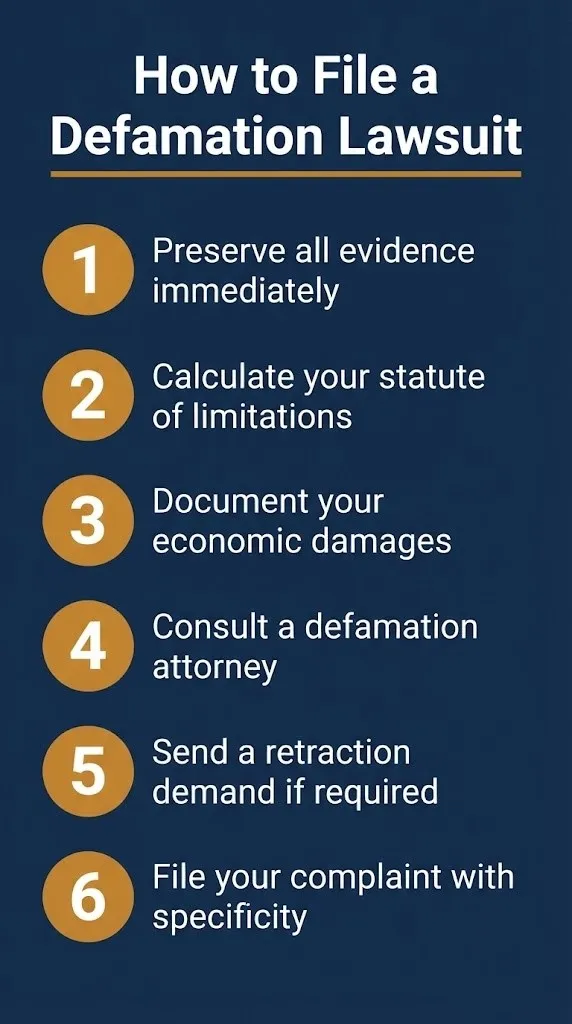
Filing a defamation lawsuit is not a do-it-yourself project. The pleading standards are strict, and the procedural steps are unforgiving. Here is the step-by-step process for someone who believes they have been defamed and is serious about pursuing a claim.
- Preserve every piece of evidence. Screenshots, URLs, timestamps, witness names, and metadata. Print copies. Save electronic copies in multiple locations. Evidence disappears fast online, and defendants often delete posts after receiving a demand letter.
- Calculate your statute of limitations deadline. Look up the statute in your state. Identify the exact date the statement was first published. Put the deadline on a calendar with a warning six weeks before it expires.
- Document your damages. Lost income, lost contracts, therapy bills, and any other quantifiable harm. Courts want numbers, not narratives. A spreadsheet showing a drop in revenue after the publication date is more persuasive than a description of stress.
- Consult an attorney who practices defamation law, not just general litigation. Defamation is a specialized area with constitutional dimensions. Ask the attorney how many defamation cases they have taken to trial or resolved. Ask about their experience with anti-SLAPP motions, which can end your case and force you to pay the defendant’s attorney fees.
- Send a retraction demand if your state requires it. Some states require a demand for retraction before filing suit. A timely and adequate retraction may limit damages even if it does not bar the claim entirely.
- Your attorney will draft and file a complaint. The complaint must plead the defamatory statement verbatim or attach it as an exhibit. It must allege falsity, publication, fault, and damages with enough specificity to survive a motion to dismiss.
- Expect a motion to dismiss or an anti-SLAPP motion. This is the make-or-break moment for most defamation cases. If your complaint survives, discovery begins. If it does not, the case is over, and you may owe the defendant’s legal fees.
- Discovery will include depositions, document requests, and possibly subpoenas to internet platforms or internet service providers to identify anonymous defendants. This phase is expensive and can take a year or more.
- Mediation or settlement negotiations typically follow the close of discovery. Most cases that survive summary judgment settle before trial.
Key Takeaway: The filing process is long, expensive, and front-loaded with procedural traps; the complaint must survive an early motion to dismiss, and failing to plead with specificity means the case ends before it starts.
What Is Defamation Per Se?
Defamation per se is a category of statements so obviously harmful that damages are presumed. The plaintiff does not need to prove specific economic loss. The statement itself is considered injurious on its face.
The four traditional categories of defamation per se are:
- Statements that accuse the plaintiff of committing a crime involving moral turpitude.
- Statements that allege the plaintiff has a loathsome disease, historically leprosy or a sexually transmitted disease.
- Statements that injure the plaintiff in their trade, business, or profession.
- Statements that accuse the plaintiff of serious sexual misconduct or unchastity.
Each state defines these categories with some variation. The core idea is consistent: if someone falsely says you committed a felony, you do not need to prove you lost your job to recover damages. The law presumes the harm.
Defamation per quod covers everything else. For these claims, the plaintiff must prove special damages, meaning specific economic loss. A statement that you are difficult to work with is likely per quod. You would need to show that a specific client canceled a contract because of the statement.
The per se classification matters because it affects what you must prove and what you can recover. Many defamation claims fail at the summary judgment stage because the plaintiff classified a per quod statement as per se and cannot produce evidence of special damages.
Can You Sue for Defamation on Social Media?
Yes. A defamatory statement posted on Facebook, X, Instagram, TikTok, or any other social media platform is a publication that can support a defamation claim. The medium does not change the legal standard. The same elements apply: falsity, publication, fault, and damages.
Social media defamation cases present unique challenges. The first is identifying the defendant. Anonymous or pseudonymous accounts are common. You cannot sue “ToxicUser427.” You need a real name and address to serve process. This requires filing a John Doe lawsuit and then obtaining a court order to subpoena the platform for the user’s identifying information, including IP addresses and account registration data.
Platforms push back on these subpoenas. They cite the First Amendment right to anonymous speech and their own terms of service. Getting a subpoena enforced can take months and cost thousands in legal fees. Some states make this easier than others.
The second challenge is the distinction between fact and opinion. Social media is rife with hyperbole, insults, and rhetorical exaggeration. Courts routinely dismiss social media defamation claims on the grounds that the statements were non-actionable opinion. Calling someone a “scam artist” in a heated Facebook argument is more likely to be viewed as opinion than a statement that someone “defrauded investors out of $2 million.”
The third challenge is the single publication rule. A defamatory tweet posted in 2023 may be time-barred by 2026, even if it continues to circulate. Check the original publication date, not the date you found it.
What Are the Defenses to a Defamation Claim?
Defendants in defamation cases have a toolkit of defenses, and understanding them before you file is essential. The most common defenses are truth, opinion, privilege, and the public figure doctrine.
Truth is the absolute defense. If the defendant can prove the statement is substantially true, the plaintiff loses. The statement does not need to be perfectly accurate in every detail. A statement that contains minor inaccuracies is still protected if the gist or sting of the statement is true.
Opinion is constitutionally protected. A statement that cannot be reasonably interpreted as stating actual facts is not defamatory. Courts look at the context, the medium, and whether the statement uses figurative or hyperbolic language. A restaurant review that says “the worst food I have ever eaten” is opinion. A review that says “the kitchen has a rat infestation” is a factual assertion.
Privilege comes in two forms. Absolute privilege applies to statements made in legislative, judicial, and certain executive proceedings. A witness testifying in court cannot be sued for defamation for their testimony, even if it is false. Qualified privilege applies to statements made in good faith on a matter of public interest or to protect a legitimate interest. An employer giving a reference to a prospective employer generally has a qualified privilege.
The public figure doctrine raises the plaintiff’s burden of proof. Public officials and public figures must prove actual malice by clear and convincing evidence. This is a heavy burden, and it is the reason many defamation claims by celebrities and politicians fail. The defendant’s knowledge of falsity or reckless disregard must be shown, not just carelessness.
How Do Anti-SLAPP Laws Affect Defamation Cases?
Anti-SLAPP statutes are the single biggest procedural risk for defamation plaintiffs. SLAPP stands for Strategic Lawsuit Against Public Participation. Anti-SLAPP laws allow defendants to file a special motion to strike a complaint early in the case, arguing that the lawsuit targets speech on a matter of public concern and lacks merit.
If the defendant wins the anti-SLAPP motion, the case is dismissed. More importantly, many state anti-SLAPP statutes require the losing plaintiff to pay the defendant’s attorney fees. This can mean writing a check for tens of thousands of dollars to the person you sued. That is not a risk. It is a reality that plays out in courtrooms regularly.
California’s anti-SLAPP statute is the most well-known and frequently invoked. It covers any statement made in connection with an issue of public interest. A defamation claim based on a critical Yelp review may trigger anti-SLAPP protection because consumer reviews connect to public interest in marketplace information. The plaintiff must show a probability of prevailing on the merits at the very start of the case, before discovery.
Not every state has an anti-SLAPP law. As of 2026, roughly thirty states have enacted some form of anti-SLAPP protection. The strength and scope vary widely. If you are considering a defamation lawsuit, ask your attorney whether your state’s anti-SLAPP statute applies and what fee-shifting exposure you face if you lose the motion.
Key Takeaway: Anti-SLAPP laws mean you can lose a defamation case fast and be ordered to pay the other side’s legal fees; this risk alone deters many meritorious claims.
What Damages Can You Recover in a Defamation Lawsuit?
Damages in defamation cases fall into three categories: actual damages, presumed damages, and punitive damages. The availability of each depends on the type of claim, the jurisdiction, and the defendant’s conduct.
Actual damages compensate for provable economic and emotional harm. Lost wages, lost business revenue, medical expenses for mental health treatment, and property damage all qualify. These must be proved with evidence. A profit and loss statement showing a revenue drop after the defamatory publication is the gold standard. Testimony about anxiety and sleeplessness is admissible but typically generates lower awards.
Presumed damages are available in defamation per se cases. The jury may award compensation for reputational harm without requiring the plaintiff to put a dollar figure on specific losses. These awards are subject to judicial review and constitutional limits. The Supreme Court held in Gertz v. Robert Welch that presumed damages cannot be awarded without a showing of actual malice, at least in cases involving matters of public concern.
Punitive damages require a showing that the defendant acted with actual malice, meaning knowledge of falsity or reckless disregard for the truth. These damages punish the defendant and deter similar conduct. They are capped by statute in many states. They are also not insurable in most jurisdictions, meaning the defendant must pay them personally.
Nominal damages of one dollar are awarded when the plaintiff proves defamation but cannot establish actual harm. This happens more often than the public realizes. A plaintiff who wins on liability but cannot show economic loss may receive a judgment that vindicates their reputation but puts no money in their pocket, and may leave them responsible for their own attorney fees.
What Happens Next
Defamation law is stable in 2026. No major Supreme Court decisions have altered the Sullivan framework, though calls to revisit the actual malice standard continue from some quarters of the judiciary. State legislatures occasionally adjust statutes of limitations and anti-SLAPP coverage, but the core elements remain unchanged.
If you are considering a defamation claim, the immediate next step is to determine your statute of limitations deadline. Everything depends on that date. If your window is still open, your next step is a consultation with a defamation attorney who can assess the merits, the defendant’s ability to pay, and the anti-SLAPP risk.
Frequently Asked Questions
Is it hard to win a defamation case?
Yes. Most defamation cases fail because the plaintiff cannot prove falsity.
The statement might be opinion, true, or protected by privilege.
Public figures face an additional hurdle of proving actual malice by clear and convincing evidence.
How much does it cost to file a defamation lawsuit?
Court filing fees range from $150 to $500 depending on the jurisdiction.
Attorney fees for defamation cases typically run $300 to $800 per hour if billed hourly.
Some firms take meritorious cases on contingency, but many require a retainer due to the high early dismissal rate.
Can I sue for defamation without a lawyer?
You can, but you should not. Defamation law involves constitutional standards that most non-lawyers cannot navigate.
Procedural mistakes, especially missed deadlines and inadequate pleading, will end your case before it begins.
The risk of an anti-SLAPP fee award makes self-representation particularly dangerous.
What counts as publication in a defamation case?
Publication means communicating the defamatory statement to at least one person other than the plaintiff.
A private message to the plaintiff alone is not publication.
A post visible to friends, followers, or the public is publication, even if only one person sees it.
Can an opinion be defamatory?
No. Pure opinion is constitutionally protected and cannot support a defamation claim.
A statement that implies unstated defamatory facts may be actionable even if phrased as an opinion.
Courts examine whether the statement can reasonably be interpreted as asserting a fact.
What is the difference between libel and slander?
Libel is written or otherwise permanently recorded defamation.
Slander is spoken defamation.
The distinction matters in some states for damages: libel may allow presumed damages, while slander per quod requires proof of special harm.
Can a business sue for defamation?
Yes. A corporation, partnership, or LLC can sue for defamatory statements that harm its business reputation.
The same elements apply: falsity, publication, fault, and damages.
Businesses are not public figures automatically, but those involved in public controversies may be treated as such.
What should I do immediately after discovering a defamatory post?
Take screenshots including the URL, date, time, and visible view count or reactions.
Do not engage with the poster or demand a retraction before speaking with an attorney.
Preserve everything and then call a defamation lawyer to assess your statute of limitations.
What You Should Do Now
Check your state’s statute of limitations for defamation. Write down the date the statement was published. If the deadline has not passed and you have evidence of falsity and harm, schedule a consultation with a defamation attorney this week. The longer you wait, the harder evidence is to preserve, and the closer you get to a deadline that permanently bars your claim.
Do not post about the situation online. Do not send an angry demand letter drafted from a template. Both can create evidence that undermines your case. Let your lawyer handle the communication. The first move in a defamation case often determines the outcome, and that move should be a calculated legal step, not an emotional reaction.