Georgia Workers Compensation Verification 2026: How to Check Coverage, Find Insurers, and Protect Your Claim
Quick Answer
- Georgia requires workers compensation insurance for most employers with three or more employees.
- You can verify coverage online through the State Board of Workers’ Compensation.
- Injured workers have one year to file a claim in Georgia.
You got hurt at work in Georgia. You need to know if your employer has workers compensation coverage. Or you are an employer checking whether your coverage is active. Or you are a contractor verifying a subcontractor’s insurance.
Georgia makes verification possible through a state-run system. This article explains how to check coverage, what the law requires, who the major insurers are, and what to do if your employer is uninsured.
| The Facts | |
|---|---|
| State Agency | State Board of Workers’ Compensation |
| Coverage Required | 3+ employees, most industries |
| Verification Method | Online, through state board |
| Claim Filing Deadline | 1 year from injury |
| Employer Report Deadline | 30 days from injury |
| Penalty for No Coverage | Fines, stop-work orders, personal liability |
| Attorney Fee Cap | 25% of recovery |
Is Georgia Workers Compensation Verification Real?
Yes, Georgia workers compensation verification is real and available through the State Board of Workers’ Compensation.
The state board maintains records of employers who carry workers comp coverage. You can search for an employer’s coverage status online.

The system exists to protect workers. If you are injured, you need to know whether your employer has insurance to pay your medical bills and lost wages.
Verification is free. You do not need an attorney or a paid service to check coverage.
How Do You Verify Workers Compensation Coverage in Georgia?
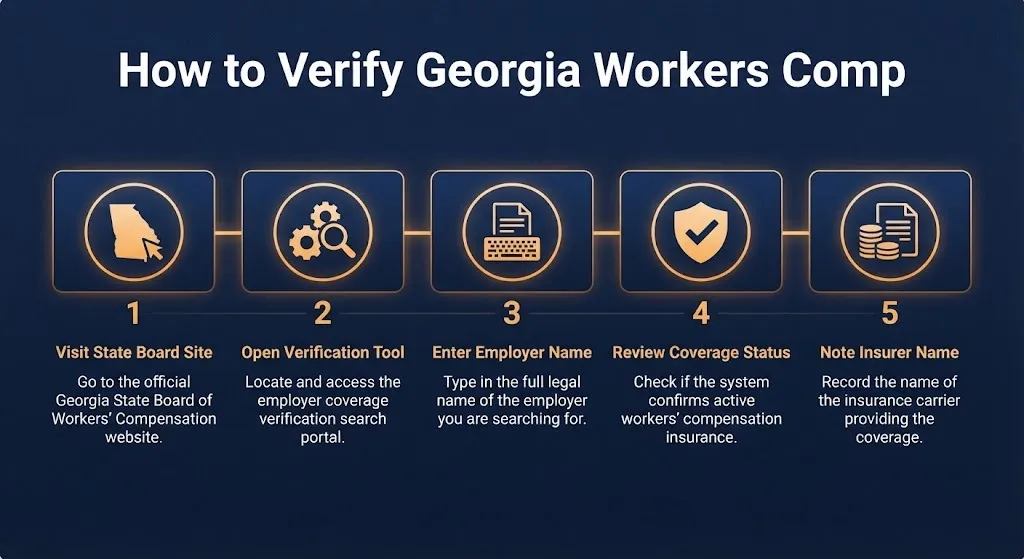
You verify Georgia workers compensation coverage through the State Board of Workers’ Compensation online verification system.
The process is straightforward:
- Go to the State Board of Workers’ Compensation website.
- Find the coverage verification tool.
- Enter the employer’s name or federal tax ID.
- Review the coverage status and insurer information.
The system shows whether coverage is active and which insurance company provides it.
| Search Method | What You Need |
|---|---|
| Employer name | Legal business name |
| Federal tax ID | EIN, if known |
| Policy number | From employer, if available |
If coverage is not found, the employer may be uninsured, which is illegal for most Georgia businesses.
What Are the Georgia Workers Compensation Requirements?
Georgia requires workers compensation insurance for employers with three or more employees, including part-time workers.
The three-employee rule applies to most private employers. Some industries, including construction, have different rules.
| Employer Type | Coverage Requirement |
|---|---|
| 3+ employees, general | Required |
| 1 to 2 employees | Generally exempt |
| Construction | Special rules apply |
| Government employers | Required |
| Sole proprietor | Optional |
The rule counts all employees, not just full-time workers. Part-time employees count toward the threshold.
What Is the Georgia Workers Compensation Verification Form?
Georgia does not require a specific paper verification form for most checks. The verification is done online through the state board.
Employers may be asked to provide a certificate of insurance to prove coverage. That certificate comes from the insurance company, not the state.
| Document | Who Issues It |
|---|---|
| Certificate of insurance | Insurance carrier |
| Online verification | State Board of Workers’ Compensation |
| Policy declaration | Insurance carrier |
The online verification is the most reliable method because it comes directly from the state.
Key Takeaway: Georgia coverage verification is online and free through the state board; a certificate of insurance from the employer is secondary evidence.
What Are the Penalties for Not Having Workers Comp in Georgia?
Georgia penalties for not having workers comp include fines, stop-work orders, and personal liability for the employer.
The State Board of Workers’ Compensation can fine an uninsured employer up to $5,000 per violation. Repeat violations can bring higher penalties.
| Penalty Type | What It Means |
|---|---|
| Fine | Up to $5,000 per violation |
| Stop-work order | Business shut down until compliant |
| Personal liability | Employer pays injury costs |
| Criminal charges | Possible for willful violation |
An uninsured employer also loses certain legal defenses if an injured worker sues in civil court.
Who Are the Major Workers Compensation Insurance Companies in Georgia?
Georgia has a competitive workers compensation insurance market with both national and regional carriers.
The largest insurers writing workers comp in Georgia include national carriers and the state’s assigned risk pool.
| Insurer Type | Examples |
|---|---|
| National carriers | The Hartford, Travelers, Zurich |
| Regional carriers | State-specific insurers |
| Assigned risk pool | Georgia Workers’ Compensation Assigned Risk Plan |
The exact list changes as insurers enter and leave the market. The State Board of Workers’ Compensation maintains current insurer information.
How Do You Find a List of Workers Compensation Insurance Companies in Georgia?
You can find a list of workers compensation insurance companies in Georgia through the State Board of Workers’ Compensation or the Georgia Office of Insurance.
The state insurance department regulates carriers and maintains records of companies licensed to write workers comp in Georgia.
| Source | What It Provides |
|---|---|
| State Board of Workers’ Compensation | Verification and insurer info |
| Georgia Office of Insurance | Licensed carrier lists |
| Assigned risk plan | Coverage for hard-to-place employers |
Employers who cannot find coverage on the open market can apply through the assigned risk plan.
Key Takeaway: Georgia workers comp insurance is available through national carriers, regional insurers, and a state assigned risk pool for employers who cannot get coverage elsewhere.
How Does the Georgia Assigned Risk Pool Work?
The Georgia assigned risk pool provides workers comp coverage to employers who cannot buy it on the open market.
Employers with high claims history, dangerous operations, or new businesses without a track record may struggle to find coverage. The assigned risk plan guarantees they can get insured.
| Feature | Assigned Risk Plan |
|---|---|
| Availability | Guaranteed for eligible employers |
| Cost | Higher than standard market |
| Administrator | National Council on Compensation Insurance |
| Coverage | Same benefits as standard policies |
The pool exists to keep the system functional. Every employer who needs coverage can get it somewhere.
What Should You Do If Your Georgia Employer Has No Workers Comp?
If your Georgia employer has no workers comp, report the injury to the State Board of Workers’ Compensation and consult an attorney.
You may still have options:
- File a claim with the state board.
- Sue your employer directly in civil court.
- Apply for benefits through state funds if eligible.
- Consult a Georgia workers comp attorney.
Uninsured employers lose the exclusive remedy defense that protects insured employers from employee lawsuits. That means you can sue for full tort damages, including pain and suffering.
Reality Check: An uninsured employer is not a dead end. It can actually open the door to a larger recovery through civil litigation, but you need legal help to navigate it.
What Is the Deadline to File a Workers Comp Claim in Georgia?
You have one year from the injury date to file a workers compensation claim in Georgia.
The employer must report the injury to their insurer within 30 days. But your filing deadline with the state board is one year.
| Deadline | Timeframe |
|---|---|
| Report to employer | 30 days |
| File claim with state board | 1 year |
| Appeal a denial | 20 days from notice |
Missing the one-year deadline can bar your claim entirely. Do not wait.
How Does the Georgia Workers Comp Claim Process Work?
The Georgia workers comp claim process starts with reporting the injury and ends with a settlement or hearing.
The steps are:
- Report the injury to your employer immediately.
- Seek medical treatment from an authorized provider.
- The employer files a claim with their insurer.
- The insurer accepts or denies the claim.
- If denied, request a hearing with the State Board.
- Negotiate a settlement or proceed to hearing.
An attorney can handle the process while you focus on recovery.
Key Takeaway: Georgia has strict deadlines and procedural rules; an attorney who knows the state board process is your best asset.
What Benefits Does Georgia Workers Comp Pay?
Georgia workers comp pays medical benefits, wage replacement, and disability benefits.
| Benefit Type | What It Pays |
|---|---|
| Medical care | Full coverage, no copay |
| Temporary total disability | 2/3 of average weekly wage |
| Temporary partial disability | 2/3 of wage difference |
| Permanent partial disability | Based on impairment rating |
| Death benefits | Funeral and survivor payments |
The wage replacement is capped at a state maximum that adjusts annually.
What Is the Role of the Georgia State Board of Workers’ Compensation?
The Georgia State Board of Workers’ Compensation oversees the state’s workers comp system.
The board processes claims, resolves disputes, and enforces coverage requirements. It also maintains the verification system workers use to check employer coverage.
| Board Function | What It Does |
|---|---|
| Coverage verification | Online employer search |
| Dispute resolution | Hearings and appeals |
| Enforcement | Fines and stop-work orders |
| Claims administration | Processes filings |
The board is the central authority for everything workers comp in Georgia.
What Happens Next With Your Georgia Workers Comp Claim
Your Georgia workers comp claim moves through a defined process once filed.
- Week 1: Report injury and seek treatment
- Week 1 to 4: Insurer accepts or denies the claim
- Month 1 to 6: Treatment and wage benefits
- Month 6 to 12: Settlement negotiations
- Year 1: Hearing if unresolved
These timeframes are estimates. Your case may move faster or slower.
Frequently Asked Questions
How do I check if my employer has workers comp in Georgia?
Use the State Board of Workers’ Compensation online verification tool.
Search by employer name or federal tax ID.
Is workers comp required in Georgia?
Yes, for most employers with three or more employees.
Construction and government employers have separate rules.
What if my Georgia employer has no workers comp?
Report the injury to the state board.
You may sue your employer directly for damages.
How long do I have to file a workers comp claim in Georgia?
You have one year from the injury date.
Report the injury to your employer within 30 days.
What is the maximum workers comp benefit in Georgia?
The maximum weekly benefit adjusts annually.
Check the State Board of Workers’ Compensation for current rates.
Do I need an attorney for a Georgia workers comp claim?
You need one if your claim is denied or your employer lacks coverage.
Attorney fees are capped at 25 percent in Georgia.
The Bottom Line
Georgia workers compensation verification is free, online, and essential for injured workers. If your employer lacks coverage, you still have options, but they require quick action.
Report your injury now. Verify coverage now. File your claim now. The one-year deadline runs from your injury date, and it does not pause while you wait.
The single most important action is verifying coverage through the State Board of Workers’ Compensation. That one search tells you whether you are dealing with an insurance claim or a civil lawsuit.