Workers Compensation Audit in 2026: What Employers Must Know Before the Auditor Calls
Quick Answer
- Workers compensation audits are routine and legally required for most policies to verify actual payroll and classifications.
- An audit can result in a refund, additional premium owed, or no change, depending on whether estimates matched reality.
- Missing the audit deadline can trigger a noncompliance charge up to double your estimated premium.
A workers compensation audit is not an investigation into wrongdoing. It is a standard end-of-policy review that most insurers conduct to confirm you paid the right premium for the coverage you actually used.
If you received an audit notice, you are not in trouble. You are in the same position as thousands of employers who estimated their payroll at the start of the policy year. Now the insurer wants to see the real numbers.
But ignoring the notice is expensive. States allow insurers to charge an Audit Noncompliance Charge (ANC) that can reach two times your estimated annual premium . That is not a penalty for owing money. It is a penalty for not participating.
This article explains what triggers an audit, what documents you need, how to dispute results you disagree with, and the deadlines that actually matter.
The Facts
| Item | Detail |
|---|---|
| What It Is | End-of-policy review comparing estimated vs. actual payroll and classifications |
| Who Gets Audited | Most workers compensation policyholders, required by state law |
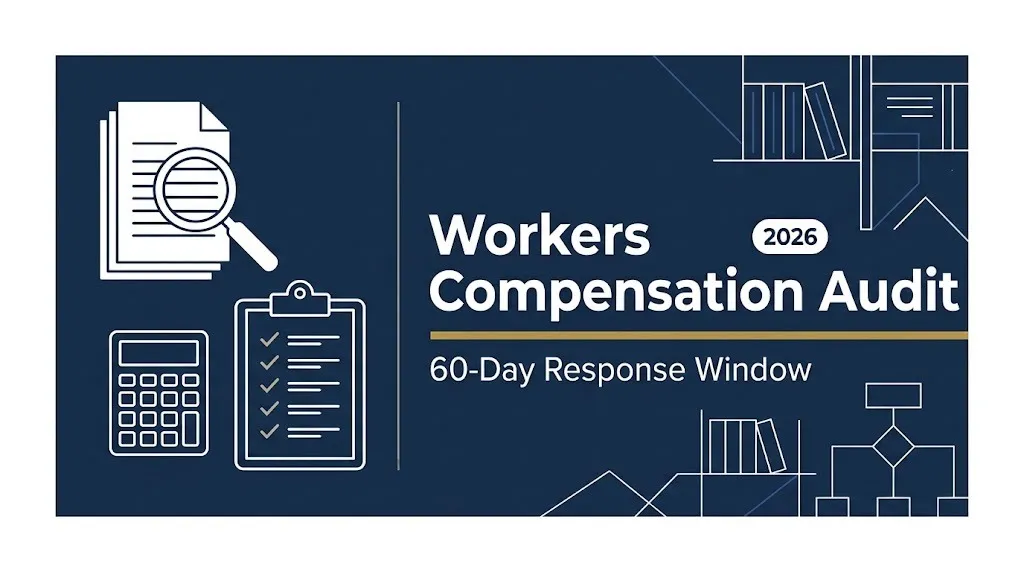
| Typical Timing | After policy expiration, often within 60 to 90 days |
| Response Window | Commonly 60 days from policy expiration to submit records |
| Possible Outcomes | Refund, additional premium owed, or no change |
| ANC Risk | Up to double estimated annual premium for noncompliance |
| Dispute Process | Varies by state, often through rating bureau or insurer appeal |
Is a workers compensation audit legitimate or a scam?
A workers compensation audit is legitimate and required by state law in most jurisdictions. It is not a scam, not a surprise penalty, and not an attempt to squeeze more money from you without cause.
The audit exists because workers compensation premiums are based on estimates. When you bought the policy, you told the insurer how much payroll you expected and what types of work your employees do. Twelve months later, the insurer needs to know if those estimates were accurate .
Think of it like a utility bill based on estimated usage. The utility reads your meter at the end of the billing cycle and adjusts. Sometimes you owe more. Sometimes you get a credit.
Signs the audit request is real:
- It comes from your insurance carrier or their designated audit vendor.
- It references your policy number and policy period.
- It provides a deadline and specific document list.
- It offers a secure portal, phone number, or mailing address to submit records.
Signs of a scam:
- The caller cannot provide your policy number or carrier name.
- They demand immediate payment over the phone.
- They ask for bank account details before you verify anything.
- They threaten legal action in the first contact.
If you are unsure, call your insurance agent or broker using a number you look up independently. Do not call back the number on a suspicious voicemail.
Key Takeaway: Real audits come from your carrier, reference your policy, and give you time to respond. Scams demand money immediately.
How much can a workers compensation audit cost you?
A workers compensation audit can result in additional premium owed, a refund, or no change at all. The amount depends on whether your actual payroll exceeded or fell short of your estimate, and whether your employee classifications were accurate .
Here is what typically drives the final number.
| Scenario | Likely Outcome |
|---|---|
| Payroll came in higher than estimated | You owe additional premium |
| Payroll came in lower than estimated | You may receive a refund or credit |
| Employees misclassified to lower-risk codes | You owe the difference plus potential penalties |
| Subcontractors without certificates of insurance | Their payroll may be added to your premium base |
| Overtime not reported separately | Premiums may be inflated on overtime wages |
The single biggest surprise for most employers is uninsured subcontractors. If you hired subs and cannot produce certificates of insurance for them, the auditor can add their payroll to your premium base as if they were your employees . That can double or triple your final bill depending on how much you paid them.
Another common hit comes from misclassification. A clerical worker who occasionally drives a delivery route should not be coded as pure clerical. The auditor will catch it and reclassify, usually upward.
Key Takeaway: The audit bill is driven by payroll accuracy and subcontractor documentation. Missing certificates are the most expensive mistake.
What documents do you need for a workers compensation audit?
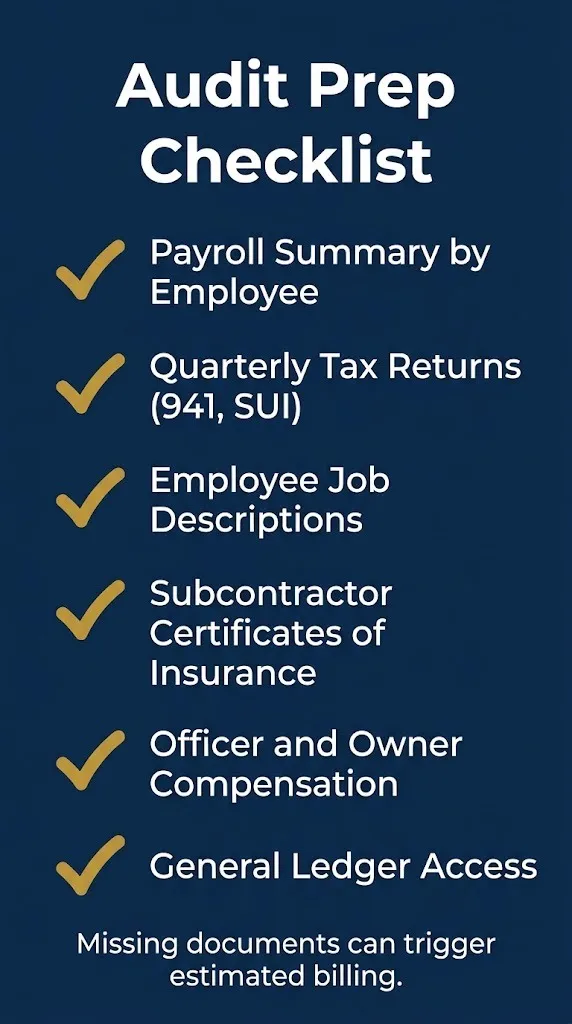
You need payroll records, tax filings, employee classification details, and subcontractor certificates of insurance to complete a workers compensation audit. Missing documents delay the process and can trigger estimated billing .
Prepare these items before the auditor calls.
Core payroll records:
- Payroll summary by employee, showing total wages, overtime, bonuses, and deductions.
- Quarterly federal tax returns (Form 941) and state unemployment tax filings for the policy period.
- Detailed employee information including names, titles, job descriptions, and compensation.
Classification support:
- List of employees in clerical (8810) or outside sales (8742) codes with duty descriptions.
- Documentation for any employees whose duties changed during the policy year.
Subcontractor documentation:
- Certificates of insurance for every subcontractor hired during the policy period.
- If no certificate exists, the subcontractor’s payroll gets added to your premium base.
Ownership and officer records:
- List of executive officers, owners, or partners with ownership percentage and compensation.
- Exemption certificates if officers are excluded from coverage.
Access records:
- General ledger, profit and loss detail, and check register for verification .
Organize everything into one folder or digital file before the audit starts. The auditor’s job is easier, and your audit goes faster.
Key Takeaway: Payroll, tax filings, and subcontractor certificates are the three pillars of audit preparation. Missing any one of them costs you.
Reality Check
A workers compensation audit is not optional, and ignoring it is not a strategy. If you do not respond within the deadline, the insurer can close your audit as noncompliant and issue an estimated bill. That estimate is often higher than what you would have owed with accurate records. Some carriers will also cancel your policy for noncompliance, which makes finding replacement coverage harder and more expensive .
How do you dispute a workers compensation audit result?
You can dispute a workers compensation audit result by submitting a written objection with supporting documentation to your insurer or the state rating bureau, depending on your jurisdiction. Most disputes center on classification errors, payroll calculations, or subcontractor treatment.
The process varies by state, but the structure is similar.
Steps to dispute an audit:
- Review the audit worksheet carefully for errors in payroll totals or classification codes.
- Gather supporting documentation that contradicts the auditor’s finding.
- Submit a written dispute to your insurer’s audit department, often within a set window after receiving the final bill.
- Escalate to the state rating bureau if the insurer does not resolve the dispute.
- Appeal to the insurance commissioner if the bureau decision is unfavorable.
In Delaware, for example, insureds can appeal audit results to the rating bureau during the policy period or within 12 months after termination . In Pennsylvania, the appeals process moves through a rating bureau subcommittee and then to the Insurance Commissioner if needed .
California handles audit disputes involving unpaid compensation through a formal Notice of Intention process, with a 14-day window to file an objection .
Key Takeaway: Disputes must be in writing and supported by records. Verbal complaints do not preserve your appeal rights.
What happens if you miss the workers compensation audit deadline?
Missing the audit deadline can trigger an Audit Noncompliance Charge of up to double your estimated annual premium, policy cancellation, and difficulty obtaining coverage elsewhere .
The timeline is strict. MEM Mutual Insurance, for example, gives policyholders a 60-day window from policy expiration to complete the audit. The carrier sends reminder notices at 30 days and 40 days. If nothing comes back, the file closes as noncompliant .
Consequences of noncompliance:
- ANC charge assessed on your final bill, often doubling what you owe.
- Policy cancellation, making it harder to get coverage with a new carrier.
- Reinstatement refused until the audit is completed.
- Future premiums increase because you are now a higher-risk account.
The ANC is not a fine you can negotiate away after the fact. It is a contractual charge built into the policy terms. The only way to avoid it is to respond.
If you genuinely cannot find records, contact the auditor anyway. Explain the situation. Many will work with you on alternative verification methods rather than closing the file as noncompliant.
Key Takeaway: The 60-day window is real. Missing it costs you up to double your premium and puts your coverage at risk.
How do employee classifications affect your audit?
Employee classifications determine your base rate, and misclassification is the most common reason audits result in additional premium owed. Workers compensation class codes reflect the risk level of specific job duties, not job titles .
A clerical employee who spends 20% of their time in a warehouse should be classified based on the higher-risk warehouse work. The auditor will catch this and reclassify.
Common classification mistakes:
- Clerical worker listed as warehouse or vice versa.
- Administrative assistant who occasionally drives coded as pure clerical.
- Seasonal hires coded as permanent employees.
- Part-time workers coded as full-time without adjustment.
Review your class codes against actual job duties at least once during the policy year. If someone’s role changed, tell your agent. Adjusting classifications mid-policy prevents surprises at audit.
Construction and staffing companies face the most classification scrutiny. The auditor may tour your job site or ask for detailed duty descriptions for each role.
Key Takeaway: Class codes follow duties, not titles. If the job changed, the code should have changed too.
What happens next in the workers compensation audit process?
The audit process moves from notice to records submission to premium adjustment, with dispute options available if you disagree with the result. Most audits resolve within 30 to 60 days of submission.
Expected timeline:
- Policy expiration: Audit notice sent within weeks.
- 60-day window: Submit payroll, tax, and subcontractor records.
- 30 to 60 days after submission: Auditor reviews records and issues final premium adjustment.
- If you dispute: Written objection, then rating bureau or state appeal if needed.
- If you do nothing: ANC assessed, policy cancellation possible.
The key date to remember is 60 days from policy expiration. That is the common response window, though it varies by carrier and state. Mark it on your calendar the day you receive the notice.
Frequently Asked Questions
What is a workers compensation audit?
A workers compensation audit is a review your insurer conducts at the end of the policy period to verify actual payroll and employee classifications against the estimates used to set your premium.
How often do workers compensation audits happen?
Most policies are audited annually at expiration. Some carriers conduct interim audits if payroll or operations change significantly during the year.
What triggers a workers compensation audit?
Policy expiration is the primary trigger. Audits are required by state law for most workers compensation policies and are standard practice across the industry.
Can you refuse a workers compensation audit?
You cannot refuse without consequences. Refusing or ignoring the audit can result in an Audit Noncompliance Charge, policy cancellation, and difficulty obtaining future coverage.
How long does a workers compensation audit take?
The review typically takes 30 to 60 days after you submit records. The preparation on your end depends on how organized your payroll and subcontractor files are.
What happens if you disagree with the audit result?
You can file a written dispute with your insurer, supported by documentation. If unresolved, you can appeal to the state rating bureau or insurance commissioner.
Do subcontractors get included in workers compensation audits?
Uninsured subcontractors’ payroll can be added to your premium base if you cannot provide certificates of insurance. Always collect COIs before work begins.
What is an audit noncompliance charge?
An Audit Noncompliance Charge (ANC) is a fee assessed when you fail to complete the audit. It can be up to double your estimated annual premium and may lead to policy cancellation.
Your Next Step
Pull your payroll records for the last policy period today. Check that every subcontractor certificate of insurance is on file. Review your employee class codes against actual job duties.
The single most important date is the 60-day window from policy expiration. Mark it now. Missing it costs up to double your premium.