Workers Compensation Insurance for Small Business: 2026 State Requirements, Costs, and Compliance Deadlines
Quick Answer
- Workers compensation insurance is a real, legally mandated coverage in almost every state if you have even one employee.
- Annual premiums for small businesses typically range from $500 to $3,000 per employee depending on industry risk classification.
- Most states require coverage from the day you hire your first employee, and gaps in coverage trigger daily fines that start at $100 to $1,000 per day.
If you own a small business and just hired your first employee, or if you received a notice from your state about missing coverage, you need a clear answer on what is required and what happens if you do not have it. This is not a government settlement or a claim you can file. It is a mandatory insurance product regulated at the state level, and the rules vary depending on where your business operates.
This article covers what small business owners need to know about workers compensation insurance in 2026. It explains who must carry it, what it costs, how to buy it, and the penalties for non-compliance. One verified fact worth knowing now: roughly 20 percent of small businesses audited by state agencies in 2025 were found to have misclassified workers or carried insufficient coverage, resulting in back premiums and fines averaging $15,000 per audit.
The Facts
| Requirement | Mandatory in 49 states for businesses with employees |
| Sole Exception | Texas (elective coverage for most private employers) |
| Coverage Trigger | Date of hire for first employee in most states |
| Average Premium Range | $0.75 to $2.74 per $100 of payroll, depending on class code |
| Common Small Business Cost | $500 to $3,000 annually per employee |
| Penalty for Non-Compliance | $100 to $1,000 per day of no coverage, plus back premiums |
| Audit Risk | State and insurer audits check payroll and classification accuracy |
| 2026 Premium Trend | National average rate increase of 3.7 percent year-over-year |
Is Workers Compensation Insurance Legally Required for Small Businesses?
Yes. In every state except Texas, workers compensation insurance is a legal requirement for most small businesses that have employees. It is not optional, it is not a recommendation, and claiming you did not know about it is not a defense against penalties.
The requirement is not federal. It comes from state laws, and each state sets its own rules. Some states, like California and New York, require coverage the moment you hire a single employee, even a part-time one. Other states exempt very small businesses. In Alabama, for example, businesses with fewer than five employees are not required to carry coverage unless they work in specific high-risk industries. In Georgia, the threshold is three employees.
The consistent rule across states is this. If you have employees and your state requires coverage, you must have a policy in place. Sole proprietors and independent contractors are generally not counted as employees for coverage thresholds, but the line between contractor and employee is heavily scrutinized. Misclassifying an employee as a contractor to avoid buying workers comp is one of the most common and costly mistakes small businesses make.
States that require coverage enforce it through stop-work orders, fines, and personal liability on business owners. A stop-work order means your business shuts down until you prove coverage. That can mean days or weeks of zero revenue.
Key Takeaway: Workers comp is not a suggestion. It is a legal mandate in 49 states, and the cost of non-compliance far exceeds the cost of a policy.
How Much Does Small Business Workers Compensation Insurance Cost?
The cost of a workers compensation policy depends on three factors: your industry classification code, your annual payroll, and your claims history. Premiums are calculated as a rate per $100 of payroll, multiplied by your total payroll, then adjusted by an experience modification factor if you have claim history.
For a low-risk small business, clerical office work, the rate might be as low as $0.75 per $100 of payroll. A bookkeeper earning $40,000 a year would generate a base premium of about $300. A roofing contractor at a rate of $20 per $100 of payroll, earning the same $40,000, would generate a base premium of $8,000.
Average Workers Comp Rates by Industry Class Code (2026)
| Industry | Class Code Example | Rate per $100 Payroll | Annual Cost, $40,000 Employee |
|---|---|---|---|
| Clerical / Office | 8810 | $0.75 | $300 |
| Retail Store | 8017 | $1.85 | $740 |
| Restaurant (no alcohol) | 9082 | $2.10 | $840 |
| Landscaping | 0042 | $7.50 | $3,000 |
| Construction (carpentry) | 5403 | $12.80 | $5,120 |
| Roofing | 5551 | $20.00+ | $8,000+ |
| Trucking (local) | 7228 | $5.90 | $2,360 |
These are illustrative rates. Actual rates vary by state, insurer, and your specific classification. Most states use the National Council on Compensation Insurance (NCCI) classification system, but some states, California, New York, Delaware, Pennsylvania, and a few others, use their own rating bureaus with different class codes and rates.
Small businesses pay a minimum premium regardless of payroll. Most insurers have a minimum policy premium of $500 to $1,500 per year. If your calculated premium based on payroll is below the minimum, you still pay the minimum.
Reality Check: Many small business owners see a quote for $750 and think that is the final number. It is not. Workers comp policies are auditable. At the end of the policy term, the insurer audits your actual payroll. If your payroll was higher than estimated, you owe additional premium. If you misclassified employees under a cheaper class code, you owe the difference plus penalties. Budget for an audit adjustment of 10 to 20 percent unless your payroll estimate was precise.
Key Takeaway: Your premium is based on payroll and risk class. Underestimate either, and the audit bill will catch up to you. Get the classification right before the policy starts.
What Are Workers Compensation Insurance Audit Requirements?
A workers compensation audit is not optional. It is a standard part of every policy. At the end of each policy term, the insurer will audit your actual payroll and operations to determine whether the premium you paid matches your actual exposure.
The audit can be conducted by mail, by phone, or in person. The insurer will request payroll records, tax filings, employee job descriptions, and certificates of insurance for any subcontractors you used. If you cannot produce certificates for subcontractors, the insurer will charge you premium for those subcontractors as if they were your employees.
The most common audit findings that cost small businesses money are underreported payroll, misclassified employees, and uninsured subcontractors. If you told the insurer your employee was a clerical worker, code 8810 at $0.75 per $100, but the audit finds they spent half their time doing warehouse work, code 8292 at $5.40 per $100, you will owe the difference.
Audit disputes are possible but difficult to win. The burden is on you to prove the classification or payroll was correct. Keep detailed records. Job descriptions, time logs, and subcontractor agreements matter. A verbal arrangement with a subcontractor is not documentation.
Key Takeaway: The audit is not a formality. It is a financial reconciliation. Treat your policy estimate like a tax estimate: accurate at the start saves a bill at the end.
How to Buy Workers Compensation Insurance for Your Small Business
Buying workers comp is not like buying general liability insurance online in five minutes. It requires specific information, and in some states, the process runs through a state-run fund rather than the private market.
Step-by-Step Purchase Process
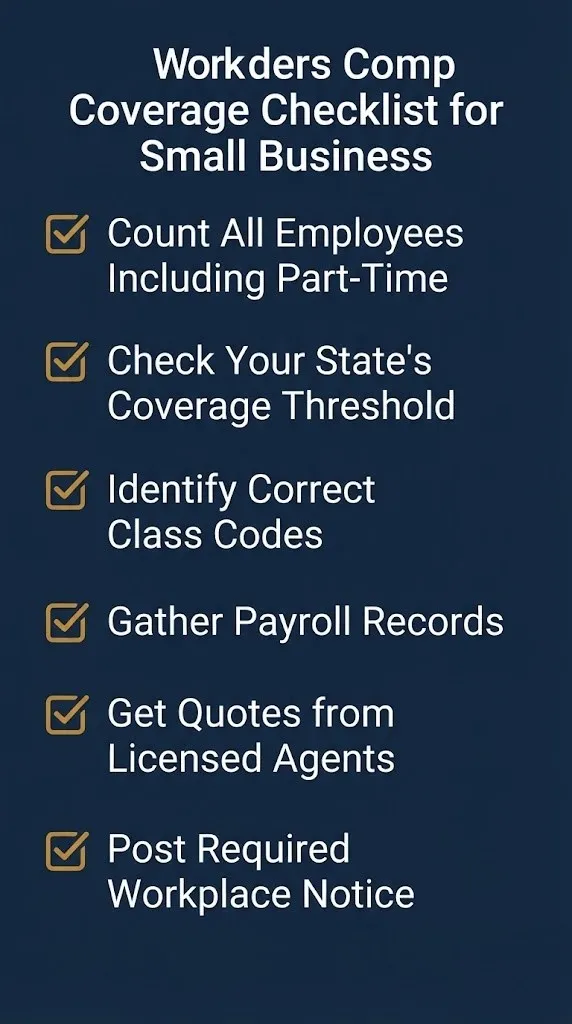
- Determine if you need coverage. Count your employees. Check your state’s threshold. If you have one employee in a mandatory state, you need coverage. Include part-time workers, family members who work for pay, and seasonal workers. Exclude sole proprietors and true independent contractors with their own coverage.
- Identify your state’s market structure. Most states have a competitive market where private insurers sell policies. Four states, North Dakota, Ohio, Washington, and Wyoming, have monopolistic state funds where you must buy from the state. Other states have a competitive state fund that competes with private insurers.
- Gather your classification information. Determine the correct class codes for every employee. This is the most common point of failure. A single business can have multiple class codes. A construction company might have carpenters (5403), clerical staff (8810), and salespeople (8742). Each code carries a different rate.
- Calculate estimated annual payroll for each class code. Use realistic numbers. Underestimating to lower the premium will result in an audit bill.
- Get quotes from multiple sources. Contact independent insurance agents who specialize in workers comp. Contact your state fund if applicable. Compare rates, but also compare the insurer’s audit reputation and claims-handling process. The cheapest quote is not always the best value if the insurer is aggressive on audits or slow on claims.
- Consider a pay-as-you-go policy. Many insurers now offer policies where premium is calculated and paid each payroll period based on actual payroll, not estimated. This reduces the audit surprise and improves cash flow.
- Review the policy before binding. Confirm the class codes, the estimated payroll, the rating bureau, and the policy dates. Errors on the declarations page become your problem at audit.
- Post the required notice. Most states require a workplace poster notifying employees of their workers compensation rights. The poster comes from the insurer or the state and must be displayed where employees can see it.
Buying workers comp is more like filing a detailed tax return than ordering office supplies. Every number you provide has downstream consequences. Accuracy at the application stage is the single best way to avoid an audit bill later.
Key Takeaway: Classify employees correctly and estimate payroll accurately before the policy starts. Fixing these after the fact is more expensive.
What Happens If You Do Not Have Workers Compensation Insurance?
The penalties for failing to carry workers comp are severe and escalate quickly. States treat non-compliance as a serious violation, not a paperwork oversight.
State Penalty Examples
| State | Daily Fine for No Coverage | Additional Consequences |
|---|---|---|
| California | Up to $1,500 per employee | Stop-work order, criminal charges possible |
| New York | $2,000 per 10-day period | Stop-work order, personal liability for claims |
| Florida | $1,000 per day | Stop-work order, business license suspension |
| Illinois | $500 per day | Stop-work order, personal liability |
| Pennsylvania | Up to $1,000 per day | Stop-work order, criminal misdemeanor charges |
| Texas | N/A (not mandatory) | No state penalty, but civil liability exposure |
Beyond fines, the real financial danger is what happens if an employee gets injured while you have no coverage. You are personally liable for all medical costs, lost wages, and disability benefits. An uninsured claim can easily exceed $100,000 for a serious injury. For a small business, that is often a bankruptcy-level event.
Stop-work orders shut down your entire operation. The state will not let you reopen until you provide proof of coverage and pay outstanding fines. Every day your business is closed, you lose revenue and possibly customers.
Criminal penalties are possible in some states. Willful failure to carry workers comp can be charged as a misdemeanor or, in cases involving serious injury, a felony. Business owners have served jail time for workers comp fraud and flagrant non-compliance.
Key Takeaway: The fines hurt. The personal liability for an uninsured claim can destroy your business. Coverage is cheaper than the alternative.
Does a Sole Proprietor Need Workers Compensation Insurance?
In most states, no. Sole proprietors with no employees are not required to carry workers compensation coverage on themselves. The same generally applies to single-member LLC owners and partners in a partnership.
However, this does not mean you should skip it. Workers comp also functions as an exclusive remedy. If you are injured on the job and have no coverage, you cannot sue your own business for damages. You would rely on your personal health insurance, which may not cover work-related injuries, and you have no access to wage replacement benefits.
Many sole proprietors choose to buy a policy for two reasons. First, health insurance often excludes work-related injuries. A broken ankle on a job site might not be covered by your personal policy. Second, general contractors and clients often require proof of workers comp from all subcontractors, even sole proprietors. If you cannot provide a certificate of insurance, you may lose the contract.
You can typically opt in to coverage on yourself through a standard workers comp policy. The insurer adds you to the policy, and your payroll is included in the premium calculation. Some states cap the payroll figure used for sole proprietors at a set amount, often $50,000 to $60,000, regardless of actual earnings.
Key Takeaway: You may not be required to cover yourself, but gaps in health insurance coverage and client requirements often make it a practical necessity.
What Does Workers Compensation Insurance Actually Cover?
Workers compensation covers four categories of costs when an employee is injured or becomes ill because of their job. It does not cover every workplace incident. The injury or illness must arise out of employment and occur in the course of employment.
Covered Benefits
- Medical treatment. All reasonable and necessary medical care related to the injury. Doctor visits, surgery, hospital stays, prescriptions, physical therapy, and medical equipment. No copays or deductibles for the employee.
- Wage replacement. Temporary disability benefits pay a portion of lost wages while the employee cannot work. Most states pay two-thirds of the employee’s average weekly wage, subject to a state-set maximum. The maximum in 2026 ranges from about $1,200 to $2,500 per week depending on the state.
- Permanent disability. If the injury results in permanent impairment, the employee may receive a scheduled loss award based on the body part and degree of impairment. A 20 percent permanent loss of use of a hand has a specific benefit value calculated under state guidelines.
- Death benefits. If the injury is fatal, workers comp pays burial expenses and ongoing benefits to dependents. Benefit amounts and duration vary by state.
- Vocational rehabilitation. Some states require insurers to pay for retraining if the employee cannot return to their previous job.
What workers comp does not cover is pain and suffering. It is a no-fault system. The employee does not need to prove the employer was negligent, and the employer is generally protected from civil lawsuits. This trade-off, guaranteed benefits regardless of fault in exchange for limited recovery, is the core structure of the workers compensation system.
Key Takeaway: Workers comp covers medical bills and a portion of lost wages. It does not cover pain and suffering, and it protects the employer from lawsuits.
What Are the 2026 Workers Compensation Rate Trends?
National workers compensation premium rates have increased modestly in 2026, continuing a trend of small annual adjustments after several years of flat or declining rates earlier in the decade.
The National Council on Compensation Insurance (NCCI) recommended an average rate increase of 3.7 percent for 2026 across the states where it files advisory rates. Individual states vary. Some approved higher increases due to rising medical costs and wage growth. Others held rates flat or approved small decreases.
Factors Driving 2026 Rate Changes
- Medical cost inflation. Healthcare costs continue to rise faster than general inflation. Workers comp medical costs per claim increased by an estimated 4.2 percent in 2025, and that pressure continues into 2026.
- Wage growth. Higher wages mean higher payroll, which increases premium even if the rate stays the same. When rates are expressed per $100 of payroll, a 5 percent wage increase translates to a 5 percent premium increase all else equal.
- Claims frequency. The number of claims per $1 million of payroll has been declining for years, which offsets some of the medical cost pressure. Safer workplaces mean fewer claims, but when claims do occur, they cost more.
- State legislative changes. Several states increased benefit levels in 2025 and 2026, which pushes premiums up. Florida increased the maximum weekly benefit by 3.5 percent. California adjusted its fee schedule for medical services.
For a small business owner, the 2026 rate environment means you should expect a modest premium increase at renewal, likely in the 2 to 5 percent range unless your claims experience or classification has changed.
Key Takeaway: Rates are rising modestly in 2026. Shopping your policy and controlling your experience modification factor are the two most effective ways to manage costs.
What Are the Workers Compensation Requirements by State?
State requirements vary significantly. What is mandatory in one state may be optional in another. The following is a summary of key state rules as of 2026. Always verify current requirements with your state’s workers compensation board or division.
State-by-State Coverage Triggers
| State | Coverage Required When | Key Exemptions |
|---|---|---|
| California | 1+ employees | Sole proprietors, some family members |
| New York | 1+ employees | Sole proprietors, partners |
| Texas | Not required (private) | N/A, elective for most |
| Florida | 4+ employees (1+ in construction) | Sole proprietors, partners |
| Georgia | 3+ employees | Sole proprietors, partners, farm workers |
| Illinois | 1+ employees | Sole proprietors, some family |
| Pennsylvania | 1+ employees | Sole proprietors, farm workers |
| Ohio | 1+ employees (state fund) | Sole proprietors, partners |
| North Carolina | 3+ employees | Sole proprietors, farm workers |
| Michigan | 1+ employees | Sole proprietors, partners |
This table is a reference point, not a compliance guide. State rules change, and industry-specific mandates apply in many states. In Florida, construction businesses with one or more employees must carry coverage regardless of the general four-employee threshold. In California, nearly every business with any employee must have coverage with very limited exceptions.
Key Takeaway: Check your state’s current threshold. Do not rely on a table alone. One call to your state’s workers compensation division can confirm your obligation.
What Happens When an Employee Files a Workers Comp Claim?
When an employee reports a work-related injury, a specific sequence of events is triggered. Knowing the process reduces the risk of a mishandled claim, which can result in penalties and higher premiums.
Claim Process Timeline
Day 1: The employee reports the injury to you. You must provide the employee with a claim form, usually a DWC-1 or state equivalent, within one working day. You must authorize medical treatment. You cannot refuse to file the claim.
Within 24 to 48 hours: You report the claim to your workers comp insurer. Most insurers have a 24-hour reporting hotline or online portal. Late reporting is a common reason claims get denied or penalties get assessed.
Within 14 days: The insurer must accept or deny the claim in most states. If the insurer needs more time, it may issue a 90-day delay notice and continue investigating.
If accepted: The insurer pays medical bills directly and begins wage replacement payments. The employee receives temporary disability benefits, typically two-thirds of average weekly wages.
If denied: The employee can challenge the denial through the state workers compensation appeals board. This is an administrative process, not a civil lawsuit. A hearing officer or administrative law judge decides the dispute.
Return to work: The treating physician determines when the employee can return, and whether with restrictions. Modified duty, lighter work while recovering, is encouraged under most state laws and can reduce the overall claim cost.
The employer’s role is to report promptly, cooperate with the investigation, and facilitate return to work. Interfering with the claim, retaliating against the employee for filing, or discouraging the employee from seeking medical care are violations that carry separate penalties.
Key Takeaway: Report every claim to your insurer within 24 hours. Delay is the most common and most avoidable mistake employers make.
Frequently Asked Questions
Can I deduct workers comp premiums from employee wages?
No, you cannot deduct workers compensation premiums from employee paychecks.
Workers comp is an employer-paid obligation in every state.
Deducting premiums from wages is illegal and will trigger state wage-and-hour violations.
Does workers comp cover remote employees?
Yes, workers comp covers remote employees if the injury arises out of and in the course of employment.
The key factor is whether the injury occurred while the employee was performing work duties.
A trip and fall in a home office during work hours may be covered. A fall while on a personal break may not.
Can I use a PEO to handle workers comp?
Yes, professional employer organizations provide workers comp as part of their service.
The PEO becomes the employer of record for insurance purposes and covers your employees under their master policy.
This can be cost-effective for very small businesses but verify the PEO’s class codes match your actual operations.
What is an experience modification factor?
An experience modification factor, or mod, adjusts your premium based on your claims history versus similar businesses.
A mod of 1.0 is average. Below 1.0 means fewer or less costly claims, and a discount on premium.
Above 1.0 means worse claims experience, and a surcharge. Most small businesses start at 1.0.
Does a workers comp policy cover the business owner?
Not automatically. Business owners, sole proprietors, partners, and corporate officers are typically excluded unless specifically added by endorsement.
You can elect to cover yourself, and many owners do to fill gaps in health insurance or to satisfy client contract requirements.
What is the difference between workers comp and general liability?
Workers comp covers employee injuries regardless of fault and pays medical bills and lost wages.
General liability covers third-party injuries and property damage.
A customer slipping in your store is a general liability claim. Your employee slipping while stocking shelves is a workers comp claim.
Can I be sued by an employee if I have workers comp?
Generally, no. Workers comp is the exclusive remedy for workplace injuries.
The employee cannot sue you for negligence in civil court.
Exceptions exist for intentional harm, but standard workplace accident claims are limited to workers comp benefits.
How often do workers comp policies audit?
Every policy is audited at expiration. It is standard in the policy contract.
Some policies are audited annually. Some on a multi-year basis, but annually is most common.
Pay-as-you-go policies reduce audit adjustments but do not eliminate the audit requirement entirely.
What Happens Next
If you do not have workers comp and you have employees, your next step is to get coverage before a claim or a state audit triggers penalties that could threaten your business. Start by confirming your state’s requirements today. Then gather your payroll records and employee job descriptions, and contact at least two licensed insurance agents who specialize in workers comp for small businesses. Ask about pay-as-you-go options if cash flow is a concern.
Once your policy is in place, post the required notice, file your certificate of coverage with any clients who require it, and make sure every new hire is added to payroll and reported to the insurer immediately. Workers comp is not a set-it-and-forget-it purchase. It is an ongoing compliance obligation that tracks your business as it grows. Handling it correctly from day one costs less than fixing it after an injury or an audit.